Understanding Local Business Listings: Complete Guide to Directory Success

Ever notice how some businesses dominate local search results while others remain practically invisible? The difference often comes down to one critical factor: how well they understand and leverage local business listings.

I’ve helped hundreds of local businesses transform their online visibility, and I can tell you this—most business owners drastically underestimate the power of properly optimized directory listings. Understanding local business listings isn’t just about creating profiles; it’s about building a comprehensive digital ecosystem that signals authority, relevance, and trustworthiness to both search engines and potential customers.
Here’s something most guides won’t tell you: the businesses seeing the biggest wins aren’t necessarily spending more money. They’re simply approaching their listing strategy with precision and consistency, treating each directory as a strategic asset rather than a checkbox to tick off.
TL;DR – Quick Takeaways
- Local listings are trust signals – Search engines use consistent NAP (Name, Address, Phone) across directories to verify legitimacy
- Google Business Profile is non-negotiable – It powers 76% of local search interactions and map results
- Completeness beats quantity – Five fully optimized listings outperform twenty incomplete ones every time
- Reviews drive conversions – 87% of consumers read reviews before visiting, making review management essential
- Measurement matters – Track specific metrics (calls, directions, clicks) to understand ROI and optimize accordingly
- Industry-specific directories deliver qualified leads – Niche platforms often convert better than general directories
What Local Business Listings Actually Are (and Why They Matter More Than Ever)
A local business listing is essentially your business’s digital identity card—a structured set of information that tells search engines, map platforms, and potential customers who you are, where you are, and what you offer. Think of it as the modern evolution of Yellow Pages, except exponentially more powerful because these listings directly influence whether someone finds you at all.
The mechanics behind listings are fascinating. When someone searches “coffee shop near me” or “emergency plumber downtown,” search engines don’t just look at websites. They aggregate data from hundreds of sources—business directories, review platforms, map services, social networks—and use that information to determine which businesses are most relevant, trustworthy, and geographically appropriate.

What makes understanding local business listings so critical in 2025 is how search behavior has evolved. According to BrightLocal’s consumer research, 98% of consumers used the internet to find information about local businesses in the past year, and 76% of people who search for something nearby visit a business within 24 hours. These aren’t casual browsers—they’re high-intent customers ready to make decisions.
The core components of an effective listing include your business name (exactly as it appears legally), complete address with proper formatting, primary phone number, accurate business hours, relevant categories, detailed service descriptions, high-quality photos, customer reviews, and increasingly, attributes like “wheelchair accessible” or “outdoor seating available.”
How Search Engines Use Directory Data
Search engines like Google don’t just trust what you say about your business on your website. They cross-reference that information against dozens of authoritative data sources. When your business name, address, and phone number appear consistently across reputable directories, it sends a powerful validation signal.
This cross-referencing process is why NAP consistency matters so much. If you’re listed as “Smith’s Bakery” on Google but “Smith’s Baking Co.” on Yelp and “John Smith Bakery” on Yellow Pages, search engines struggle to confirm these references all point to the same business. That uncertainty can torpedo your local rankings.
I remember working with a family restaurant that couldn’t figure out why they weren’t appearing in local searches despite having a website and Google Business Profile. After auditing their listings, we found they had seven different phone numbers across various directories (including disconnected numbers from previous locations). Within three weeks of standardizing their information, they jumped from page 3 to the top three map results.
The Strategic Foundation: Why Local Listings Drive Real Business Outcomes
Local business listings deliver tangible business value across multiple dimensions that compound over time. The visibility benefit is obvious—you appear where customers are actively searching—but the advantages extend far beyond just being found.
First, listings dramatically reduce customer acquisition costs. Traditional advertising requires you to interrupt people and convince them they need what you offer. Directory listings connect you with people already searching for your exact service in your specific location. That intent-driven discovery means higher conversion rates and lower cost per acquisition compared to almost any other marketing channel.
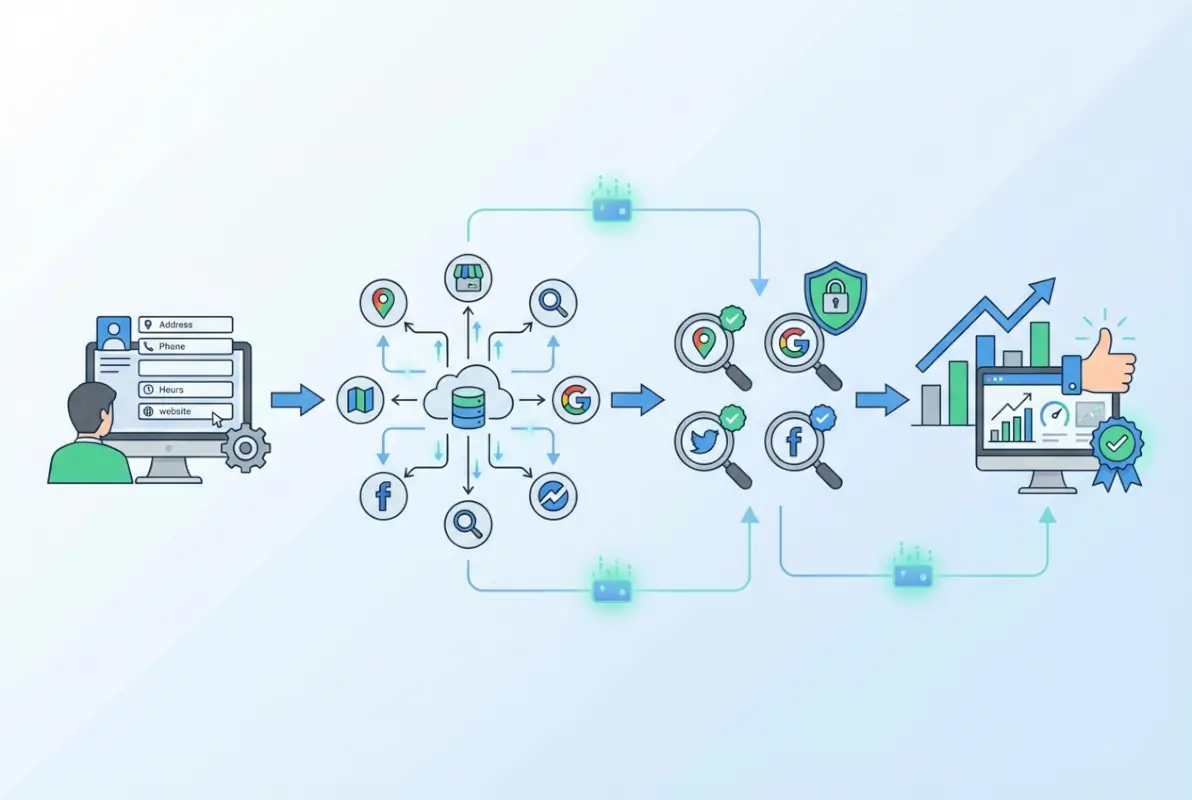
Second, listings build credibility through third-party validation. When a customer finds your business on multiple reputable platforms with consistent information and positive reviews, they subconsciously classify you as established and trustworthy. This is particularly crucial for service businesses where trust is the primary barrier to conversion.
Third, listings create multiple pathways to your business. If your website goes down, if your social media account gets compromised, if your email server fails—your directory listings keep working. They provide redundancy that protects your business from single points of failure in your digital presence.
| Benefit Category | Business Impact | Time to Results |
|---|---|---|
| Local SEO Rankings | Higher visibility in map packs and local results | 4-12 weeks |
| Trust & Credibility | Increased conversion from search to action | Immediate |
| Customer Acquisition Cost | Reduced spending on paid advertising | 2-8 weeks |
| Review Accumulation | Social proof that drives purchase decisions | Ongoing |
| Brand Protection | Control narrative and prevent misinformation | Immediate |
The Local SEO Multiplier Effect
Understanding local business listings means recognizing how they work synergistically with your other digital assets. Your listings don’t just help people find you—they strengthen your website’s authority through citations and backlinks, they feed rich snippet data to search results, and they provide content (reviews, Q&A, photos) that keeps your digital presence fresh and engaging.
Quality directories with high domain authority pass valuable link equity back to your website. While not every directory link carries massive weight individually, collectively they create a diverse backlink profile that search engines interpret as natural and authoritative. This is particularly important for new businesses that haven’t yet built substantial organic backlinks.
Building Your Listing Strategy: Platform Selection and Prioritization
Not all directories deserve equal attention. With limited time and resources, strategic prioritization becomes essential for maximizing return on effort. The goal isn’t omnipresence—it’s strategic presence on platforms that actually deliver results for your specific business type and target market.
Start with the essential tier: Google Business Profile, Bing Places, and Apple Maps. These platforms directly power the search and navigation tools that billions of people use daily. Google Business Profile alone influences the majority of local search interactions and is absolutely non-negotiable regardless of your business type.

Next, evaluate major general directories like Yelp, Yellow Pages, and Better Business Bureau. These platforms carry significant domain authority and often rank prominently in search results themselves. However, their value varies by industry—Yelp matters enormously for restaurants and service businesses but less so for B2B companies.
Industry-specific directories often deliver the highest-quality leads despite potentially lower traffic volumes. A dentist gets far more value from Healthgrades and Zocdoc than from most general directories. A wedding photographer should prioritize platforms like WeddingWire and TheKnot. These niche platforms attract users with specific, immediate intent.
Evaluation Framework for Directory Selection
When considering whether a directory deserves your attention, evaluate it against these criteria: domain authority (check using tools from Moz), search visibility for your key terms, audience alignment with your target customers, review functionality, cost versus features, and whether competitors in your market are actively using it.
Domain authority matters because high-authority directories pass more SEO value and typically rank better themselves. A listing on a DA 70 directory carries more weight than ten listings on DA 20 directories. Quality absolutely beats quantity in the directory game.
Audience alignment is paramount. A directory with massive traffic means nothing if those users aren’t looking for what you offer. A local chamber of commerce directory might have modest traffic but delivers highly qualified local leads because users specifically seek local businesses. Similarly, understanding what is business directory listing essential facts helps you recognize which platforms align with actual customer behavior.
Implementation: Creating and Optimizing High-Performance Listings
Actually creating effective listings requires methodical preparation and attention to detail that most businesses skip. This is where understanding local business listings transforms from theory into competitive advantage.
Before you create or claim a single listing, build a standardized data sheet. Document your exact legal business name (as it appears on government filings), complete address with proper formatting, primary phone number, website URL, business category selections, operating hours including special hours for holidays, detailed service descriptions, and your brand’s unique value proposition.

This data sheet becomes your single source of truth. Every listing you create should pull from this document to ensure perfect consistency. Even minor variations—”St.” versus “Street,” different phone formats, abbreviated versus full business names—create confusion that undermines your local SEO efforts.
When claiming existing listings (which often exist before you create them, auto-generated from data aggregators), verify ownership through whatever method the platform requires. For Google Business Profile, this typically means receiving a postcard with a verification code. Don’t skip this step—unverified listings have severely limited functionality and won’t appear in most searches.
Profile Completeness: The Often-Overlooked Ranking Factor
Most businesses create 60-70% complete profiles and wonder why they don’t rank well. Directory algorithms heavily favor complete profiles because completeness signals active management and provides more data points for matching user searches.
Fill out literally every available field. Add detailed business descriptions that naturally incorporate relevant keywords while clearly communicating your value proposition. Select all applicable categories (primary and secondary). Upload 10-15 high-quality photos showing your storefront, interior, products, team, and work examples. Add attributes like payment methods, accessibility features, and special services offered.
| Profile Element | Why It Matters | Optimization Priority |
|---|---|---|
| Business Name | Primary identifier for brand searches | Critical |
| NAP Consistency | Trust signal for search engines | Critical |
| Categories | Determines search matching relevance | High |
| Photos & Media | Increases engagement by 35%+ | High |
| Reviews | Primary conversion influencer | High |
| Posts & Updates | Signals active management | Medium |
For businesses needing to manage listings efficiently, consider using a local business directory guide approach that documents your process. This creates repeatable systems that save time as you expand to additional directories.
Visual Content Strategy
Photos aren’t optional decorations—they’re conversion drivers. Listings with quality photos receive significantly more engagement across every metric: profile views, website clicks, direction requests, and phone calls.
Upload photos that show your business in action, not just static product shots. Include your storefront (helps customers recognize you when they arrive), interior ambiance, your team interacting with customers, before-and-after work examples, and popular products or services. Refresh photos seasonally to signal active management.
Ongoing Management: Turning Static Listings into Dynamic Assets
Creating listings is just the beginning. The businesses that extract maximum value from directories treat them as dynamic assets requiring ongoing management, not “set it and forget it” tasks.
Schedule quarterly audits of all your listings. Business information evolves—hours change seasonally, services expand, phone numbers get updated, team members turn over—and outdated information frustrates potential customers while signaling neglect to search algorithms. Set calendar reminders to systematically review and update every listing.

Review management deserves particular attention because reviews directly influence both rankings and conversions. According to research from BrightLocal, 87% of consumers read online reviews for local businesses, and the presence and recency of reviews significantly impact local search rankings.
Respond to every review—positive, negative, and neutral. Positive review responses show appreciation and encourage future reviewers. Negative review responses demonstrate accountability and problem-solving (potential customers read your responses just as carefully as the reviews themselves). Even neutral reviews benefit from engagement that shows you value feedback.
Measurement and Attribution
Track specific performance metrics to understand which directories actually drive business results. Most platforms provide analytics showing profile views, website clicks, phone calls, and direction requests. Export this data monthly and identify patterns.
Implement tracking mechanisms for more precise attribution. Use unique phone numbers for different directories (call tracking services make this affordable), add custom UTM parameters to website URLs in your listings so Google Analytics identifies traffic sources, and train staff to ask new customers “How did you find us?” during initial interactions.
I worked with an HVAC company that discovered through proper tracking that a small local directory was generating three times more qualified service calls than Yelp, despite costing a fraction as much for premium placement. That insight allowed them to reallocate budget to their highest-performing platforms while maintaining only free listings on underperformers.
Advanced Tactics for Competitive Markets
In highly competitive markets, standard optimization isn’t enough. Consider these advanced approaches: regularly publish posts or updates on platforms that support them (Google Business Profile posts), actively solicit reviews through automated follow-up systems, add FAQ content using platform Q&A features, and respond within hours (not days) to customer questions and reviews.
For businesses exploring best low cost business directories for startups, prioritize platforms offering the best ratio of reach to cost. Many highly effective directories offer robust free tiers that small businesses can leverage before investing in premium features.
Frequently Asked Questions
What is a local business listing and why does it matter for search?
A local business listing is a digital profile containing your business name, address, phone, hours, and other details on directories and platforms. It matters because search engines use these listings to verify your business legitimacy, determine local search rankings, and provide information directly in search results. Consistent, optimized listings dramatically improve your visibility when customers search for services you offer.
How do I claim and verify my business listing on Google?
Visit Google Business Profile, search for your business name, and click “Claim this business” if a listing exists, or “Add your business” if not. Google will verify ownership, typically by mailing a postcard with a verification code to your business address. Enter this code in your account to gain full control. Verification usually takes 5-7 business days and is essential for managing your listing.
Do local citations still affect local SEO in 2025?
Yes, local citations remain a significant ranking factor. Search engines use consistent NAP mentions across directories to verify business legitimacy and geographic relevance. While their relative importance has evolved as algorithms became more sophisticated, citation consistency and quality still strongly influence local search rankings, particularly for businesses in competitive markets or newer establishments building authority.
How many directory listings should I have, and which ones matter most?
Quality trumps quantity—focus on 10-15 high-value directories rather than 50 mediocre ones. Prioritize Google Business Profile, Bing Places, Apple Maps, then major general directories like Yelp and BBB. Add 3-5 industry-specific directories where your target customers actually search. For startups, understanding business directory ID what it is why you need one helps organize your listing management efforts efficiently.
What data quality signals influence local rankings?
NAP consistency across all platforms, profile completeness (filled sections, photos, attributes), accurate business categories, regular updates signaling active management, review quantity and recency, response rate to reviews and questions, and verification status all influence rankings. Search engines reward businesses demonstrating legitimacy through consistent data and active engagement with customers.
How can I measure the impact of my listings on foot traffic and calls?
Use directory-provided analytics to track profile views, clicks, and calls. Implement unique tracking phone numbers for each major directory to precisely attribute calls. Add UTM parameters to website URLs in listings for traffic tracking. Train staff to ask customers “How did you find us?” and log responses. Compare conversion patterns before and after optimization to measure impact on business outcomes.
Should I invest in directory listings for a single-location business vs. multi-location?
Both benefit substantially, but strategies differ. Single-location businesses should deeply optimize 10-15 high-impact directories with complete profiles and active management. Multi-location businesses need centralized data governance ensuring consistency across all locations while allowing location-specific content like photos and posts. Multi-location businesses often benefit more from paid listing management tools that scale across locations efficiently.
How often should I update my listing information?
Conduct comprehensive audits quarterly to verify all information remains accurate. Update immediately when core details change—address, phone, hours, services. Add fresh photos monthly or seasonally. Respond to reviews within 24-48 hours. Publish posts or updates weekly on platforms supporting them. Regular activity signals to algorithms that your business is active and well-managed, positively influencing rankings.
What’s the difference between a directory listing and a review platform?
The distinction has blurred significantly—most directories now include review functionality, and review platforms function as directories. Traditional directories primarily organized business information by category and location. Review platforms centered on customer feedback and ratings. Today, platforms like Yelp, Google Business Profile, and TripAdvisor serve both functions, making the distinction largely semantic rather than functional.
How do I handle duplicate listings or NAP inconsistencies?
First, claim legitimate listings and update them with consistent information. For duplicates, request removal through the platform’s support system (this typically requires proving ownership of both listings). For listings you can’t control, submit correction requests with documentation proving accurate information. Use data aggregator services that push correct information to hundreds of directories simultaneously, gradually overwriting inconsistent data with authoritative information.
Ready to Transform Your Local Visibility?
Understanding local business listings isn’t just theoretical knowledge—it’s a competitive advantage waiting to be claimed. Start today by auditing your Google Business Profile for completeness, then systematically expand to the directories where your customers actually search.
The businesses dominating local search aren’t necessarily bigger or better—they’re simply more strategic and consistent with their directory presence. Build your standardized data sheet, claim and optimize your core listings, implement review management processes, and track what actually drives results.
Remember: local directory optimization isn’t a one-time project but an ongoing competitive moat. The consistency and quality you build today compounds over months and years, creating durable visibility advantages that protect your business from competitors and algorithm changes alike.