6 Ways to Make Money from an Online Directory (Earn $10K/Month)

Generating summary...
Online directories aren’t just digital phonebooks anymore, they’re sophisticated revenue engines that smart entrepreneurs are using to pull in serious monthly income. While everyone’s chasing the next app idea or SaaS product, a well-positioned directory can quietly generate $10,000 per month or more by connecting the right people with the right services. The beauty of this business model? It scales beautifully once you understand the core monetization levers and how to combine them strategically.
Here’s what most people miss: successful directory monetization isn’t about choosing one revenue stream, it’s about layering multiple income sources that complement each other. Premium listings provide recurring revenue, lead generation fees capture high-intent transactions, advertising monetizes your growing traffic, and value-added services increase your average revenue per user. When you orchestrate these elements correctly, you create a business that’s resilient, scalable, and genuinely valuable to both users and listed businesses.
TL;DR – Quick Takeaways
- Multiple revenue streams are essential – Successful directories combine 3-5 monetization methods to reach sustainable income levels
- Premium listings provide the foundation – Tiered subscriptions create predictable recurring revenue that funds growth
- Niche focus beats broad appeal – Specialized directories command higher prices and attract more qualified traffic
- Lead generation unlocks premium pricing – In high-value verticals, single leads can justify $50-500 fees
- Timeline matters – Most directories need 6-18 months to reach $10K/month with consistent execution
- Traffic quality trumps quantity – 1,000 targeted visitors convert better than 10,000 general browsers
Premium Listings and Tiered Subscriptions: Your Revenue Foundation
Premium listings represent the bedrock of directory monetization because they deliver predictable, recurring revenue that you can actually forecast and build around. Unlike one-time payments or unpredictable ad income, subscription-based listing fees give you visibility into next month’s revenue, which makes everything from hiring to marketing decisions significantly easier.
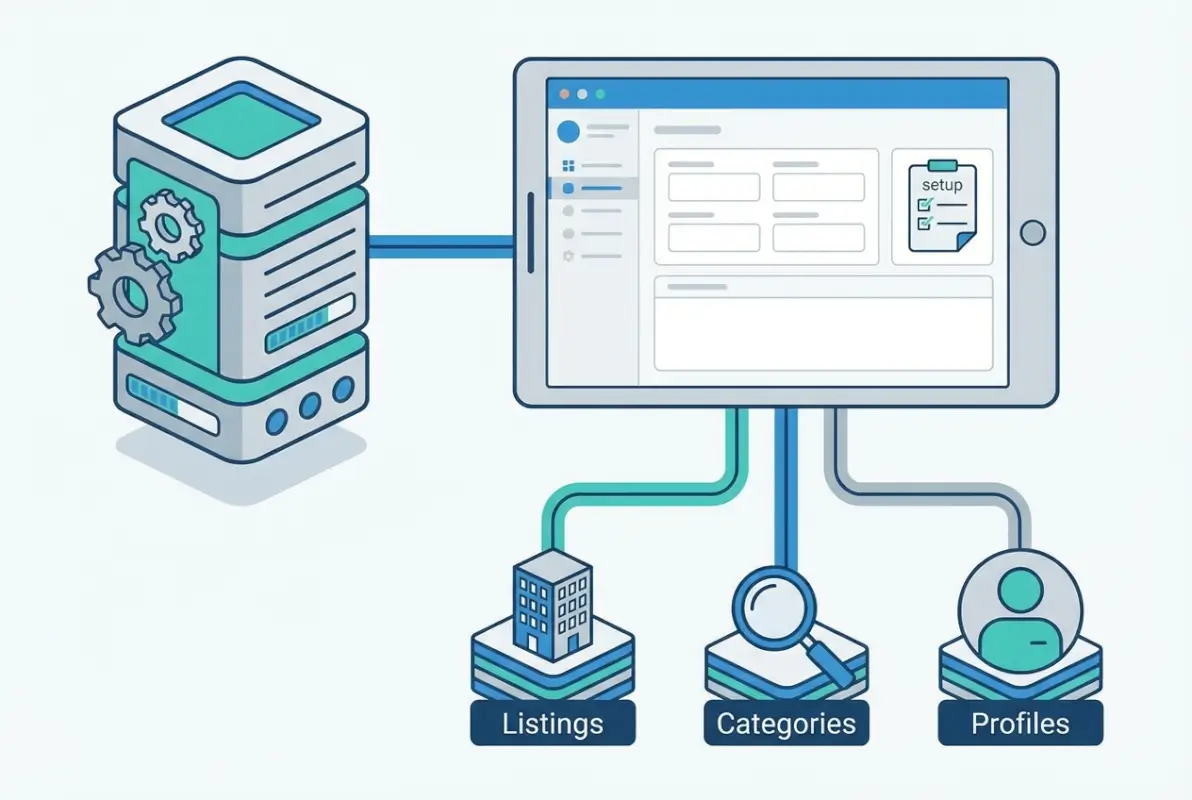
How Premium Listings Work
The core concept is straightforward: businesses pay for enhanced visibility and features beyond what free listings offer. Featured placements at the top of search results, enhanced profile pages with photos and videos, priority in category browsing, verified badges, and direct contact options all represent upgrades that businesses willingly pay for. The psychology is simple, if your directory drives qualified traffic, businesses will invest to stand out from competitors.
I remember launching my first niche directory for wedding photographers, initially I offered everything for free just to build the database. Once I had 200 listings and decent traffic, I introduced a “Featured Photographer” tier at $29/month. Within two weeks, 15 photographers upgraded without me even asking, they could see the traffic and understood the value proposition.
The key differentiation factors for premium tiers typically include: search result placement (appearing in top 3 positions), profile enhancements (unlimited photos, video embedding, portfolio galleries), lead priority (receiving inquiries before free listings), analytics access (showing profile views and click-throughs), and trust signals (verified badges, customer reviews display).
Building Tiered Pricing That Converts
Effective tier structures follow a proven pattern: three tiers work better than two or four. The “Starter” tier at $19-49/month offers basic premium features, the “Pro” tier at $79-149/month includes everything most businesses need, and the “Enterprise” tier at $199-499/month targets larger operations willing to pay for maximum visibility.
| Tier | Monthly Price | Key Features | Best For |
|---|---|---|---|
| Starter | $29-49 | Enhanced profile, 5 photos, basic analytics | Solo practitioners, new businesses |
| Pro | $99-149 | Featured placement, unlimited media, verified badge, lead priority | Established businesses, competitive markets |
| Enterprise | $249-499 | Top placement guaranteed, custom branding, API access, dedicated support | Large companies, franchises, high-value services |
The pricing sweet spot depends heavily on your vertical. Professional services directories (lawyers, accountants, consultants) can command $149-499/month because a single client might be worth thousands. Local service directories (plumbers, electricians, landscapers) typically range $49-149/month. Product directories often sit at $29-79/month unless they’re highly specialized.
Example Pricing Benchmarks and Upgrade Paths
Real-world benchmarks from successful directories show conversion rates of 3-8% from free to paid listings when value is clear. That means if you have 500 free listings, expect 15-40 to convert to premium tiers. Your initial goal should be hitting 50-100 paying subscribers, which at an average of $79/month delivers $3,950-7,900 in monthly recurring revenue.
Upgrade paths matter tremendously. Offering annual plans at a 15-20% discount accelerates cash flow and improves retention. Including a 14-30 day free trial for premium features helps hesitant businesses experience the value before committing. Creating “seasonal promotions” (first month $1, or 50% off for early adopters) can jumpstart your subscriber base while you’re building traffic and credibility.
To explore more about setting up directory listing businesses, you’ll find that the technical implementation is actually simpler than most entrepreneurs expect.
Lead Generation Fees: Monetizing High-Intent Connections
Lead generation represents one of the highest-value monetization strategies for directories, particularly in verticals where customer lifetime value justifies aggressive acquisition costs. Instead of charging for visibility alone, you’re charging for actual business opportunities, which fundamentally changes the value equation and allows for premium pricing.

When to Charge Per Lead vs. Per Inquiry
The distinction between leads and inquiries matters more than you might think. An inquiry is any contact attempt (someone clicked “contact business” or filled out a form). A lead is a qualified inquiry that meets specific criteria: verified contact information, clear project scope, realistic budget, and genuine intent to hire. Smart directories charge for leads, not inquiries, because quality gating protects your reputation with listed businesses.
Per-inquiry models work when: volume is high, qualification is difficult, businesses want maximum reach, and average transaction values are lower ($100-1,000). Per-lead models make sense when: you can verify quality, transaction values are substantial ($1,000+), businesses need fewer but better opportunities, and you can track conversion outcomes.
In my experience running a professional services directory, we initially charged $15 per inquiry and got constant complaints about low-quality contacts. After implementing a qualification system (phone verification, project budget questions, timeline confirmation) and raising prices to $45 per qualified lead, satisfaction scores jumped and retention improved dramatically.
Tracking, Qualification, and Delivering High-Intent Leads
The operational backbone of lead-gen monetization is your tracking and qualification system. You need technology that captures inquiry details, applies qualification filters (budget thresholds, project timelines, geographic coverage), routes leads to appropriate businesses based on capacity and specialization, and provides confirmation and follow-up mechanisms.
Qualification questions should be strategic: “What’s your project timeline?” filters out tire-kickers, “What’s your estimated budget range?” ensures financial alignment, “Have you worked with [service type] before?” indicates sophistication level, and “How did you hear about us?” provides attribution data. Keep forms short enough to maintain conversion rates (5-7 fields maximum) while gathering enough data for meaningful qualification.
Delivery mechanisms vary based on your model. Real-time lead distribution works well for time-sensitive services (emergency repairs, immediate consultations) but requires businesses to be responsive 24/7. Batched daily delivery suits less urgent services and allows businesses to plan their follow-up. Exclusive leads (sent to one business only) command premium prices ($75-300), while shared leads (sent to 3-5 businesses) cost less ($15-50) but create competitive urgency.
Case Framing: Typical Lead Values by Category
Lead pricing should reflect the economic value to businesses. Home services (plumbing, HVAC, roofing) typically support $20-75 per lead because project values range $500-5,000. Real estate leads command $50-200 since commission values justify the investment. Legal services can sustain $100-500 per lead depending on practice area (personal injury leads are worth more than traffic tickets). B2B software directories might charge $150-1,000 per qualified demo request based on annual contract values.
Your math should work backward from business economics. If a contractor closes 20% of leads and average project value is $3,000, each lead is theoretically worth $600 (20% × $3,000). Charging $75 per lead represents just 12.5% of that value, which is sustainable. Businesses typically accept lead costs between 10-30% of the opportunity value, depending on their margins and conversion rates.
Learning how businesses can leverage directory platforms helps you understand their perspective and price your lead-gen services appropriately.
Advertising Revenue: Scaling with Traffic
Advertising represents the most scalable monetization method for directories because revenue grows proportionally with traffic, once you’ve established the infrastructure. However, the tension between user experience and ad monetization requires careful management, you can’t just plaster ads everywhere and expect both revenue and retention to thrive.

Balance Between User Experience and Ad Monetization
The fundamental challenge is that ads inherently detract from user experience, even when well-implemented. Every ad unit competes for attention with your core content (the listings and information users came for). The question isn’t whether ads impact experience, it’s whether the impact is acceptable relative to the revenue generated.
Best practices for maintaining this balance include: limiting ad density to one unit per screen view, using native ad formats that blend with your design, implementing frequency capping to avoid showing the same ad repeatedly, blocking objectionable categories (adult content, sketchy products), and maintaining fast page loads despite ad scripts.
Strategic ad placement works better than scattered monetization. Header bidding units (top of page) capture premium CPMs but shouldn’t push content below the fold. In-content ads (between listings or after every 3-5 results) perform well without destroying usability. Sidebar ads work on desktop but disappear on mobile. Sticky footer ads maintain visibility but can feel intrusive if not implemented carefully.
The general guideline: your ad-to-content ratio should never exceed 30% of visible screen real estate. Most successful directories keep it around 15-20%, which maintains credibility while capturing meaningful revenue. Users tolerate reasonable advertising when the core directory value (finding quality businesses or services) remains intact.
Direct-Sold vs. Programmatic Ad Sales
Directory advertising typically follows two paths: direct sales to businesses in your vertical or programmatic networks (Google AdSense, Mediavine, Ezoic). Each has distinct economics and operational requirements.
| Approach | Revenue Potential | Effort Required | Best For |
|---|---|---|---|
| Direct Sales | $500-5,000/month per advertiser | High (sales, creative, reporting) | Niche directories with clear advertiser fit |
| Programmatic | $5-25 per 1,000 pageviews | Low (set and forget) | High-traffic directories (50K+ monthly visitors) |
| Hybrid | Combined revenue from both | Medium (reserve premium placements) | Established directories with diverse traffic |
Direct sales work beautifully in specialized directories where you can identify obvious advertisers. A wedding directory can sell to venues, planners, photographers, and dress shops. A software directory can sell to complementary tools and services. Pricing typically ranges $300-2,000/month for banner placements, $500-5,000/month for sponsored content, and $1,000-10,000/month for exclusive category sponsorships.
Programmatic advertising provides passive income with minimal effort but requires significant traffic to generate meaningful revenue. At typical CPMs of $5-15, you need 100,000 monthly pageviews to generate $500-1,500/month. Premium directories in lucrative verticals (finance, legal, real estate) can achieve $20-50 CPMs, which dramatically improves the economics.
Best Practices for Ad Placement That Preserve Conversion Rates
The biggest mistake directory owners make is optimizing purely for ad revenue without considering how ads impact core conversion metrics (inquiry form submissions, phone calls, click-throughs to business websites). If aggressive advertising reduces inquiries by 30% while increasing ad revenue by 20%, you’ve actually damaged your business because listed businesses see less value and churn increases.
Protect your core conversion paths by avoiding ads directly above or adjacent to inquiry forms, keeping sponsored listings visually distinct from organic results, ensuring mobile ad placements don’t obscure contact buttons, and testing ad configurations against conversion baselines. Run A/B tests where you measure both ad revenue and conversion rates, then optimize for the combination that maximizes total business value.
For insights on presenting large directories with better user experience, the fundamental principle is that usability directly impacts all your monetization metrics.
Affiliate Partnerships: External Revenue Without Friction
Affiliate partnerships represent an elegant monetization layer because they generate revenue from user activity that would happen anyway, without requiring businesses to pay more or users to see additional advertising. When implemented thoughtfully, affiliate income complements your core directory revenue while enhancing rather than detracting from user experience.

How to Structure Affiliate Relationships
The most effective affiliate integrations feel like natural extensions of your directory’s value proposition rather than awkward commercial insertions. Contextual tool recommendations (suggesting relevant software or services alongside listings), booking engine integrations (hotel directories linking to reservation platforms), resource libraries (courses, templates, or tools that help users evaluate options), and comparison tools (embedding affiliate-linked product comparisons) all provide genuine utility while generating commissions.
Structural approaches vary by directory type. Service directories might integrate with booking platforms (Calendly, Acuity) or payment processors (Stripe, Square) where both the listed business and end user benefit. Product directories can embed price comparison tools or link to e-commerce platforms. B2B directories might partner with business software providers (CRM, analytics, marketing tools) that their listed businesses need.
The commission economics depend heavily on your vertical. SaaS affiliates typically offer 20-30% recurring commissions on monthly subscriptions, which can mean $10-100+ per referral monthly. E-commerce affiliates usually pay 3-10% of purchase value, requiring higher volumes to be meaningful. Lead-gen affiliates (insurance, loans, education) might pay $5-200 per qualified submission depending on vertical economics.
Choosing Affiliates Aligned with Your Vertical
Strategic affiliate selection focuses on products or services that genuinely help your audience accomplish their goals. A contractor directory might partner with project management software, cost estimation tools, or licensing/insurance services. A restaurant directory could integrate with reservation systems, point-of-sale providers, or food delivery platforms. A job board might partner with resume builders, interview prep courses, or background check services.
The key question: “Would I recommend this even if I didn’t get paid?” If the answer is yes, you’ve found an appropriate affiliate relationship. If you wouldn’t naturally recommend something, the commission isn’t worth the credibility cost. Remember that users associate affiliate recommendations with your brand integrity, one bad referral can damage trust that took months to build.
Priority should go to affiliates offering: products your audience actually needs, fair pricing and value delivery, reliable tracking and payment systems, reasonable cookie durations (30-90 days), and recurring revenue opportunities where possible. Avoid affiliates with aggressive upsells, questionable value propositions, or conversion funnels that feel manipulative.
Tracking and Compensation Models
Affiliate tracking happens through unique referral links, cookies, and conversion pixels. Most programs provide these automatically, but you should understand the attribution windows and limitations. A 30-day cookie means you get credit if the user converts within 30 days of clicking your link. Last-click attribution means you only get credit if yours was the last affiliate link clicked before purchase.
Compensation models include CPA (cost per action, one-time payment for conversions), revenue-share (percentage of customer lifetime value), and hybrid models (upfront CPA plus ongoing percentage). For directory monetization, recurring revenue-share models on subscription products deliver the best long-term economics. A $30/month SaaS product with 25% commission generates $7.50/month for as long as the customer subscribes, 100 referrals could mean $750/month in recurring affiliate income.
To explore how businesses can leverage directory platforms for their own growth, you’ll see why appropriate affiliate partnerships create win-win-win scenarios (user gets helpful tools, business succeeds, directory earns commissions).
Value-Added Services: Increasing Revenue Per Customer
Value-added services represent one of the most overlooked monetization opportunities in directory businesses. Once you’ve established relationships with listed businesses, you’re positioned to offer additional products and services that help them get more value from their listings and succeed in their market. This approach increases average revenue per user (ARPU) without requiring proportional increases in traffic or user acquisition.

Services Like Enhanced Analytics, Vetting, and Integrations
Listed businesses constantly struggle with questions your directory is uniquely positioned to answer: “How many people viewed my profile this month?”, “Where is my traffic coming from?”, “How do I compare to competitors?”, “Which keywords drive the most inquiries?” Premium analytics packages that answer these questions can command $29-149/month on top of basic listing fees.
Enhanced analytics offerings typically include detailed traffic reports (views, clicks, geographic distribution), competitive benchmarking (how you rank against similar businesses), inquiry analytics (lead quality, conversion tracking, response time monitoring), and SEO insights (search rankings, keyword performance, optimization recommendations). The key is making data actionable, not just overwhelming businesses with numbers but providing insights that drive decisions.
Other high-value services include professional photography and video production for listings (one-time fees of $200-1,500), reputation management and review response services ($99-299/month), content creation for enhanced profiles ($150-500/month), social media integration and posting ($199-499/month), and CRM integrations that sync directory leads with business systems ($49-149/month setup plus monthly fees).
Businesses working with directory systems often need technical assistance they’re willing to pay for, creating natural service opportunities.
White-Labeling and Co-Branded Features
White-labeling your directory platform for larger organizations or associations represents a premium service opportunity. Trade associations, franchise systems, and professional organizations need member directories but lack the resources to build and maintain sophisticated platforms. You can license your technology and expertise for $500-5,000/month depending on customization needs and member volume.
Co-branded directory features allow larger businesses to sponsor sections of your directory with their branding while you maintain ownership and operations. A major insurance company might sponsor your contractor directory’s “insurance verification” features. A franchise brand might sponsor their category with enhanced branding and filtering. These sponsorships typically command $1,000-10,000/month for exclusive positioning and co-branding rights.
The economics are compelling because you’re monetizing assets you’ve already built. Once your directory platform is established, white-labeling requires configuration rather than new development. Each white-label instance might represent 10-50 hours of setup work generating $500-5,000/month in ongoing revenue, that’s exceptional return on time investment.
Upsell Flows and Packaging Into Recurring Revenue
Effective upselling happens through systematic flows, not random pitches. When a business joins at the basic tier, your onboarding sequence should include timed upgrade offers (week 2: “See who’s viewing your profile with analytics”), contextual prompts (when they log in to check messages: “Respond faster with SMS notifications, $29/month”), and milestone-triggered offers (after receiving 10 inquiries: “Compare your performance to competitors, upgrade now”).
Packaging services into bundles improves conversion compared to à la carte pricing. Your “Growth Bundle” might combine featured listing ($99), analytics ($49), and review management ($79) for $199/month instead of $227 separately. The discount incentivizes package adoption while your revenue increases substantially versus the basic listing alone.
Recurring revenue is the goal for all value-added services. One-time fees provide cash flow but don’t build enterprise value the same way monthly recurring revenue (MRR) does. When positioning services, emphasize ongoing value (monthly reports, continuous monitoring, regular updates) rather than one-time deliverables.
Niche Specialization and Community Content: The Quality Multiplier
While broad directories chase massive scale, niche-focused directories often achieve superior monetization by serving specific markets exceptionally well. The principle is simple: when you’re the definitive resource for a particular vertical, you command higher prices, attract more qualified traffic, and build defensible competitive advantages that generic directories can’t replicate.
Selecting a Defensible Niche
Effective niche selection balances three factors: market demand (enough businesses and users to sustain a marketplace), monetization potential (businesses that can afford listing fees and have strong lead values), and competitive intensity (avoiding markets where established players dominate). The sweet spot combines underserved demand with decent transaction economics and manageable competition.
Promising niche characteristics include specialized professions (not just “lawyers” but “immigration attorneys” or “IP lawyers”), geographic focus (becoming the definitive directory for your metro area rather than competing nationally), vertical industries (construction, healthcare, hospitality), demographic targeting (seniors, parents, specific cultural communities), and problem-specific services (emergency services, luxury providers, eco-friendly options).
Research tactics for evaluating niches involve analyzing keyword search volumes (using tools like Ahrefs or SEMrush to confirm demand), reviewing competitor directories (understanding their monetization and weaknesses), interviewing potential listed businesses (confirming willingness to pay), and examining transaction values (ensuring economics support directory fees).
Building Community-Generated Content and Curation
The most valuable directories transcend simple listing databases to become trusted information resources. User reviews, detailed business profiles, educational content, comparison tools, and community discussions all contribute to this transformation. When users spend time engaging with content beyond basic search-and-click, your monetization potential increases because dwell time, page depth, and return visits all improve.
Community-generated content strategies include verified customer reviews with photo uploads and detailed feedback, business Q&A sections where companies answer common questions, comparison guides and best-of lists curated from user input, discussion forums for your vertical, and user-submitted tips or recommendations. The key is moderation and quality control, low-quality user content damages credibility faster than no user content at all.
Quality signals that drive monetization include verification badges (confirming business legitimacy), response ratings (showing how quickly businesses reply to inquiries), completion scores (indicating profile detail and information comprehensiveness), user ratings and review counts, and tenure indicators (showing how long a business has been listed). These signals help users make confident decisions, which increases conversion rates and justifies premium pricing for businesses that want those quality markers.
Licensing and Data Products for B2B Use
Once you’ve built a comprehensive, well-curated directory in a specific niche, your database becomes a valuable asset that other businesses may want to license. Marketing agencies need lists of target businesses, software companies want integration partnerships, research firms need market data, and media companies seek sources for stories and expert commentary. Your directory data can monetize through these B2B channels independent of traditional directory revenue.
Data licensing models typically involve subscription access to your database ($500-5,000/month depending on size and exclusivity), API access for real-time integrations ($200-2,000/month based on call volume), custom reports and market analyses ($1,000-10,000 per project), and lead list exports for marketing ($0.50-5.00 per record depending on data richness).
API monetization works particularly well because once implemented, it generates passive recurring revenue with minimal ongoing costs. A software platform that integrates your directory data might pay $500-2,000/month for API access serving their user base, if you secure 5-10 such partnerships, that’s $2,500-20,000/month in revenue from infrastructure you’ve already built.
Building Your Go-To-Market Plan: From Zero to $10K/Month
Theory matters less than execution. Let’s break down a practical 12-month roadmap for launching and scaling a directory to $10,000/month in revenue, combining the monetization strategies we’ve discussed into a realistic growth plan.
Define Your Niche and Target User Personas
Start by crystallizing exactly who you serve. Your target user persona (the person searching for businesses) might be “homeowners aged 35-55 planning renovation projects valued at $10,000+” or “HR managers at companies with 50-500 employees hiring specialized contractors.” Your business persona (the companies you list and monetize) might be “established contractors with 5-50 employees seeking qualified leads” or “independent consultants charging $150+/hour who need visibility.”
The specificity matters because it drives every downstream decision: which platforms you advertise on, what content you create, how you price services, which features to prioritize. Generic targeting leads to generic positioning and commoditized pricing. Specific targeting enables premium pricing and focused marketing that actually converts.
Document your personas with demographic details, pain points and goals, current solutions they use (and what’s lacking), budget and willingness to pay, decision criteria, and preferred communication channels. This becomes your strategic foundation for the next 12 months.
Create a 12-Month Monetization Plan with Milestones
Realistic directory growth follows a predictable pattern, assuming consistent effort and reasonable niche selection. Here’s a sample timeline:
| Month | Focus | Revenue Target | Key Metrics |
|---|---|---|---|
| 1-3 | Platform setup, initial listings (50-100), content foundation | $0-500 | 100 free listings, 1,000 monthly visitors |
| 4-6 | Launch premium tiers, first paid listings, SEO growth | $1,000-2,500 | 20-30 paying listings, 5,000 monthly visitors |
| 7-9 | Add lead-gen or advertising, expand listings to 200+ | $3,000-5,000 | 50 paying listings, 15,000 monthly visitors |
| 10-12 | Layer value-added services, affiliate programs, hit target | $8,000-12,000 | 80-100 paying listings, 25,000+ monthly visitors |
This timeline assumes you’re working on the directory as a serious part-time project (20+ hours/week) or full-time. If you’re treating it as a side hobby with 5 hours/week, extend this timeline by 2-3x. The math doesn’t change, just the calendar.
Revenue composition at the $10K/month milestone might look like: $6,000 from 75 premium listings averaging $80/month, $2,500 from lead generation fees (50 leads at $50 average), $1,000 from advertising revenue (100K monthly pageviews at $10 RPM), and $500 from affiliate partnerships and value-added services. This diversification protects against single-source dependency.
Budget, Forecast, and KPIs
Initial investment for a directory typically ranges $2,000-10,000 depending on whether you use turnkey solutions or custom development. Costs include platform/hosting ($50-300/month for quality infrastructure), design and UX ($500-5,000 for professional implementation), initial content creation ($500-2,000 for seed content and listings), and marketing/advertising budget ($500-2,000/month for paid acquisition during growth phase).
Key performance indicators to track weekly include new listings added (free and paid), premium conversion rate (free to paid), average revenue per user (ARPU), monthly recurring revenue (MRR), churn rate (what percentage cancel monthly), traffic metrics (visitors, pageviews, bounce rate), and lead generation metrics (inquiries submitted, lead qualification rate). These KPIs tell you whether you’re on track or need course correction.
Customer acquisition cost (CAC) and lifetime value (LTV) represent your core economic indicators. If it costs you $150 to acquire a premium listing customer (through ads, sales effort, or content marketing) and they stay an average of 18 months at $99/month, your LTV is $1,782 with an LTV:CAC ratio of nearly 12:1, that’s extremely healthy economics that justify aggressive growth investment.
Frequently Asked Questions
How do directory websites actually make money?
Directory websites generate revenue through multiple streams including premium listing subscriptions where businesses pay monthly fees for enhanced visibility, pay-per-lead models charging for qualified customer inquiries, display advertising from both direct sales and programmatic networks, affiliate partnerships earning commissions on referred products or services, and value-added services like analytics, photography, or integrations. Successful directories typically combine 3-5 of these methods to reach sustainable revenue levels.
What is a realistic timeline to earn $10K per month from a directory?
Most niche directories require 12-18 months of consistent effort to reach $10,000 monthly revenue, assuming you’re working on it seriously (20+ hours weekly) with reasonable niche selection and execution. The timeline involves building initial listings and traffic (months 1-3), launching paid tiers and getting first customers (months 4-6), scaling listings and adding revenue streams (months 7-9), and optimizing conversion and expanding services (months 10-12). Exceptionally strong niches or aggressive execution might reach this milestone in 9-12 months.
Which industries or verticals are most profitable for directory businesses?
The most profitable directory verticals share high customer lifetime values and strong lead economics. Professional services (legal, financial, consulting) support premium pricing because single clients justify significant acquisition costs. Home services (contractors, renovations, major repairs) work well due to project values of $5,000-50,000. Real estate, both commercial and residential, offers excellent economics. Healthcare and specialized B2B services also monetize effectively. The key factors are transaction values above $1,000 and customers willing to pay for qualified leads.
Can I monetize a brand new directory with minimal traffic?
Yes, through strategic approaches that don’t require massive traffic. Start with paid listing models rather than advertising (which needs volume), offer “founding member” pricing to incentivize early adopters, implement affiliate partnerships that monetize the traffic you do have, provide value-added services like profile enhancement or photography, and focus on quality over quantity with a smaller number of premium-paying businesses. Some directories generate their first $1,000-2,000/month with under 5,000 monthly visitors through focused monetization.
What are the best practices to avoid customer churn when monetizing?
Reducing churn requires delivering measurable value that justifies ongoing payments. Provide regular reporting showing profile views, inquiries received, and leads generated. Maintain high listing quality through moderation and verification. Ensure responsive customer support addressing issues quickly. Keep pricing aligned with delivered value and offer annual discounts to lock in commitments. Balance monetization with user experience so traffic and inquiry quality remain strong. Survey churning customers to understand their reasons and address systemic issues proactively.
Do I need unique content or community features to succeed with a directory?
While basic directories can work with just listings, unique content and community features significantly improve monetization potential. Quality curation, detailed reviews, educational content, and comparison tools build trust and increase dwell time. These elements help you rank better in search engines, convert visitors at higher rates, and justify premium pricing to businesses. Directories with strong content and community typically achieve 2-3x higher revenue per visitor than bare-bones listing sites.
Should I focus on one monetization method or combine multiple strategies?
Combining multiple revenue streams provides both higher total revenue and business resilience. Starting with premium listings establishes recurring revenue and proves your value proposition. Adding lead generation or advertising as traffic grows diversifies income and maximizes the value of each visitor. Layering affiliate partnerships and value-added services increases revenue per customer without proportionally increasing costs. Most directories reaching $10K monthly have 3-5 active revenue streams rather than relying on a single method.
What technology or platform should I use to build a directory?
Platform selection depends on technical skills and customization needs. WordPress with directory plugins (like specialized directory themes) offers flexibility and affordability for $500-2,000 setup costs. No-code solutions provide faster launches with less customization for $100-300 monthly. Custom development delivers complete control but costs $10,000-50,000 and requires ongoing technical resources. For most entrepreneurs, WordPress-based solutions or quality turnkey platforms offer the best balance of functionality, cost, and speed to market.
How important is SEO for directory monetization success?
SEO represents the foundation of sustainable directory growth because organic search traffic converts better and costs less than paid acquisition. Directories naturally have SEO advantages through user-generated content, location-specific pages, and keyword-rich business profiles. Focusing on long-tail keywords, optimizing individual listing pages, building quality backlinks, and maintaining fast page loads drives the traffic that makes all monetization strategies work. Directories reaching $10K monthly typically derive 60-80% of traffic from organic search rather than paid sources.
What’s the biggest mistake new directory owners make with monetization?
The most common mistake is trying to monetize too aggressively too early, which damages user experience and prevents the network effects that make directories valuable. Launching with immediate paywalls before you have traffic, plastering ads everywhere before establishing credibility, or charging premium prices before delivering premium value all backfire. The smarter approach is building initial value through free listings and quality content, proving your traffic and lead quality to businesses, then gradually introducing monetization as your value becomes undeniable.
Ready to Launch Your Directory?
Building a successful online directory requires the right combination of niche focus, technical infrastructure, and monetization strategy. The path to $10,000 monthly revenue isn’t mysterious, it’s methodical. Start by identifying an underserved niche where you can deliver genuine value, build a quality platform that serves both users and businesses effectively, and layer monetization strategies as your traffic and credibility grow.
The entrepreneurs succeeding with directory businesses aren’t necessarily the most technical or best-funded, they’re the ones who understand their market deeply, deliver consistent value, and optimize relentlessly based on data. Your directory doesn’t need to be perfect on day one, it needs to be launched, tested, and improved based on real user feedback and business results.
Take the frameworks outlined here and adapt them to your specific situation. Whether you’re targeting local services, professional networks, product comparisons, or specialized industries, the fundamental principles remain constant: build trust through quality, monetize through multiple streams, and scale by delivering measurable value to all stakeholders.
Was this article helpful?