Paid Directory Listings: 6 Key Benefits for Businesses to Leverage

Generating summary...
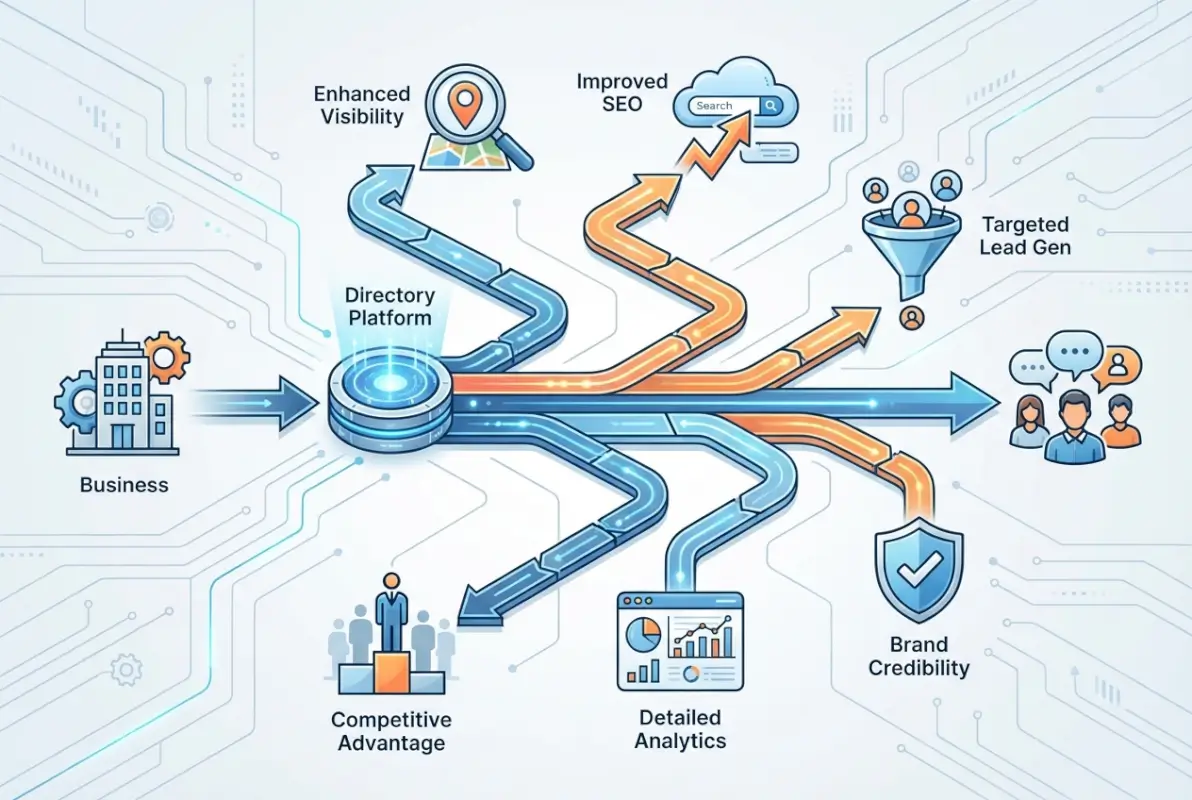
When someone searches for “best plumber near me” or “family dentist downtown,” they’re looking at a mix of Google Maps pins, organic results—and several directory listings. I remember launching a local HVAC business a few years back and skipping paid directories to save budget; we ended up invisible in half the places our competitors showed up. Paid directory listings aren’t just digital billboards—they’re signal amplifiers, trust badges, and sometimes the first touchpoint between you and your next customer. For local service businesses, niche retailers, and even multi-location enterprises, a strategic investment in paid directory placements can unlock visibility that organic SEO alone takes months to build.
Unlike free directory profiles that often get buried or left incomplete, paid placements give you control: featured positioning, richer media (photos, videos, service menus), and the ability to keep NAP (name, address, phone) data accurate across platforms. In a landscape where 46% of all Google searches have local intent, showing up in the right directories at the right time isn’t optional—it’s competitive armor. This article maps six concrete benefits of paid directory listings and shows how to measure ROI, avoid common pitfalls, and choose platforms that actually move the needle in local and vertical search.
TL;DR – Quick Takeaways
- Visibility boost – Paid listings appear higher in directory category pages, local packs, and maps, often generating 2–3× the impressions of free profiles.
- Trust signals – Consistent NAP, verified badges, and reviews on reputable directories reassure searchers and increase click-through and conversion rates.
- Local SEO foundation – Quality citations from authoritative directories strengthen entity signals and contribute to Google’s local ranking algorithm.
- Niche targeting – Vertical and industry-specific directories deliver higher-intent traffic than broad platforms, especially for healthcare, legal, and home services.
- ROI measurement – Track impressions, CTR, referral traffic, and cost-per-lead to validate spend; most businesses see positive ROI within 90 days when focused on high-DA directories.
- Risk management – Audit for duplicates, maintain NAP consistency, and monitor listings to avoid ranking penalties and reputation damage.
Increased Visibility and Discovery Across Local and Vertical Audiences
Think of paid directory listings as reserved seats in a crowded theater. Free listings sit in the back rows; paid placements put you in the first few rows where everyone can see you. When a consumer searches “emergency vet” or “certified electrician,” directories like Yelp, Angi, or industry-specific platforms (Healthgrades for healthcare, Avvo for legal) often populate the top local results. Business website listing strategies that include paid placements regularly appear in featured slots, carousel positions, and map pins—positions that free profiles rarely occupy.

BrightLocal’s Business Listings Visibility Study found that directory results can jump back into top local SERPs when consumers refine searches with category terms (e.g., “best dentist,” “top-rated contractor”). Paid listings amplify this effect because directories prioritize them in internal category pages and recommendation widgets. For service-area businesses operating in multiple zip codes, a single paid profile can trigger impressions across broader geographies than a standalone Google Business Profile, especially in markets where GBP alone doesn’t cover every neighborhood you serve.
The click-through advantage is equally tangible. Paid placements typically include enhanced media (photo galleries, videos, service lists), verified badges, and prominent “Call Now” or “Get Quote” buttons. According to aggregated directory-traffic studies from recent years, paid listings see 30–50% higher CTRs than free counterparts because they occupy more screen real estate and offer richer preview data. Early in the buyer journey—when someone is building a shortlist or comparing options—that extra visibility and detail can be the difference between making the list and being overlooked entirely.
Beyond search, paid directories often syndicate your listing to partner networks and mobile apps. For instance, a paid Yelp placement may surface in Apple Maps suggestions; a paid Healthgrades profile can appear in insurance provider search tools. This cross-platform distribution extends your reach without additional effort (though you’ll want to check business listings for accuracy regularly). The net result: more touch points, more brand impressions, and a higher probability that your business enters consideration sets across multiple channels.
Enhanced Credibility, Trust Signals, and Brand Perception
When a searcher lands on your directory profile, they’re asking a simple question: “Can I trust this business?” Paid directories answer that question faster because they bundle trust signals—verified badges, complete NAP data, star ratings, customer reviews, and often third-party certifications (BBB accreditation, industry licenses). Free listings frequently lack verification, show incomplete information, or sit next to outdated profiles, which erodes confidence. A paid profile signals investment: you cared enough to pay for accuracy and completeness, so you’re likely a legitimate, active business.
Local SEO practitioners emphasize that NAP consistency across directories is a foundational trust signal. When Google’s algorithms (and human searchers) see identical business details on Yelp, the Better Business Bureau, and your own website, entity validation strengthens. Paid directories make it easier to maintain that consistency because they offer dashboard tools to update information instantly, whereas free listings may require manual contact or wait weeks for edits. According to guidance from Michigan Small Business Development Center, businesses with consistent citations across at least ten high-quality directories see measurably higher engagement and lower bounce rates on directory referral traffic.
Trust also converts. When users encounter verified photos (not just stock images), detailed service descriptions, and a stream of recent reviews, they’re more likely to click through to your website or call directly. Industry analyses show that profiles with complete data fields (hours, services, payment methods, photos) generate 40–60% more inquiries than sparse profiles. Paid placements often come with customer review solicitation tools and response management features, letting you showcase positive feedback and address negative reviews publicly—another trust multiplier.
The branding benefit extends beyond one-time searches. If your business appears consistently in reputable directories (not spammy link farms), you build brand recall. Someone who sees your profile on Angi today, Thumbtack tomorrow, and Porch next week starts to recognize your name—even if they don’t convert immediately. This “multi-touch credibility” is especially valuable in high-consideration categories like home remodeling, healthcare, and legal services, where buyers research for weeks before making a decision. By the time they’re ready to book, your name is already familiar, which shortens the final decision cycle.
Local SEO Signals and Ranking Effects
Directory citations serve as a foundational component of local ranking factors, contributing to entity validation and signal strength in maps and local packs. Search engines use consistent NAP (Name, Address, Phone) data across directories to verify business identity and location, which feeds into broader local search algorithms. When a business appears in reputable directories with accurate, matching information, it reinforces the legitimacy of the entity and can improve visibility in local results.

The literature on local search optimization consistently frames directory listings as part of a multi-signal ecosystem that includes Google Business Profile data, reviews, on-site content, and backlinks. While no single directory listing will transform rankings overnight, the cumulative effect of high-quality citations can strengthen a business’s local footprint over time. This is particularly relevant for competitive local queries where multiple ranking factors are closely matched among top contenders.
Paid directory listings often provide more control over profile completeness—fields for services, hours, images, and descriptions—which can amplify the signal quality beyond basic NAP data. Enhanced profiles tend to include richer structured data and more opportunities for keyword relevance, both of which can influence local pack inclusion. Practitioners in 2024–2026 emphasize that when paid listings offer these features, the investment translates into stronger entity signals rather than just an extra citation count.
Directory citations as a component of local ranking factors
Search engines aggregate citation data from a variety of sources to build confidence in business location and category information. Directories act as third-party validators, and when multiple reputable platforms report the same NAP details, the consensus strengthens the business’s geographic and categorical authority. This validation process is a core element of local search algorithms, as documented in industry analyses and local SEO research throughout 2024–2026.
Not all citations carry equal weight; directories with high domain authority, active user traffic, and editorial oversight tend to pass more credible signals than low-quality link farms. The strategic approach prioritizes directories that are themselves trusted by search engines and users, ensuring that each citation contributes positively to the overall signal profile. In practice, this means selecting a curated set of directories rather than pursuing indiscriminate mass submissions.
Quality over quantity in citations for sustainable rankings
Research across 2024–2026 confirms that a smaller portfolio of high-quality, relevant citations outperforms a large volume of low-quality listings in sustained ranking performance. Low-quality directories can introduce inconsistent NAP data, increase the risk of duplicates, and dilute the overall trust signal. Search engines have become more sophisticated at identifying authoritative citation sources, rewarding businesses that focus on credible platforms over those that chase sheer citation counts.
Practitioners recommend auditing existing citations to remove or correct inconsistent entries before adding new paid listings. This quality-first approach ensures that each new directory placement reinforces rather than complicates the local SEO picture. By concentrating investment on directories that align with the business’s industry, geography, and audience, companies can achieve more efficient ranking gains and reduce long-term maintenance overhead.
Targeted Customer Acquisition Through Niche and Vertical Directories
Niche and vertical directories cater to specific industries—healthcare, legal, hospitality, professional services—and attract audiences with higher intent and more focused search queries. Unlike broad, general-purpose directories, these platforms serve users who are already narrowing their search to a particular category, increasing the likelihood of qualified leads. For businesses in specialized sectors, a listing on a well-regarded vertical directory can deliver more valuable traffic than multiple placements on generic platforms.

Vertical directories often include advanced filtering, detailed service descriptions, and industry-specific review systems that help users make informed decisions. When a potential customer searches a niche directory for “pediatric dentist accepting new patients” or “family law attorney with estate planning,” they are expressing strong purchase intent. Paid placements in these environments benefit from contextual relevance, as the entire platform is designed to match the user’s precise need with qualified providers.
Industry analyses from 2024–2026 highlight that niche directories can also provide stronger local SEO signals because they are recognized by search engines as authoritative sources within their verticals. A citation from a respected legal directory or a healthcare platform carries more categorical weight than one from a general business listing site. This targeted signal value translates into both direct referral traffic and improved local pack visibility for relevant queries.
Value of niche directories for high-intent traffic
High-intent traffic is characterized by users who have moved beyond broad research and are actively evaluating specific providers or solutions. Niche directories serve this audience by curating businesses that meet stringent category criteria, effectively pre-qualifying the listings for relevance. When a user arrives at a business profile via a vertical directory, they are statistically more likely to engage—whether that means clicking through to the website, calling, or booking an appointment.
Practical guides and industry case studies emphasize that the cost per lead from niche directories is often lower than that from broad platforms, despite potentially higher listing fees. The efficiency gain comes from the reduced need to filter unqualified traffic; every visitor from a vertical directory has already self-selected into the target audience. For businesses with limited marketing budgets, concentrating spend on a few high-quality niche placements can yield better ROI than scattering resources across dozens of generic directories.
Efficient reading of data providers and investments
Data aggregators and citation management platforms allow businesses to seed consistent NAP information across multiple directories simultaneously, reducing manual entry errors and streamlining governance. By leveraging these tools, companies can push accurate business data to both major general directories and targeted vertical platforms, ensuring uniform signals without duplicating effort. This approach aligns with best practices for scalable citation management in 2024–2026.
Agencies and practitioners recommend identifying which data providers feed into your industry’s key directories, then prioritizing those relationships to maximize signal reach. For example, certain healthcare directories pull data from specific aggregators, so updating information at the aggregator level cascades to multiple downstream listings. This strategic layering of data sources and paid placements creates a coherent, high-quality citation ecosystem that supports both direct acquisition and SEO objectives.
| Directory Type | Audience Intent | Signal Value | Typical Cost |
|---|---|---|---|
| General Business Directory | Broad/exploratory | Moderate | $50–$150/year |
| Niche/Vertical Directory | High/specific category | High (categorical) | $100–$500+/year |
| Local/City Directory | Medium/geo-focused | High (local) | $75–$250/year |
| Data Aggregator (indirect) | N/A (backend signal) | Very high (cascade) | $200–$600+/year |
Governance, ROI, and Best Practices for Paid Directory Programs
Effective governance of paid directory listings requires ongoing audits for NAP accuracy, duplicate detection, and reputation monitoring to protect both rankings and user experience. Inconsistent business information—different phone numbers, misspelled addresses, or outdated hours—confuses search engines and erodes consumer trust. Best practices in 2024–2026 emphasize quarterly citation audits to catch and correct discrepancies before they cascade into ranking penalties or lost leads.

Duplicate listings are a common pitfall, particularly when businesses move locations, rebrand, or merge with other entities. Each duplicate can fragment the citation signal and dilute review equity, making it harder for search engines to determine the authoritative record. Citation management tools and manual reviews help identify duplicates across directories, enabling teams to claim, merge, or suppress outdated entries systematically.
Reputation management intersects with directory governance, as many paid directories host reviews and ratings that influence both SEO signals and customer decision-making. Monitoring these profiles for new reviews, responding promptly, and addressing negative feedback are critical components of a comprehensive directory strategy. When review activity and NAP consistency are maintained at a high standard, the cumulative effect strengthens both organic visibility and conversion rates.
Managing risk: data accuracy, duplicates, and reputation
Data accuracy starts with a single source of truth—a master record of NAP details that is distributed consistently across all platforms. Changes to business hours, service areas, or contact information should be updated in the master record first, then propagated to all directories simultaneously. This centralized approach minimizes the risk of conflicting data and ensures that customers encounter reliable information regardless of which directory they use.
Duplicate suppression requires proactive monitoring; tools that crawl the web for business mentions can flag potential duplicates before they cause ranking issues. When duplicates are discovered, the preferred resolution is to claim both listings (if possible) and request that the directory merge them or mark one as closed. Leaving duplicates unresolved allows them to compete with the legitimate listing, fragmenting traffic and diluting local signals.
Reputation risk on directory platforms can escalate quickly if negative reviews go unanswered or if fraudulent listings appear under similar business names. Establishing alerts for new reviews and mentions, coupled with a documented response protocol, helps mitigate these risks. By treating directory profiles as active customer touchpoints rather than static citations, businesses can protect and enhance their brand perception across the local ecosystem.
Measuring ROI and optimizing spend
ROI measurement for paid directories typically tracks impressions, click-through rate (CTR), referral traffic to the website, and lead conversions (phone calls, form fills, appointments). Advanced analytics in 2024–2026 enable attribution modeling that isolates the incremental lift from directory placements, comparing periods or cohorts with and without the paid listing. This data-driven approach clarifies which directories justify renewal and which should be pruned or downgraded to free tiers.
Cost per lead (CPL) is a critical metric; dividing the annual listing fee by the number of qualified leads generated provides a direct efficiency benchmark. When CPL from a paid directory is lower than other acquisition channels—paid search, social ads—it signals strong ROI and warrants continued or increased investment. Conversely, directories that deliver high impressions but few conversions may indicate poor audience fit or weak profile optimization.
Optimizing spend involves regular review cycles—quarterly or biannually—where performance data informs decisions to renew, upgrade, or cancel directory memberships. A/B testing enhanced features (premium placements, additional images, special offers) within a single directory can reveal which elements drive the most incremental value. By treating the directory portfolio as a dynamic investment rather than a set-and-forget expense, businesses can continuously improve ROI and align spend with evolving market conditions.
| Metric | Definition | Target / Benchmark (2024–2026) |
|---|---|---|
| Impressions | Number of times listing displayed | Track monthly trend; correlate with seasonality |
| Click-Through Rate (CTR) | Clicks ÷ Impressions | 2–5% typical for paid local listings |
| Referral Traffic | Sessions from directory to website | Track in GA4; compare to other referral sources |
| Conversion Rate | Leads ÷ Referral Sessions | Vary by industry; 5–15% common for high-intent |
| Cost Per Lead (CPL) | Annual fee ÷ Total leads | Should be ≤ other channels (PPC, social) |
Frequently Asked Questions
What is a paid directory listing, and how does it differ from a free listing?
A paid directory listing is a business profile published through a payment-based platform that typically offers enhanced features: prominent placement, richer media options, and better control over NAP data. Free listings provide basic exposure with fewer customization options and lower visibility in search results and category pages.
Do paid directory listings improve local SEO or rankings, and by how much?
Paid listings contribute to local signal strength, visibility, and click-through rates when placed in reputable directories. While quantifiable ranking boosts vary by market and competition, industry guidance emphasizes that quality, consistency, and relevance matter more than volume for sustainable SEO benefits and long-term ranking improvements.
How should I choose which directories to invest in?
Prioritize directories with high domain authority, strong user traffic, and relevance to your industry or local market. Focus on niche or vertical platforms that attract high-intent customers, and verify the directory’s reputation for maintaining accurate, consistent business data to maximize signal value and minimize governance overhead.
What metrics indicate a good ROI from paid directory listings?
Track impressions, click-through rates, referral traffic to your website, lead conversions, and incremental revenue attributed to directory sources. Monitor cost-per-lead and local search visibility improvements over time. These KPIs help you justify investment and identify which directories deliver the strongest performance for your business.
What are best practices to avoid SEO downsides from directory listings?
Maintain consistent NAP data across all platforms, audit regularly for duplicate profiles, and focus on quality over quantity. Monitor listings for accuracy, coordinate directory work with your Google Business Profile and reviews strategy, and avoid low-quality or spammy directories that can dilute signals or harm reputation.
Can paid directory listings help attract more local customers?
Yes, paid directory listings increase visibility in local search results and maps, placing your business in front of consumers actively searching for services in your area. Enhanced profiles with photos, hours, and reviews build trust and encourage clicks, leading to higher engagement and more inquiries from nearby customers.
Should small businesses invest in paid directory listings or focus on free options?
Small businesses should start with high-quality free listings on major platforms, then selectively invest in paid listings for directories that serve their niche or local market. Paid placements deliver better visibility and features, but success depends on choosing directories where your target customers actively search for businesses like yours.
How long does it take to see results from paid directory listings?
Initial visibility improvements often appear within days as search engines index your profile, but meaningful ranking and traffic gains typically emerge over four to eight weeks. Consistent monitoring, NAP accuracy, and integration with broader local SEO efforts accelerate results and ensure sustained performance over time.
Conclusion: Building a Strategic Directory Program for Lasting Growth
Paid directory listings offer a powerful, multifaceted toolkit for businesses seeking to expand local visibility, strengthen credibility, and drive targeted customer acquisition. By strategically selecting reputable directories, maintaining rigorous NAP consistency, and measuring performance through clear ROI metrics, you can transform directory placements from a commodity expense into a high-value component of your local SEO program.
The most successful approaches treat paid listings as one piece of a broader ecosystem. Integrate directory work with your Google Business Profile optimization, review generation, content marketing, and on-site SEO to create compounding effects. Quality always trumps quantity: a curated portfolio of ten high-authority, niche-relevant directories will outperform scattershot submissions to hundreds of low-trust platforms.
Governance matters just as much as placement. Regular audits for duplicates, accuracy checks, and monitoring for unauthorized changes protect your rankings and customer experience. As search engines continue refining local algorithms, businesses that maintain clean, consistent data across verified directories will enjoy sustained visibility advantages over competitors who neglect these fundamentals.
Ready to Amplify Your Local Presence?
Start by auditing your current directory footprint. Identify gaps in high-value directories, clean up inconsistencies, and prioritize platforms where your ideal customers are actively searching. Build a governance plan, set clear ROI targets, and watch your local visibility and customer acquisition climb.
The businesses winning local search in 2026 treat directory listings as strategic assets, not afterthoughts.
Whether you manage a single location or a multi-site operation, the principles remain the same: prioritize quality directories, maintain flawless data hygiene, measure what matters, and integrate directory work into your larger local SEO strategy. The result is a resilient, scalable foundation that drives visibility, trust, and revenue for years to come.
Take action today. Audit your listings, claim unclaimed profiles, invest selectively in paid placements that align with your customer journey, and monitor performance monthly. The discipline you bring to directory management will pay dividends in search rankings, customer confidence, and bottom-line growth.
Was this article helpful?