How Business Directories Make Money: 6 Revenue Streams Revealed
Opens a Google-translated copy of this article in a new tab.
Business directories have quietly become one of the internet’s most reliable money-making machines. While social media platforms chase users and e-commerce sites battle over margins, well-run directories generate steady revenue from multiple streams—often with minimal overhead. The secret? They don’t rely on a single revenue model. Instead, successful directory operators layer six distinct income sources, turning what looks like a simple listing site into a diversified revenue engine that weathers market shifts better than most online businesses.
What makes directory monetization particularly interesting is how it inverts the typical platform economics. Unlike content sites that monetize attention or marketplaces that take transaction cuts, directories monetize access—to audiences, to data, to qualified leads, and to market visibility itself. This creates multiple natural monetization points that reinforce rather than cannibalize each other.
TL;DR – Quick Takeaways
- Six revenue streams – Premium listings, advertising, lead generation, affiliate partnerships, data licensing, and managed services work together to create stable income
- Recurring revenue wins – Subscription-based premium placements provide predictable cash flow that outperforms one-time listing fees
- Data is the new oil – Aggregated directory data becomes increasingly valuable for licensing and market intelligence as your database grows
- Trust commands premium pricing – Verification badges, quality reviews, and compliance tools justify higher price points and improve retention
- Layering beats specialization – Directories that combine multiple revenue streams significantly outperform those relying on ads or listings alone
Premium Listings and Subscriptions as Core Revenue Foundations
The foundation of directory revenue starts with premium listings—enhanced visibility placements that businesses pay for monthly or annually. Unlike basic free listings, premium tiers offer features like multimedia galleries, detailed descriptions, priority placement in search results, and direct contact options. According to the U.S. Small Business Administration, local business visibility directly correlates with customer acquisition, making these premium placements valuable enough to justify recurring fees.
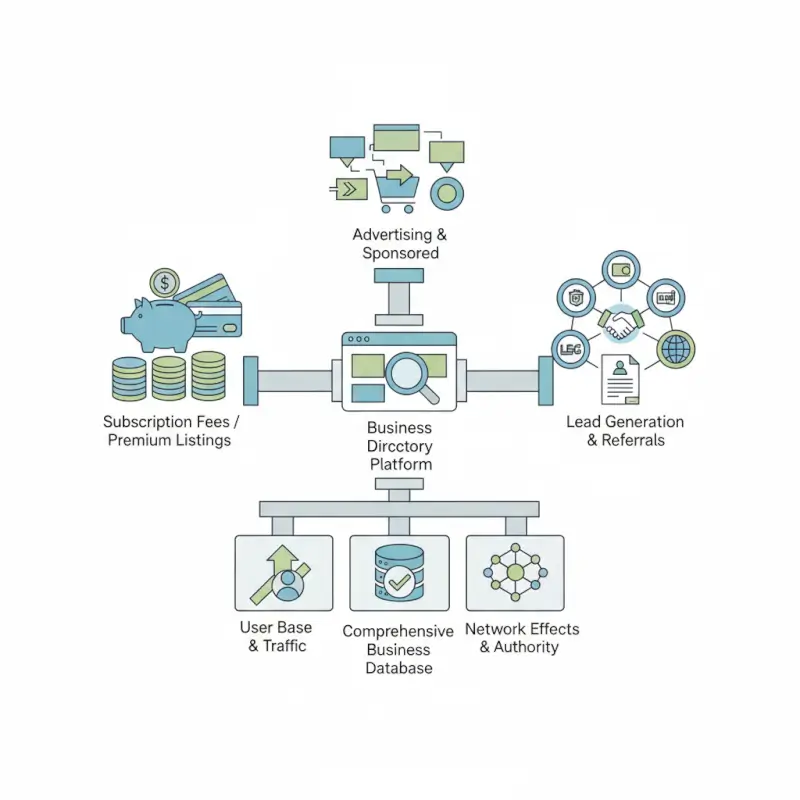
What separates successful directories from struggling ones is the tier structure. A directory website that monetizes effectively typically offers 3-4 distinct tiers—from basic enhanced listings ($20-50/month) to featured placements with lead-forwarding and analytics ($200-500/month). The psychology here matters: businesses don’t just buy visibility, they buy competitive advantage over peers in the same category. When a roofing contractor sees their competitor’s logo appearing first with a verified badge, the decision to upgrade becomes defensive as much as offensive.
Subscription models create predictable revenue that advertising alone cannot match. A directory with 500 premium subscribers at an average $75/month generates $37,500 in monthly recurring revenue—$450,000 annually—before adding any other income stream. Compare that to ad-dependent sites where CPM rates fluctuate and traffic seasonality creates feast-or-famine cycles. I remember talking to a local directory operator who switched from annual listings ($200 one-time) to monthly subscriptions ($25/month); his year-two retention jumped from 42% to 78% because the psychological commitment felt smaller, even though customers paid $300 annually.
Tiered Listings, Featured Placements, and Subscription Models
The mechanics of tiered pricing deserve attention because they directly impact lifetime customer value. Basic tiers remove restrictions (character limits, image counts) while mid-tiers add prominence (category featured spots, homepage rotation). Top tiers bundle services: professional photography, SEO optimization, monthly performance reports. Statista research on SaaS pricing shows that three-tier structures optimize conversion, with 60-70% of paying customers choosing the middle option.
Featured placements operate differently—they’re often sold as add-ons rather than tier upgrades. A business might maintain a mid-tier listing but pay extra for homepage visibility during peak season (think HVAC companies buying summer prominence). This creates upsell opportunities without forcing full tier upgrades. Smart directories also offer geographic featured placement, letting a plumber dominate their specific zip code rather than competing citywide, which feels more attainable and cost-effective for smaller operators.
User Value Signals and Trust as Monetization Accelerants
Trust signals transform commodity listings into premium products worth paying for. Verification badges confirming business licenses, insurance, or background checks let directories charge 40-60% more for premium tiers, according to industry commentary from platforms like TurnKey Directories which specializes in WordPress business directory solutions. The verification isn’t just a badge—it’s permission to filter searches to “verified only,” making unverified businesses functionally invisible to quality-conscious users.
Review integrity matters more than review volume. Directories that actively moderate reviews, flag suspicious patterns, and showcase response rates create environments where businesses want to participate at premium levels. When a contractor sees their 4.9-star rating with verified reviews appearing above a competitor’s unverified 5.0 score, the value proposition clicks. This is why free business directory submissions serve as lead-generation for premium upsells rather than the end product.
Advertising and Display Revenue (Strategic Ad Inventory)
Display advertising represents the second major revenue pillar, but directory ad inventory operates under different economics than content sites. Directories sell intent-based impressions—users actively searching for services—which command CPMs 3-5x higher than passive content browsing. A home services directory showing ads to users searching “emergency plumber” can charge $25-40 CPM versus $6-10 CPM for general news sites, according to Federal Trade Commission guidance on digital advertising markets.
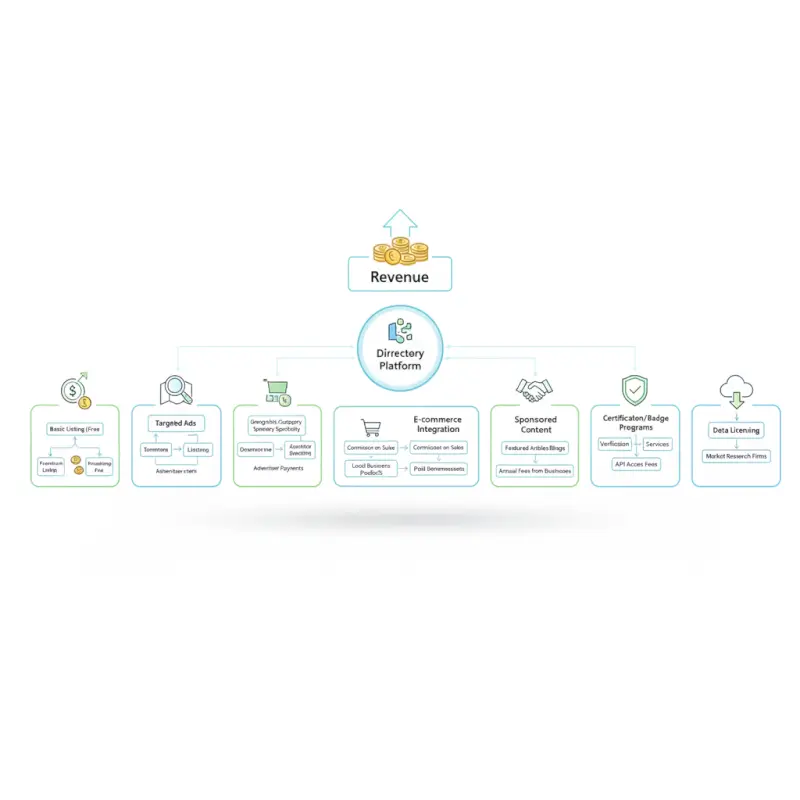
The challenge is balancing ad revenue against user experience. Directories that plaster banners across every page might generate short-term revenue but tank engagement metrics that drive organic growth. The smart play? Context-aware placement where ads feel like additional options rather than interruptions. When someone searches “wedding photographers in Austin,” a sponsored listing from a related vendor (videographer, venue, florist) adds value rather than annoyance. This is fundamentally different from forcing irrelevant programmatic ads into the layout.
Sponsored content—paid articles, guides, or featured posts—bridges advertising and editorial in ways that benefit all parties. A roofing materials supplier might sponsor a “Complete Guide to Roof Replacement” on a contractor directory, reaching the exact audience that specifies products. These placements typically command $500-2,000 per piece depending on traffic and audience quality, with the added benefit of SEO value and permanent visibility rather than impression-based decay.
Banner/Display Advertising, Network Ads, and Sponsored Content
Network ads (Google AdSense, Media.net) provide baseline revenue for directories still building direct advertiser relationships. The math is straightforward but rarely impressive: a directory pulling 100,000 monthly pageviews with $8 RPM generates about $800/month—helpful but not transformative. The real opportunity emerges when you transition those impressions to direct-sold inventory at $25-40 CPM, potentially 3-5x the revenue from identical traffic. Many established directories still use network ads to monetize remnant inventory (pages that don’t sell out) while reserving prime placements for direct deals.
Banner positioning affects yield dramatically. According to testing discussed in directory platform research, top-of-search-results banners convert 6-8x better than sidebar placements, justifying premium pricing for that specific inventory. Similarly, category page sponsorships (where one advertiser owns all ad space in “Plumbing” for a month) command premiums because they eliminate competitive clutter and create category ownership perception.
Performance-Based and Context-Aware Advertising
CPC (cost-per-click) models shift risk from advertiser to directory, which works when your traffic converts. A legal directory might charge $5-15 per click to law firms because those clicks represent genuine case inquiries worth hundreds or thousands in fees. The directory assumes the risk that users won’t click, but benefits from highly qualified traffic that clicks at 2-4% rates versus 0.3% on display networks. This performance alignment often leads to longer advertiser relationships because ROI is transparent and measurable.
Context targeting goes beyond basic category matching. Sophisticated directories use search query data, user behavior patterns, and seasonal trends to optimize ad delivery. A directory tracking search volume for “roof leak repair” can alert roofing advertisers to bid higher during storm season or in zip codes with recent weather events. Geographic and temporal targeting like this, increasingly common in B2B directory platforms, turns advertising from spray-and-pray into precision lead generation that justifies premium CPCs.
Lead Generation, Deals, and Partnerships (Direct Monetization of Connections)
Beyond passive advertising and subscription models, directories can actively monetize every connection they facilitate between businesses and customers. Lead generation transforms directory traffic into quantifiable, billable interactions—quote requests, contact form submissions, phone calls, and booking inquiries. This model aligns revenue directly with value delivered: businesses pay only when they receive a qualified lead, making it easier to justify ROI and maintain long-term relationships.
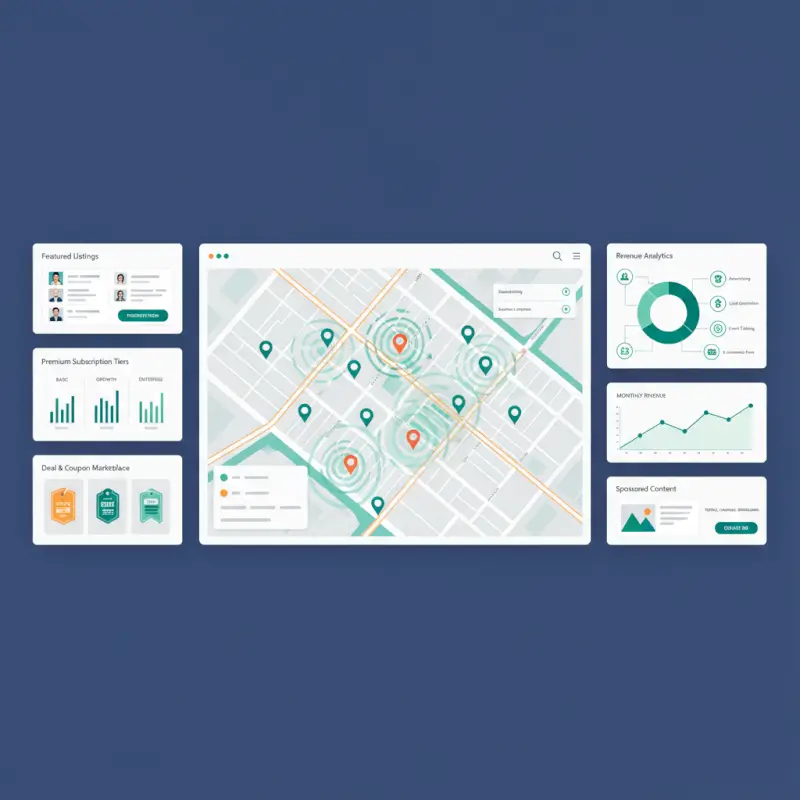
Pay-per-lead pricing varies widely by industry and lead quality. In competitive sectors like home services, legal consulting, or B2B software, directories can charge $10 to $200+ per lead, depending on conversion likelihood and customer lifetime value. Some platforms offer tiered lead packages—businesses purchase monthly credits or subscribe to lead bundles, smoothing revenue while incentivizing ongoing engagement. Advanced directories filter leads by geography, project size, urgency, and budget, ensuring that premium subscribers receive the highest-intent prospects first.
Affiliate and referral partnerships extend monetization beyond direct lead sales. Directories earn commissions by integrating booking engines, payment processors, scheduling tools, or third-party service marketplaces directly into listing pages. For example, a restaurant directory might embed reservation widgets and earn a percentage of each completed booking; a B2B directory could partner with CRM or invoicing software and collect recurring affiliate fees. These arrangements require minimal overhead once integration is complete, and they compound as traffic and listing volume grow.
The strategic advantage of lead-gen and partnerships is alignment of incentives: the directory, the listed business, and the end user all benefit when a transaction occurs. This triple win encourages businesses to invest in premium placements and verified profiles, knowing that higher visibility translates to more qualified leads. It also allows directories to capture value from users who might never click an ad or upgrade a listing but who actively seek service providers through the platform.
| Lead-Gen Model | Typical Pricing | Best Use Case |
|---|---|---|
| Pay-per-lead | $10–$200+ per qualified lead | High-value services (legal, home improvement, B2B) |
| Lead bundles/credits | Monthly subscription + per-lead fee | Directories with steady lead volume |
| Affiliate/referral | 5–20% commission per transaction | Booking platforms, SaaS integrations |
| Click-to-call | $2–$50 per call | Local services, urgent needs (plumbing, locksmiths) |
Lead-Gen Fees and Pay-Per-Lead Models
Pay-per-lead models shift risk from the business to the directory: companies pay only when they receive a contact request, quote inquiry, or other actionable signal. This performance-based approach is especially attractive to small and mid-sized businesses that lack large marketing budgets or struggle to measure ROI from traditional advertising. Directories that invest in lead-quality filters—verifying contact information, tracking bounce rates, and monitoring conversion outcomes—can command higher per-lead fees and build reputation as trusted demand-generation partners.
Many directories use lead-routing algorithms to match inquiries with the most relevant or highest-paying subscribers. A tiered system might send the first response opportunity to a platinum member, the second to gold, and overflow leads to standard subscribers. This hierarchy encourages upgrades while ensuring that every lead is monetized. Transparency is critical: businesses expect clear reporting on lead volume, source, and quality, so robust analytics dashboards and CRM integrations are often required to maintain trust and renewals.
Some platforms bundle lead credits into subscription packages, allowing businesses to pre-purchase a monthly allocation at a discounted rate. This hybrid model stabilizes cash flow for the directory and reduces per-lead cost for the business, creating a win-win. Over-allocation fees or pay-as-you-go top-ups provide additional revenue during high-demand periods, while usage data helps directories forecast capacity and optimize pricing seasonally.
Affiliate and Referral Partnerships
Affiliate arrangements let directories monetize user intent without directly selling services. By embedding booking widgets, payment gateways, or third-party tools into listing pages, directories earn a commission every time a user completes a transaction through an integrated partner. For example, a travel directory might partner with hotel booking engines; a healthcare directory could integrate appointment-scheduling software. These integrations add convenience for users, increase listing value for businesses, and generate passive, recurring revenue for the directory with minimal incremental cost.
Referral partnerships often extend to complementary service providers—web designers, SEO agencies, payment processors, or business insurance brokers. The directory promotes these partners to its listed businesses, earning a fee or revenue share for each referral that converts. This ecosystem approach deepens engagement and positions the directory as a comprehensive business resource, not just a listing platform. High-quality referral partners also enhance the directory’s reputation, driving retention and word-of-mouth growth.
To maximize affiliate and referral revenue, directories should track attribution carefully and negotiate performance-based terms that align with user behavior. Cookie-based tracking, UTM parameters, and dedicated landing pages help prove ROI to partners and justify higher commission rates. Transparency in reporting—showing partners exactly how many clicks, sign-ups, or transactions originated from the directory—builds trust and supports long-term collaboration.
Data, Insights, and Data Licensing (Value from Directory Data)
Every interaction on a directory—searches, clicks, reviews, contact requests—generates behavioral and transactional data that can be packaged, analyzed, and sold. As directories accumulate millions of listings and user sessions, this data becomes a strategic asset with applications far beyond internal optimization. Market researchers, investors, software vendors, and government agencies increasingly seek curated, anonymized datasets to inform investment decisions, product roadmaps, and policy development. Data monetization transforms passive user activity into a high-margin, scalable revenue stream.

Directories can offer tiered data products: basic market reports (category trends, regional growth rates) sold as downloadable PDFs; premium analytics dashboards with real-time filters and export capabilities; and enterprise API access for partners who want to integrate directory data into their own platforms. Pricing varies by granularity, frequency, and exclusivity—aggregate trend reports might sell for hundreds of dollars, while custom data feeds command thousands per month. Because data collection is a byproduct of normal operations, incremental costs are low, making data licensing one of the most profitable revenue streams at scale.
Privacy and compliance are non-negotiable: directories must anonymize personally identifiable information (PII), honor user consent preferences, and adhere to regulations like GDPR, CCPA, and sector-specific standards. The Federal Trade Commission provides guidance on consumer data practices, and directories should consult legal counsel before launching data products. Ethical data stewardship enhances brand trust and reduces regulatory risk, allowing directories to monetize insights without compromising user privacy or business relationships.
Beyond direct sales, data can power value-added services such as competitive benchmarking, SEO audits, or reputation monitoring. Directories might offer listed businesses a monthly “market position report” showing how their listing performs relative to competitors, which keywords drive the most traffic, and where reviews rank them in local search. These insights justify premium subscriptions and create upsell opportunities, while the underlying data infrastructure supports multiple revenue streams simultaneously.
Data-Driven Insights and Market Intelligence Offerings
Market intelligence products transform raw directory data into actionable business insights. For example, a B2B directory tracking software vendors can publish quarterly reports on adoption trends, pricing changes, and feature gaps across verticals. Investors use these reports for due diligence; product managers reference them for roadmap planning; marketers leverage them for positioning and messaging. By curating high-quality, category-specific intelligence, directories position themselves as authoritative industry sources and command premium pricing for reports, webinars, and consulting engagements.
Interactive dashboards offer a higher-margin alternative to static reports. Subscribers access real-time filters—geography, category, listing tier, review sentiment—and export custom datasets for their own analysis. This self-service model reduces directory overhead while maximizing perceived value: users pay for flexibility and depth, not just pre-packaged insights. Freemium tiers with limited filters and date ranges can drive trial adoption, while enterprise plans with unlimited exports and API access generate recurring, high-value contracts.
Directories can also monetize predictive analytics and trend forecasting. By applying machine learning to historical search and listing data, platforms can predict category growth, seasonal demand shifts, or emerging service niches. These forecasts are especially valuable to franchisors, investors, and economic development agencies. McKinsey research on data monetization highlights that organizations capturing predictive insights command significantly higher pricing than those selling historical datasets alone.
Data Licensing to Partners and Researchers
Data licensing agreements grant third parties ongoing access to directory datasets for a recurring fee or one-time payment. Common licensees include academic researchers studying local economies, software vendors enriching their own databases, and aggregators building meta-platforms. Licensing terms specify data scope (categories, geographies, update frequency), usage rights (internal analysis vs. redistribution), and privacy safeguards. Well-structured agreements protect the directory’s intellectual property while generating predictable, high-margin revenue.
API access is the most scalable licensing model: partners integrate directory data directly into their applications via authenticated endpoints, receiving real-time updates as listings change. Directories charge based on API call volume, data depth, or concurrent users. For example, a mapping platform might license geocoded business listings to power local search features, paying per thousand API requests. This usage-based pricing aligns cost with value and scales automatically as partners grow, creating a compounding revenue stream.
Research institutions and government agencies often seek data for public-interest projects—workforce development, small business support, or urban planning. While these partnerships may carry lower fees or pro-bono terms, they generate positive PR, credibility, and citation in authoritative publications. Directories can structure tiered academic pricing, offering discounted or embargoed access in exchange for co-authorship credit or public acknowledgment. These relationships enhance the directory’s reputation and open doors to grant funding or public-sector contracts.
Data-Driven Services, Bundled Offerings, and Managed Solutions (Value-Add Services)
As directories mature, they often evolve from passive listing platforms into full-service marketing and business-growth ecosystems. Value-added services—SEO optimization, profile audits, review management, photography, and copywriting—allow directories to capture a larger share of each customer’s budget while deepening engagement and retention. These services transform a one-time listing fee into an ongoing partnership, with recurring revenue from managed packages and premium support tiers.

Bundling services with listings creates stickiness: businesses that rely on the directory for multiple functions—visibility, reputation, lead flow, and analytics—are far less likely to churn. For example, a “Platinum Plus” tier might include featured placement, monthly SEO reports, review-response support, and dedicated account management. This all-in-one approach simplifies procurement for customers and increases average revenue per account (ARPA) for the directory. White-label partnerships with agencies or freelancers allow directories to offer services without building in-house teams, maintaining margins while scaling rapidly.
Trust-building features—verified badges, compliance certifications, background checks, and review-integrity tools—command premium pricing because they directly impact conversion and customer confidence. Directories that invest in robust verification processes can charge businesses for trust signals that differentiate them from competitors. For users, these signals reduce decision friction and increase transaction velocity; for businesses, they justify higher subscription costs and deliver measurable ROI through improved lead quality and close rates.
Managed solutions extend the service model to done-for-you offerings: the directory handles listing creation, optimization, ongoing updates, and performance reporting on behalf of the business. This concierge approach appeals to time-constrained owners and large franchises managing hundreds of locations. Pricing is typically monthly retainer-based, with tiered packages by listing count, service complexity, and reporting frequency. Managed services generate high lifetime value (LTV) and foster long-term relationships that survive market downturns and competitive pressure.
| Service Type | Typical Pricing | Core Benefit |
|---|---|---|
| SEO audit & optimization | $99–$499/month | Improved organic visibility, higher listing rank |
| Review management | $49–$299/month | Faster response, reputation protection |
| Professional photography/video | $199–$999 one-time | Higher engagement, better first impressions |
| Verification/background checks | $50–$200/year | Trust badge, compliance, user confidence |
| Managed listing service | $199–$999/month | Hands-off, ongoing optimization, reporting |
White-Label Services, Managed Listings, and Ancillary Offerings
White-label partnerships allow directories to offer professional services without hiring specialized staff. By partnering with SEO agencies, content writers, photographers, or developers, directories can resell these services under their own brand, capturing margin while delivering expert execution. Customers benefit from one-stop convenience; the directory benefits from recurring service revenue and deeper customer lock-in. Clear service-level agreements (SLAs) and quality control processes ensure consistent delivery and protect the directory’s reputation.
Managed listing services take the burden off business owners by handling all aspects of profile maintenance: updates, photo uploads, review monitoring, and performance reporting. This done-for-you model is especially attractive to multi-location brands, franchises, and enterprises that lack centralized marketing teams. Directories can charge per location or offer volume discounts for large portfolios, creating predictable monthly recurring revenue (MRR) that scales with customer growth.
Ancillary offerings—event listings, job boards, e-commerce storefronts, or webinar hosting—expand the directory’s value proposition and open new revenue streams. For example, a local business directory might charge for premium event placement or sponsor a community job fair. These add-ons diversify income sources and increase time-on-site, which in turn boosts ad impressions and lead-generation opportunities. Bundling ancillary services into tiered packages simplifies pricing and encourages customers to upgrade for the full suite of tools.
Premium Experiences and Trust-Building Features (Verification, Reviews Integrity, Compliance Tools)
Trust signals are conversion accelerators: verified badges, third-party certifications, and transparent review processes reduce buyer hesitation and increase inquiry rates. Directories can monetize verification by charging businesses an annual fee for background checks, license validation, or insurance confirmation. These checks protect end users from fraud and substandard service, while businesses gain a competitive edge through visible trust markers. The directory benefits from higher listing quality, reduced liability, and the ability to command premium pricing for verified placements.
Review-integrity tools—automated fraud detection, moderation workflows, and verified-purchase badges—preserve platform credibility and user trust. Directories that proactively police fake reviews and reward authentic feedback can charge businesses for enhanced review features: priority review requests, review-response templates, or sentiment analytics. Maintaining a clean, trustworthy review ecosystem attracts more users, which drives listing demand and justifies higher advertising and subscription rates.
Compliance tools help businesses meet regulatory requirements—accessibility standards, data privacy, industry certifications—and directories can package these as premium features. For example, a healthcare directory might offer HIPAA compliance checklists and audit logs; a financial-services directory could provide AML (anti-money laundering) verification. These features reduce customer risk and position the directory as a strategic partner, not just a marketing platform. By aligning services with customer needs and regulatory trends, directories create durable, high-margin revenue streams that resist commoditization.
Frequently Asked Questions
How do business directories typically make money?
Business directories generate revenue through multiple streams: premium listings with enhanced visibility, paid placements, display advertising, lead generation fees, affiliate partnerships, and data licensing. The most successful directories layer these streams rather than relying on a single model, creating predictable recurring revenue and resilience against market fluctuations.
What is the difference between a premium listing and a sponsored listing?
Premium listings are ongoing subscription enhancements that improve a business’s profile visibility, features, and ranking within the directory. Sponsored listings are paid placements that position a business prominently in search results or category pages, often priced by impressions or clicks, delivering immediate visibility boosts.
Can directories license their data to third parties?
Yes, data licensing represents an increasingly valuable revenue stream for established directories. Aggregated listing data, market trends, category insights, and API access can be licensed to researchers, service providers, and partners. This high-margin stream requires substantial data quality and volume to attract enterprise buyers.
Are directory revenue streams affected by market cycles?
Directory revenue is sensitive to economic conditions, particularly advertising and premium listing renewals. Successful directories diversify across multiple streams to weather downturns, shifting emphasis from upfront fees to recurring subscriptions, performance-based advertising, and data services that maintain value even when discretionary spending contracts.
What metrics indicate a successful directory monetization strategy?
Key performance indicators include annual gross revenue, revenue mix across streams, subscription retention and churn rates, lead conversion percentages, and data licensing growth. Healthy directories show balanced diversification, with no single stream accounting for more than 50% of total revenue, and year-over-year growth in recurring revenue.
What role do trust signals play in directory monetization?
Verification badges, review integrity systems, and compliance tools elevate perceived listing value and user engagement. These trust signals justify premium pricing for enhanced placements, reduce churn by demonstrating quality, and attract advertisers seeking high-intent audiences. Trust infrastructure becomes a competitive moat that supports higher monetization across all revenue streams.
Should new directories focus on one revenue stream or multiple?
New directories should start with one core stream—typically premium listings or advertising—to establish product-market fit, then layer additional streams as traffic and data assets grow. Early diversification dilutes focus, but mature directories benefit from three to five complementary streams that balance predictability, scalability, and margin.
How do directories price premium listings and subscriptions?
Pricing depends on audience size, niche competitiveness, and feature depth. Common models include tiered monthly subscriptions ranging from $25 to $500, annual packages with discounts, and dynamic pricing based on category demand. Testing and iteration guided by conversion data and competitor benchmarks refine pricing over time.
Building Your Multi-Stream Monetization Engine
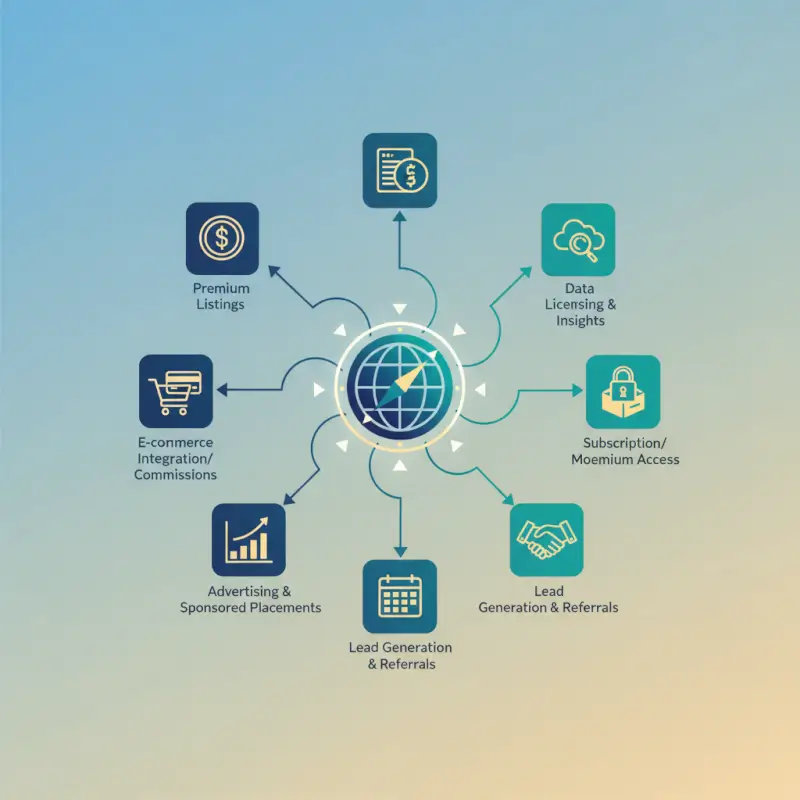
The most resilient business directories treat monetization as an interconnected ecosystem, not a single revenue lever. Premium listings and subscriptions provide the predictable foundation. Display advertising and sponsored content scale with traffic. Lead generation and affiliate partnerships monetize connections directly. Data licensing unlocks high-margin opportunities from aggregated insights. Value-added services and managed solutions command premium pricing by solving real business problems.
Each stream reinforces the others. Trust signals justify higher subscription tiers. Rich data attracts licensing partners. Quality traffic improves ad yield. Engaged businesses renew and upgrade. The compounding effect of layered revenue streams creates defensibility that single-model directories struggle to replicate.
Your next step is deliberate architecture. Map your current traffic, data assets, and user behavior against the six revenue streams outlined here. Identify the one or two streams where you have immediate traction, then design a roadmap to layer complementary models over the next 12 to 24 months. Focus on streams that align with your audience’s needs and your operational strengths.
Diversification is not dilution—it’s insurance and opportunity. The directories that thrive through market cycles are those that build multiple revenue engines early, test pricing and packaging relentlessly, and invest in the trust infrastructure that makes premium monetization sustainable. Start with one stream, master it, then methodically add the next.
Ready to Diversify Your Directory Revenue?
Audit your current monetization mix, identify gaps, and design a layered revenue strategy that balances predictability with growth. The most successful directories don’t rely on a single stream—they build an ecosystem.
Start by mapping your traffic and data assets to the six revenue streams covered in this guide, then prioritize the two or three streams that align with your strengths and market opportunity.
Was this article helpful?