
Small Business Directory: 5 Reasons to Get Listed Today
Opens a Google-translated copy of this article in a new tab.
Most small business owners think their website is enough to get found online. Here’s the uncomfortable truth: your beautiful website might as well be invisible if it’s not backed by a strategic directory presence. I learned this the hard way when a client’s $15,000 website redesign generated exactly zero new customers in its first three months – until we spent an afternoon getting her listed in the right directories. Within two weeks, she had her first Google Maps inquiry. Within a month, she was booked solid.
Business directories aren’t relics from the Yellow Pages era – they’re the connective tissue of local search. According to U.S. Census small business data, businesses with consistent directory listings see measurably higher engagement rates than those flying solo with just a website. The difference? Directories put you exactly where high-intent customers are already looking.
TL;DR – Quick Takeaways
- Visibility multiplier – Directory listings create multiple discovery points beyond your website
- Local SEO foundation – Consistent citations dramatically improve local search rankings
- Trust signals – Third-party validation through reviews builds instant credibility
- High-intent traffic – Directory visitors are actively searching, not passive browsers
- Cost advantage – Free or low-cost compared to paid advertising with comparable results
Why Directory Listings Matter More Than Ever in 2025
The local search landscape has fundamentally shifted. Google Business Profile (formerly Google My Business) dominates local discovery, but it’s just one piece of a larger ecosystem. Smart businesses understand that directory presence is about creating a web of interconnected citations that reinforce each other and compound your visibility.
According to BrightLocal’s SMB Marketing 2025 research, consumers check an average of 4-6 different sources before choosing a local business. If you’re only on one platform, you’re invisible to everyone whose research path doesn’t cross yours. The businesses winning local search are the ones showing up consistently across the platforms their customers actually use.

Think of directory listings as your business’s references on a job application. One reference might get questioned, but five consistent references from reputable sources? That’s credibility you can’t buy with advertising dollars.
How Directories Work With Google Business Profile
Google Business Profile is non-negotiable, but it’s most powerful when supported by a network of consistent directory listings. Google’s algorithm cross-references your business information across hundreds of sources. When it sees identical NAP (Name, Address, Phone) data on Yelp, Yellow Pages, Better Business Bureau, and industry directories, it gains confidence that your business is legitimate and accurately represented.
This citation consistency directly impacts your visibility in the local pack – those three businesses displayed prominently at the top of local search results with map pins. Getting into that local pack is worth more than ranking #1 in organic results below it, because the local pack captures the majority of clicks for local-intent searches.
The Trust Signal Ecosystem
Reviews scattered across multiple platforms create a trust ecosystem that’s nearly impossible to fake. A business with 50 reviews on Google, 30 on Yelp, 20 on industry-specific directories, and consistent 4.5+ star ratings across all platforms? That’s a business consumers feel safe choosing, even if they’ve never heard of it before.
Single-platform review profiles look suspicious by comparison. Savvy consumers wonder: “Why do they only have reviews on their own website?” or “Why are all their reviews on just one platform?” Distribution of social proof across independent third parties is what makes it truly credible.
5 Compelling Reasons to Get Listed Today
Let’s cut through the theory and get to what actually happens when you implement a strategic directory presence. These aren’t abstract benefits – they’re measurable business outcomes I’ve watched dozens of small businesses achieve.
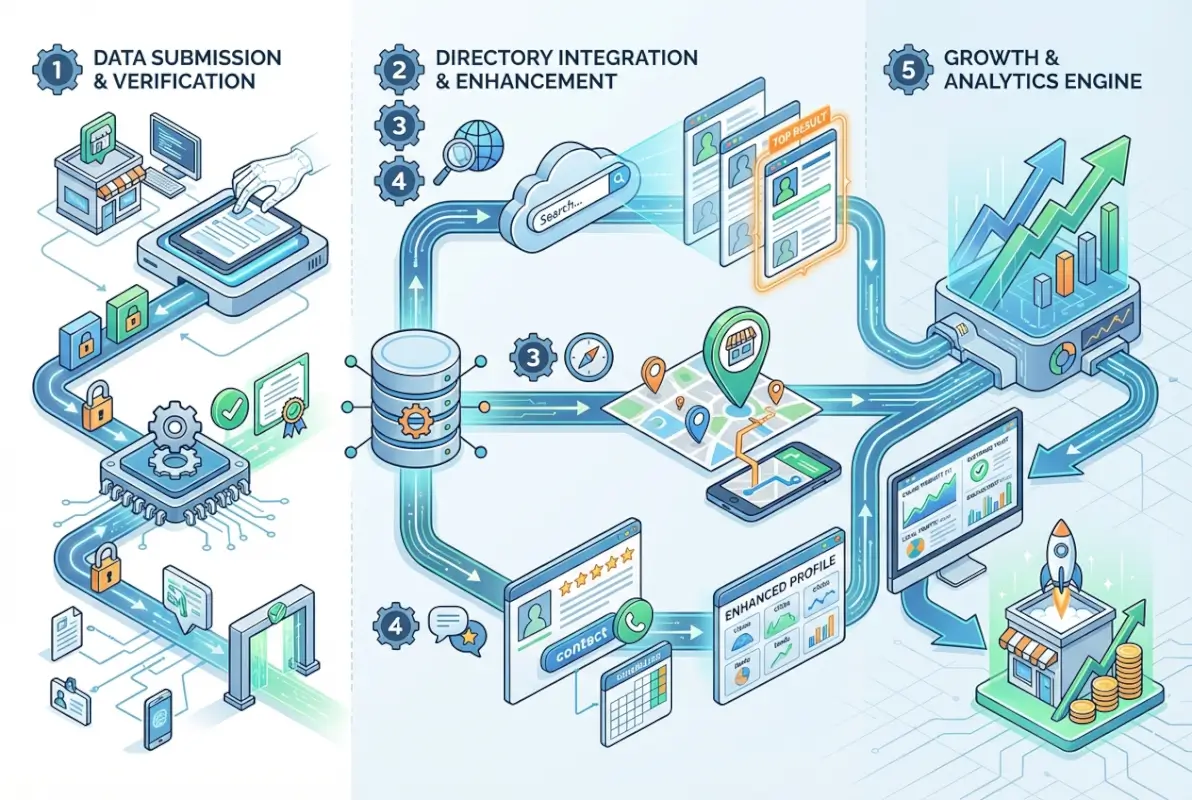
1. Multiply Your Local Discoverability
Every directory listing is another door customers can walk through to find you. When someone searches “emergency plumber near me” at 11 PM with a flooded basement, they’re not conducting careful research – they’re clicking the first credible option they find. Being present on the platform they happen to check first is the difference between winning or losing that customer.
Directory listings also capture people at different stages of the research process. Someone just starting to explore options might browse Yelp categories. Someone comparing specific businesses might use Google Maps. Someone looking for verified credentials might check the Better Business Bureau. You want to be visible at every stage of that journey.
2. Build Unshakeable Credibility Through Social Proof
Third-party validation carries exponentially more weight than anything you say about yourself. When potential customers see your business listed and reviewed on established platforms, it answers their biggest unspoken question: “Can I trust these people?”
According to recent Google Business Profile statistics, businesses with complete listings including reviews receive significantly more direction requests, website clicks, and phone calls than incomplete profiles. The presence of reviews – even just a handful – transforms a listing from an advertisement into a recommendation.
3. Control Your Brand Across Multiple Touchpoints
Directory listings let you control your narrative everywhere customers might encounter your business. Without claimed and optimized listings, you’re letting outdated information, competitor-generated content, or algorithmic guesses represent your brand.
I once worked with a restaurant owner who discovered his Google listing showed permanently closed because a competitor had suggested an edit (which Google accepted). He’d lost three months of potential customers before noticing. Claimed listings with verified ownership give you control and protection against misinformation.
4. Attract High-Intent Traffic Without Advertising Costs
Directory visitors are fundamentally different from general website traffic. They’re actively searching for what you offer, often with immediate purchase intent. Someone browsing “divorce attorney” on Avvo isn’t casually exploring career options – they need legal help now.
This targeted, intent-driven discovery delivers conversion rates that make paid advertising jealous, often at zero ongoing cost. A well-optimized Google Business Profile can generate dozens of monthly inquiries indefinitely without spending a dollar on ads. Try getting that ROI from Facebook advertising.
| Marketing Channel | Avg. Cost Per Lead | Intent Level |
|---|---|---|
| Directory Listings | $0-5 | High |
| Google Ads | $25-150 | Medium-High |
| Facebook Ads | $15-75 | Low-Medium |
| Direct Mail | $50-200 | Very Low |
5. Access Valuable Business Intelligence Data
Directory platforms provide analytics that many small businesses overlook. Google Business Profile shows exactly how people find you (direct searches vs. discovery searches), what actions they take (calls, direction requests, website visits), and how you compare to similar businesses.
This data is gold for refining your marketing. If you notice most calls come on Tuesday mornings, you can ensure adequate staffing then. If direction requests spike but visits don’t follow, maybe your storefront signage needs work. This actionable intelligence typically costs thousands in market research – directories give it to you free.
The Local SEO Impact: How Directories Boost Rankings
Local SEO isn’t mysterious – it’s a system where consistent signals across multiple trusted sources tell search engines your business deserves to rank. Directory listings are the foundation of that signal network.

Citation Building as Ranking Currency
Every directory listing mentioning your business name, address, and phone number is a citation. Search engines use these citations like votes of confidence. Ten consistent citations from established directories carry more weight than a hundred backlinks from random blogs.
What matters most isn’t quantity but consistency and quality. According to current local search trends analysis, businesses with NAP consistency across major directories rank significantly higher than those with scattered or conflicting information.
The Local Pack Algorithm
Getting into the local pack (those three map listings at the top of local searches) requires three primary factors: relevance, distance, and prominence. Directory listings impact all three. They establish relevance through category associations, verify your actual location for distance calculations, and build prominence through review quantity and citation volume.
Businesses in the local pack receive the lion’s share of clicks for local searches – often 40-50% of all clicks from that search. Ranking #1 in regular organic results below the pack doesn’t compare. That makes directory-driven local pack optimization one of the highest-ROI SEO activities possible.
Review Signals and Ranking Velocity
Review volume, recency, and rating quality directly influence local rankings. Businesses actively generating new reviews (especially on Google) see ranking improvements, while those with stagnant review profiles slowly decline relative to competitors.
Directory listings create multiple channels for review generation. Instead of putting all your eggs in the Google basket, you can encourage happy customers to leave reviews on the platform most convenient for them – whether that’s Yelp, Facebook, industry directories, or Google. This diversified review strategy protects you from algorithm changes on any single platform.
Optimizing Your Directory Listings for Maximum Impact
Creating a listing takes ten minutes. Optimizing it for actual business results takes strategic thinking. The difference between mediocre and exceptional directory performance often comes down to execution details most businesses overlook.

The Complete Business Information Audit
Before touching any directory, create your master business data document. This should include your exact business name (no variations), full address formatted precisely how it appears on your storefront and mail, primary phone number, business hours including holidays, service areas if you’re mobile, and primary/secondary business categories.
This document becomes your single source of truth. Every directory listing should mirror it exactly. Store it somewhere accessible to everyone who might update listings (you’d be surprised how often an employee “helpfully” updates information differently across platforms, tanking your citation consistency).
Strategic Description Writing
Most business descriptions are terrible – boring recitations of services that could describe any company in the industry. Your description should accomplish three things: communicate your specific value proposition, include relevant keywords naturally, and give potential customers a reason to choose you over the competition.
For a plumbing company, “We fix pipes” is useless. “24/7 emergency plumbing with 30-minute response times and upfront pricing – no surprises on your bill” tells customers exactly what makes you different. Work in location-specific keywords naturally (neighborhood names, nearby landmarks) to strengthen local relevance signals.
Photography That Converts Browsers Into Customers
Listings with 10+ high-quality photos receive dramatically more engagement than sparse profiles. According to SBA small business research, visual content is increasingly critical for local business discovery and evaluation.
Required photos: exterior (so people can recognize your building), interior (showing your space/ambiance), products or services in action, team photos (people like seeing who they’ll work with), and any relevant credentials or certifications. Real photos always outperform stock images – customers can spot stock photos instantly and they kill credibility.
| Photo Type | Purpose | Recommended Quantity |
|---|---|---|
| Exterior | Location identification | 2-3 |
| Interior | Showcase ambiance | 4-6 |
| Products/Services | Show what you offer | 6-10 |
| Team | Build personal connection | 3-5 |
Category Selection Strategy
Choose your primary category carefully – it determines which searches you’re eligible to appear in. Most directories let you add secondary categories; use all available slots with relevant options, but never choose categories that don’t genuinely describe your business just for visibility. Google penalizes category spam.
For a coffee shop that also sells pastries, “Coffee Shop” should be primary, with “Bakery” and “Cafe” as secondaries. Don’t add “Restaurant” unless you serve full meals – category irrelevance confuses algorithms and customers alike.
Review Generation Systems
Waiting for reviews to happen organically is a losing strategy. Build systematic review requests into your customer journey. The best time to ask is immediately after delivering value – right after closing a successful deal, completing a service, or when a customer expresses satisfaction.
Make it easy: send a text or email with direct links to your directory profiles. Don’t overthink the ask – “We’d love if you could share your experience on Google” works better than elaborate requests. Most happy customers are willing to help if you simply ask and make it convenient.
Choosing Quality Directories Over Quantity
Not all directories deserve your time. Focus your energy on platforms that actually drive results rather than scattering yourself across dozens of low-value sites. Strategic selection beats blanket coverage every time.

Tier 1: Non-Negotiable Directories
Start with the platforms that dominate local search: Google Business Profile (absolute first priority), Bing Places, Apple Maps, and Yelp. These four should be fully optimized before considering anything else. They collectively reach the vast majority of local searchers and carry significant SEO weight.
Add Facebook Business Page to this tier – while not traditionally a “directory,” it functions as one for local discovery and appears in many local search results. The effort-to-impact ratio on these five platforms is unbeatable.
Tier 2: Industry-Specific Authority Directories
After securing the big platforms, identify 3-5 industry-specific directories with genuine authority in your field. For restaurants: TripAdvisor, OpenTable, Zomato. For home services: Angie’s List, HomeAdvisor, Thumbtack. For professionals: Avvo (legal), Healthgrades (medical), Houzz (home design).
These specialized directories attract users with specific, high-intent searches. Someone on Healthgrades isn’t casually browsing – they’re looking for a doctor. That intent focus makes industry directories incredibly valuable despite smaller overall traffic numbers.
Tier 3: Local and Niche Opportunities
Local chamber of commerce directories, neighborhood association listings, and city-specific business directories can provide valuable local SEO signals and community connections. These typically have lower traffic but highly targeted local audiences.
Evaluate these based on domain authority (use a tool like Moz or Ahrefs to check) and actual traffic (do people in your area actually use this directory?). Skip vanity directories that exist solely to sell “premium” listings – they provide zero real value.
The 30/60/90 Day Directory Implementation Plan
Systematic execution beats sporadic effort. Here’s a practical roadmap to build your directory presence without overwhelming yourself or your team.
Days 1-30: Foundation Phase
Week 1: Create your master NAP document and gather all necessary business information (descriptions, categories, photos, hours, service areas). Audit your current directory presence using a tool like Moz Local or BrightLocal to identify existing listings that need claiming.
Week 2: Claim and fully optimize your Google Business Profile. This alone should take 2-3 hours if done properly. Verify your listing, add all business information, upload 15-20 photos, select categories carefully, and write a compelling description.
Week 3: Claim and optimize Bing Places, Apple Maps, and Facebook Business Page using your master NAP document. Ensure absolute consistency across all platforms.
Week 4: Add Yelp and Better Business Bureau. Set up review monitoring so you’re notified immediately when new reviews appear. Implement your review request system.
Days 31-60: Expansion Phase
Weeks 5-6: Research and claim 3-5 industry-specific directories most relevant to your business. Look at where your competitors are listed and which directories appear in search results for your target keywords.
Weeks 7-8: Begin actively generating reviews across your primary platforms. Train staff on when and how to request reviews. Create email/text templates with direct review links. Target 2-3 new reviews per week across various platforms.
Days 61-90: Optimization and Measurement Phase
Weeks 9-10: Add local and niche directories that make strategic sense for your market. Update existing listings with any new photos, expanded service descriptions, or business hour changes.
Weeks 11-12: Review analytics from all major platforms. Identify which directories are driving the most calls, direction requests, and website visits. Double down on what’s working and deprioritize underperformers. Create a maintenance schedule for ongoing updates and monitoring.
Frequently Asked Questions
What exactly is a business directory and why should I list my company?
A business directory is an online platform that lists businesses by category, location, or industry, allowing customers to discover and compare options. Listing your company increases visibility, improves local SEO through citations, builds credibility through reviews, and connects you with high-intent customers actively searching for your services – all typically at minimal or zero cost.
Are business directory listings free, paid, or both?
Most reputable directories offer free basic listings with optional paid upgrades for enhanced features like priority placement, additional photos, or advanced analytics. Start with free listings on major platforms (Google, Bing, Yelp) before considering paid upgrades on directories that prove they drive actual customer inquiries for your business.
How many directories should a small business be listed on?
Focus on quality over quantity. Aim for 5-10 high-authority directories: the major platforms (Google, Bing, Apple Maps, Yelp, Facebook) plus 3-5 industry-specific directories relevant to your business type. Being fully optimized on ten quality directories delivers far better results than scattered, incomplete listings across fifty mediocre ones.
How often should I update my directory listings?
Review and update your listings monthly for the first 90 days to ensure accuracy and add fresh content like photos or service updates. After establishing complete, optimized listings, quarterly audits are typically sufficient unless business information changes (hours, phone number, services offered). Always update immediately when NAP information changes to maintain citation consistency.
How can I measure the impact of directory listings on my business?
Use built-in analytics from platforms like Google Business Profile to track views, clicks, calls, and direction requests. Set up call tracking numbers specific to directory listings to attribute phone inquiries. Monitor website analytics for referral traffic from directories. Track new customer sources during intake (ask “how did you find us?”). Most businesses see clear attribution within 60-90 days.
How do I avoid directory scams and ensure listing legitimacy?
Legitimate directories never demand payment for basic listings or threaten removal for non-payment. Research directory domain authority and user traffic before investing time. Avoid directories that exist solely to sell premium listings or make unrealistic visibility promises. Stick with established platforms (Google, Yelp, industry-recognized directories) and verify legitimacy through reviews from other business owners.
How does a directory listing affect my local SEO and Google Business Profile performance?
Directory listings create citations (NAP mentions) that validate your business location and legitimacy to search engines, directly improving local pack rankings. Consistent citations across authoritative directories reinforce your Google Business Profile credibility. Review volume and distribution across directories serve as prominence signals. Combined, these factors significantly impact your visibility in “near me” and location-specific searches.
What specific data should I provide in a directory listing?
At minimum, provide consistent NAP (name, address, phone), complete business hours including holidays, primary and secondary business categories, a keyword-optimized description (150-300 words), website URL, and 10-15 high-quality photos. Additionally include: payment methods accepted, service areas if applicable, social media links, and any relevant certifications or credentials that build trust.
Should I respond to negative reviews on directory listings?
Absolutely respond to every review, especially negative ones. Professional, empathetic responses to complaints demonstrate that you care about customer satisfaction and can actually improve your business’s perception. Address the specific concern, apologize if appropriate, and offer to resolve the issue offline. Prospective customers reading reviews pay close attention to how you handle criticism.
Can I use the same description across all directory platforms?
While maintaining consistent core messaging and NAP data is critical, tailoring descriptions slightly for each platform’s audience can improve effectiveness. Your Google Business Profile might emphasize services most searched on Google, while your industry directory description might highlight credentials valued by that specific audience. Just ensure NAP remains absolutely identical across all platforms to maintain citation strength.
Your Directory Presence Starts Now
The businesses dominating local search in your market didn’t get there by accident. They built systematic directory presence, optimized every listing, and created processes for ongoing maintenance and review generation. The good news? There’s nothing stopping you from doing exactly the same thing, starting today.
Begin with business directory boosts local marketing efforts that deliver measurable results within weeks, not months. Your first three priorities: claim your Google Business Profile, ensure perfect NAP consistency, and start generating reviews from happy customers. Those three actions alone will put you ahead of most local competitors.
Directory marketing isn’t glamorous. It’s systematic, detail-oriented work that requires consistency and follow-through. But here’s what makes it worth every minute: it actually works. While competitors dump thousands into Facebook ads that generate vague “brand awareness,” you’ll be answering calls from customers who found you through directories and are ready to buy.
The question isn’t whether directory listings will improve your local visibility – the data proves they will. The only question is whether you’ll implement systematically or continue hoping customers somehow find you despite your invisible online presence. For businesses exploring comprehensive directory strategies, understanding business directory website complete guide principles can provide valuable perspective. Those interested in how to start profitable business directory steps can explore advanced implementation. Technical users may find php business directory simple steps useful for custom solutions.
What’s the first directory you’ll optimize this week?
Was this article helpful?