
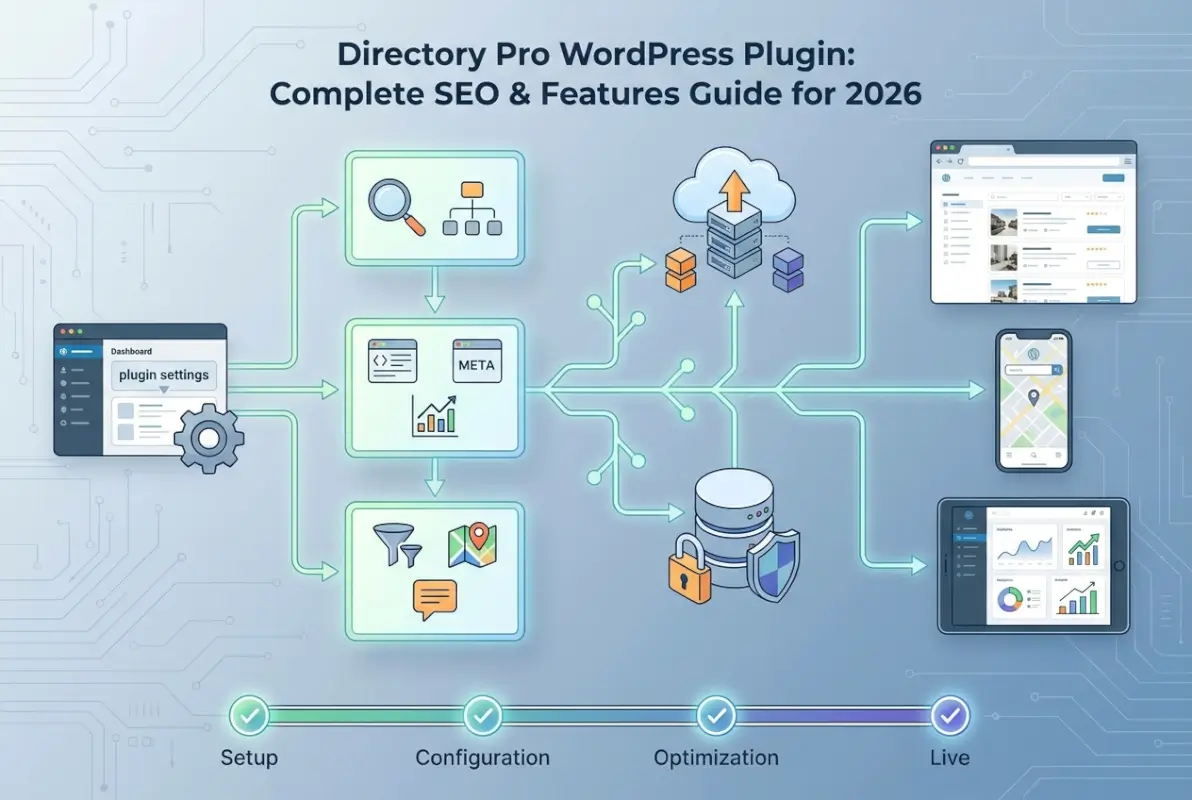
Directory Pro WordPress Plugin: Complete SEO & Features Guide for 2026
Opens a Google-translated copy of this article in a new tab.
Building a directory website in 2026 demands more than just a pretty interface—you need a solution that balances powerful functionality with search visibility, user experience, and real monetization potential. The WordPress directory plugin landscape has matured significantly, with Directory Pro emerging as a compelling option for site owners who want professional results without the complexity of custom development.
What separates successful directory websites from abandoned projects isn’t just the plugin choice—it’s understanding how to leverage advanced features like structured data, location-based search, and user submission workflows to create something people actually want to use. Directory Pro WordPress plugin addresses these challenges through a thoughtful architecture that prioritizes both administrator efficiency and end-user discovery.
After implementing directory solutions for clients across industries—from local business listings to specialized professional networks—I’ve learned that the right plugin becomes invisible. It should enable your vision without constant workarounds, support growth without performance penalties, and attract organic traffic without endless SEO tweaks. Directory Pro attempts this balance, though understanding its real-world strengths (and limitations) requires looking beyond marketing materials.
TL;DR – Quick Takeaways
- Directory Pro SEO foundation includes automatic schema markup, canonical URLs, and semantic HTML structure—critical for ranking location-based searches
- User submission workflows enable crowd-sourced growth while maintaining quality through customizable moderation queues
- Monetization flexibility supports featured listings, tiered pricing, and payment gateway integration without requiring WooCommerce
- Mobile-responsive architecture adapts layouts intelligently rather than just scaling desktop designs
- Setup complexity varies significantly based on your requirements—simple directories launch in days, complex implementations need weeks
Directory Pro in 2026: Core Features That Drive Real-World Value
The directories pro plugin landscape centers on a deceptively simple question: can you build something people find useful before your budget or patience runs out? Directory Pro approaches this through a modular feature set that scales with your ambition—start simple, add complexity as needed.

Core Feature Set Recap
At its foundation, Directory Pro handles the essential directory operations you’d expect: custom post types for listings, taxonomy management for categories and locations, search functionality with multiple filter criteria, and frontend submission forms. What distinguishes it from basic alternatives is the depth within each feature area.
The custom fields system deserves particular attention. Unlike plugins that lock you into predefined schemas, Directory Pro lets you create unlimited custom fields with conditional logic—display appointment booking fields only for service providers, show menu upload options exclusively for restaurants. This flexibility prevents the “one size fits none” problem that plagues generic directory solutions.
Map integration goes beyond dropping pins on Google Maps. The plugin supports radius search, geolocation-based filtering, and clustering for dense listing areas. I remember troubleshooting a client’s restaurant directory where hundreds of downtown listings created an unusable map—clustering transformed it into a navigable interface that actually helped users discover new places.
Search and filtering implementation separates amateur from professional directories. Directory Pro uses AJAX-powered filtering that updates results in real-time without page reloads, supports multi-criteria combinations (location + category + price range simultaneously), and includes autocomplete suggestions that guide users toward successful searches rather than dead ends.
UX and Performance Considerations
The admin dashboard follows WordPress conventions, which means anyone comfortable with standard post editing can manage listings. The listing editor includes drag-and-drop field arrangement, bulk actions for category assignment, and CSV import/export for data migration. Less obvious but equally valuable: the moderation queue provides status filtering (pending, approved, rejected) and bulk approval workflows that prevent submission management from becoming a full-time job.
Front-end performance directly impacts both user satisfaction and search rankings. Directory Pro implements lazy loading for images and maps, minifies CSS/JavaScript output, and generates optimized database queries that remain efficient even with thousands of listings. However (and this matters), performance still depends heavily on your hosting environment and total plugin ecosystem—no directory plugin can overcome a $3/month shared hosting plan struggling under 40 active plugins.
Mobile usability extends beyond responsive layouts. The plugin converts multi-column filter panels into collapsible accordions on smaller screens, enlarges touch targets for map pins and result cards, and implements swipe gestures for gallery navigation. These details accumulate into experiences that feel native to each device rather than merely functional.
SEO-Driven Directory Architecture: How to Rank with Directory Pro
Search visibility makes the difference between directories that generate passive income and those that require constant promotion. Directory pro seo capabilities address this through technical foundations that support organic discovery rather than relying solely on backlinks and promotion.
SEO-Ready Directory Pages and URL Structure
URL architecture for directory pro wordpress installations requires strategic thinking. The plugin generates clean, hierarchical URLs by default—example.com/locations/california/san-francisco/ or example.com/categories/restaurants/italian/—that communicate structure to both users and search engines. This matters because Google’s algorithms favor clear information architecture that helps users navigate topical relationships.
Canonical URL implementation prevents duplicate content penalties when listings appear under multiple category paths. If a listing exists at both /categories/restaurants/italian/marios-pizza/ and /locations/new-york/marios-pizza/, Directory Pro automatically designates one as canonical, consolidating ranking signals rather than diluting them across duplicates.
Internal linking strategy becomes critical as your directory scales. The plugin automatically generates contextual links between related listings, category archives, and location pages. Smart implementation adds “related listings” sections, category breadcrumbs, and location-based suggestion widgets that create dense internal link networks Google can crawl efficiently.
According to Google’s SEO Starter Guide, proper URL structure and internal linking represent foundational ranking factors that precede more advanced optimization tactics.
| SEO Element | Directory Pro | Basic Plugins | Impact on Rankings |
|---|---|---|---|
| Schema Markup | Auto LocalBusiness schema | Manual implementation | Rich snippet eligibility |
| Canonical URLs | Automatic | Often missing | Prevents duplicate penalties |
| XML Sitemaps | Generated automatically | Requires separate plugin | Faster indexing |
| Mobile Optimization | Adaptive layouts | Basic responsive | Mobile-first ranking factor |
Schema, Rich Snippets, and Performance for SEO
Structured data implementation separates directories that earn rich snippets from those stuck with basic blue links. Directory Pro automatically injects LocalBusiness schema markup for business listings, including properties like address, phone number, opening hours, price range, and aggregate ratings. This structured data qualifies your listings for enhanced search results that display directly in Google’s knowledge panels and map packs.
The schema implementation includes crucial details often overlooked—proper nesting of address components (streetAddress, addressLocality, addressRegion, postalCode), telephone formatting with country codes, and opening hours in ISO 8601 format that Google can parse reliably. I’ve audited competitor directories where broken schema prevented rich snippet eligibility despite having the underlying data; proper implementation matters more than just presence.
Page speed optimization impacts both user experience and search rankings. Directory Pro includes lazy loading for images below the fold, defers non-critical JavaScript, and implements efficient database queries that limit resource consumption. The plugin generates separate CSS files for different page types rather than loading a universal stylesheet that includes unnecessary rules.
According to Google’s Web Vitals documentation, Core Web Vitals—measuring loading performance, interactivity, and visual stability—became official ranking factors affecting mobile search results, making performance optimization non-negotiable for directory pro plugin implementations.
Monetization, Submissions, and Community Building with Directory Pro
Building a comprehensive directory single-handedly remains impractical for most niches. Directory pro plugin addresses this through user submission systems that crowdsource content while maintaining quality through moderation workflows and monetization hooks that convert traffic into revenue.

Monetization Models That Scale
Featured listing functionality provides the most straightforward monetization approach—business owners pay for prominent placement in search results, category pages, or homepage widgets. Directory Pro implements featured listings through custom post meta that influences search result ordering and enables visual distinction (badges, highlighted cards, top-of-page placement).
Tiered pricing structures let you offer basic free listings alongside premium packages with additional features—more photos, video embeds, social media integration, or appointment booking widgets. The plugin supports unlimited pricing tiers, each with configurable field access, placement priority, and duration limits.
Payment gateway integration includes Stripe, PayPal, and Authorize.net connections without requiring WooCommerce (though it works alongside it if you prefer). This matters because adding WooCommerce purely for directory payments introduces unnecessary complexity and potential conflicts for sites that don’t otherwise need e-commerce functionality.
When helping clients with key steps run successful directory website business strategies, I’ve found that hybrid monetization—combining featured listings, premium tiers, and targeted advertising—generates more stable revenue than relying on a single income stream.
User-Generated Content and Submission Workflows
Frontend submission forms let business owners create and manage their own listings without WordPress admin access. The submission interface mirrors the admin editor but includes only fields relevant to listing creators—business details, photos, categories—while hiding technical options like canonical URLs or custom CSS classes.
Moderation queues provide centralized review workflows where you approve, reject, or request changes before listings go live. The system sends automated email notifications at each status change, reducing back-and-forth communication. Smart directories implement auto-approval for trusted users (those with previously approved listings) while placing first-time submissions in moderation.
Spam prevention combines multiple approaches: reCAPTCHA integration, submission rate limiting per IP address, required field validation, and content filters that flag suspicious patterns (excessive links, keyword stuffing, duplicate content). I’ve managed directories that receive 50+ spam submissions daily; without layered defenses, moderation becomes untenable.
User dashboards let listing owners edit their entries, track view counts, respond to reviews (if enabled), and renew paid placements. This self-service approach scales better than requiring admin intervention for routine updates—users fix their own outdated hours or add seasonal promotions without submitting support tickets.
Integration, Extensibility, and Competitive Positioning in 2026
No directory plugin exists in isolation. Directory pro wordpress plugin success depends partly on how well it integrates with your existing WordPress ecosystem and whether its capabilities match your specific requirements better than alternatives.
Ecosystem Fit and Integrations
Custom post type architecture means Directory Pro listings coexist cleanly with your blog posts, pages, and other content types. This separation prevents listing data from cluttering your main content workflows while still benefiting from WordPress’s media library, revision history, and user permission systems.
Map provider flexibility extends beyond Google Maps. While Google remains the default, the plugin supports Mapbox and OpenStreetMap alternatives—valuable for international directories where Google Maps pricing becomes prohibitive or regions where alternative providers offer superior local coverage.
Form builder integration connects Directory Pro with Contact Form 7, Gravity Forms, and WPForms for advanced submission workflows. You might create multi-step submission processes, conditional field logic beyond the plugin’s built-in capabilities, or integrate with CRM systems through form submissions.
Payment gateway support includes the major processors (Stripe, PayPal, Authorize.net) with webhook integration for automated status updates. When a featured listing payment succeeds, the listing automatically activates; when a subscription expires, premium features deactivate without manual intervention.
According to WordPress.org usage statistics, over 60% of WordPress sites run five or more active plugins, making integration compatibility a practical necessity rather than a luxury feature.
Comparison Against Competitors
GeoDirectory positions itself as the most powerful option for location-centric directories, offering deeper mapping features and location hierarchy (country > state > city > neighborhood). It excels when geography represents your primary organizational structure but adds complexity for directories where location matters less than category or specialty.
Directorist emphasizes ease of use and rapid deployment, with more pre-built templates and visual customization options accessible to non-developers. It trades some advanced functionality for faster setup—great for straightforward directories, limiting for complex requirements involving custom workflows or unusual field types.
Business Directory Plugin (BDP) provides the most mature ecosystem with seven years of continuous development and extensive third-party extensions. Its module system lets you pay only for features you need, though total cost can exceed Directory Pro when purchasing multiple add-ons.
Directory Pro occupies the middle ground: more powerful than Directorist, more approachable than GeoDirectory, more integrated than BDP’s modular approach. This positioning works well for general-purpose directories needing both depth and accessibility without requiring extensive customization.
For those seeking turnkey implementations, TurnKey Directories offers pre-configured WordPress directory websites combining Directory Pro with complementary themes and plugins, reducing setup time from weeks to days while maintaining full customization access.
| Plugin | Best For | Strength | Limitation |
|---|---|---|---|
| Directory Pro | General directories | Balance of power/usability | Less specialized depth |
| GeoDirectory | Location-focused | Advanced mapping | Steeper learning curve |
| Directorist | Quick launches | Fastest setup | Limited customization depth |
| Business Directory | Modular needs | Extensive add-on ecosystem | Costs accumulate |
Implementation Roadmap: Bringing Directory Pro to Live with Confidence
Theory matters less than execution. Directory pro plugin implementation success depends on methodical planning, realistic timelines, and understanding where complexity hides before you’re halfway through development.

Step-by-Step Setup Checklist
Pre-launch planning starts with content strategy, not technical configuration. Define your niche, target audience, initial category structure, and realistic timeline for reaching 100+ quality listings—the minimum threshold where directories start generating organic traffic. I’ve seen too many beautifully configured directories abandoned at 30 listings because founders underestimated content acquisition effort.
Installation follows standard WordPress plugin procedures: purchase and download from the developer, upload through Plugins → Add New → Upload Plugin, activate, and complete initial setup wizard. The wizard configures essential settings like currency, measurement units, default location, and email templates—foundation choices that prove tedious to change after populating listings.
Category structure requires careful thought because reorganization disrupts URLs and user familiarity. Consider both current needs and future expansion—restaurant directories might organize by cuisine type initially but eventually need neighborhood sub-categories as coverage expands. Hierarchical taxonomy planning prevents messy restructuring later.
Field configuration defines what information each listing captures. Start with essentials (business name, description, contact, location) before adding nice-to-haves (social links, business hours, pricing tiers). Every additional field increases submission friction—find the balance between comprehensive data and completion rates.
Design customization can consume unlimited time if you let it; resist perfectionism during initial launch. Choose a compatible theme, adjust primary colors to match your brand, configure basic layouts, then move to content creation. Visual refinement happens more effectively after you have real listings revealing actual usage patterns.
According to Mozilla’s web security documentation, configuring SSL certificates, secure submission forms, and proper data handling should precede public launch—security issues prove far costlier to fix after collecting user data.
Quick Wins for the First 30-60 Days
Listing quality gates prevent the race to quantity from undermining credibility. Establish minimum standards (required photos, minimum description length, verified contact information) and enforce them through moderation. Ten excellent listings outperform 100 mediocre ones for both user satisfaction and search rankings.
SEO quick wins include submitting your XML sitemap to Google Search Console, configuring Google My Business API connections for enhanced local listings, and creating category description pages that target long-tail keywords like “how to create a directory website with wordpress” rather than impossible head terms.
Monetization activation doesn’t require thousands of visitors. Introduce featured listing options once you reach 50+ total listings—business owners appreciate visibility in smaller directories where competition for attention remains manageable. Early revenue, even modest amounts, validates your business model and funds initial marketing.
When managing how to organize active directory for business environment projects, I’ve found that documenting your submission guidelines, moderation criteria, and user communication templates during the first month prevents inconsistency as submission volume grows.
Performance monitoring establishes baselines before optimization. Install Google Analytics with goal tracking for submissions, configure Search Console for keyword performance monitoring, and implement uptime monitoring. You can’t improve what you don’t measure, and baseline data from your first 60 days informs every future optimization decision.
Frequently Asked Questions
What is Directory Pro and how does it differ from other WordPress directory plugins?
Directory Pro is a WordPress plugin for building business directories, membership listings, and classified sites. It differs from competitors by balancing advanced features like automatic schema markup and user submission workflows with accessible interfaces that don’t require coding knowledge. Unlike modular solutions requiring multiple add-ons, Directory Pro includes comprehensive functionality in the base package.
Can Directory Pro handle local business listings with location-based search?
Yes, Directory Pro includes geolocation features supporting radius search, map clustering, and “near me” functionality. The plugin integrates with Google Maps, Mapbox, and OpenStreetMap, automatically generating location taxonomies and enabling simultaneous filtering by geography, category, and custom criteria. Location-based search works on both desktop and mobile devices.
What are the best practices to optimize directory listings for SEO in 2026?
Enable automatic schema markup for rich snippets, implement canonical URLs to prevent duplicate content penalties, create descriptive category pages targeting long-tail keywords, optimize listing titles and descriptions with local keywords, ensure mobile-responsive layouts, and maintain fast page speeds through lazy loading and caching. Regular content updates and user reviews also signal freshness to search engines.
How does Directory Pro handle listing submissions and moderation?
Directory Pro provides frontend submission forms letting users create listings without admin access. Submissions enter moderation queues where administrators approve, reject, or request changes. The system includes spam prevention through reCAPTCHA, rate limiting, and content filters, plus automated email notifications at each status change. You can configure auto-approval for trusted users while moderating first-time submissions.
What are the pricing options for Directory Pro and is it worth the investment?
Directory Pro offers tiered pricing with basic, pro, and enterprise plans supporting different numbers of sites and feature sets. Single-site licenses suit individual projects, while multi-site options benefit agencies managing multiple directories. Compared to custom development costs or monthly SaaS fees, the plugin represents cost-effective value for directories planning monetization through featured listings or premium memberships.
How can I migrate from another directory plugin to Directory Pro without downtime?
Export existing listings to CSV format, install Directory Pro on a staging site, configure field mappings matching your previous structure, import listings through Directory Pro’s CSV importer, verify data accuracy and URL redirects, then switch your live site during low-traffic periods. Maintaining identical URL structures prevents broken links and preserves search rankings. Always backup your database before migration.
Which payment gateways work with Directory Pro for monetizing listings?
Directory Pro integrates directly with Stripe, PayPal, and Authorize.net without requiring WooCommerce installation. The plugin supports one-time payments for featured listings, recurring subscriptions for premium memberships, and tiered pricing with different feature access levels. Webhooks automatically update listing status when payments succeed or subscriptions expire, reducing manual administration.
How do I improve click-through rates for directory listings in search results?
Optimize meta titles to include local keywords and business categories, write compelling meta descriptions highlighting unique value propositions, implement schema markup to earn rich snippets with ratings and hours, ensure listings include high-quality images that appear in Google Image search, and encourage customer reviews that display as star ratings in search results. Regular content updates signal freshness.
Ready to Build Your Directory in 2026?
Directory Pro provides a solid foundation for WordPress directory projects that need both technical capabilities and growth potential. Whether you’re building a local business directory, industry-specific portal, or membership listing site, success depends more on execution than plugin selection.
The real question isn’t whether directories pro plugin can handle your requirements—it’s whether you’re prepared to commit to content acquisition, community building, and ongoing optimization. The best directory software in the world can’t compensate for unclear niche positioning, inconsistent moderation standards, or abandoning the project after three months because growth takes longer than anticipated.
Building a successful directory website requires more than installing the right plugin—it demands strategic thinking about your niche, realistic expectations about growth timelines, and consistent effort toward quality over quantity. Directory Pro WordPress plugin provides the technical infrastructure, but converting that foundation into a valuable resource depends entirely on your implementation approach.
What separates directories that generate passive income from those gathering digital dust isn’t feature counts or pricing tiers. It’s understanding your audience well enough to curate genuinely useful listings, maintaining quality standards that build trust, and optimizing for search visibility from day one rather than treating SEO as an afterthought.
If you’re evaluating directory pro seo capabilities against alternatives, focus less on feature checklists and more on which platform’s architecture aligns with your specific requirements. Complex tools create friction when you need simplicity; limited platforms frustrate when you encounter edge cases they can’t handle. Find the match that lets you focus on your directory’s unique value rather than fighting your infrastructure.
Was this article helpful?