
7 Best Business Directory Software Solutions for Local Marketing in 2025
Opens a Google-translated copy of this article in a new tab.
Managing your business listings across dozens of online directories isn’t just tedious—it’s a strategic necessity that most companies get wrong. While competitors manually update information across scattered platforms (or worse, ignore directories entirely), smart businesses leverage specialized software to dominate local search results and capture customers at the exact moment they’re searching for services.
The business directory software market has matured dramatically, evolving from simple submission tools into comprehensive platforms that synchronize data across 100+ directories, monitor reviews in real-time, and provide analytics that directly tie directory presence to revenue. For local businesses competing in 2025, the right business directory software isn’t optional—it’s the difference between showing up consistently where customers search versus losing them to better-organized competitors.
What catches most business owners off guard is discovering their “verified” listings contain outdated phone numbers, incorrect hours, or conflicting addresses across different platforms. These inconsistencies don’t just frustrate potential customers; they actively damage your local search rankings as Google interprets conflicting information as a trust signal problem.
TL;DR – Quick Takeaways
- Automated consistency – Business directory software synchronizes your NAP (name, address, phone) across 50-200+ directories simultaneously, eliminating manual updates
- Local SEO impact – Consistent citations across directories account for approximately 10% of local search ranking factors according to industry research
- Review centralization – Top platforms consolidate review monitoring and response across all directories into a single dashboard
- ROI measurement – Modern solutions track which directories generate actual calls, directions requests, and conversions
- Multi-location scaling – Enterprise platforms manage hundreds of locations with templated content and location-specific customization
Understanding Business Directory Software in 2025
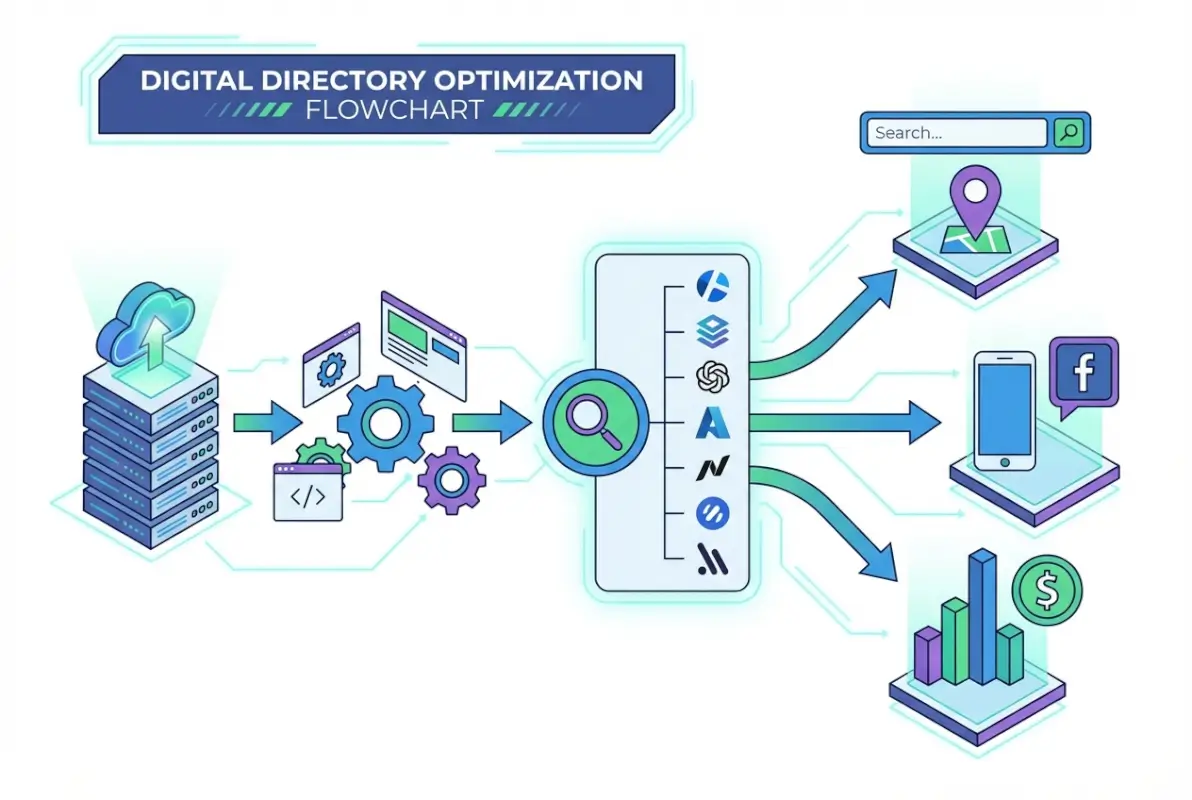
Business directory software serves as your command center for managing how your business appears across the digital ecosystem where consumers search for local services. These platforms connect to major directories like Google Business Profile, Apple Maps, Yelp, Facebook, Bing Places, and industry-specific directories through APIs and data aggregators.
The core value proposition is straightforward: update your business information once, and the software propagates changes across every connected platform automatically. But that’s just the starting point. Modern local business directory software integrates review management, competitive analysis, performance tracking, and increasingly, AI-powered optimization suggestions that help you improve visibility systematically.

Consider how consumers actually find local businesses today. They don’t just search Google—they use Apple Maps for directions, check Yelp for reviews, browse Facebook for hours and photos, ask Siri or Alexa for recommendations, and scroll industry-specific directories when researching providers. If your information is inconsistent across these platforms, you’re essentially competing against yourself, confusing both customers and search algorithms.
I once worked with a dental practice that couldn’t understand why call volume had dropped 30% over six months despite unchanged marketing spend. After auditing their directory presence, we discovered their phone number was incorrect on 34 of 47 directories where they were listed. Potential patients were literally calling a disconnected number. Three weeks after implementing proper directory software and correcting the listings, call volume had recovered completely.
What Separates Basic from Advanced Solutions
Not all business directory software delivers equal value. Basic platforms might connect you to 20-30 major directories and sync NAP information. That’s useful, but limited. Advanced directory listing software offers substantially more capability including real-time synchronization (not monthly batch updates), duplicate listing detection and suppression across the web, rich content management (photos, videos, service menus, attributes), review monitoring with sentiment analysis and automated response suggestions, competitor tracking to benchmark your presence against local rivals, and detailed attribution showing which directories generate actual business results.
The directory software market has consolidated around a few major players while specialized solutions serve specific niches. According to BrightLocal’s research on local search behavior, the platforms that integrate listing management with review generation and response tend to deliver substantially better ROI because they create a virtuous cycle: better listings drive more reviews, which improve rankings, which generate more visibility.
7 Best Directory Software Solutions for 2025
After evaluating dozens of platforms based on directory coverage, automation capabilities, review management, analytics depth, and cost-effectiveness, these seven solutions represent the strongest options for different business scenarios. Your ideal choice depends on factors like business size, number of locations, industry vertical, and whether you need additional marketing capabilities beyond pure directory management.
1. Yext – Best for Enterprise and Multi-Location Businesses
Yext pioneered the “knowledge network” approach to business directory management, connecting businesses to 200+ directories, apps, maps, GPS systems, and voice assistants through a single platform. Their AI-powered system continuously monitors for unauthorized changes to your listings and corrects them automatically—valuable for brands that face frequent spam or competitor interference.
Key Strengths: The platform excels at scale, managing hundreds or thousands of locations with sophisticated hierarchy controls that allow corporate oversight while giving local managers appropriate autonomy. Their knowledge graph technology ensures consistency not just in static information but in understanding relationships between locations, services, and attributes.
Yext’s analytics go deeper than most competitors, tracking not just impressions and clicks but actual conversions tied to specific directories. This attribution capability helps justify ROI for executive stakeholders who need concrete evidence that directory investment generates business results.
Best For: Multi-location businesses (10+ locations), enterprise organizations, franchises, and businesses in competitive markets where maintaining listing accuracy against interference matters. If you’re comparing solutions for enterprise needs, the discussion often comes down to platforms like this versus alternatives.
Pricing: Custom pricing based on location count and feature requirements, typically starting around $199/month for smaller implementations. Enterprise contracts can run substantially higher but include dedicated support and custom integrations.
Limitations: The sophistication and price point can exceed what single-location businesses need. Some users report that the platform’s extensive capabilities come with a steeper learning curve than simpler solutions.
2. BrightLocal – Best for Small to Mid-Sized Businesses
BrightLocal built its reputation on local SEO tools before expanding into comprehensive directory management, and that heritage shows in how tightly the platform integrates listing management with broader local search optimization. For businesses that want to manage directories as part of a holistic local SEO strategy rather than as an isolated task, this integration delivers substantial value.
Key Strengths: The platform combines citation building across 50+ directories with local rank tracking, reputation management, and audit tools that identify specific optimization opportunities. Their reporting is particularly strong for agencies serving multiple clients, with white-label options that allow you to brand deliverables as your own.
BrightLocal’s citation builder doesn’t just submit information—it audits your existing presence first, identifying inconsistencies and duplicates that need correction before building new citations. This cleanup process often delivers the biggest immediate ranking improvements for businesses with messy legacy listings.
Best For: Local businesses with 1-10 locations, marketing agencies managing multiple clients, and businesses that want integrated local SEO tools beyond pure directory management. The listedin business directory key benefits for your business approach aligns well with BrightLocal’s methodology.
Pricing: Plans start at $29/month for single locations, with multi-location packages scaling appropriately. Their track plan ($49/month) adds rank tracking capabilities that provide valuable context for measuring directory impact.
Limitations: Directory network coverage is smaller than enterprise solutions like Yext. Some advanced features like API access are reserved for higher-tier plans.
3. Moz Local – Best for Moz Ecosystem Users
Moz Local takes a streamlined approach focused on ensuring your core business information flows accurately to the major data aggregators (Acxiom, Factual, Infogroup, Localeze) that feed hundreds of downstream directories, apps, and GPS systems. Rather than managing relationships with individual directories, Moz emphasizes getting your data correct at the aggregator level where it has the widest impact.
Key Strengths: The platform’s greatest value comes from integration with Moz’s broader SEO toolkit. If you already use Moz Pro for keyword research, link analysis, and rank tracking, adding Moz Local creates a unified workflow where listing management informs and is informed by your overall SEO strategy.
Their duplicate detection system is particularly sophisticated, identifying variations of your business name or slight address differences that create conflicting citations. The platform then helps you suppress these duplicates systematically rather than just creating new listings that compete with old ones.
Best For: Businesses already using Moz SEO tools, companies that prefer a focused approach over maximum directory quantity, and organizations that value data aggregator relationships over individual directory management.
Pricing: Starts at $129/year per location, making it one of the more affordable options. However, maximum value requires a Moz Pro subscription ($99-$599/month depending on tier).
Limitations: Fewer individual directory connections than competitors. Review management capabilities are basic compared to specialized reputation platforms. Not ideal as a standalone solution for businesses not already in the Moz ecosystem.
4. Semrush Listing Management – Best for Existing Semrush Users
Semrush entered the local listings space by integrating directory management into their already comprehensive digital marketing platform. For businesses already using Semrush for SEO, content marketing, or competitive analysis, adding listing management creates workflow efficiencies that standalone directory tools can’t match.
Key Strengths: The platform connects to 70+ directories and data aggregators while providing deep integration with Semrush’s position tracking, keyword research, and competitive analysis tools. This means you can identify local search opportunities, optimize your listings for those opportunities, and track ranking improvements all within one platform.
Their Google Business Profile management tools are particularly robust, offering post scheduling, Q&A monitoring, and performance analytics that help you maximize the value of your most important listing. Voice search optimization features help ensure your business appears in results when consumers use voice assistants.
Best For: Businesses already invested in Semrush for broader digital marketing needs, companies that want listing management integrated into comprehensive SEO workflows, and organizations focused on voice search optimization.
Pricing: Available as an add-on starting at $20/month per location, but requires a base Semrush subscription ($119.95-$449.95/month). Total cost depends on which Semrush plan you need for non-listing features.
Limitations: Less cost-effective if you only need listing management without other Semrush capabilities. Directory network is smaller than specialized listing platforms. The business directory boosts local marketing approach works best when integrated with other Semrush tools.
5. Birdeye – Best for Review-Centric Businesses
Birdeye approaches directory software from a reputation management perspective, building listing management around robust review generation, monitoring, and response capabilities. For service businesses where reviews significantly influence customer decisions—restaurants, healthcare, home services, automotive—this review-first approach often delivers better results than pure listing platforms.
Key Strengths: The platform excels at generating reviews systematically through text message campaigns, email sequences, and QR codes that make leaving feedback effortless for customers. These reviews flow to your directory listings automatically, creating a consistent positive presence across platforms.
Birdeye’s AI-powered response suggestions help you reply to reviews quickly and appropriately, maintaining engagement even when you’re managing hundreds of reviews monthly. Their competitive benchmarking shows how your review profile compares to local competitors, identifying specific gaps to address.
Best For: Service-based businesses where reputation strongly influences customer choice, multi-location businesses that need centralized review management, and companies that want to use directory presence primarily for reputation building.
Pricing: Custom pricing based on business size and feature requirements, typically starting around $299/month. Higher cost reflects the platform’s comprehensive reputation management capabilities beyond basic listing management.
Limitations: Premium pricing may exceed what businesses need if they’re primarily focused on listing accuracy rather than comprehensive reputation management. Directory network coverage is solid but not as extensive as pure listing platforms.
6. Podium – Best for Customer Communication Integration
Podium differentiates itself by treating directory listings as one component of a broader customer communication platform. The software integrates listing management with text messaging, webchat, payment processing, and review generation into a unified system focused on converting directory visibility into actual transactions.
Key Strengths: The platform’s messaging-first approach means every directory listing becomes a potential conversation starting point. When customers find you on a directory, they can text your business directly, ask questions, book appointments, and even complete payments—all without leaving the conversation thread.
This integration particularly benefits retail and service businesses where immediate communication drives conversions. The ability to accept payments via text message dramatically shortens the time from directory discovery to completed transaction, capturing customers while intent is highest.
Best For: Retail and service businesses that benefit from immediate customer communication, companies wanting to combine directory presence with conversion capabilities, and businesses that prefer text-based customer interaction over phone calls.
Pricing: Custom pricing typically starting at $249/month, reflecting the platform’s comprehensive communication capabilities beyond directory management alone.
Limitations: Higher cost and broader feature set may exceed what businesses need if they’re primarily seeking directory management. The communication-centric approach works best for businesses where immediate customer interaction drives sales.
7. TurnKey Directories – Best for WordPress-Based Solutions
TurnKey Directories takes a fundamentally different approach from cloud-based SaaS platforms by providing WordPress-integrated solutions that give you complete control over your directory infrastructure. Rather than subscribing to an external platform, you build and manage directory functionality directly within your WordPress site with full customization and data ownership.
Key Strengths: The platform offers unmatched flexibility for businesses that want to create their own directory websites rather than just manage listings on external directories. You control the design, functionality, monetization strategy, and every aspect of how your directory operates.

For businesses that want to create industry-specific or location-specific directories as marketing assets or revenue generators, this self-hosted approach provides capabilities that SaaS platforms can’t match. The how to start profitable business directory steps become manageable even for non-technical users through WordPress’s familiar interface.
Best For: Businesses building their own directory websites, organizations requiring complete data ownership and control, WordPress users wanting native CMS integration, and companies creating niche directories as content marketing or revenue strategies.
Pricing: Custom pricing based on specific feature requirements and implementation scope, with one-time licensing options available rather than recurring subscriptions.
Limitations: Requires WordPress hosting and basic technical knowledge for setup. The php business directory simple steps approach still needs some technical comfort, though support is available. This solution serves different needs than typical listing management platforms.
| Platform | Best For | Starting Price | Key Differentiator |
|---|---|---|---|
| Yext | Enterprise & multi-location | ~$199/mo | AI-powered at scale |
| BrightLocal | Small-mid businesses | $29/mo | Integrated local SEO |
| Moz Local | Moz users | $129/year | Aggregator focus |
| Semrush | Semrush users | $20/mo add-on | Marketing integration |
| Birdeye | Service businesses | ~$299/mo | Reputation focus |
| Podium | Retail & service | ~$249/mo | Customer messaging |
| TurnKey | WordPress users | Custom | Self-hosted control |
How to Choose the Right Directory Software for Your Business
Selecting directory software isn’t about finding the “best” platform universally—it’s about identifying which solution aligns with your specific business context, goals, and constraints. The right choice for a single-location restaurant differs dramatically from what a 50-location healthcare system needs, even though both benefit from directory management.

Assess Your Current Directory Situation
Start by auditing your existing directory presence before evaluating software. Search for your business name and city to see where you already appear. Check whether information is consistent across platforms. Note which directories show up in the top 10 results for your primary service keywords plus your location. This baseline reveals whether you need comprehensive cleanup or just ongoing maintenance.
Most businesses discover they have more listings than expected—often 40-60+ across major and minor directories. Many of these contain outdated information, creating the consistency problems that damage local SEO. Understanding your starting point helps you evaluate which platforms offer the cleanup capabilities you need versus just ongoing synchronization.
Define Your Primary Objectives
Different platforms excel at different goals. If your priority is maximum directory coverage to capture every possible discovery channel, enterprise platforms like Yext make sense. If review generation and reputation management matter most, Birdeye’s approach delivers better returns. For businesses wanting directory management integrated into comprehensive digital marketing, Semrush or BrightLocal provide the workflow efficiencies you need.
Be honest about what matters for your business model. A home services company benefits enormously from review generation features because customers heavily weight reputation when choosing contractors. A retail store might benefit more from features that drive foot traffic and enable immediate communication. The business directory website complete guide approach works when aligned with specific business outcomes.
Consider Your Location Count and Growth Plans
Single-location businesses have simpler needs than multi-location operations. But if you plan to expand, choosing software that scales smoothly prevents the painful migration process later. Platforms like Yext and Birdeye excel at managing hundreds of locations with consistent branding but location-specific details. Budget solutions work fine initially but become unwieldy as you add locations.
Consider not just current needs but where you’ll be in 2-3 years. If expansion is planned, the higher initial investment in scalable software often costs less than migrating platforms mid-growth. I’ve seen businesses pay $5,000+ to migrate listing data and reviews when they outgrew initial platforms, negating all the savings from choosing the cheapest option initially.
Evaluate Integration Requirements
Directory software doesn’t operate in isolation. Consider what other tools you use daily and whether tight integrations would save time and improve data consistency. If you’re already invested in Moz or Semrush for SEO, their listing management integrations create workflow efficiencies. If you use specific CRM or marketing automation platforms, check whether your directory software options integrate natively.
According to research from Moz on local business schema and structured data, platforms that integrate well with your existing tech stack deliver better ROI because they reduce manual data entry and the errors that inevitably accompany it.
Calculate Total Cost of Ownership
Don’t evaluate only subscription prices. Factor in setup and onboarding costs, time investment for initial implementation, ongoing management time required, potential agency fees if you outsource management, and costs for additional users or locations beyond base pricing. Some “expensive” platforms actually cost less per location when you factor in time savings and superior automation.
A $299/month platform that requires minimal ongoing management may deliver better ROI than a $49/month solution that demands 10 hours monthly of your time. Calculate the fully-loaded cost including your time at an appropriate hourly rate to make meaningful comparisons.
Implementation Best Practices for Maximum Impact
Choosing software is only the first step. Implementation quality determines whether you’ll actually achieve the visibility improvements and customer acquisition benefits that justify your investment. Rushed implementations that skip critical steps often deliver disappointing results that have more to do with execution than platform capabilities.

Complete Comprehensive Business Information Before Launch
The most common implementation mistake is incomplete business information. Before connecting to any directories, compile complete details including primary business name (exactly as you want it everywhere), full address with proper formatting, primary phone number (use a tracked number if you want attribution data), business categories (primary and secondary), comprehensive business description with relevant keywords, full list of services or products offered, operating hours including special holiday schedules, payment methods accepted, and attribute details (parking, accessibility, WiFi, etc.).
Take time getting this right. Once distributed to 100+ directories, corrections become tedious even with software automation. Establish this as your single source of truth that all platforms will mirror.
Prioritize Directory Cleanup Over New Submissions
If you already have listings (and most businesses do), prioritize identifying and correcting or suppressing them before creating new ones. Duplicate listings compete with each other, diluting your presence rather than strengthening it. Most quality directory software includes duplicate detection—use this capability first.
I watched a retail chain waste three months building new listings before realizing they had dozens of existing duplicates with incorrect information ranking higher in search results. They should have spent those three months cleaning up the mess before building anything new. The cleanup process often delivers bigger immediate ranking improvements than new submissions because it resolves the confusion signals you’re currently sending to search engines.
Optimize for Google Business Profile First
While comprehensive directory coverage matters, Google Business Profile remains the most important single listing for most local businesses. Ensure this listing is 100% complete with every field filled, fully verified through Google’s process, updated with fresh photos at least monthly, actively managed with posts about offers/events, and monitored for questions that need answers.
According to Google’s official business profile guidelines, completeness and activity level significantly influence visibility in local search results. Treat your GBP as your most important directory listing and manage it accordingly.
Establish Review Generation Processes
Directory presence means little without reviews providing social proof and freshness signals. Implement systematic review generation by requesting reviews from satisfied customers within 24-48 hours of transaction, making the review process as frictionless as possible (direct links, not instructions), responding to all reviews—positive and negative—within 48 hours, and monitoring review velocity to ensure consistent flow rather than sporadic bursts.
Most directory software includes review generation tools. Use them consistently rather than sporadically. The businesses that dominate local search typically have review generation built into their standard customer follow-up workflows, not treated as an occasional campaign.
Monitor Performance and Iterate
Track metrics that matter to your business, not just vanity metrics like total citations. Focus on directory-attributed calls and direction requests, conversion rates from directory traffic, ranking improvements for target keywords, review volume and sentiment trends, and NAP consistency scores across your directory network. Most importantly, use these insights to double down on high-performing directories and optimize underperforming ones.
The beauty of modern business listings software is that it provides this attribution data, connecting directory presence to actual business outcomes. Review your analytics monthly and adjust your strategy based on what the data reveals about which directories actually drive customer acquisition in your market.
Frequently Asked Questions
What is business directory software and why do local businesses need it?
Business directory software automates the management of your business listings across multiple online directories, ensuring consistent information everywhere customers might find you. Local businesses need it because maintaining accuracy across 50-100+ directories manually is virtually impossible, and inconsistent information damages both local search rankings and customer trust. The software synchronizes changes across all platforms automatically, monitors for unauthorized changes, and tracks which directories generate actual business results.
How does directory software improve local SEO rankings?
Directory listings create citations (mentions of your business name, address, phone number) that search engines use as trust signals when determining local search rankings. Consistent, accurate citations across authoritative directories signal legitimacy and help search engines confidently display your business for relevant local queries. Research indicates citations account for approximately 10% of local ranking factors. Directory software ensures this consistency automatically while also helping you build citations on directories you might not discover manually.
What’s the difference between directory submission software and listing management software?
Directory submission software focuses primarily on distributing your business information to multiple directories quickly—essentially automation for the initial submission process. Listing management software provides ongoing synchronization, monitoring, and optimization beyond just initial submission. It detects unauthorized changes, suppresses duplicate listings, tracks performance, and manages reviews. Most modern platforms combine both capabilities, but the management features deliver more long-term value than one-time submission alone.
Can small businesses afford quality directory software or is it only for enterprises?
Quality directory software is available at price points suitable for businesses of all sizes. Single-location businesses can find effective solutions starting at $29-50/monthly that provide substantial value through time savings and improved visibility. While enterprise platforms with advanced features cost more, the ROI from proper directory management—increased calls, foot traffic, and conversions—typically far exceeds the subscription cost even for small businesses. The key is choosing software aligned with your specific needs rather than paying for enterprise features you won’t use.
How long does it take to see results from implementing directory software?
Initial results typically appear within 4-8 weeks as corrected information propagates across directories and search engines recrawl and reindex your listings. However, maximum impact develops over 3-6 months as citation consistency strengthens, reviews accumulate, and search algorithms gain confidence in your business information. Businesses with significant existing inconsistencies often see faster initial improvements as cleanup resolves confusion signals. The key is consistent implementation rather than expecting overnight transformation.
Should I manage directories myself or hire an agency?
For most businesses with 1-5 locations, modern directory software is user-friendly enough to manage in-house with minimal time investment after initial setup. Agencies make sense when you have 10+ locations requiring sophisticated management, lack internal marketing resources to handle implementation properly, or want to bundle directory management with broader digital marketing services. Evaluate whether the agency cost exceeds what you’d pay for software plus the value of your time. Many businesses start in-house and move to agencies only as complexity increases.
What happens to my listings if I cancel my directory software subscription?
This varies by platform. Some maintain your existing listings but stop updating them, while others may remove listings they created from certain directories. Review each platform’s policy carefully before committing. Generally, listings you created manually before using the software remain regardless of subscription status. Data you’ve entered into the platform should be exportable, but ongoing synchronization ceases. This is one reason the business directory website complete guide approach of self-hosted solutions appeals to businesses wanting permanent control.
How do I handle multiple locations with different services or attributes?
Quality directory software includes location-specific customization within overall brand consistency. You’ll typically create a master template with brand-level information, then customize services, descriptions, photos, and attributes for each location. Better platforms support bulk updates for company-wide changes while preserving location-specific details. This balance ensures consistent branding across all locations while allowing each to highlight what makes it unique—different services, staff, or features specific to that market.
Can directory software help with review management across multiple platforms?
Yes, most comprehensive directory platforms include review monitoring across all connected directories, presenting them in a unified dashboard. Better solutions offer response capabilities directly from the platform, sentiment analysis showing review trends, competitive benchmarking against local rivals, and automated review generation requests. This centralization is valuable because manually checking reviews across dozens of platforms is impractical. However, review management depth varies significantly between platforms, so evaluate this capability specifically if it matters for your business model.
Is it better to be listed on 100+ directories or focus on the top 10 most important ones?
Quality matters more than quantity, but comprehensive coverage provides benefits if information is accurate. Focus first on ensuring major directories (Google, Apple Maps, Bing, Facebook, Yelp, industry-specific platforms) are 100% complete and accurate. Then expand to secondary directories that provide additional citation diversity. Having 100+ listings only helps if they’re consistent and maintained—inconsistent listings across numerous directories actively harm you. Modern software makes broad coverage manageable by automating updates, so you can have both quality on priority directories and quantity across the broader network.
Take Control of Your Local Market Visibility
The businesses dominating local search results in competitive markets aren’t necessarily better at what they do—they’re better at systematically managing how they appear everywhere customers search. Directory software provides the automation and insights that make this systematic management practical even for small businesses with limited marketing resources.
Your competitors are already using these tools. The question isn’t whether to implement directory software but which solution aligns with your specific business model, growth plans, and marketing ecosystem. Start by auditing your current directory presence to understand what needs fixing. Then evaluate 2-3 platforms using free trials with your actual business data to see which workflow fits best.
The investment you make today in proper directory management compounds over time. Each corrected listing, each new review, each improved ranking creates momentum that becomes increasingly difficult for competitors to overcome. But this only works if you implement consistently rather than treating directory management as a one-time project.
Directory management isn’t glamorous marketing work, but it’s foundational. Get this right and every other local marketing investment you make—paid ads, content marketing, social media—performs better because customers consistently find accurate, compelling information about your business everywhere they look. Get it wrong and you’re essentially competing against yourself, confusing both customers and search algorithms while competitors with better-managed directories capture the customers who should be yours.
Was this article helpful?