How to Monetize a Business Directory: 6 Revenue Streams to Explore

Generating summary...
Building a business directory is one thing—turning it into a predictable revenue machine is another. Most directory owners treat monetization as an afterthought, slapping on a few paid listings and hoping for the best. But the real opportunity lies in layering multiple revenue streams so that when one channel slows, three others keep humming. Think of it this way: the most successful directory platforms don’t just charge for visibility—they monetize every layer of the value they create, from data access to affiliate partnerships to premium services that businesses can’t resist.
If you’re sitting on a directory with decent traffic but anemic revenue, you’re probably leaving money on the table. The economics of platform-based businesses have matured significantly, and research from Harvard Business School shows that the most resilient platforms combine transaction fees, advertising, and data monetization. This isn’t theory—it’s the playbook used by Yelp, Angie’s List, and every major vertical directory that survived the last decade. In this guide, we’ll walk through five core revenue approaches that work today, with tactical advice on pricing, scalability, and the guardrails you need to maintain user trust.
TL;DR – Quick Takeaways
- Premium listings and memberships — Create tiered exposure packages with free, growth, and premium tiers to generate recurring revenue
- Advertising and sponsorships — Layer display ads, contextual placements, and co-branded content to monetize traffic without disrupting user experience
- Lead generation and affiliates — Sell qualified leads to listed businesses and earn commissions from tool integrations that solve real problems
- Data services and API access — Package your directory data for B2B customers, researchers, and SaaS tools via API licensing
- Services and ecosystem extensions — Offer managed services, events, and certifications that deepen engagement and command premium pricing
Premium Listings and Memberships
The foundation of directory monetization is simple: businesses will pay for better visibility. But the execution matters—charge too early and you stunt growth, charge too little and you leave money on the table, charge unfairly and users revolt. The sweet spot is a freemium model where basic listings remain free but enhanced placements, analytics, and profile features sit behind a paywall. According to WP Explorer’s monetization research, tiered membership structures outperform flat-rate models because they let businesses self-select based on their growth stage and budget.
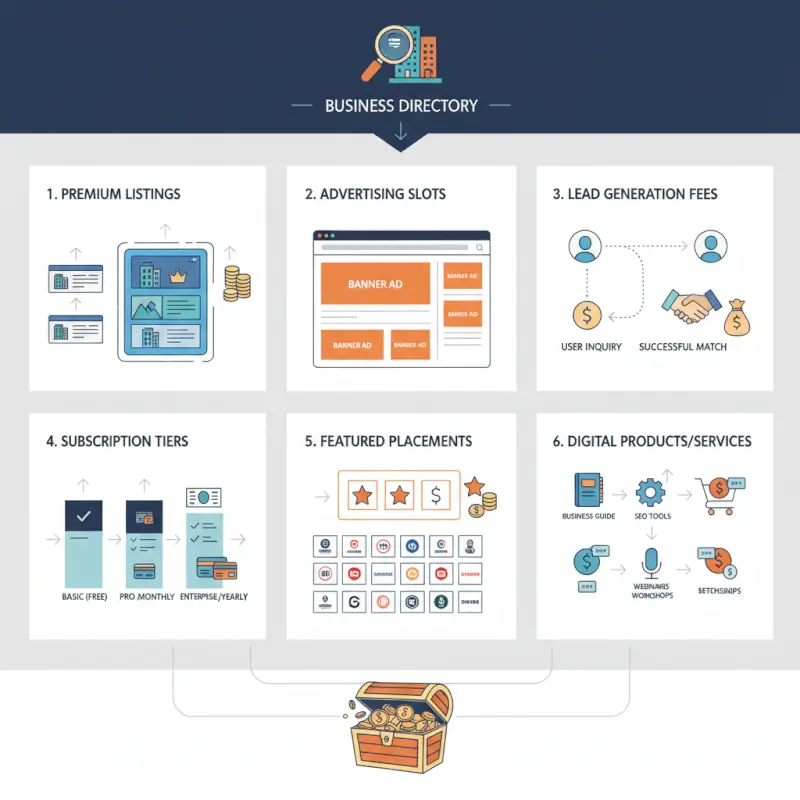
Think of premium listings as real estate—location and floor space determine price. A featured badge at the top of search results is worth more than position twelve on page two. Your job is to create clear pricing tiers that reflect this reality: a free tier for basic presence, a mid-tier “Growth” plan with enhanced profiles and limited analytics, and a “Pro” tier with top placement, video embeds, priority support, and full reporting. Businesses understand this math (they already pay for Google Ads), so transparency wins.
The risk here is perception. If users suspect that search results favor paying customers over quality, trust erodes fast. Mitigate this by publishing clear ranking criteria—mix organic signals (reviews, completeness, engagement) with paid boosts, and never let a low-quality listing buy its way to the top without meeting baseline standards. Platforms like TurnKey Directories make it easy to configure these tiered membership rules directly within WordPress, so you can test pricing without custom development.
Premium Listings and Featured Spots
Featured placements are the easiest sell because the value is obvious: more eyeballs mean more calls, clicks, and conversions. Charge businesses for top-of-page positioning, category page highlights, or home page rotation slots. Pricing should scale with exposure—a homepage feature costs more than a category-level boost. Add visual differentiation (colored borders, badges, star icons) so users immediately recognize premium listings without feeling deceived. Many directories cap the number of featured slots per category to preserve scarcity and maintain value for paying customers.
Beyond placement, consider feature-based upsells: photo galleries, video tours, verified badges, extended business hours, booking widgets, or links to social profiles. Each feature solves a specific conversion problem for the business owner, which means they’ll pay for it if you frame the value correctly. For context on how directory websites monetize visibility, feature bundling often drives higher average revenue per user than simple listing fees alone.
Tiered Memberships and Freemium Upsells
Multi-tier memberships turn one-time listing fees into recurring revenue streams with higher lifetime value. Structure your tiers around tangible outcomes: the free tier gets a basic claim and static listing, the $29/month Growth tier unlocks analytics dashboards and five photos, and the $99/month Pro tier adds priority placement, unlimited media, lead notifications, and API access. The key is to make each tier feel like a no-brainer upgrade for businesses at different maturity stages—startups grab the free tier, growing businesses move to Growth for data, and established players pay for Pro to dominate their category.
Freemium upsells work because they reduce friction at signup (free gets users in the door) while capturing revenue from those who see clear ROI. According to MIT Sloan Management Review’s platform research, subscription-based models create predictable cash flow and higher customer retention compared to one-off payments. Just make sure your free tier is generous enough to demonstrate value—stingy free plans breed resentment and churn before users ever experience the paid benefits.
Advertising and Sponsorships
Once your directory has consistent traffic, advertising becomes a scalable revenue layer that doesn’t depend on converting listed businesses. Display ads (banners, sidebar placements, in-content units) monetize pageviews via CPM or CPC models, while sponsored content and partner sponsorships align advertiser goals with user intent in a less disruptive format. The trick is balancing ad density with user experience—too many ads and users bounce, too few and you miss revenue. Start conservatively with one or two high-value placements and expand based on engagement metrics.
Contextual targeting matters more than raw impressions. A plumber searching for “emergency HVAC repair” is more valuable to an HVAC tool vendor than a random visitor browsing wedding venues. Use category-level targeting, search keyword triggers, and behavioral signals to serve relevant ads that feel helpful rather than intrusive. According to research on online business models and digital ads from MIT Economics, platforms that align ad relevance with user intent see higher CPMs and lower ad blindness. If you’re exploring multiple revenue streams for directories, ads should complement premium listings, not replace them.
Sponsorships offer a premium alternative to self-serve display ads. Sell exclusive category sponsorships where one advertiser owns all top placements in, say, “Legal Services” for a flat monthly fee. Or offer co-branded content deals: the sponsor provides a case study or how-to guide, you publish it with clear labeling and attribution, and both parties benefit from the exposure. Event sponsorships (webinars, in-person meetups) create additional revenue opportunities while strengthening community ties—just make sure sponsorship terms are transparent to maintain editorial independence.
Display Advertising and Sponsored Positions
Display ads are straightforward: sell banner slots to Google AdSense, Media.net, or direct advertisers via CPM (cost per thousand impressions) or CPC (cost per click) pricing. Start with high-visibility zones—header, sidebar, above-the-fold—but avoid cluttering the listing pages where users are trying to make decisions. Sponsored positions (clearly labeled “Sponsored” or “Featured Ad”) let businesses buy their way into search results or category pages without confusing users. The key is disclosure: label sponsored content clearly to maintain trust and comply with advertising regulations.
Test ad placements methodically—run A/B tests on position, size, and format to find the sweet spot where revenue maximizes without tanking engagement. Many directories reserve one or two sponsored slots per page and rotate advertisers to keep content fresh and competition healthy. If you rely on free directory submission sites for backlinks, remember that ad-heavy pages can hurt SEO if Google perceives them as low-quality, so balance monetization with content depth.
Sponsored Content and Partner Sponsorships
Sponsored content is native advertising done right: an advertiser pays for a co-branded article, video, or case study that educates users while subtly promoting their product or service. Unlike banner ads, sponsored content integrates into your editorial flow and drives engagement rather than interruptions. The catch is maintaining credibility—always disclose sponsorships, enforce editorial standards (no fluff or hard sells), and reserve the right to reject content that doesn’t serve your audience. Partner sponsorships extend this model to events, webinars, or certification programs where sponsors fund the experience in exchange for branding and lead access.
Event sponsorships create win-win scenarios: you offset event costs, sponsors gain visibility and leads, and attendees get free or discounted access. Structure sponsorship tiers (Platinum, Gold, Silver) with clear deliverables—logo placement, speaking slots, booth space, email list access—and price them based on audience size and engagement. For directories in professional niches (legal, healthcare, finance), certification programs can become lucrative sponsorship vehicles where industry vendors fund training in exchange for association with your credibility.
Lead Generation and Affiliate Partnerships
Performance-based revenue models align your directory’s incentives with those of the businesses you list and the third-party tools they need. Instead of fixed listing fees or impressions, you earn when a real transaction or verified action occurs—a qualified lead forwarded, a form submitted, or a user purchasing a service through an affiliate link. This approach works especially well in high-intent verticals (legal services, home contractors, healthcare) where businesses are willing to pay for warm leads, and it scales alongside your traffic without demanding upfront inventory or fulfillment.

Platform-economy research confirms that transaction fees and partner revenue-sharing arrangements are now mainstream monetization levers, often layered atop advertising and subscription streams. Harvard Business School’s platform-economy overview highlights how marketplaces and directories can capture value from each conversion event while maintaining trust through transparency and quality controls. By tying your revenue directly to outcome, you also gain a natural incentive to improve lead quality, user experience, and match relevance—all of which strengthen your directory’s brand over time.
Qualified Lead Sales and Verification
Selling verified, high-intent leads turns your search traffic into a direct revenue stream for listed businesses. When a user fills out a contact form, requests a quote, or dials a tracked phone number, that event can be packaged as a lead and delivered—often in real time—to the business. The key to sustainable lead-gen revenue is quality assurance: validate user inputs, filter spam and low-intent inquiries, and tie pricing to lead attributes (geography, service type, urgency) so businesses see clear ROI and continue to buy.
Implement robust privacy safeguards—obtain explicit consent from users before sharing contact information, comply with GDPR, CCPA, and local data regulations, and provide clear opt-out mechanisms. Many directories charge per-lead (PPL) on a flat fee or auction basis, or they use a shared-lead model where multiple businesses receive the same inquiry at a reduced price. Transparent lead-scoring and delivery rules help maintain trust on both sides: users feel their request is handled respectfully, and businesses receive leads they can convert, which keeps them coming back and justifies higher pricing over time.
Affiliate Marketing and Tool Integrations
Affiliate partnerships let you recommend adjacent products and services—appointment-booking platforms, customer-relationship-management (CRM) tools, local-marketing suites—and earn a commission when a listed business or visitor signs up. Because your directory already attracts businesses seeking visibility and growth, contextually relevant tools often see strong conversion rates. Choose partners whose products genuinely help your audience: a scheduling SaaS for service providers, a payments processor for e-commerce listings, or a review-management platform for multi-location brands.
Integrate affiliate offers into your interface organically—feature them in onboarding checklists, premium-tier benefits pages, or resource hubs—and disclose the commercial relationship clearly. Revenue-share arrangements can be one-time referral fees or recurring commissions for subscription products, providing predictable income that scales with your user base. Well-executed affiliate integrations also deepen your value proposition: businesses discover tools that improve their operations, and you build an ecosystem around your directory that becomes harder to replace, increasing long-term retention and lifetime value.
Data Services and API Access
Your directory accumulates a valuable asset over time: structured, curated data on businesses, categories, locations, hours, reviews, and user behavior. B2B customers—market researchers, SaaS platforms, local-marketing agencies, and data aggregators—are willing to pay for access to this data, either as one-time exports, ongoing feeds, or programmable API endpoints. Data monetization transforms your directory from a pure listing site into a data platform, opening high-margin revenue streams that scale without proportional content or support costs.
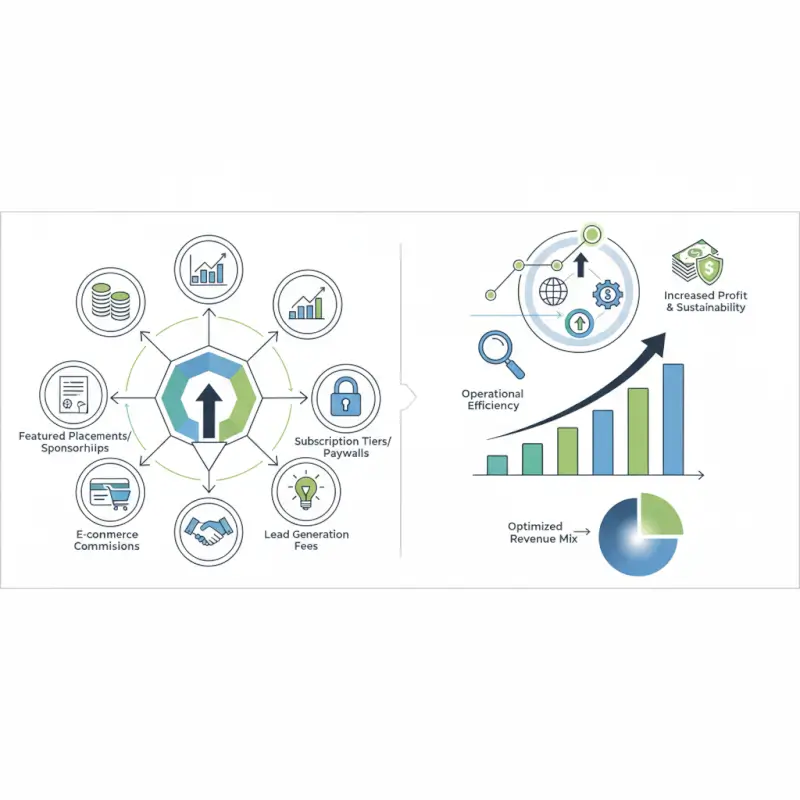
Platform-economy literature emphasizes that data services and API licensing are increasingly central to directory and marketplace revenue models. MIT Sloan Management Review’s strategy discussions and MIT Economics research on digital ad models both note that platforms can monetize aggregated, anonymized usage and entity data while preserving user privacy. The guardrails are clear: never sell personally identifiable information (PII), implement strict access controls and rate limits, and require data buyers to agree to usage terms that prohibit resale or misuse.
Directory Data as a Service (DaaS)
Packaging your directory’s curated listings as a Data-as-a-Service product means offering bulk exports, periodic data feeds, or subscription-based access to cleaned, categorized business information. Common buyers include competitive-intelligence platforms that need comprehensive market coverage, local-SEO tools that enrich their own databases, and academic or government researchers studying industry trends. Pricing can be usage-based (per record or API call) or subscription tiers that grant monthly data refreshes and specified query limits.
To protect data quality and your competitive edge, consider offering tiered data products: a basic tier with public business details (name, address, category), a premium tier with enriched attributes (hours, ratings, claim status), and a research tier with aggregated insights (category growth trends, geographic heatmaps). Always anonymize user-level data and strip PII before any external distribution. Clear documentation, sample datasets, and integration support make your DaaS offering attractive to developers and analysts, while usage audits and license enforcement ensure buyers respect the terms and protect your long-term data asset.
API Access for Partners and Developers
Offering a programmatic API turns your directory into an integration-ready platform that third-party apps, widgets, and services can build upon. A well-designed RESTful or GraphQL API lets partners query listings by location, category, or keyword; retrieve reviews and ratings; check business hours in real time; and even write back data (such as updated contact details) if you support two-way sync. API monetization typically follows a freemium or tiered model: free access with low rate limits for hobbyists and startups, paid plans with higher quotas and priority support for commercial integrations.
API revenue complements other streams by expanding your directory’s reach without requiring you to build every feature in-house. A booking-tool vendor might embed your listings in their interface, driving more traffic and premium upgrades back to your site. A mapping app could surface your reviews alongside business markers, increasing brand visibility. Implement robust authentication (OAuth2 or API keys), rate limiting, and monitoring to prevent abuse, and publish clear API documentation with versioning and deprecation policies. As your API ecosystem grows, consider offering dedicated account management and custom enterprise agreements for high-volume partners, creating a sticky, high-value revenue channel that scales with partner success.
| Data Monetization Model | Typical Pricing | Best For |
|---|---|---|
| One-time data export | Flat fee per dataset or record count | Researchers, agencies needing a snapshot |
| Subscription data feed | Monthly/annual fee for ongoing updates | SaaS platforms, competitive-intel tools |
| API access (freemium) | Free tier + paid tiers by call volume | Developers, startups, widget builders |
| Enterprise API license | Custom contract with SLAs and support | Large integrations, white-label partners |
Services and Ecosystem Extensions
Beyond passive listings and automated ad placements, many directories unlock new revenue by offering human-powered services and community-building features that deepen engagement and lock in long-term relationships. Managed onboarding, listing-optimization consulting, review-response coaching, and professional audits command premium fees because they save businesses time and improve outcomes. Events—webinars, virtual roundtables, certification programs, or in-person conferences—generate ticket sales, sponsorship revenue, and brand authority, turning your directory into a trusted industry hub rather than a static database.

This ecosystem approach aligns with broader monetization trends in platform businesses: as HBS platform research notes, platforms that bundle value-added services alongside core transactions see higher retention and customer lifetime value. Services revenue is also more defensible—competitors can replicate a listing interface, but they cannot easily replicate your team’s domain expertise, established community, or the trust you’ve built through personalized support. By layering services on top of listings, ads, and data, you create a diversified portfolio that smooths revenue volatility and positions your directory as an indispensable partner, not just a marketing channel.
Managed Services and Professional Support
Offering white-glove onboarding and ongoing optimization services turns your directory from a self-serve platform into a concierge experience for businesses that lack time or expertise. Managed services might include claiming and populating a listing on behalf of the business, sourcing high-quality photos and descriptions, setting up tracking analytics, coaching on review solicitation and response, and conducting quarterly listing-health audits. These services are typically sold as one-time setup packages or retainer agreements, with pricing that reflects the hands-on effort and the value of improved search rankings and conversion rates.
Target these offerings at businesses in complex or competitive categories—legal, healthcare, home services—where a well-optimized listing can mean thousands of dollars in new customer acquisition. Deliver measurable outcomes: increased profile views, higher click-through rates, more qualified leads, or improved star ratings. Document each service engagement with before-and-after metrics, case studies, and testimonials, then use that proof to upsell additional businesses and justify premium pricing. Managed services also create a natural feedback loop: by working closely with customers, you discover pain points and feature gaps that inform your product roadmap, making your directory more valuable for everyone.
Events, Certifications, and Community Features
Hosting events—whether virtual webinars on local-marketing best practices, networking mixers for listed businesses, or annual industry conferences—positions your directory as a thought leader and community convener. Events generate direct revenue through ticket sales or registration fees, and they attract sponsorships from service providers eager to reach your concentrated audience of business owners. Certifications and badge programs (verified provider, top-rated professional, industry-certified partner) add credibility layers that businesses will pay to earn and display, especially if those badges unlock additional visibility or trust signals in search results.
Community features—member forums, peer-reviewed Q&A boards, exclusive Slack or Discord channels—drive engagement and stickiness, making your directory a daily habit rather than an occasional lookup. While some community access can be free to build network effects, premium tiers can gate advanced features: priority support in forums, direct access to industry experts, or invitation-only networking events. These extensions create a virtuous cycle: businesses that participate in your community are more likely to renew premium listings, recommend your directory to peers, and provide testimonials and case studies that fuel your marketing, compounding the value of every new member you onboard.
Frequently Asked Questions
What is the most common monetization model for business directories?
Premium listings and subscriptions remain the most widely adopted models, offering predictable recurring revenue. Many operators layer advertising, lead-generation services, and data licensing on top to diversify income streams and reduce dependence on a single revenue source.
Should I charge for listings from the start or go free first?
A freemium approach lets you build audience and demonstrate value before introducing paid tiers. Start with free baseline listings, then introduce premium upgrades once traffic, engagement, and data quality prove your directory delivers measurable results for listed businesses.
How much revenue can a business directory realistically generate?
Revenue scales with audience size, niche depth, and the number of monetization streams you activate. Top-performing directories layer premium listings, ads, and lead sales to reach six or seven figures annually, though results vary widely by vertical and traffic volume.
Can I sell directory data and API access legally?
Yes, when paired with robust data governance and clear usage terms. Data licensing and API access create high-value B2B revenue, especially for curated, verified listings. Ensure you own the data, respect privacy laws, and establish usage controls for partners.
What are guardrails to maintain user trust when monetizing a directory?
Transparent pricing, clear sponsored-content labels, rigorous listing quality standards, and strong privacy safeguards preserve trust as you scale revenue. Avoid hidden fees and ensure search algorithms prioritize relevance over payment, so users always find the best matches.
How do I price premium listings and memberships?
Tie pricing to measurable value—visibility metrics, lead volume, analytics access, or enhanced profile features. Start with tiered packages that reflect different business sizes and goals, and test pricing pilots to calibrate willingness to pay before setting permanent rates.
Which monetization stream should I launch first?
Begin with premium listings or featured positions, since they require minimal infrastructure and validate demand quickly. Once you have paying customers, layer in display ads or affiliate partnerships, then explore data services and managed offerings as your platform matures.
How do I balance free and paid listings without alienating users?
Ensure free listings remain discoverable and useful, with paid tiers offering genuine advantages like priority placement, analytics, or multimedia content. Communicate the value proposition clearly and avoid making free listings invisible or overly limited in functionality.
Turn Your Directory Into a Revenue Engine
The path from a simple business directory to a diversified revenue platform is clear: layer complementary monetization streams, test each with small pilots, and scale what delivers real value to both users and listed businesses. Premium listings anchor predictable subscription income, while advertising and lead generation unlock performance-based upside. Data services and managed offerings extend your reach into B2B markets and professional services, creating defensible moats as your platform matures.
Start with one revenue stream this quarter. If you haven’t introduced premium listings yet, define three tiers—basic, growth, and premium—and validate pricing with ten target customers. If subscriptions are already live, prototype a single display-ad format or test an affiliate partnership for a high-intent category. Build momentum through iteration, not perfection, and let early adopters guide your roadmap.
As platform economics evolve through 2024 and beyond, the directories that thrive will be those that balance user trust with revenue diversification. Transparent pricing, rigorous data governance, and genuine value delivery aren’t just ethical imperatives—they’re competitive advantages. Your directory sits at the intersection of discovery, trust, and commerce. Monetize it thoughtfully, and you’ll build a sustainable business that serves both sides of your marketplace for years to come.
Ready to Launch Your First Revenue Stream?
Pick one monetization model from this guide, design a pilot for the next 30 days, and measure results against a clear success metric. Whether it’s ten premium subscribers, your first sponsored listing, or a data-license proof of concept, actionable progress beats endless planning every time.
Start small, validate fast, and scale what works—your directory’s revenue engine awaits.
Was this article helpful?