How to Monetize an Online Business Directory & Earn $5K/Month

Generating summary...
Building an online business directory can feel like assembling a puzzle where every piece is revenue potential—except most founders don’t realize they’re sitting on a treasure chest until they’ve already burned months chasing the wrong model. I’ve watched directory owners struggle for years with free-only listings, wondering why their traffic never converts, while others crack $5K/month in under six months by stacking three or four complementary revenue streams from day one. The difference? They didn’t pick a single monetization model and hope for the best—they built a monetization system where listings, ads, leads, and data licensing all feed into one another, creating a flywheel that compounds value with every new business that joins.
Here’s what almost no one tells you: your directory’s monetization blueprint should start before you finalize your niche. The most profitable directories aren’t just well-trafficked—they’re architected around a specific willingness-to-pay that exists in their target market. A local contractor directory and a SaaS marketplace might both get 50,000 monthly visitors, but their revenue models look completely different because their users behave differently. One monetizes through lead generation and premium placements, the other through API access and data licensing. Understanding this distinction early is the difference between a hobby project and a business that scales past five figures monthly.
TL;DR – Quick Takeaways
- Multi-model monetization – Successful directories combine 3-4 revenue streams (premium listings, ads, lead gen, data licensing) rather than relying on a single source
- Validate before you scale – Run small paid-listing pilots and sponsored content tests to confirm willingness-to-pay before investing in full infrastructure
- Niche determines model – Your directory’s industry and audience dictate which revenue models will work; local service directories thrive on lead gen while B2B directories profit from data licensing
- Traffic-to-revenue alignment – Build SEO content that directly supports monetization (comparison guides, category deep-dives) rather than generic filler
- Pricing transparency wins trust – Clear tier structures and labeled sponsorships outperform opaque pricing and hidden promotions
Validate Your Value Proposition and Market Fit
Most directory founders jump straight to building out hundreds of categories and collecting listings, but that’s backwards. The directories that hit $5K/month fastest start with a ruthlessly narrow focus on a segment where they can prove value before they expand. Think about it—would you rather have 10,000 unvetted listings in a generic business directory, or 200 verified, high-quality vendors in a niche where you’re the only trusted source? The second option is infinitely more monetizable because you’ve created scarcity and curation, two ingredients that make businesses willing to pay for visibility.
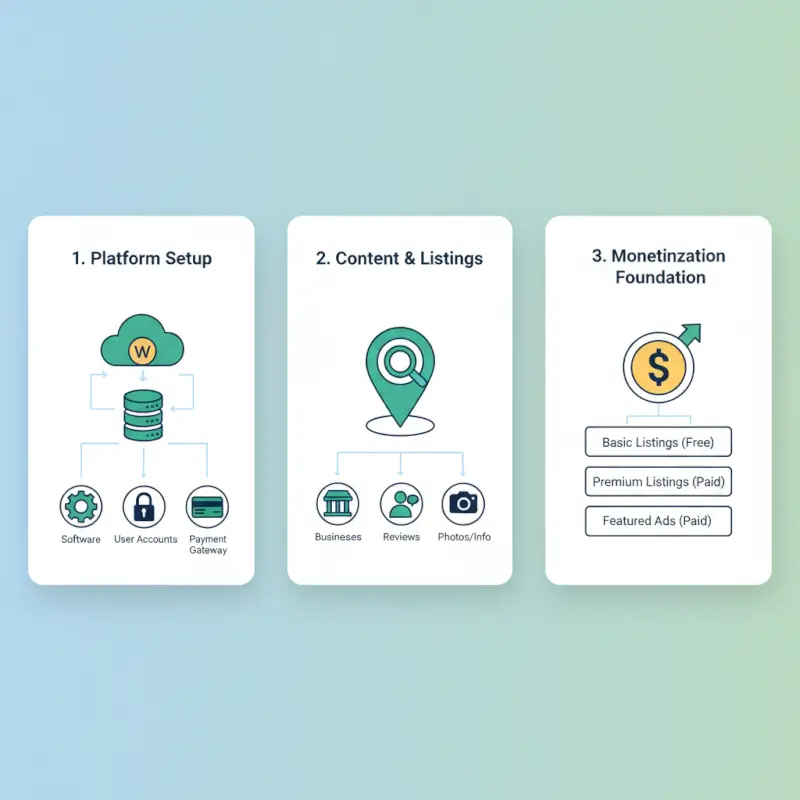
Your value proposition isn’t “we list businesses”—that’s table stakes. It’s the specific problem you solve that unlocks monetization. Are you the only directory that verifies contractor licenses before listing? Do you aggregate real-time pricing data that users can’t find elsewhere? Maybe you’ve built category-specific comparison tools or buyer’s guides that turn browsers into qualified leads. According to research from the U.S. Census Bureau, there are over 30 million small businesses in the U.S. alone, which means standing out requires a differentiated angle, not just another general listing site.
Here’s where founders get tripped up: they assume traffic alone validates the model. I’ve seen directories with 100,000 monthly visitors earn less than $500/month because they never tested willingness-to-pay. Contrast that with a niche directory pulling 5,000 visitors but converting 20 businesses into $99/month premium listings—that’s nearly $2,000 in monthly recurring revenue from a fraction of the traffic. The lesson? Validation isn’t about page views; it’s about whether your target businesses will actually open their wallets for the value you’re creating.
Define Target Segments and Signage of Value
Choosing your niche isn’t just about picking an industry—it’s about identifying a segment where you can deliver signage of value that’s immediately obvious to both users and businesses. Signage of value means the moment someone lands on your directory, they instantly understand what makes you different and why they should trust you over Google or Yelp. For example, a directory of “verified eco-friendly contractors” signals value through curation and verification, while “all contractors in your city” signals… nothing distinctive.
Narrow beats broad almost every time when you’re building toward monetization. A directory focused on “mobile app developers for healthcare startups” can charge $299/month for a premium listing because it’s serving a high-intent, high-budget audience with a specific need. A directory of “all app developers” has to compete on price with massive platforms and ends up racing to the bottom. The narrower your niche, the easier it is to articulate why a business should pay you for access to your audience—and the higher you can price that access (you might even consider approaches similar to those who build productivity tools, where specificity drives conversion).
Geography, industry vertical, and audience type are your three main levers for niche definition. A local directory (e.g., “wedding vendors in Austin”) monetizes differently than a national vertical directory (e.g., “B2B SaaS tools for HR teams”). Local directories tend to profit from lead generation and sponsored placements, while vertical directories excel at data licensing and API access. Choose based on where you have unique insight, existing relationships, or the ability to build trust faster than competitors.
Test Demand with Lightweight Monetization Bets
You don’t need a fully built platform to test monetization—in fact, launching with everything baked in is usually a mistake. The smartest approach is to run small, low-friction experiments that validate willingness-to-pay before you invest in complex infrastructure. Offer 10 businesses a “founding member” premium listing for $49/month with manual invoicing and see how many convert. Run a single sponsored blog post for $200 and measure whether the sponsor sees ROI. These tiny bets cost almost nothing but give you real signal about what will scale (this philosophy aligns with lean approaches used by those who test multiple revenue streams early).
One founder I know launched a legal services directory by cold-emailing 50 law firms and offering a “beta partner” package: premium placement for three months at 50% off the future price. Twelve firms signed up at $75/month, giving him $900/month in revenue before he’d even built automated billing. That validation gave him the confidence to invest in a proper subscription system and expand the program. Without that test, he might’ve spent six months building features no one wanted to pay for.
Sponsored content trials are another low-lift validation method. Reach out to businesses in your directory and offer to write a case study or comparison guide featuring them for a flat $150-$300 fee. If they say yes, you’ve validated that they’re willing to pay for exposure within your audience. If they say no, you’ve learned that your current traffic or positioning isn’t compelling enough yet—time to double down on SEO and content before pushing monetization harder. Testing beats guessing every single time (much like how those who optimize battery life on devices start with small tweaks before committing to major changes).
Core Monetization Models (Choose a Multi-Model Approach)
The directories earning consistent $5K+ monthly revenue don’t pick a single monetization model and stick with it—they layer multiple streams that reinforce one another. A business might start with a free basic listing, upgrade to a $99/month featured placement, then add a $500 sponsored blog post, and eventually become a quarterly sponsor for $2,000. Each step builds on the last, and the cumulative effect is far more powerful than any single revenue stream alone. According to Statista, diversified revenue models reduce platform risk and improve retention by giving businesses multiple entry points at different price levels.
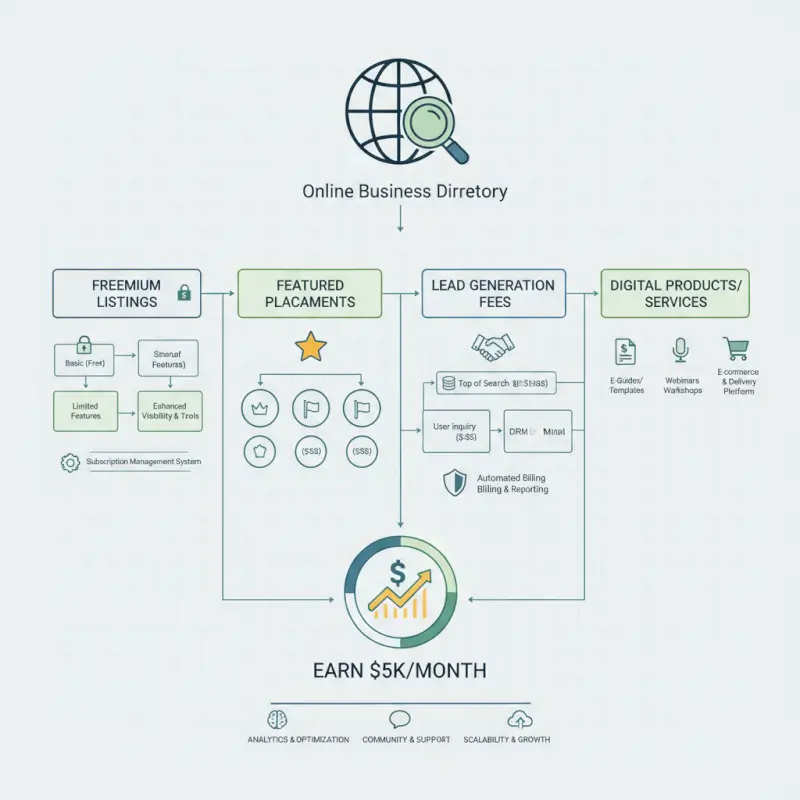
Think of your monetization stack as a ladder, not a single rung. Free listings are the bottom rung—they get businesses in the door and build your index. Paid listings are the middle rungs, offering progressively more visibility and features. Sponsorships, lead generation, and data licensing are the top rungs, reserved for businesses that need maximum exposure or agencies that want to license your data. The key is making each rung valuable on its own while creating natural incentives to climb higher (this is similar to how government directories often layer public access with premium research tiers).
I’ve seen too many directory owners launch with only free listings, hoping to monetize later through ads once they hit some magical traffic threshold. That almost never works because you’ve trained your audience and your listed businesses to expect everything for free. It’s brutally hard to reverse that expectation. Launch with a paid tier from day one—even if it’s just $29/month for a “pro” badge and priority placement—so everyone understands value exchange is part of the model. You can always discount or comp early partners, but having the structure in place from the start is crucial.
Listings and Subscriptions (Tiered Exposure)
Tiered listing packages are the backbone of most directory monetization because they’re simple to explain and directly map to the value businesses care about: visibility. A basic free listing gets you in the index with minimal details. A $49/month “enhanced” listing adds photos, extended descriptions, and category badges. A $149/month “premium” listing puts you at the top of search results, in featured carousels, and in email newsletters. The pricing ladder is transparent, and businesses can self-select based on their budget and growth stage.
The mistake most founders make is offering too many tiers or making the differences too subtle. Three tiers is the sweet spot: free (entry point), mid-tier paid (core revenue driver), and premium (for businesses that want maximum exposure). If you add five or six tiers, decision paralysis kicks in and conversion rates drop. Keep the tiers visually distinct—use badges, colors, or placement rules that make the difference obvious at a glance. Tools like TurnKey Directories make it easy to set up tiered subscription models with automated billing and featured listing slots, so you’re not manually managing renewals for dozens of businesses.
Renewal is where listings subscriptions really shine—or fall apart. A business that’s been paying $99/month for six months and seeing steady lead flow will renew almost automatically if the value is there. But if you haven’t built reporting or analytics into your listings (showing businesses how many views or clicks they’re getting), renewal becomes a coin flip. Bake in simple analytics from the start: “Your listing was viewed 847 times this month and received 23 contact form submissions.” That one line justifies the renewal better than any sales email ever could.
Advertising and Sponsored Content (Sponsor Packages)
Display ads and sponsored placements can add a significant revenue stream, but they only work if you’ve built category authority and consistent traffic in specific niches. A directory pulling 50,000 monthly visitors across 200 random categories won’t command high ad rates because the traffic is too diffuse. But a directory with 10,000 monthly visitors all searching for “commercial HVAC contractors” can charge premium rates to HVAC equipment suppliers, insurance companies, and training programs because the audience is hyper-targeted (similar to how eBay listing templates work best when optimized for specific product categories).
Sponsored listings are different from display ads—they’re promoted placements within your directory’s organic results, clearly labeled as “sponsored” or “featured partner.” A contractor might pay $200/month to appear in the top three results for their category, or a SaaS tool might sponsor an entire category page for $500/month. The key is transparency: users need to know what’s sponsored, or you erode trust fast. According to FTC guidelines, clear labeling of sponsored content isn’t just good practice—it’s legally required in many contexts.
Sponsored content (blog posts, case studies, comparison guides) often yields higher margins than banner ads because you’re creating unique value rather than renting pixels. A well-written sponsored guide comparing “Top 5 Project Management Tools for Agencies” can live on your site for years, driving traffic and conversions long after the sponsor paid the initial $500 fee. Bundle sponsored content with a premium listing and a category sponsorship, and you’ve got a $1,500-$2,000 quarterly package that delivers measurable ROI for the sponsor and high-margin revenue for you.
Lead Gen, Partnerships, & Data-Driven Revenue
Once your directory attracts meaningful traffic, you can layer in lead-generation and commission-based models that convert listing exposure into measurable business outcomes. Instead of charging a flat subscription, you bill per qualified lead (enquiry, quote request, booking) or take a percentage of transactions completed through your platform. This performance-oriented model aligns incentives: businesses pay for results, and you earn more as you deliver higher-quality, higher-volume leads. It works especially well in categories where users expect to request quotes or book services directly—think home services, professional consultants, event vendors, or B2B software.

To implement lead-gen revenue, integrate contact forms, call-tracking numbers, or booking widgets into each listing page, then route inquiries to the business owner via email or a dedicated dashboard. Charge per lead (common pricing ranges from $5 to $50+ depending on vertical and lead quality) or take a commission on completed bookings (often 5–15%). Track lead quality rigorously: use analytics to monitor conversion rates, and set up feedback loops so businesses can flag low-quality leads. Over time, refine your lead-scoring criteria—geography, user intent signals, form completeness—to maximize conversion and justify higher per-lead pricing.
Beyond direct lead fees, explore partnership and data-driven revenue streams that leverage the unique dataset your directory accumulates. If you maintain verified business profiles, operating hours, service offerings, and customer reviews, that structured data has value to third-party apps, marketplaces, or analytics platforms. License aggregated, anonymized data via API access or batch exports to partners who need category insights or enrichment feeds. Pricing can follow per-call, monthly subscription, or revenue-sharing models; always enforce clear Terms of Service and data-use agreements to protect user privacy and comply with GDPR, CCPA, or other regulations. Data licensing works best once you reach critical mass—typically thousands of high-quality, regularly updated listings—and have invested in data-validation and API infrastructure.
When structuring partnerships, consider co-marketing or affiliate arrangements that drive additional traffic and revenue without requiring upfront capital. Partner with complementary services (payment processors, scheduling tools, CRM platforms) to offer bundled subscriptions; take a revenue share or referral fee for each customer you send their way. Similarly, join affiliate programs for products relevant to your audience—software, insurance, marketing services—and embed affiliate links in guides or resource pages. Both approaches diversify income and reduce reliance on any single monetization pillar, helping you hit $5K/month faster and with lower risk.
Growth Engine: Traffic to Revenue Alignment
Revenue models only deliver if you have sufficient, targeted traffic; the growth engine of a directory is built on content-driven SEO and category authority. Develop high-quality editorial content—how-to guides, comparison articles, buyer’s guides, case studies—that targets long-tail keywords and establishes your site as the go-to resource in your niche. For example, a home-services directory might publish “How to Choose a Licensed Electrician in [City]” or “Plumbing Cost Guide: What to Expect in [Year].” Each piece of content should link internally to relevant category or city landing pages and individual listings, driving organic traffic directly to monetizable inventory. Search engines reward depth and freshness, so update content quarterly, add new data points (average pricing, new regulations, seasonal trends), and encourage user-generated reviews and Q&A to keep pages dynamic.
As your content library grows, map keywords to revenue intent: some queries indicate research (top-of-funnel, best monetized via display ads or sponsored content), while others signal purchase readiness (bottom-of-funnel, ideal for lead-gen or premium listings). Use Google Search Console and keyword-research tools to identify which pages drive conversions, then double down on creating similar content and optimizing those pages for speed, mobile UX, and clear calls-to-action. Consider adding interactive elements—calculators, wizards, or comparison tables—that increase engagement and dwell time, signaling quality to search algorithms and providing natural hooks for premium placements and sponsorships.
Beyond organic search, partnerships, APIs, and developer ecosystems can unlock additional traffic and monetization channels. Offer an embeddable widget or API endpoint that lets partner sites pull featured listings or category data; charge partners a monthly fee or take a revenue share on leads generated through the widget. Build an affiliate or referral program where local bloggers, influencers, or industry sites earn a commission for sending traffic or sign-ups to your directory. Provide clear developer documentation, SDKs, and sandbox environments to encourage third-party integrations, which expand your reach and create network effects—more partners mean more inbound links, more backlinks, and higher domain authority.
Track the full funnel from traffic source to conversion with analytics tags and UTM parameters; segment users by channel (organic, paid, referral, API) and measure revenue per session or per visitor. This data lets you allocate marketing spend efficiently—if organic content delivers a $0.50 cost-per-acquisition and paid search costs $5, shift budget accordingly. Set up automated dashboards (Google Analytics 4, Mixpanel, or a custom BI stack) that surface key metrics weekly: new listings, paying subscribers, leads delivered, and revenue by model. Use A/B testing on pricing pages, CTA copy, and listing-tier labels to iterate toward higher conversion rates, and share performance snapshots with sponsor partners to justify rate increases and renewal commitments.
| Traffic Source | Typical Conversion | Best Monetization Fit |
|---|---|---|
| Organic (long-tail) | 1–3% to lead/signup | Premium listings, lead gen |
| Direct / branded | 3–5% to conversion | Subscriptions, renewals |
| Referral / partner | 0.5–2% | Affiliate, rev-share |
| Paid (PPC) | 2–4% with intent kw | High-ticket leads, trials |
Operational Playbook: Pricing, Contracts, & Compliance
Transparent, tiered pricing is the foundation of sustainable monetization. For each revenue stream—listings, sponsorships, leads, data licensing—define clear pricing tiers with explicit feature sets and renewal terms. A typical listing ladder might include Free (basic profile, limited visibility), Professional ($29/month: enhanced profile, category placement, analytics), and Premium ($99/month: top placement, lead routing, premium badge). Publish your pricing page publicly or share it during onboarding calls; avoid custom, per-client pricing until you reach scale, as it creates operational complexity and undermines trust. Model profitability under realistic traffic scenarios: if you need 100 paid listings at $50/month to hit $5K, work backward to calculate the visitor-to-subscriber conversion rate required (typically 1–3%), then size your SEO and content roadmap accordingly.

Structure subscription contracts with auto-renewal clauses, cancellation policies, and service-level expectations spelled out in simple terms. Offer monthly and annual plans (annual subscriptions often carry a 10–20% discount to lock in revenue and reduce churn). For lead-gen or commission models, define what constitutes a qualified lead—valid contact info, relevant service request, within service area—and how disputes will be resolved. Set caps on the number of leads per business per month to prevent oversaturation, and provide a dashboard where subscribers can pause or adjust their lead budgets. Include a straightforward refund or credit policy for low-quality leads; this builds trust and reduces support overhead.
On the compliance and quality-control front, implement Terms of Service, Privacy Policy, and listing standards before you monetize. Your privacy policy must disclose how you collect, store, and share user data—especially if you offer data licensing or API access—and comply with GDPR (for EU visitors), CCPA (California), and other regional regulations. Use cookie-consent banners, honor opt-out requests, and anonymize or aggregate data before sharing with partners. For advertising and sponsorships, clearly label sponsored content (“Sponsored,” “Featured,” or “Ad”) to comply with FTC guidelines and maintain editorial integrity. Establish listing guidelines that prohibit spam, duplicate profiles, or misleading claims; use automated and manual moderation to enforce quality, and provide a public reporting mechanism for users to flag bad actors.
Finally, track key compliance milestones in your operational calendar: annual privacy-policy reviews, data-retention audits, advertiser-disclosure updates, and contract renewals. As you grow, consider liability insurance (E&O or cyber) to cover data breaches or disputes, and consult with legal counsel on revenue-sharing agreements, international tax obligations, and intellectual-property protections for your proprietary data. Building these guardrails early prevents costly legal issues and customer churn down the road, and signals professionalism to enterprise sponsors and data-licensing partners who conduct due diligence before signing contracts.
| Operational Area | Key Action | Timeline |
|---|---|---|
| Pricing tiers | Publish public pricing page | Pre-launch |
| Contracts & ToS | Draft subscription & lead-gen agreements | Month 1 |
| Privacy policy | Implement GDPR/CCPA consent flows | Month 1 |
| Listing standards | Publish moderation guidelines & reporting form | Month 2 |
| Annual review | Audit data retention, update policies | Yearly |
FAQ: Frequently Asked Questions
How long does it take to start earning from a directory?
Most directories start generating meaningful revenue within 3–6 months after launching premium listings and sponsor opportunities. Success depends on traffic volume, trust signals, and the mix of monetization models you deploy. Early validation with pilot programs accelerates the timeline significantly.
What is the simplest monetization model for a new directory?
Start with a combination of paid listings and display advertising. Offer basic, featured, and premium listing tiers to businesses, then layer in banner ads or sponsored content as traffic builds. This two-model approach requires minimal technical overhead and validates willingness-to-pay quickly.
Can data licensing work for a local directory?
Yes, if you accumulate unique, high-quality business data and offer APIs or data feeds to partners. Local marketing platforms, review sites, and analytics tools often license directory data. Ensure compliance with privacy regulations and establish clear data-use agreements before sharing any information.
Should I rely on ads or sponsorships at first?
Ads and sponsorships can coexist successfully. Sponsorships typically yield higher CPMs and stronger partner relationships when bundled with category branding or featured placements. Start with display ads for immediate fill, then pitch sponsorships to key players in your niche as traffic grows.
How do I price sponsored placements without harming user trust?
Clearly label all sponsored content, limit saturation to maintain relevance, and tie sponsorships to high-value placements like featured listings or category pages. Transparency is critical: users tolerate sponsored content when it’s clearly marked and genuinely useful, not deceptive or overwhelming.
What traffic volume do I need to reach $5K per month?
Revenue depends more on monetization mix than raw traffic. With premium listings at $50–200/month and 25–50 paying businesses, you can hit $5K even with moderate traffic. Add lead generation or sponsorships, and the traffic threshold drops further as average revenue per user increases.
How do I convince businesses to pay for listings?
Demonstrate clear value: verified placement, SEO benefits, lead capture, or enhanced visibility. Show proof with pilot case studies, traffic analytics, or testimonials from beta partners. Tiered pricing lets businesses test affordability before committing to premium placements, reducing sales friction.
Can I use affiliate marketing in a business directory?
Absolutely. Integrate affiliate links in category guides, comparison pages, or tool recommendations. Ensure affiliate relationships are disclosed and genuinely add value to users. Affiliate commissions work especially well for directories focused on software, services, or e-commerce products where conversion tracking is straightforward.
Conclusion: Your Path to $5K/Month
Building a directory that earns $5,000 per month isn’t about chasing every monetization trend—it’s about deploying a disciplined, multi-model strategy tailored to your niche and audience. By validating demand early, layering complementary revenue streams, and maintaining operational rigor around pricing and compliance, you create a foundation for sustainable, scalable income.
The roadmap is clear: start with validated value propositions and lightweight monetization tests. Build your core around tiered listings and strategic advertising. Expand into lead generation, partnerships, and data licensing as traffic and trust grow. Fuel everything with content-driven SEO and category authority that justifies premium placements and attracts sponsor dollars. Finally, lock in profitability with transparent pricing, solid contracts, and respect for privacy and quality standards.
Success hinges on continuous measurement and iteration. Track conversion rates for each listing tier, monitor lead quality and partner satisfaction, and refine your sponsorship packages based on real performance data. The directories that hit—and exceed—$5K per month are those that treat monetization as an evolving system, not a one-time launch.
Ready to Turn Your Directory Into a Revenue Engine?
You’ve learned the framework. Now it’s time to act. Pick your first two monetization models, set a 90-day pilot, and measure ruthlessly. Whether you’re launching from scratch or scaling an existing directory, the path to $5K starts with a single committed step.
Start building your monetization stack today—your directory’s profitability depends on it.
Was this article helpful?