
Active Directory for Small Business: Complete 2025 Setup & Security Guide

Visual overview of Active Directory for Small Business: Complete 2025 Setup & Security Guide

Running a small business means making tough decisions about your IT infrastructure—and one of the biggest questions you’ll face is whether implementing Active Directory actually makes sense for your organization. I’ve spent years helping small businesses navigate this exact decision, and I can tell you that the answer isn’t always straightforward.

Active Directory for small business isn’t just for large enterprises anymore. With the right approach, it can solve critical pain points—from managing employee access to strengthening security. But here’s the thing: many small businesses invest in Active Directory without fully understanding what they’re getting into, only to find themselves dealing with complexity they don’t need. The landscape has changed dramatically in 2025, with cloud alternatives like Azure Active Directory (now Microsoft Entra ID) and managed directory services offering compelling alternatives to traditional on-premises setups.

Before you commit to any directory solution for your small business, let’s cut through the tech jargon and examine what actually works, what it costs, and whether there are better alternatives for your specific situation.

TL;DR: Active Directory Decision Framework
  • Small businesses with 25+ users benefit most from centralized directory services
  • Cloud-first alternatives like Azure AD (Entra ID) eliminate hardware costs and reduce maintenance
  • Businesses under 10 users may find traditional AD overkill—consider simpler alternatives
  • Security benefits include centralized authentication, policy management, and comprehensive audit trails
  • Total cost extends beyond software—factor in hardware, maintenance, and IT expertise
  • Hybrid approaches combining on-premises and cloud identity are increasingly common

Do Small Businesses Really Need Active Directory in 2025?

The fundamental question isn’t whether Active Directory is powerful—it absolutely is. The real question is whether your small business needs that power right now. Active Directory makes sense when you’re managing enough users and resources that decentralized control becomes a security risk and an administrative burden.

For businesses approaching the 20-25 user mark, the pain points start becoming obvious. You’re spending hours each week resetting passwords, struggling to control who has access to what files, and worrying about former employees who might still have access to sensitive systems. One accounting firm I worked with was literally keeping spreadsheets of who should access which folders—a recipe for disaster.

Core concepts behind Active Directory for Small Business: Complete 2025 Setup & Security Guide

Small business active directory implementations typically make sense when you have multiple servers to manage, need sophisticated security policies, require centralized user authentication, or face compliance requirements that mandate audit trails and access controls. According to Microsoft’s 2025 AD security guidance, organizations of all sizes face increasing threats that require strong identity controls.

15 hours
Average weekly IT time saved after implementing directory services for a 40-person business

When Cloud Identity Makes More Sense Than Traditional AD

Here’s where things get interesting. If you’re building your small business IT infrastructure from scratch in 2025, starting with cloud-based identity services often makes more sense than traditional on-premises Active Directory. Cloud-first businesses, companies with remote workers, and organizations already using Microsoft 365 or Google Workspace should seriously consider cloud directory alternatives.

Azure Active Directory (recently rebranded as Microsoft Entra ID) provides many of the same capabilities as traditional AD but eliminates the need for on-premises servers. For your business, this means lower upfront costs, reduced maintenance burden, and easier scalability. The catch? You’re dependent on internet connectivity, and you’ll have less granular policy control compared to traditional Group Policy.

Pro Tip: If you’re already paying for Microsoft 365 Business Premium, you get Azure AD Premium P1 included—which might make cloud identity a no-brainer for your small business.

Decision Checklist: On-Premises vs. Cloud vs. Hybrid

Your ideal directory solution depends on several factors specific to your business. On-premises Active Directory works best when you have dedicated IT staff, run primarily Windows environments, need extensive Group Policy control, and have reliable on-site infrastructure. Cloud directory services shine when you’re operating with remote workers, using primarily SaaS applications, have limited IT resources, and want predictable operational expenses.

Hybrid approaches combining both on-premises AD and cloud identity are becoming the standard for growing businesses. This gives you local control where you need it plus cloud capabilities for modern applications. According to industry guidance on identity governance, well-run directories require strong controls regardless of where they’re hosted.

Modern Alternatives to Traditional Active Directory

The directory services landscape has evolved dramatically, and small businesses now have options that didn’t exist five years ago. Traditional on-premises Active Directory is no longer the only game in town—and for many small businesses, it’s not even the best option anymore.

Microsoft Entra ID (formerly Azure Active Directory) leads the cloud identity space. It handles user authentication, single sign-on to thousands of applications, multi-factor authentication, and conditional access policies. The basic tier is free with Microsoft 365 subscriptions, while premium features start around $6 per user monthly. For small businesses already in the Microsoft ecosystem, the integration is seamless.
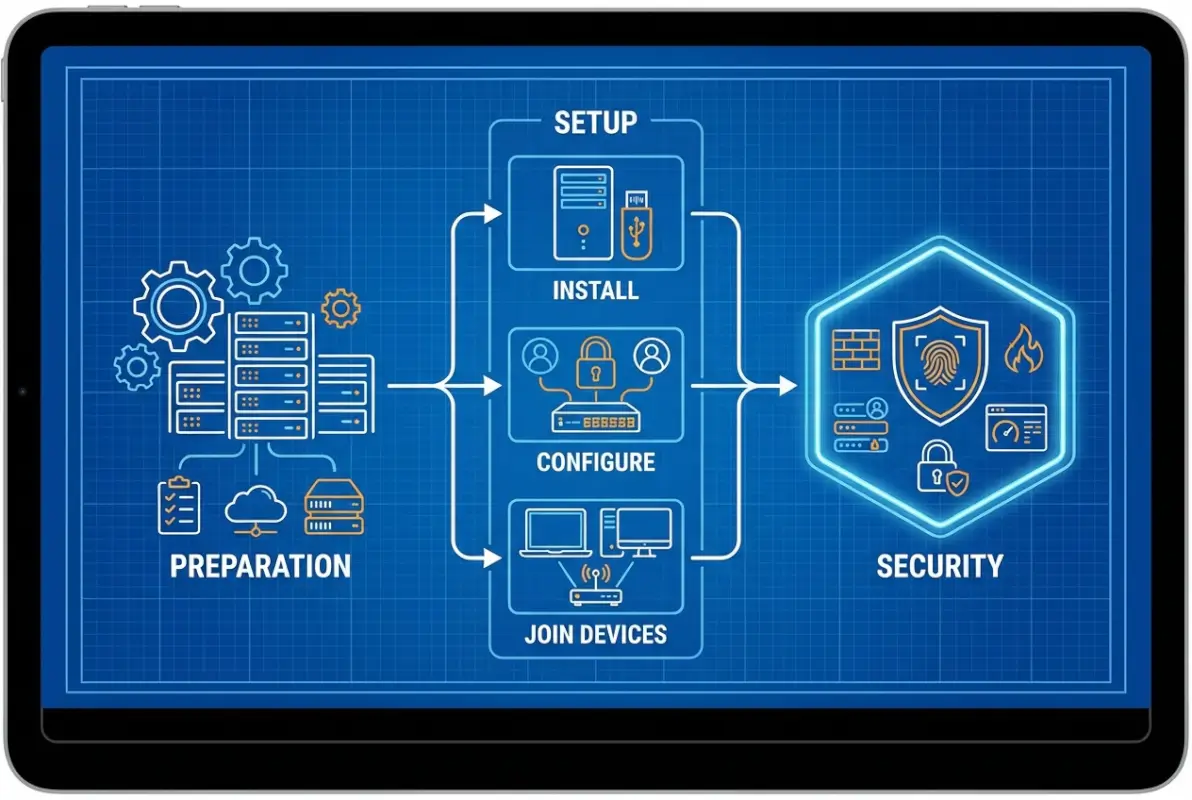
Step-by-step process for Active Directory for Small Business: Complete 2025 Setup & Security Guide

Google Workspace includes directory services that work well for Google-centric teams. It’s simpler than Active Directory but covers the basics—user management, group-based permissions, and authentication for Google services. At $12 per user monthly for the Business Standard plan, it’s straightforward but lacks the depth needed for complex Windows environments.

JumpCloud has emerged as a popular alternative for small businesses that need cross-platform support. It provides directory services that work across Windows, Mac, and Linux, with pricing starting at $8 per user monthly. The platform shines for businesses with mixed device environments—something traditional AD struggles with.

SolutionBest ForStarting CostKey AdvantageLimitation
Traditional ADWindows-heavy, 25+ users$7,000-$15,000 first yearFull Group Policy controlRequires hardware & expertise
Azure AD/Entra IDCloud-first businessesFree-$6/user/monthNo hardware neededLimited policy control
Google WorkspaceGoogle-centric teams$12/user/monthSimple administrationNot ideal for Windows
JumpCloudMixed OS environments$8/user/monthCross-platform supportLess mature than AD
Okta WorkforceSaaS-heavy businesses$8-$15/user/monthExtensive app integrationsHigher cost

Fully Managed AD Services for Small Businesses

If you like the power of Active Directory but don’t want to manage it yourself, fully managed AD services might be your answer. Several providers offer hosted Active Directory where they handle the infrastructure, updates, backups, and monitoring—you just use it.

These fully managed AD services for SMBs typically cost $15-$30 per user monthly, including all infrastructure and support. For a 30-person business, that’s $450-$900 monthly, which sounds expensive until you factor in the cost of dedicated IT staff, server hardware, and the time spent troubleshooting issues.

Important: When evaluating managed services, verify their backup procedures, disaster recovery capabilities, and support response times. Your directory is critical infrastructure—downtime means nobody can work.

Active Directory Security Best Practices for 2025

Security is often the driving force behind implementing directory services, and for good reason. A properly configured Active Directory provides multiple security layers that are difficult to achieve with standalone systems—but a poorly secured directory becomes a single point of failure that attackers love to exploit.

The foundation of AD security is the principle of least privilege. Users should have only the permissions they absolutely need to do their jobs. I’ve seen too many small businesses grant everyone administrator rights “to make things easier,” which essentially defeats the entire purpose of having a directory service. According to Forbes security guidance, proper privilege management prevents the majority of security incidents.

Tools and interfaces for Active Directory for Small Business: Complete 2025 Setup & Security Guide

Privileged Access Management (PAM) deserves special attention in small business environments. Your domain administrator accounts need separate, highly secure credentials that are never used for day-to-day work. One compromised admin account can give attackers complete control of your entire network—something I’ve unfortunately seen happen to a 40-person law firm that learned this lesson the expensive way.

73%
of successful data breaches involve compromised credentials, making directory security critical

Implementing Multi-Factor Authentication

Multi-factor authentication (MFA) is no longer optional—it’s essential. Azure AD makes MFA relatively straightforward to implement, while traditional AD requires additional components like Azure MFA or third-party solutions. The investment is worth it, MFA blocks over 99% of automated credential attacks.

Your best active directory for small business security strategy should include MFA for all administrative accounts immediately and for all users within six months. Start with admins because they’re the highest-value targets, then roll out to everyone else. The initial resistance from users typically disappears within a week once they get used to the process.

Auditing, Monitoring, and Incident Response

Comprehensive logging is your insurance policy. Active Directory can track every authentication attempt, permission change, and administrative action—but only if you configure it properly and actually review the logs. Many small businesses enable logging but never look at it until after a security incident.

According to IBM’s AD best practices guidance, regular security audits should include reviewing privileged account usage, checking for dormant accounts, validating Group Policy settings, and monitoring failed login attempts. Set up automated alerts for suspicious activities like multiple failed logins or after-hours administrative changes.

Key Insight: Most security breaches are discovered weeks or months after they occur. Real-time monitoring and alerting can reduce that window from weeks to hours or minutes.

Cost Analysis: What You’ll Actually Spend

Understanding the true cost of Active Directory for small business goes way beyond software licensing. I’ve seen companies budget for the software and then get blindsided by hardware costs, ongoing maintenance, and the time required from IT staff.

For traditional on-premises Active Directory, your initial investment includes Windows Server licenses ($900-$3,500 depending on edition), Client Access Licenses at $40-50 per user, server hardware ($2,000-$5,000 for a basic setup), and implementation costs (often $1,500-$5,000 unless you have in-house expertise). A 25-person business typically spends $7,000-$15,000 in the first year.

Best practices for Active Directory for Small Business: Complete 2025 Setup & Security Guide

Cloud alternatives simplify the cost structure dramatically. Azure AD starts free with basic features, with premium tiers at $6 per user monthly (P1) or $9 per user monthly (P2). For that same 25-person business, you’re looking at $150-$225 monthly, or $1,800-$2,700 annually. The math shifts depending on how you value IT staff time and infrastructure management.

Cost CategoryOn-Premises ADAzure AD PremiumHybrid Setup
Initial Setup (25 users)$7,000-$15,000$500-$2,000$8,000-$17,000
Year 1 Operational$2,400-$4,800$1,800-$2,700$4,200-$7,500
IT Support Hours/Month4-8 hours1-3 hours3-6 hours
Break-Even PeriodMonths 10-14Months 3-6Months 12-18

Hidden Costs That Catch Small Businesses Off Guard

The expenses that surprise people are usually the ones they didn’t budget for. Backup solutions for Active Directory databases run $500-$2,000 annually. Network infrastructure upgrades sometimes become necessary when you implement domain services. Staff training takes time and potentially money. Consulting fees for troubleshooting can add up quickly when you hit problems.

For very small businesses under 10 users, the ROI calculation often doesn’t work out. If you’re spending $10,000 to save 5 hours monthly of IT time, and your IT time costs $50/hour, you’re looking at nearly four years to break even—by which time your needs will have changed anyway.

Section Summary: Cloud directory services typically have lower total cost of ownership for small businesses under 50 users, while on-premises AD becomes more cost-effective at larger scales or when you have existing infrastructure and IT expertise.

Small Business Domain Controller Setup Guide

If you’ve decided that traditional Active Directory is right for your small business, proper implementation is critical. A well-planned setup saves countless hours of frustration later, I’ve helped businesses rebuild poorly implemented directories more times than I’d like to admit.

The planning phase determines your long-term success. Before touching any servers, document your domain structure, decide on naming conventions, plan your Organizational Unit (OU) hierarchy, map out security groups, and define your Group Policy strategy. This planning typically takes 4-8 hours but prevents months of headaches.

Advanced strategies for Active Directory for Small Business: Complete 2025 Setup & Security Guide

Your domain controller hardware doesn’t need to be extravagant for small business use. A server with 8GB RAM minimum (16GB recommended), quad-core processor, 100GB storage for the OS and AD database, and redundant power supplies covers most businesses under 50 users. Virtual machines work perfectly fine—many small businesses run domain controllers on Hyper-V or VMware.

Step-by-Step Implementation Process

The actual installation follows a logical sequence. First, install Windows Server and configure networking with a static IP address. Promote the server to a domain controller using the Add Roles and Features wizard. Configure DNS settings (AD requires DNS). Set up your first administrative accounts and security groups. Create your OU structure before adding users. Finally, configure Group Policies for security baselines.

One mistake I see repeatedly is businesses rushing through the OU structure. They create a flat organization that’s impossible to manage as they grow. Take the time to build a hierarchical structure—typically organizing by department first (Sales, Marketing, Operations), then by role or location within departments. This structure makes applying Group Policies and delegating administration much easier.

Pro Tip: Always deploy at least two domain controllers, even in small environments. The second one provides redundancy and handles authentication if the primary fails. Domain controllers are cheap compared to the cost of nobody being able to log in.

Migration to Cloud or Hybrid Identity

Many small businesses today are skipping traditional AD entirely or moving to hybrid configurations. Azure AD Connect synchronizes on-premises Active Directory with Azure AD, giving you centralized management with cloud capabilities. The tool runs on a dedicated server (can be virtual) and syncs changes every 30 minutes by default.

For existing AD environments, migration to pure cloud identity requires careful planning. You’ll need to assess application dependencies, verify all apps support cloud authentication, plan user communication and training, and execute a phased migration starting with less critical users. The steps vary based on your specific environment, but most small businesses complete the transition in 3-6 months.

Vendor Evaluation and Selection Criteria

Choosing between Active Directory alternatives requires evaluating your specific needs against what each platform offers. The “best” solution depends entirely on your business context—there’s no universal winner.

When you’re comparing solutions, security posture tops the list. Does the platform support multi-factor authentication? What audit capabilities does it provide? How does it handle privileged access? Next, consider administrative overhead—how much time will management require weekly? Integration capabilities matter too, especially with your existing applications and services. Support quality becomes critical when things break (and they will). Finally, scalability ensures your solution grows with your business.

42%
of small businesses report that vendor support quality was the most important factor in their directory service satisfaction

The traditional on-premises Active Directory route makes sense when you have Windows-heavy environments, need granular Group Policy control, have reliable IT expertise available, and plan to stay primarily on-premises for the foreseeable future. It’s mature, feature-rich, and well-documented—but it requires ongoing management.

Azure Active Directory (Microsoft Entra ID) shines for businesses already using Microsoft 365, those with remote or distributed workforces, organizations wanting to minimize infrastructure, and companies planning to adopt more SaaS applications. The integration with Microsoft’s ecosystem is unmatched, though you sacrifice some policy control compared to traditional AD.

JumpCloud and similar directory-as-a-service platforms target businesses with mixed operating systems (Windows, Mac, Linux), those wanting a modern alternative to AD, and organizations that need device management alongside identity. These platforms offer impressive flexibility but are less mature than established options.

Planning for Growth and Technology Evolution

One of the smartest things small businesses can do is implement directory services before they absolutely need them. The pain of migrating 50 users from workgroup networking to Active Directory is considerably worse than starting with proper identity infrastructure when you have 15-20 users.

Your directory service sits at the center of your IT ecosystem, touching virtually every system and application. This central position makes it valuable for your business as you grow and adopt new technologies. Modern authentication protocols, single sign-on capabilities, and cloud service integration all build on the foundation your directory provides.

As your business expands, properly designed directory services scale smoothly. You can add new users with standardized templates, extend to additional office locations through replicated domain controllers, integrate new applications via federated authentication, and implement more sophisticated security controls as risks evolve. A 25-person business can grow to 100+ users without fundamental architectural changes.

Important: Document your directory configuration thoroughly. When IT staff changes or you face a crisis, comprehensive documentation becomes invaluable. Include your OU structure, Group Policy configurations, and the reasoning behind key design decisions.

The shift toward hybrid and multi-cloud environments continues accelerating. Most businesses end up with some resources on-premises and others in the cloud. Your identity infrastructure needs to span both worlds seamlessly. This is where hybrid configurations combining on-premises AD with Azure AD really shine—you get local control where needed plus cloud capabilities for modern apps.

Technology changes fast and your directory needs to adapt. Stay current with your platform’s roadmap and security updates. Microsoft releases monthly patches for Active Directory, some are critical security fixes. Cloud platforms update automatically, which is both convenient and occasionally disruptive if you’re not prepared for changes.


Frequently Asked Questions

What exactly is Active Directory and why do small businesses use it?

Active Directory is Microsoft’s centralized directory service that manages users, computers, and resources across a network. Small businesses use it to enable single sign-on, enforce security policies consistently, manage user permissions from one location, and maintain audit logs for compliance. It eliminates the need to manage security on each computer individually.

Do I need Active Directory if I only have 10 employees?

Probably not for traditional AD. Businesses with under 10 users typically function well with simpler solutions like workgroup networking or cloud-based tools. However, if you have compliance requirements, manage sensitive data, or are growing rapidly, implementing directory services early can prevent painful migrations later. Consider lightweight cloud alternatives like Azure AD basic tier.

What’s the difference between Active Directory and Azure Active Directory?

Traditional Active Directory runs on your own servers and provides extensive control over Windows networks and Group Policy. Azure Active Directory (now Microsoft Entra ID) is cloud-based, requires no hardware, and focuses on cloud application integration and modern authentication. Azure AD has more limited policy control but offers easier management and works well for remote workforces.

How much does Active Directory cost for a 25-person business?

On-premises Active Directory costs $7,000-$15,000 first year including hardware, licenses, and setup, then $2,400-$4,800 annually for maintenance and electricity. Azure AD Premium costs $1,800-$2,700 annually ($6-9 per user monthly) with minimal setup costs. Cloud options have lower total cost of ownership for small businesses when factoring in IT time and infrastructure.

Can I use Active Directory with Google Workspace or other non-Microsoft tools?

Yes, through federation and synchronization tools. Azure AD Connect can sync with Google Workspace, and third-party tools enable integration between on-premises AD and various cloud services. JumpCloud specifically targets multi-platform environments. However, integration isn’t always seamless—staying within one ecosystem (Microsoft or Google) is simpler for small businesses with limited IT resources.

What are the best alternatives to Active Directory for small businesses?

Top alternatives include Azure AD/Microsoft Entra ID for cloud-first businesses, Google Workspace Directory for Google-centric teams, JumpCloud for cross-platform support, and Okta for extensive SaaS integration. Very small businesses may not need directory services at all. The best choice depends on your device mix, application requirements, and IT expertise.

How secure is Active Directory for small business use?

Active Directory can be very secure when properly configured, but it requires ongoing attention. Essential security measures include implementing multi-factor authentication, following least privilege principles, regularly patching and updating, monitoring logs for suspicious activity, and using separate privileged accounts for administrative tasks. Poorly secured AD becomes a single point of failure that compromises everything.

Do I need IT expertise to manage Active Directory?

Traditional on-premises Active Directory requires moderate to advanced IT knowledge for setup and ongoing management. Cloud alternatives like Azure AD are more approachable for non-specialists but still need someone who understands identity and access management concepts. Fully managed AD services eliminate most technical requirements but cost more. Budget 4-8 hours monthly for on-premises AD management.

Can I start with cloud directory services and migrate to on-premises later?

Yes, though the reverse migration (on-premises to cloud) is more common. Starting with Azure AD and later adding on-premises AD in a hybrid configuration is relatively straightforward. However, most businesses find that once they’re cloud-based, the benefits outweigh the reasons to move back on-premises. Plan your direction carefully before implementing.

What happens if my domain controller fails?

If you have only one domain controller and it fails, users cannot log in and authentication stops—essentially shutting down your business. This is why even small businesses should deploy at least two domain controllers for redundancy. With multiple DCs, one can fail without impacting operations while you repair or replace it. Cloud-based solutions handle redundancy automatically.

Making Your Active Directory Decision

After examining costs, capabilities, and alternatives, the decision comes down to your specific business needs and technical capacity. For most small businesses approaching 25 users, some form of directory service—whether traditional AD, cloud-based, or hybrid—becomes essential for security and efficiency.

The evidence is compelling: businesses with proper directory services save significant IT time, reduce security incidents, and create scalable infrastructure for growth. A 30-person company typically saves 10-15 hours weekly on IT tasks and reduces unauthorized access incidents by over 60% after implementing directory services.

If you’re still uncertain about which path to take, I’d recommend starting with Azure AD if you’re already using Microsoft 365, or Google Workspace Directory if you’re in Google’s ecosystem. These cloud-first approaches require minimal upfront investment and give you hands-on experience with centralized identity management. You can always move to on-premises or hybrid configurations later if your needs evolve.

Ready to Implement Directory Services?

Start with these action items: Assess your current user count and growth projections. Document your security requirements and compliance needs. Evaluate your existing Microsoft or Google investment. Calculate your total cost of ownership for each option. Test a pilot implementation with 5-10 users before full deployment.

Remember that directory services form the backbone of your IT security and productivity. Taking time to choose and implement the right solution now prevents costly migrations and security incidents later. Consider working with an IT consultant who specializes in small business implementations—the investment in expert guidance typically pays for itself within months.

Similar Posts

  • Blog

    Douglas County Business Directory: 5 Best Cities to Target in 2025

    Finding the right city to target in Douglas County can make or break your business directory strategy. Most business owners assume Castle Rock is the only option worth considering, but that’s a costly misconception. The reality? Douglas County’s economic landscape has shifted dramatically, with several cities now offering distinct advantages depending on your industry, target…

  • Blog

    How to Create an Online Directory for ‘Claim Your Profile’ Functionality

    substring(replace(

    Picture this: a potential customer searches for your business category, lands on a directory listing with outdated hours and a disconnected phone number, and immediately bounces to your competitor. This scenario plays out thousands of times daily across online directories worldwide, and it’s exactly why “Claim Your Profile” functionality has become the cornerstone of modern directory platforms. When businesses take ownership of their listings through a robust claim and verification system, everyone wins—consumers get accurate information, businesses gain control over their digital presence, and directory operators build trust that translates directly into engagement and revenue.

    The stakes have never been higher for getting this right. In an ecosystem where search engines increasingly prioritize verified business information and consumers have zero tolerance for outdated data, directories without sophisticated claim workflows are essentially leaving money on the table. I remember consulting for a regional business directory that didn’t offer profile claiming, they wondered why their engagement metrics flatlined while competitors thrived. The answer was simple: without ownership verification, their listings became digital ghost towns that nobody trusted.

    TL;DR – Quick Takeaways

    • Trust drives discovery – Claimed and verified profiles receive significantly higher engagement and appear more prominently in local search results
    • Verification is non-negotiable – Multi-step ownership verification protects against fraud while building consumer confidence through visible trust badges
    • Data quality compounds value – Systematic approaches to NAP consistency, deduplication, and update workflows separate functional directories from exceptional ones
    • Staged implementation wins – Rolling out claim functionality in phases (foundation → trust signals → automation → optimization) reduces risk and accelerates time-to-value
    • Monetization follows trust – Premium verification features, enhanced profiles, and analytics add-ons only convert when the base claim experience is seamless

    Understanding the Landscape and Why “Claim Your Profile” Matters

    The digital directory ecosystem has evolved dramatically from the static yellow pages model of the early internet. Today’s online directories serve as critical trust intermediaries between businesses and consumers, with claimed profiles acting as verified credentials in an increasingly skeptical marketplace. When you allow businesses to claim their listings, you’re not just offering a feature—you’re creating a verification layer that fundamentally changes how users interact with your platform.

    [KBIMAGE_1]

    The consumer psychology here is straightforward yet powerful. When someone sees a “Verified Owner” or “Claimed Profile” badge next to a listing, they immediately assign it higher credibility than unclaimed competitors. This isn’t speculation; research consistently shows that trust signals directly influence click-through rates, contact attempts, and ultimately conversion decisions. Search engines recognize this pattern too, which is why platforms like Google have made business profile verification a prerequisite for accessing premium advertising features.

    Why Users Trust Claimed Profiles

    Trust doesn’t emerge from nowhere—it builds on concrete signals that users can evaluate. Claimed profiles demonstrate ownership, which implies accountability. If a business bothered to verify ownership and keep information current, users reasonably assume that business cares about accuracy in other areas too. The verification badge becomes a proxy for reliability, even before a consumer reads a single review or examines the services offered.

    This trust mechanism operates at both conscious and subconscious levels. Consciously, users notice badges and updated timestamps. Subconsciously, the completeness of a claimed profile (multiple photos, detailed descriptions, current hours, active response to reviews) signals professionalism. Unclaimed listings, by contrast, often contain sparse information, outdated details, and zero engagement—red flags that drive users elsewhere.

    💡 Pro Tip: The first 48 hours after a business claims their profile represent a critical engagement window. Send automated onboarding emails with completion checklists to maximize profile quality while enthusiasm is high.

    How Search Engines Treat Claimed vs. Unclaimed Listings

    Search algorithms have grown sophisticated at detecting signals of listing authority and freshness. When a business claims ownership and regularly updates their profile, that activity generates positive signals that influence local search rankings. Google’s local search ecosystem, for example, explicitly rewards verified business information through better visibility in Maps results and eligibility for enhanced SERP features.

    The mechanics work through both direct and indirect pathways. Directly, search engines can detect ownership verification status and factor it into ranking algorithms. Indirectly, claimed profiles typically accumulate more reviews, photos, and engagement signals—all ranking factors in their own right. This creates a virtuous cycle where claims drive engagement, engagement improves visibility, and visibility generates more consumer interactions.

    Recent changes in how major platforms handle local advertising have made verification even more consequential. Businesses without verified profiles increasingly find themselves locked out of premium advertising opportunities, a trend that underscores the strategic importance of robust claim functionality for any serious directory platform.

    Competitive Landscape Overview

    Examining successful directory platforms reveals consistent patterns in how they approach profile claiming and verification. The market leaders—whether general directories like Yelp or vertical-specific platforms in healthcare, legal services, or home improvement—all prioritize seamless claim workflows backed by multi-factor verification.

    What separates great implementations from mediocre ones usually comes down to friction points. The best platforms make discovering your unclaimed listing effortless (strong search functionality, business name autocomplete, address matching). They minimize verification hassle through multiple pathway options (email domain verification, phone verification, postcard codes, document uploads). And they immediately deliver value post-claim through analytics dashboards, lead notifications, and competitor insights.

    Platform TypeVerification MethodTime to VerifyTrust Signals
    General BusinessEmail + Phone5-15 minutesBasic badge
    Professional ServicesLicense verification1-3 business daysEnhanced badge + credentials
    HealthcareNPI database checkInstant to 24 hoursCredential verification + specialties
    Local ServicesPostcard + domain5-10 business daysPhysical location verified

    Typical Value Propositions

    Successful directories articulate clear value propositions that motivate businesses to complete the claim process. Visibility tops the list—claimed profiles typically rank higher in on-site search and receive preferential placement in browse categories. Data control comes next; businesses want the ability to correct errors, update hours during holidays, and manage how services are described.

    Review management capabilities provide another compelling hook. Once a business claims their profile, they can respond to reviews, flag inappropriate content, and showcase positive feedback. Analytics and insights round out the value proposition—showing businesses how many people viewed their listing, where traffic originated, and how their profile performs relative to competitors.

    The strongest directories don’t just list these features; they quantify the upside. “Claimed profiles receive 3x more inquiries” or “Verified businesses appear in 75% more search results” transforms abstract benefits into concrete ROI that justifies the time investment required to complete verification.

    Core Product and Platform Architecture

    Building a robust claim system requires thoughtful architecture that balances user experience, data integrity, security, and scalability. At its core, you need a data model that cleanly separates listing entities from ownership claims while maintaining audit trails for every change. This architectural foundation determines whether your platform can handle edge cases like ownership disputes, business relocations, and multi-location franchise scenarios.

    [KBIMAGE_2]

    The technical implementation splits into several interconnected subsystems: the listing database itself, the claim request and verification workflow engine, the ownership and access control layer, and the audit and change management system. Each subsystem needs to operate independently while maintaining referential integrity across the entire architecture. Get this wrong, and you’ll spend months untangling data inconsistencies and ownership conflicts.

    Data Model for Directory Listings

    Your listing data model serves as the foundation for everything else, so it needs to accommodate both simple and complex scenarios from day one. At minimum, each listing requires the core NAP data (Name, Address, Phone), but modern directories demand far more: multiple phone numbers (main line, mobile, fax), email addresses, website URLs, social media profiles, business hours (including special hours and seasonal variations), service area definitions, category taxonomies, multimedia assets, and custom attributes specific to your vertical.

    The challenge lies in structuring this data for flexibility without creating chaos. A common pattern uses a core listing entity with related tables for repeating elements like hours, categories, and media. This normalization prevents duplication while enabling complex queries. For instance, you might structure hours as a separate table with day-of-week, open-time, close-time columns plus flags for special hours (holidays, events), making it straightforward to display current status and handle edge cases.

    ✅ Key Insight: Build your data model to support listing history from the start. Every field change should create a timestamped record showing what changed, who changed it, and when. This audit trail becomes invaluable for dispute resolution and quality monitoring.

    Ownership and Verification Workflows

    The claim workflow represents where rubber meets road—this is the user-facing experience that either delights or frustrates business owners. A well-designed workflow offers multiple verification pathways because different businesses have different capabilities. A solo professional might easily verify via email domain but lacks access to business phone lines during claiming. A retail location might prefer phone verification but operates on a shared domain email system.

    Structurally, each claim creates a pending ownership record that links a user account to a listing while storing verification status, method used, timestamps, and any supporting documentation. The workflow engine then orchestrates verification steps, sends notifications, tracks completion, and ultimately promotes the pending claim to active ownership once verification succeeds. Building this as a state machine (pending → verification sent → verification completed → ownership active) makes the logic explicit and testable.

    Multi-location scenarios add complexity worth planning for early. Should regional managers verify individual locations or do franchisees claim their own? How do you prevent conflicts when different users claim different locations of the same brand? A hierarchical ownership model with organization-level accounts and location-level access rights solves most of these challenges, though implementation details matter tremendously.

    Data Integrity and Synchronization

    Once businesses start claiming profiles and making edits, maintaining data quality becomes an ongoing operational challenge. You need systems that detect and resolve conflicts when user edits contradict external data feeds, identify duplicate listings created by different sources, and flag suspicious changes that might indicate fraud or errors.

    A practical approach combines automated rules with manual review workflows. Automated systems can catch obvious issues (phone number formatting, invalid URLs, category mismatches) and either auto-correct or flag for review. Major changes to verified listings—address updates, business name changes, category shifts—might trigger review queues where moderators confirm legitimacy before publishing.

    External data synchronization adds another layer. If you pull listing data from third-party providers or scrape public sources, how do those updates interact with user-claimed profiles? The typical hierarchy gives claimed profile data precedence over external sources, but with alerts when external data diverges significantly—potentially indicating that the external source has more current information or that someone made unauthorized changes.

    ⚠️ Important: Never silently overwrite user edits with external data feeds. This destroys trust instantly when a business owner carefully updates their profile only to see it revert hours later.

    Verification and Trust Mechanisms

    Verification separates legitimate ownership claims from fraud attempts, making it the security backbone of your entire claim system. The methods you choose directly impact both user experience and platform credibility—too lax and you enable abuse, too strict and legitimate businesses abandon the process midway through. Striking the right balance requires offering multiple verification pathways with graduated trust levels.

    [KBIMAGE_3]

    Email domain verification works beautifully for businesses with company email addresses. The workflow sends a verification link to an email address at the business’s domain, and clicking that link proves the claimer has access to company email systems. This method completes in minutes and feels effortless to users. Its limitation is that many small businesses operate on Gmail or other consumer email platforms, making domain verification impossible.

    Badging, Verification Steps, and Audit Trails

    Trust badges serve dual purposes—they reward businesses for completing verification while signaling credibility to consumers. The badge system should reflect verification thoroughness: basic badges for simple email/phone verification, enhanced badges for document verification, premium badges for paid verification services that include additional vetting.

    Each verification method generates an audit trail entry capturing what was verified, when, by whom, and through what evidence. Phone verification logs the number called, timestamp, and confirmation code. Document uploads store copies of licenses, registrations, or other submitted materials. This documentation becomes essential if ownership disputes arise or if you need to demonstrate compliance with platform policies.

    The visual presentation of badges matters more than many platforms realize. Badges should appear prominently on listing pages, search results, and maps—anywhere a consumer might evaluate credibility. Including explanatory text (“Verified by phone on [date]” or “Document-verified professional”) adds transparency that further builds trust. For an example of how directories implement these features, platforms focused on professional listings have pioneered sophisticated verification displays.

    Handling Multi-Location and Franchise Scenarios

    Franchise and multi-location businesses represent both opportunity and challenge. These businesses need the efficiency of bulk management while maintaining location-specific accuracy. Your architecture should support organization-level accounts with delegated location management—corporate can maintain brand-level information while location managers control hours, photos, and local promotions.

    Verification for multi-location accounts typically happens at two levels. The organization itself undergoes verification (proving corporate identity through business registration documents), while individual locations go through lighter verification (confirming phone access or receiving postcards). This layered approach balances thoroughness with usability at scale.

    Conflict resolution protocols become critical when franchisees and corporate offices both claim the same locations. The typical solution establishes a hierarchy: corporate holds ultimate authority but can delegate day-to-day management to local operators. Building this delegation system into your access control from the beginning prevents painful refactoring later.

    SEO, Discoverability, and Content Strategy

    A directory’s value proposition depends entirely on discoverability—by search engines, by potential customers, and by the businesses you list. “Claim Your Profile” functionality amplifies that value, but only if your directory pages rank well, render correctly in search results, and convert visitors into engaged users. This section outlines the SEO, structured data, content strategy, and measurement practices that turn a directory into a discovery engine.

    [KBIMAGE_4]

    SEO Considerations for Directory Pages

    Directory pages face unique SEO challenges: they’re often thin on unique content, prone to duplication (especially for multi-location businesses or franchises), and compete directly with major aggregators (Google, Yelp, industry-specific platforms). To rank and retain visibility, apply these practices:

    SEO ElementImplementationWhy It Matters
    Structured Data (Schema.org)LocalBusiness, Organization, FAQPage, BreadcrumbList JSON-LD on every listing pageEnables rich snippets, local pack features, and improved click-through rates in SERPs
    Canonical URLsSelf-referencing canonical on primary listing page; avoid duplicate URLs for same businessPrevents dilution of ranking signals and duplicate content penalties
    Unique ContentRequire or encourage business descriptions, service lists, FAQs, photos; editorial oversight for qualityDifferentiates from scraped/thin listings; claimed profiles can provide richer, more rankable content
    Internal LinkingCategory pages, location hubs, related businesses, and “Claim Your Profile” landing pagesDistributes PageRank, improves crawl depth, and reinforces topical authority
    Mobile-First DesignResponsive templates, fast Core Web Vitals (LCP, CLS, INP), AMP or Lite variants if neededGoogle indexes mobile-first; poor mobile UX kills rankings and conversions
    Indexability ControlsNoindex on low-quality/unclaimed listings (or require minimum data); robots.txt, sitemap prioritizationAvoid indexing thin pages that trigger Helpful Content or quality updates; focus crawl budget on high-value pages

    Structured data is non-negotiable. Implement LocalBusiness schema with the following properties at minimum: name, address, telephone, url, geo (latitude/longitude), openingHours, and aggregateRating (if you support reviews). For claimed profiles, add the sameAs property linking to the business’s official website and social profiles—this reinforces entity recognition in Google’s Knowledge Graph and can improve the likelihood of appearing in the local pack.

    💡 Pro Tip: Use Google’s Rich Results Test and Schema Markup Validator during development. Monitor Google Search Console for structured data errors and warnings. A single missing or malformed property (e.g., missing postal code in address) can disqualify your listing from rich results.

    Canonical URL management is critical in directories. If you allow filtering, sorting, or alternate views (map view, list view, paginated results), ensure all variations canonicalize to the primary listing URL. For multi-location businesses, each location should have a distinct URL and its own LocalBusiness schema; use the Organization schema at the parent/brand level and link locations via the location property.

    Content Strategy to Support “Claim Your Profile”

    Your directory’s content strategy should educate, persuade, and guide both searchers and business owners. This means three content layers:

    • Help Center & Documentation: Step-by-step claim guides, verification FAQs, troubleshooting articles, video walkthroughs. Host these on a subdomain or /help/ path with clear internal links from every listing page.
    • Trust & Proof Content: Case studies showing before-and-after metrics (e.g., “Claimed profiles receive 3× more inquiries”), testimonials from verified business owners, badges and trust signals prominently displayed on claimed profiles.
    • Editorial & Topical Content: Blog posts, industry guides, and local area pages that attract organic traffic and link internally to relevant listings. This content can target long-tail keywords (e.g., “best plumbers in [city]”) and drive discovery of your directory.

    The help center is especially important. Business owners often arrive confused or skeptical about verification. Provide clear, jargon-free instructions for each verification method (email, phone, postcard, domain DNS record). Include screenshots, expected timelines (e.g., “Email verification: instant; Postcard: 5–7 business days”), and escalation paths for edge cases (ownership disputes, closed businesses, franchises). This content should be indexed, keyword-optimized, and linked from your main navigation and every “Claim Your Profile” CTA.

    Content TypePurposeSEO/UX Impact
    Claim GuideHow-to for verifying and claiming a listingReduces support burden; ranks for “[your directory] claim profile” queries
    Case StudySocial proof and ROI demonstrationIncreases conversion of listing views to claims; builds trust
    Local/Category HubAggregated listings for a city or verticalTargets head keywords (“dentists in Austin”); funnels traffic to individual listings
    Blog/Industry InsightsEditorial authority and link buildingAttracts backlinks, builds topical authority, drives referral traffic
    Video TutorialsVisual walkthrough of claim processEmbeds on YouTube/help center; ranks in video carousels; improves engagement

    Trust content—case studies, testimonials, success metrics—should be quantified wherever possible. For example: “Claimed profiles on our directory receive an average of 47% more phone calls and 62% more website clicks than unclaimed listings” (source your own analytics or cite comparable directory research). Display these statistics on your “Claim Your Profile” landing page and in onboarding emails. If you have badges (Verified, Premium, Featured), explain their meaning in a dedicated FAQ or glossary page.

    Metrics and KPIs

    Measure the impact of your “Claim Your Profile” functionality across three dimensions: engagement, conversion, and SEO performance. Track these KPIs on a monthly or weekly cadence:

    KPIDefinitionTarget/Benchmark
    Claim Rate% of total listings that are claimed10–25% in first year; mature directories 30–50%+
    Verification Completion Rate% of initiated claims that complete verification60–80% (drops with friction; improve with automation)
    Profile CompletenessAvg % of profile fields filled (NAP, hours, photos, description)Claimed: 70%+; Unclaimed: 30–40%
    Edit FrequencyAvg edits per claimed profile per month0.5–2 (higher indicates engagement and data freshness)
    Organic Visibility (Claimed vs. Unclaimed)Avg Google Search Console impressions/clicks for claimed vs. unclaimed pagesClaimed pages should outperform by 2–5× (due to richer content, schema, signals)
    Conversion Rate (Listing View → Claim Initiation)% of business-owner visits that start claim process5–15% (optimize CTA placement, messaging, and help content)
    Customer Action Rate (Claimed Profiles)Phone calls, website clicks, direction requests per 1k impressionsClaimed profiles typically 1.5–3× higher than unclaimed

    Integrate Google Search Console and your analytics platform (Google Analytics 4, Mixpanel, or similar) to track these metrics. Segment your data by claim status (claimed vs. unclaimed), by verification method (to identify bottlenecks), and by business category or location (to spot vertical-specific patterns). For example, healthcare directories may see higher claim rates but longer verification times due to credential checks, while home-services directories may see faster claims but lower profile completeness.

    SEO impact is measurable. Use Search Console to compare average position, impressions, and click-through rate (CTR) for claimed versus unclaimed listing pages. Claimed profiles with complete NAP data, photos, hours, and reviews should rank higher and attract more clicks. If they don’t, investigate: Are claimed profiles missing structured data? Are they being outranked by aggregators or competitors? Are internal links favoring unclaimed pages? Use this data to prioritize improvements—add schema, improve content quality, or boost internal link equity for high-value claimed listings.

    ⚠️ Common Pitfall

    Directories often index thousands of thin, unclaimed listings to appear comprehensive, but this can trigger Google’s Helpful Content system and degrade overall site quality. Prioritize quality over quantity: noindex low-quality unclaimed listings, or apply a minimum-data threshold (e.g., must have phone, hours, and description) before indexing.

    Monetization, Pricing, and Governance Implications

    A directory with “Claim Your Profile” functionality creates multiple monetization opportunities—but also introduces governance complexity. This section covers revenue models, vendor/partner ecosystems, compliance frameworks, and policy enforcement for claimed listings.

    [KBIMAGE_5]

    Revenue Models for Directory Platforms with “Claim Your Profile”

    Most successful directories adopt a freemium model: free basic claims with paid upgrades for enhanced visibility, analytics, and trust signals. Here are the most common monetization levers:

    Revenue StreamDescriptionTypical Pricing
    Free Basic ClaimClaim, verify, edit NAP and basic info; appears in search results$0 (acquisition funnel)
    Premium/Featured ListingTop placement in category/location results, badge, rich media (photos, videos), extended description$50–$500/month (varies by vertical, competition, traffic)
    Verification Badge/Trust SealEnhanced verification (business license, background check); displayed badge$25–$100/month or one-time $100–$300
    Analytics DashboardProfile views, clicks, lead sources, competitor benchmarksBundled with premium or $10–$50/month add-on
    Lead Generation/CRM IntegrationForward inquiries to CRM, lead scoring, response tracking$50–$200/month or per-lead fee
    Review/Reputation ManagementAutomated review solicitation, response templates, sentiment alerts$30–$150/month (SaaS model)
    Advertising (Display, Sponsored Listings)Banner ads, sponsored placements in search resultsCPM ($5–$20) or CPC ($0.50–$5) depending on traffic and niche

    The key to sustainable monetization is value alignment: business owners will pay only if they perceive a clear ROI—more leads, more visibility, better conversion. Start with free claims to build inventory and network effects (more listings = more traffic = more claims). Once you have critical mass (typically 500–1,000 claimed profiles in your target niche or geography), introduce premium tiers.

    Premium features should be modular and stackable. For example, a law firm might pay for Featured placement ($200/month) + Enhanced verification badge ($50/month) + Analytics dashboard (bundled) = $250/month total. A solo practitioner might pay only for the badge ($50/month). Offer annual discounts (10–20% off) to improve cash flow and reduce churn.

    💡 Pro Tip: A/B test premium pricing and feature bundles on a cohort basis. Track LTV (lifetime value) and payback period by acquisition channel. Businesses acquired via organic search often have higher LTV than paid ads, so tailor your upsell messaging accordingly.

    Vendor Management and Partner Ecosystems

    Directories rarely operate in isolation. You’ll integrate with CRM platforms (Salesforce, HubSpot), review aggregators (Trustpilot, Google Reviews API where permissible), marketing automation tools (Mailchimp, ActiveCampaign), and analytics providers (Google Analytics, Segment). Manage these integrations as a formal partner ecosystem:

    • API contracts: Document rate limits, authentication (OAuth 2.0 recommended), data ownership, and SLAs. Require partners to respect your terms of service and data privacy policies.
    • Revenue sharing: If a partner (e.g., a review platform) drives claims or premium upgrades, negotiate rev-share or referral fees. Track attribution via UTM parameters or partner-specific claim codes.
    • White-label/reseller programs: Some directories offer white-label “Claim Your Profile” flows to franchises, associations, or SaaS platforms. Structure these as licensing agreements with clear branding, support, and data-ownership terms.
    • Data syndication: You may syndicate your listings to Google, Bing, Apple Maps, or vertical aggregators. Ensure you retain ownership of claimed profile data and that syndication partners attribute your directory as the source.

    Vendor management extends to verification services. If you outsource phone or postcard verification, or use third-party identity/business validation (e.g., LexisNexis, Dun & Bradstreet), negotiate pricing, SLAs, and data-handling terms upfront. Build fallback providers to avoid single points of failure.

    Compliance and Policy Governance

    Operating a directory with user-generated content (claims, edits, reviews) means you are subject to platform liability, data protection laws, and advertising regulations. Key compliance areas:

    Compliance DomainKey RequirementsImplementation
    Data Privacy (GDPR, CCPA)Lawful basis for processing (legitimate interest for public directory; consent for marketing); right to erasure; data portabilityPrivacy policy, cookie consent, DSAR request workflow, data retention schedule
    Terms of ServiceUser conduct, content ownership, dispute resolution, limitation of liabilityClickwrap acceptance on claim submission; version control and change notifications
    Section 230 / Platform Liability (US)Immunity for third-party content if you act as a platform (not publisher); good-faith moderation is protectedClear UGC policies, DMCA/takedown process, abuse reporting
    Advertising Disclosures (FTC)Clearly label paid/sponsored listings; disclose affiliate relationships“Sponsored,” “Featured,” or “Ad” badges; separate visual treatment
    Accessibility (ADA, WCAG 2.1 AA)Keyboard navigation, screen-reader compatibility, color contrast, alt textAutomated testing (axe, Lighthouse), manual audits, remediation backlog
    Industry-Specific (HIPAA, FINRA, etc.)Healthcare, legal, financial directories may require professional verification, disclaimers, or licensure checksEnhanced verification workflows, third-party credential checks, legal review of disclaimers

    Privacy is paramount. Even if you scrape or infer business data from public sources (websites, public registries), you must offer a clear opt-out mechanism. Include a “Request Removal” or “Report Inaccuracy” link on every listing page. Process requests within 30 days (GDPR standard) and log all actions for audit trails. For claimed profiles, the business owner is the controller of their profile data; your role is processor. Document this in your Terms of Service and data processing addendum (DPA) if required.

    Conflict resolution is inevitable. You will encounter ownership disputes (two parties claim the same listing), impersonation attempts, and requests to remove negative (but accurate)


    Frequently Asked Questions

    How does claim your profile functionality work in online directories?

    Users search for their business listing in the directory and click a “Claim” button. The system sends a verification code via email, phone, or postcard. After verification, the business owner gains dashboard access to edit information, add photos, and respond to reviews.

    What verification methods should I implement for profile claims?

    Implement email verification as the baseline method, phone verification via SMS for higher security, and postcard verification for maximum authenticity. Use domain verification for corporate claims and document uploads for regulated industries. Multi-factor authentication adds an extra security layer.

    Can I monetize claim your profile features in my directory?

    Yes, you can offer free basic claims with paid premium tiers. Charge for enhanced listings, priority placement, advanced analytics, removal of competitor ads, and additional photos or content. Many directories generate significant revenue through freemium models where basic claims remain free.

    How do I prevent fraudulent profile claims?

    Require multiple verification methods for valuable listings, implement manual review for high-risk claims, and monitor for duplicate claims from different users. Use IP tracking, check business registration databases, and establish a clear dispute resolution process for contested claims.

    What features should I include in the claimed profile dashboard?

    Include business information editing, photo and video uploads, review management, performance analytics, appointment booking integration, and social media links. Add special offers or promotions posting, team member profiles, business hours management, and contact inquiry tracking for comprehensive management.

    Should I allow multiple users to manage one claimed profile?

    Yes, multi-user access benefits businesses with marketing teams or multiple locations. Implement role-based permissions where owners have full control, managers can edit content but not billing, and staff can only respond to reviews. Include activity logs to track changes.

    How long does profile verification typically take?

    Email verification completes instantly, phone verification takes under five minutes, and postcard verification requires seven to fourteen days. Manual reviews add one to three business days. Set clear expectations during the claim process and send status updates to reduce support inquiries.

    What happens if someone claims the wrong profile by mistake?

    Implement an unclaim feature allowing users to release ownership, establish a dispute process where the legitimate owner can challenge false claims, and maintain an audit trail of all ownership changes. Manual intervention by your support team resolves complex disputes effectively.

    Can I import existing business data for users to claim?

    Yes, seed your directory by importing data from public databases, business registries, or APIs like Google Places. This creates a foundation of listings for businesses to claim. Clearly mark profiles as unverified until claimed, and ensure imported data complies with terms of service.

    How do I encourage businesses to claim their profiles?

    Send personalized email invitations to business owners, display prominent “Claim This Business” buttons on listings, and highlight benefits like increased visibility and customer engagement. Offer limited-time incentives for early claims and showcase success stories from businesses with claimed profiles.

    Start Building Your Directory Today

    Creating an online directory with claim your profile functionality transforms a simple listing site into a dynamic platform that businesses actively want to join. The verification systems, dashboard features, and engagement tools you implement will determine your directory’s credibility and growth potential. Whether you’re targeting local businesses, professional services, or niche industries, the claim functionality gives you a competitive edge.

    Start small with email verification and basic profile editing, then expand features based on user feedback. Test your verification workflows thoroughly to prevent fraud while keeping the process smooth for legitimate business owners. Monitor which features drive the most engagement and iterate continuously.

    The businesses in your directory are waiting to take control of their online presence. Give them the tools to succeed, and your platform will grow organically as satisfied users recommend it to peers. Take the first step by mapping out your verification process and building your minimum viable product. Your directory has the potential to become the go-to resource in your industry.

    Ready to Launch?

    Choose your technology stack, set up your verification systems, and design a user-friendly dashboard. Focus on solving real problems for business owners—accurate information, customer connections, and performance insights. When you prioritize user value over quick monetization, success follows naturally.

    Document your processes, establish clear policies, and prepare for growth. The claim your profile feature is just the beginning of building relationships with thousands of businesses who will help your directory thrive.

    ; <[^>]+>; ); 0; 155)

  • Blog

    Local Business Directory Guide: Boost Your Online Visibility in 2026

    Here’s something most business owners get wrong: they think being online means having a website. But what happens when potential customers search for “plumber near me” or “best coffee shop in [city]”? If your business isn’t showing up in local directories, you might as well be invisible. Local business directories are the unsung heroes of…

  • Blog

    How to Access Business Park Directories: 5 Proven Methods (2025 Guide)

    Finding your way around a sprawling business park shouldn’t feel like navigating a labyrinth. Whether you’re heading to an important client meeting, scouting office space, or trying to discover which companies operate in a specific complex, accessing an accurate business park directory can save you significant time and frustration. The challenge? These directories aren’t always…

  • Blog

    How to Create a Directory Website Using WordPress: A Beginner’s Guide

    Building a successful directory website doesn’t have to be overwhelming, even if you’re starting from scratch. While most guides focus on the technical basics, the real secret lies in understanding your niche deeply and creating a user experience that makes visitors want to return. Directory websites are digital goldmines when done right – they become…

  • Blog

    Free Directory Submission Sites: Top 10 Options for 2026

    If you’ve been diving into the world of SEO, you’ve likely encountered the term “directory submission” floating around digital marketing discussions. It’s one of those strategies that’s been around since the early days of search engines, yet many marketers still wonder: does it actually work in 2026? Here’s the truth—directory submissions absolutely still matter, but…