6 Proven Strategies to Grow an Online Directory & Attract More Listings

Think of your online directory as a marketplace. Without enough listings, it’s an empty storefront—no matter how beautifully designed. Yet, attracting quality listings isn’t about luck or passive waiting. The directories that thrive in competitive niches share a common DNA: they systematically optimize every touchpoint in the listing lifecycle, from initial discovery through conversion and ongoing retention.

After auditing dozens of directory platforms (from niche B2B tools to hyperlocal service marketplaces), I’ve noticed a pattern. The top 10% don’t just wait for submissions—they engineer them. They use structured data to win SERP real estate, they partner with ecosystem players to seed categories, and they obsess over the smallest friction points in their submission flows. Most importantly, they treat their listing owners as customers, not just data suppliers.
What separates a stagnant directory from one that compounds growth quarter over quarter? It comes down to six strategic pillars that work in concert: optimizing your listings engine for discoverability and trust, creating content that attracts both searchers and submitters, proactively recruiting listings through partnerships, maximizing SEO and traffic leverage, building sustainable monetization, and maintaining rigorous quality standards. Miss any one of these, and you’re leaving growth on the table.
TL;DR – Quick Takeaways
- Structured data is non-negotiable – Schema.org markup improves discoverability and SERP features for every listing
- Reduce submission friction ruthlessly – Every extra field costs you conversions; use smart defaults and previews
- Content attracts listings, not just visitors – Case studies and category hubs convince business owners to submit
- Partnerships accelerate growth – Trade associations and local chambers offer direct pipelines to bulk listings
- Trust signals multiply conversions – Verification badges and reviews boost both SEO and credibility
- Measure what matters – Track submission rates, activation, and category density, not just traffic
Optimize Your Directory’s Core Listings Engine
Your listings engine is the foundation of everything else. If the data underneath is inconsistent, if profiles lack depth, or if your submission flow frustrates business owners, no amount of marketing will compensate. The best directories treat their listings database as a product in itself, constantly refining accuracy, completeness, and usability.

Ensure Consistent Business Data Across All Listings
Data consistency is table stakes for both user experience and SEO. When a listing shows one phone number on the directory page and another in the schema markup, search engines lose confidence. When business hours are missing or formatted inconsistently, users abandon the listing. The solution is a “golden record” system: a single source of truth for each business that enforces field-level validation rules.
Start by defining core fields that every listing must populate—name, address (including zip code and coordinates), phone, primary category, and website URL. For multi-location businesses, distinguish parent entities from individual branches. Implement a taxonomy for categories and tags that’s specific enough to be useful but broad enough to avoid empty silos. For example, “Plumbing” might nest under “Home Services,” with tags like “emergency,” “commercial,” “residential” applied as modifiers.
Data hygiene isn’t a one-time task. Schedule quarterly audits that flag duplicate listings, incomplete profiles, and outdated hours. Give listing owners self-serve edit capabilities with version control, so they can update details without waiting on your team (this also improves accuracy over time, since they’re the source of truth).
Rich Profiles and Structured Data
Complete profiles outrank thin ones in search results and convert better when users land. A listing with only a name and address is a missed opportunity—it won’t rank for long-tail queries, and it offers no reason for a visitor to click through or contact the business. Encourage (or require) descriptions that include services offered, service areas, and differentiators. Add fields for operating hours (with schema-friendly formatting), price ranges or starting rates, and media galleries (photos, videos, virtual tours).
Structured data is your secret weapon for SERP visibility. Implement schema.org/LocalBusiness markup on every listing page, and layer in category-specific schemas where applicable (e.g., schema.org/Restaurant for eateries, schema.org/LegalService for law firms). This signals to Google and other engines exactly what your listing represents, increasing the odds of rich snippets, knowledge panels, and local pack inclusion.
Don’t stop at the basics. Add aggregateRating and review markup if you collect reviews, and embed OpeningHoursSpecification to display hours directly in search results. The richer your structured data, the more “real estate” your listings claim on SERPs, which compounds traffic over time.
Submission Flow Design That Encourages Listings
Your submission form is a conversion funnel. Every extra field, every confusing label, every missing validation message costs you potential listings. I remember auditing a niche directory where the submit page had 27 required fields—no wonder their submission rate was under 2%. After trimming to 9 core fields and making the rest optional (with clear incentives to complete), submissions doubled in a month.
Start by articulating a clear value proposition right at the top of the form: “Get discovered by X local customers searching for your service” or “Join 500+ verified providers in our trusted network.” Show a progress indicator if the form spans multiple steps. Offer pre-filled templates for common business types (e.g., “Photographer starter profile” with placeholder text for description and services). Use auto-suggested categories and tags powered by existing taxonomy, so submitters don’t have to guess.
Include inline validation—check for duplicate listings by name and address in real time, and warn the user before they finish. Provide a preview of how the listing will appear on the directory (this builds confidence and often prompts submitters to add more detail). Finally, explain the next steps clearly: “Your listing will be reviewed within 24 hours” or “You’ll receive a verification email shortly.”
Listing Verification and Trust Signals
Verification serves two purposes: it filters out low-quality or fraudulent submissions, and it provides a trust badge that reassures both users and search engines. The key is balancing rigor with friction. A multi-step manual review might ensure perfection, but it slows time-to-listing and discourages borderline submitters who won’t wait.
Most successful directories use a lightweight email or phone verification: send a unique link or code, and mark the listing “verified” once confirmed. For higher-stakes categories (legal, medical, financial), layer in additional checks like business registration lookup or license validation. Display the verified badge prominently on listings, and include a “last updated” or “verified on” timestamp to show freshness.
Trust signals extend beyond verification. If your directory supports user reviews, showcase aggregate ratings and review counts on listing cards. Highlight listings with complete profiles (“100% complete profile” badge). Show social proof like “Claimed by owner” or “Responding to inquiries within 2 hours.” According to BrightLocal’s consumer review research, trust indicators significantly influence whether users contact a business from a directory.
Data Governance and Ongoing Accuracy
Listings decay over time. Businesses move, change hours, rebrand, or close. If your directory shows outdated information, users lose trust and search engines downrank stale pages. Implement a governance strategy that keeps data fresh without manual heroics.
Quarterly audits are a good baseline: export your full listings database, flag records that haven’t been updated in 12+ months, and send automated “confirm or update” emails to listing owners. Provide mass-update tools for partners or data providers (e.g., a CSV upload with change-sets, or an API endpoint for bulk edits). Maintain a change-history log for each listing so you can roll back errors or investigate disputes.
Encourage listing owners to claim and manage their profiles through a self-serve dashboard. Claimed listings are updated more frequently and tend to be more complete, which benefits your SEO and user experience. Offer incentives like enhanced visibility or analytics access to drive claims.
Content Strategy That Attracts Listings and Improves SEO
Content marketing for directories has a dual mandate: attract end-users searching for services, and convince business owners to submit their listings. Many directories focus only on the former, but the most effective strategies do both. When a plumber searches “how to get more local leads,” and lands on your case study about a plumber who tripled inquiries after listing, you’ve turned content into a listing acquisition channel.

Niche-Focused Content That Aligns With Listing Categories
Category pages are the workhorses of directory SEO. A well-optimized page for “wedding photographers in Austin” ranks for that exact query, surfaces relevant listings, and explains the benefits of being listed in that category (which converts visitors into submitters). Treat each category page as a hub: include a curated intro paragraph with local context, list the top-rated or featured providers, and embed a clear CTA for businesses to “Add Your Wedding Photography Business.”
Layer in local and service-type variations. If your directory covers multiple metros, create geo-specific category pages (“Austin wedding photographers,” “Dallas wedding photographers”). If your categories have natural sub-segments, break them out (e.g., “Fine Dining Restaurants” vs. “Fast Casual Restaurants”). Each page is a new ranking opportunity and a new entry point for both users and potential listings.
Don’t forget about blog content tied to categories. Publish guides like “How to Choose a Wedding Photographer in Austin” or “Top 10 Questions to Ask Before Hiring a Plumber.” These rank for informational queries and naturally link to your category pages and top listings, driving traffic and establishing your directory as an authority.
Value Content for Listing Owners
Listing owners are a distinct audience with different needs. They want to know: Will this directory drive leads? How much does it cost? How do I optimize my profile? Create content that answers these questions explicitly. Case studies are gold—interview a high-performing listing owner and document the results (“This contractor got 50 inquiries in 90 days after optimizing his profile”). Publish success guides: “5 Ways to Maximize Your Directory Listing,” “The ROI of Premium Listings: Data from 100+ Businesses,” or “How to Respond to Reviews and Boost Your Ranking.”
Use concrete data wherever possible. If you have aggregate metrics (average lead volume per listing, conversion rates for premium vs. free listings), share them transparently. This builds credibility and provides social proof that listing on your platform works.
Linkable Assets and Resources
Linkable assets attract backlinks, which improve your domain authority and ranking potential. Think infographics (“The State of Local Search in 2025”), downloadable checklists (“10-Point Directory Listing Optimization Checklist”), or interactive tools (a calculator that estimates lead volume based on category and location). These resources get shared by industry blogs, local business associations, and marketing agencies, earning you high-quality inbound links.
For example, one directory I worked with published an annual report on pricing trends in their niche (landscaping services). It got picked up by trade publications and local news sites, generating dozens of backlinks and driving a sustained traffic lift. The key is offering unique data or insights that others can’t easily replicate.
Case Studies and Social Proof
Showcase your wins loudly. Feature a “Listing of the Month” on your homepage and blog, highlighting a business that’s thriving on your platform. Include testimonials from listing owners: “Since joining XYZ Directory, we’ve seen a 40% increase in phone calls” (attributed with name, business, and photo). Video testimonials are even better—they’re more engaging and harder to fake, which amplifies trust.
Don’t just focus on outcomes; document the process. Walk through how a business optimized their profile, the changes they made, and the timeline of results. This educates other listing owners and subtly reinforces best practices that improve your overall listing quality.
Content Governance for Reliability
Content quality matters as much as listing quality. If your category descriptions are thin or outdated, or if you publish poorly researched blog posts, it undermines trust. Establish editorial standards: minimum word counts for descriptions, required image specs (resolution, aspect ratio), and update cadence (e.g., refresh category intros annually). Assign an owner for content accuracy, and run periodic audits to catch broken links, outdated claims, or inconsistencies.
Listing Acquisition & Partnerships (Strategies to Grow Submissions)
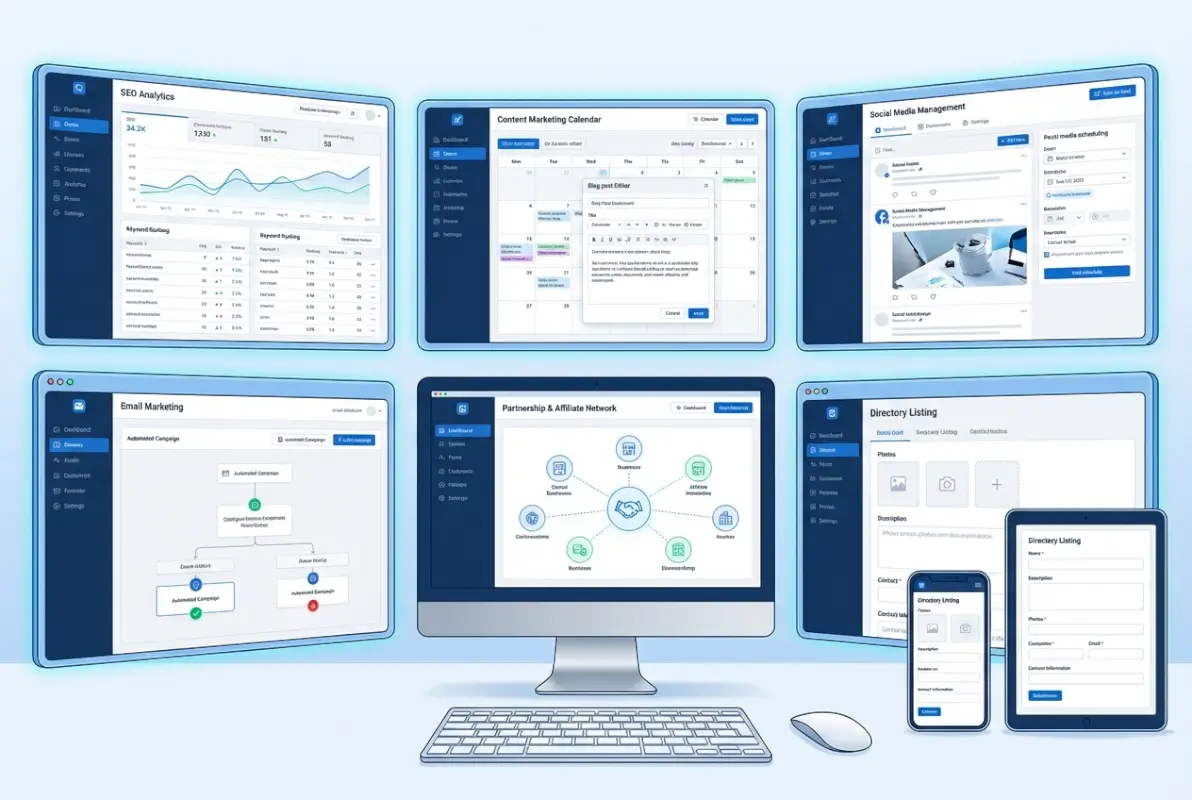
Organic submissions are great, but they’re rarely enough to reach critical mass quickly. The directories that scale fastest use proactive outreach and strategic partnerships to seed categories and sustain growth. This means treating listing acquisition like a sales and marketing funnel, with defined targets, outreach playbooks, and conversion tracking.
Proactive Outreach and Advertiser Partnerships
Direct outreach works, especially in niches where businesses actively seek marketing channels. Identify target verticals with high listing potential (e.g., home services, healthcare, professional services) and build prospecting lists. Use tools like LinkedIn Sales Navigator, local chamber directories, or even scraping tools (carefully, respecting terms of service) to gather contact info for decision-makers.
Your outreach message should lead with value: “I manage [Directory Name], which gets 10,000 monthly searches from people looking for [service]. I’d like to feature your business in our [Category] section—no cost for a basic listing, and we have premium options if you want enhanced visibility.” Personalize each message with a detail about their business (recent award, new location, unique service). Follow up 2-3 times if you don’t hear back (persistence converts).
For larger or more commercial directories, treat advertiser partnerships as a revenue stream and growth lever. Offer starter packs (e.g., “First 3 months free for premium listings”) to incentivize early adopters. Provide clear ROI messaging: exposure stats, lead estimates, and case studies from similar businesses. Renew partnerships by demonstrating performance through a self-serve analytics dashboard.
Community and Ecosystem Partnerships
Partnerships with established organizations provide instant credibility and access to bulk listings. Local chambers of commerce, industry trade associations (e.g., National Association of Realtors, state bar associations), and event organizers (conference sponsors, local fairs) already have curated lists of businesses in your target categories. Propose co-marketing arrangements: you provide their members with free or discounted listings, and they promote your directory in their newsletters and events.
For example, partner with a regional business expo to be the “official directory sponsor.” Offer every exhibitor a free enhanced listing and promote the directory in the event program. You gain 50-100 quality listings in one go, and the expo organizers get added value for their vendors. Win-win partnerships like these compound over time as you build a network of advocates.
Pioneer Listings and Starter Packs
When you’re launching a new category or entering a new geography, cold-start is the hardest phase. Nobody wants to be the first (or only) listing. Pioneer programs solve this by offering incentives to early submitters: free premium placement for the first 20 listings in a category, exclusive “founding member” badges, or guaranteed featured spots for 90 days.
Market these starter packs aggressively through targeted ads (Facebook, Google Local Services Ads) and outreach. Once you have a critical mass (typically 15-25 listings in a category), organic submissions pick up because the category looks active and credible.
Earned Media and Authority-Building
Publishing data-driven reports or trend analyses positions your directory as an industry authority and earns media coverage. For instance, aggregate anonymized data from your listings to produce a report like “The State of Pricing in Home Services” or “Top Growing Business Categories in Metro Austin.” Distribute it to local news outlets, trade publications, and bloggers in your niche. Each mention typically includes a backlink and drives referral traffic, both of which boost SEO and credibility.
Speaking engagements and webinars work similarly. Host a webinar on “How Local Businesses Can Improve Their Online Presence” and invite listing owners and prospects. You provide value, establish expertise, and create a natural segue to promoting listings on your platform.
Directory-Specific Outreach Playbooks
Consistency is key in outreach. Develop templated playbooks for each acquisition channel: cold email templates (with placeholders for personalization), LinkedIn message scripts, partner pitch decks, and co-marketing one-pagers. Track what works—subject lines, CTAs, follow-up cadences—and iterate. Over time, you’ll build a repeatable system that new team members can execute without reinventing the wheel.
Growth Levers: Traffic, SEO, and Listings Quality
Traffic and listings quality feed each other in a virtuous cycle: better listings rank higher and convert more visitors, which attracts more listings. Breaking into this cycle requires deliberate SEO tactics, technical excellence, and relentless iteration based on data.

SEO Fundamentals Tailored to Directories
Directory SEO hinges on long-tail and location-based queries. Most users don’t search “directory”—they search “emergency plumber near me” or “divorce lawyer in Dallas.” Your category pages and individual listings must target these queries. Conduct keyword research using tools like Ahrefs, SEMrush, or even Google’s autocomplete to identify high-volume, low-competition phrases in each category.
Ensure every category page and listing page is indexable (check your robots.txt and meta robots tags). Implement clean URL structures: `/category/plumbers-austin/` is far better than `/index.php?cat=12&loc=45`. Build robust internal linking: category pages should link to top listings and related sub-categories, and listing pages should link back to their category hub and to related listings. This distributes link equity and helps search engines understand your site structure.
Don’t neglect on-page SEO basics: title tags that include category and location, meta descriptions with compelling CTAs, H1 tags that match search intent, and alt text on images. For directories, freshness signals matter—regularly updated listings and category pages rank better than static ones.
If you’re interested in technical best practices, resources on open-source business directory software can offer insights into platform-level SEO configurations.
Local Signals and Reviews
Local SEO is a game of signals: name, address, phone (NAP) consistency, proximity to the searcher, and review quality/quantity. If your directory includes reviews, they’re a ranking factor (both on your site and indirectly through sentiment and engagement). Encourage listing owners to request reviews from customers, and make it easy with one-click review prompts or embeddable review widgets.
Respond to reviews—both positive and negative. Engagement signals activity and care, which search engines and users both value. Aggregate reviews into structured data (schema.org/Review) so they can appear in rich snippets. According to research from BrightLocal, 87% of consumers read online reviews for local businesses, and review recency is a major trust factor.
| Signal Type | Impact on Local SEO | Implementation Tip |
|---|---|---|
| NAP Consistency | High – reduces confusion for search engines | Validate via geocoding API on submission |
| Reviews (quantity & recency) | High – boosts credibility and CTR | Prompt for reviews; embed schema markup |
| Proximity to Searcher | Very High – Google prioritizes nearby results | Store lat/long; use GeoJSON for maps |
| Claimed & Verified Listings | Medium – signals authority and freshness | Email/SMS verification + dashboard access |
Backlinks and Authority
Domain authority matters, and you build it through high-quality backlinks. Focus on relevance: a link from a local chamber of commerce or a trade association site is worth more than a generic directory submission. Guest post on industry blogs, contribute expert quotes to journalists (use services like HARO), and publish original research that earns natural links.
Resource pages are goldmines. Many organizations maintain “useful links” or “member resources” pages; pitch them your directory as a valuable tool for their audience. Sponsor local events or charities in exchange for a link (and brand exposure). Over time, a diverse backlink profile signals to search engines that your directory is a trusted resource.
Avoid black-hat tactics like link farms or paid link schemes—they risk penalties and provide no long-term value. For directories, removing old or broken listings can also improve perceived quality and reduce link rot, indirectly benefiting your backlink profile.
Technical Health and Performance
Speed and mobile-friendliness are non-negotiable. Page load times above 3 seconds correlate with steep drop-offs, and Google uses Core Web Vitals as a ranking factor. Optimize images (use WebP format, lazy loading), minimize JavaScript bloat, and leverage CDN caching for static assets. Test your category and listing pages on mobile devices—if the layout breaks or navigation is clunky, you’re losing conversions and rankings.
Accessibility is both a legal requirement (in many jurisdictions) and a UX win. Ensure your site meets WCAG 2.1 Level AA standards: keyboard navigable, screen-reader friendly, sufficient color contrast, and descriptive link text. Accessible sites tend to have better overall UX, which improves engagement metrics that indirectly boost SEO.
Run regular technical audits using tools like Screaming Frog or Ahrefs Site Audit. Fix crawl errors (404s, redirect chains), resolve duplicate content issues (canonicalization), and ensure your XML sitemap is up to date. For directories, managing thousands of URLs means technical debt can accumulate quickly if you’re not vigilant.
Analytics-Driven Iteration
You can’t improve what you don’t measure. Track submissions per month, submission conversion rate (form starts to completions), listing activation rate (submitted to verified), and retention (listings renewed or updated). At the category level, monitor listing density (how many listings per category), average profile completeness, and traffic per category.
Set up funnel tracking in Google Analytics or a product analytics tool (Mixpanel, Amplitude) to identify drop-off points in your submission flow. If 50% of users abandon on page 2 of a multi-step form, that’s a red flag. A/B test changes (field order, copy, incentives) and measure impact on conversion rate. Small, iterative wins compound into significant growth.
Monetization, Pricing & Value Exchange
Monetization is where many directories struggle. Free-only models limit revenue and don’t incentivize listing quality, while overly aggressive paywalls scare off submissions. The sweet spot is a tiered model that offers a valuable free listing and clear upgrade paths that deliver ROI for paying customers.

Listing Tiers and Premium Exposure
A three-tier structure works well for most directories: Basic (free), Enhanced (mid-tier paid), and Featured (premium paid). The basic tier should provide real value—a complete profile, inclusion in category pages, basic schema markup—so businesses see results even without paying. This builds goodwill and trust, and many free users will upgrade once they see the benefit.
Enhanced listings add features that improve visibility and conversion: priority placement in category results, additional photos or video, custom branding (logo, color scheme), and analytics (profile views, click-throughs). Featured listings go further: homepage or category-hero placement, social media promotion, inclusion in email newsletters, and dedicated account support. Price each tier based on the value delivered (test willingness-to-pay through surveys or tiered landing pages).
Make the upgrade CTA clear and contextual. After a user submits a free listing, show a one-time offer for enhanced placement. Send follow-up emails 30 and 60 days post-submission with performance data (“Your listing got 47 views last month—upgrade to get 3x more”) and an upgrade link.
Advertising and Partner Programs
Display ads (Google AdSense, programmatic) are an easy monetization layer, but they’re low-margin and can clutter UX. Contextual or native ads work better: sponsored listings in category results (“Sponsored Plumber: XYZ Services”), banner placements on category pages, or promoted content in your blog. These are less intrusive and more relevant to users.
Partner programs open up B2B revenue. Offer white-label or co-branded directory solutions to industry associations or franchise networks. They get a turnkey directory for their members, and you get bulk listing fees and ongoing management revenue. Another model: affiliate partnerships where you earn a commission for leads or sales generated from your directory (works well for SaaS, e-commerce, or service marketplaces).
Tools for Listing Owners
Self-serve tools add value and reduce your support burden. Provide a dashboard where listing owners can update their profile, view performance analytics (views, clicks, leads), manage reviews, and upgrade their tier. Offer API access for businesses that want to sync data from their own systems (e.g., updating hours or services in bulk).
Renewal reminders and lifecycle emails keep engagement high. Notify users 30 days before a paid listing expires with renewal options and a summary of value received (“You got 150 inquiries this year—renew now to keep growing”). Automate as much of this as possible to scale without headcount.
Compliance, Trust, and Data Privacy
Transparent pricing and terms build trust. Publish a clear pricing page with no hidden fees, and provide straightforward terms of service that explain what listing owners can expect. If you collect user data (emails, business details), comply with GDPR, CCPA, and other privacy regulations—publish a privacy policy, offer opt-out mechanisms, and secure data with encryption.
Trust is your most valuable asset in a directory business. One data breach or shady pricing practice can tank your reputation overnight. Invest in security (SSL, regular penetration testing, secure authentication) and be proactive about communicating how you protect listing owners’ information.
Trust, Security, and User Experience
User experience and trust are intertwined. A cluttered interface, slow load times, or spam-filled listings erode confidence fast. The best directories obsess over UX details and proactively manage quality to ensure every visitor (and every listing owner) has a positive experience.
Moderation and Content Integrity
Spam and low-quality listings damage both SEO and user trust. Implement moderation workflows: new submissions enter a review queue where a team member (or automated filter) checks for completeness, accuracy, and policy compliance. Reject or flag listings with placeholder text, fake contact info, or spammy keywords. Provide feedback to rejected submitters so they can correct and resubmit.
Establish clear content guidelines: photo resolution minimums, description length requirements, prohibited content (illegal services, hate speech, deceptive claims). Display these guidelines on your submission page and enforce them consistently. A “report this listing” feature empowers users to flag issues, creating a community-moderation layer.
Security for Listing Owners
Listing owners entrust you with sensitive business data. Protect it. Use HTTPS everywhere, hash and salt passwords (never store plaintext), and offer two-factor authentication for dashboard logins. Regularly update your CMS and plugins to patch vulnerabilities. If you suffer a breach, disclose it promptly and transparently—transparency preserves trust even in crisis.
Secure your submission flow against automated abuse (bots, scrapers) with CAPTCHA or invisible reCAPTCHA. Rate-limit submission endpoints to prevent spam floods. Monitor for suspicious activity (bulk submissions from a single IP, identical contact info across listings) and investigate anomalies.
Accessibility and UX Benchmarks
Accessibility is both inclusive and practical. Screen readers, keyboard navigation, and high-contrast modes benefit users with disabilities, but they also improve usability for everyone (voice interfaces, mobile users with large fingers, etc.). Follow WCAG 2.1 guidelines: use semantic HTML, provide alt text for images, ensure sufficient color contrast, and make interactive elements keyboard-accessible.
UX benchmarks to aim for: page load under 2 seconds, mobile-responsive layout, intuitive search and filter controls, and clear calls-to-action. Run usability tests (user interviews, session recordings, heatmaps) to identify friction points and iterate. Small improvements—like moving a CTA button above the fold or simplifying filter labels—can yield measurable gains in engagement and conversions.
Measurement, KPIs & Optimization
Growth without measurement is guesswork. The directories that scale systematically define key performance indicators (KPIs), track them religiously, and run experiments to improve them. Your KPI dashboard should answer: Are we acquiring listings? Are those listings high-quality? Are they driving traffic and conversions?
Core Metrics to Track
Start with these KPIs and expand as your data infrastructure matures:
- Listings submitted per month: Volume trend over time, segmented by source (organic, outreach, partner).
- Activation rate: Percentage of submitted listings that complete verification and go live.
- Profile completeness: Average percentage of fields populated per listing (higher is better for SEO and UX).
- Traffic per category: Pageviews, unique visitors, and bounce rate for each category page.
- Lead/inquiry volume: Clicks on contact buttons, phone taps, form submissions generated from listings.
- Retention and renewal rate: Percentage of paid listings that renew (monthly or annually).
- ROI per listing tier: Revenue minus cost-to-acquire, segmented by free, enhanced, and featured tiers.
Visualize these metrics in a dashboard (Google Data Studio, Tableau, or custom analytics) and review weekly or monthly. Look for trends, outliers, and correlations (e.g., does higher profile completeness correlate with lower churn?).
Experimentation and A/B Testing
Don’t rely on intuition—test everything. Run A/B tests on submission flow variations (number of steps, field labels, CTA copy), pricing page layouts (monthly vs. annual pricing emphasized), and category page designs (grid vs. list view, filter placement). Use tools like Google Optimize, Optimizely, or VWO to split traffic and measure conversion impact.
Even small wins add up. A 5% improvement in submission conversion rate might mean 20 extra listings per month, which compounds as those listings rank and attract more users. Document test results and iterate continuously—optimization is never “done.”
For those just getting started, guides on starting a digital directory from scratch can provide a foundation before diving into advanced testing.
Benchmarking Against Competitors
Periodic competitive audits reveal gaps and opportunities. Identify 3-5 competing directories in your niche and analyze: How many listings do they have per category? What’s their pricing model? How complete are their profiles? What’s their domain authority and backlink profile? Use tools like Ahrefs, SEMrush, or SimilarWeb to gather data.
Look for categories where competitors are weak (few listings, outdated info) and prioritize growth there—you can capture market share quickly. Conversely, study categories where competitors excel and learn from their tactics (content strategy, partnerships, UX design).
Frequently Asked Questions
What is the best way to attract more listings to an online directory?
The best approach combines proactive outreach (direct emails, LinkedIn, phone), strategic partnerships (chambers, trade associations), and content marketing that demonstrates ROI for listing owners. Offer a valuable free tier to reduce friction, and use case studies to prove that your directory drives leads. Consistency and personalization in outreach matter more than volume.
How do I optimize directory listings for local SEO in 2026?
Focus on NAP consistency, structured data (schema.org/LocalBusiness), complete profiles with rich media, and user reviews. Ensure each listing page has unique, keyword-optimized content and that category pages target long-tail location-based queries. Mobile performance and page speed are critical ranking factors. Backlinks from local sources (chambers, local news) further boost authority.
Should I offer free listings or paid premium listings to grow my directory?
Offer both. A free tier attracts volume and builds trust, while premium tiers monetize engaged users and fund growth. Free listings should provide real value (profile, category placement, basic exposure) so businesses see benefit without paying. Premium upgrades (enhanced visibility, analytics, priority placement) convert users who want more ROI. Test pricing and feature bundles to optimize conversion.
How important are reviews and trust signals for directory listings?
Extremely important. Reviews influence both consumer decisions and search rankings. Research shows that 87% of consumers read reviews for local businesses, and listings with recent, positive reviews rank higher in local search. Implement structured review markup, encourage listing owners to request reviews, and respond to feedback to signal engagement. Verification badges and “claimed by owner” indicators also boost trust.
What are effective partnerships to grow a niche directory?
Partner with industry trade associations, local chambers of commerce, event organizers, and franchise networks. Offer their members free or discounted listings in exchange for promotion in newsletters and events. Co-branded directories or white-label solutions for associations provide bulk listings and recurring revenue. Sponsorships at local business expos or conferences can yield 50-100 listings in one go.
How do I ensure data accuracy and prevent listing fraud in a directory?
Use email or phone verification during submission to confirm legitimacy. Implement duplicate-detection logic (matching by name, address, phone) to prevent multiple submissions for the same business. Moderate new listings through a review queue, checking for completeness and policy compliance. Display “last updated” timestamps and send quarterly “confirm or update” emails to listing owners. Allow users to report suspicious listings and act on reports promptly.
What metrics matter most when evaluating directory growth?
Track listings submitted per month, activation rate (verified/live listings), profile completeness, category density (listings per category), traffic per category, and lead/inquiry volume generated from listings. For paid models, monitor retention/renewal rate and ROI per listing tier. These metrics reveal whether you’re acquiring quality listings, driving user engagement, and generating value for listing owners.
How can I improve my directory’s submission conversion rate?
Simplify your submission form—remove unnecessary fields and use smart defaults. Show a progress indicator for multi-step forms and provide inline validation to catch errors early. Offer a preview of how the listing will appear to build confidence. Use clear, benefit-focused copy (“Get discovered by local customers”) and social proof (listing count, testimonials). A/B test different form layouts and CTAs to identify the highest-converting version.
What role does structured data play in directory SEO?
Structured data (schema.org markup) helps search engines understand and display your listings in rich results—knowledge panels, local packs, and featured snippets. Implementing LocalBusiness, aggregateRating, and OpeningHoursSpecification schemas increases SERP visibility and click-through rates. It’s one of the highest-leverage SEO tactics for directories because it improves discoverability without requiring backlinks or content creation.
How often should I audit and update listings in my directory?
Conduct a comprehensive audit quarterly. Flag listings that haven’t been updated in 12+ months and send automated “confirm or update” requests. For high-value or frequently changing categories (e.g., restaurants with seasonal hours), consider monthly or even weekly checks. Encourage listing owners to claim their profiles and self-update through a dashboard—claimed listings stay fresher and more accurate, benefiting both SEO and user trust.
Bringing It All Together: Your Quarterly Growth Plan
Growing an online directory isn’t a one-time project; it’s a continuous cycle of optimization, acquisition, and iteration. The six strategic pillars we’ve covered—listings engine optimization, content strategy, proactive acquisition, SEO and traffic growth, monetization, and trust—work in concert, each reinforcing the others. When your listings engine is clean and rich, your SEO improves. When your content demonstrates ROI, your outreach converts better. When your trust signals are strong, both users and search engines reward you.
Here’s a repeatable quarterly plan to keep momentum: Start each quarter with a competitive audit and performance review (KPIs, category health, user feedback). Identify 2-3 priority categories to grow or optimize—maybe they’re high-traffic but low-density, or strategically important to your niche. Launch targeted outreach and partnership campaigns for those categories, using your refined playbooks and case studies. Simultaneously, run 3-4 experiments (A/B tests on pricing, submission flow tweaks, new content formats) to improve conversion and retention. Mid-quarter, review early results and adjust tactics as needed. End the quarter with a data retrospective: what worked, what didn’t, and what hypotheses to test next.
This cadence ensures you’re always moving forward, learning, and compounding small wins into significant growth. It also prevents the trap of “set it and forget it”—directories that stagnate are directories that lose to more agile competitors.
One last thought: don’t underestimate the power of community. Your listing owners, your users, even your competitors (in some cases) form an ecosystem around your directory. Engage them, listen to feedback, and co-create value. Host virtual meetups, publish user-generated success stories, and be generous with advice. A directory with a loyal community behind it is far more resilient and scalable than one that treats everyone as transactional.
Now it’s your turn. Take one section from this guide—maybe it’s optimizing your submission flow, maybe it’s launching a partnership campaign, maybe it’s implementing structured data—and commit to executing it this week. Growth compounds from small, consistent actions. In six months, you’ll look back and see how those incremental improvements transformed your directory’s trajectory.
Ready to take the next step? If you’re evaluating platforms or looking for templates to accelerate your launch, explore resources on business directory website templates to kickstart your platform with proven foundations.