5 Proven Ways to Monetize Your Local Business Directory in 2025

Generating summary...
Running a local business directory without a clear monetization strategy is like owning prime real estate and forgetting to collect rent. The opportunity cost is staggering—you’re sitting on a goldmine of local business connections, user traffic, and community trust, yet many directory owners struggle to convert that value into sustainable revenue. The difference between a hobby directory and a profitable business asset comes down to implementing the right monetization framework at the right time.
What most directory owners miss is this: monetization isn’t about squeezing every penny from your audience—it’s about creating value exchanges that benefit everyone involved. Businesses get visibility and leads, users find what they need faster, and you build a sustainable operation that funds growth and improvement. The challenge lies in balancing these interests without degrading the user experience that makes your directory valuable in the first place.
- Premium listings create tiered value that appeals to businesses of all sizes while maintaining free options
- Lead generation services command the highest prices because they deliver measurable ROI to businesses
- Subscription models provide predictable recurring revenue essential for long-term stability
- Strategic partnerships and affiliate relationships generate passive income streams
- Local events and sponsorships build community while opening additional revenue channels
- Diversification across multiple channels protects against market fluctuations and platform changes
Understanding the Local Directory Monetization Landscape
The local directory business model has evolved dramatically over the past few years. What worked in 2020 doesn’t necessarily work now, and what works today might need adjustment tomorrow. The Forbes Councils perspective on local content strategy in 2025 emphasizes that traditional directory approaches—simply listing businesses alphabetically with contact information—no longer cut it in an era of Google Business Profiles and AI-driven search results.

Today’s successful directories position themselves as community hubs rather than digital yellow pages. They provide context, curation, and connection—three things that massive platforms like Google can’t replicate at the hyper-local level. This creates unique monetization opportunities, but you need to understand the competitive landscape first.
Most directory owners make the mistake of implementing monetization too aggressively too early, or waiting too long until they’ve lost momentum. The sweet spot typically comes when you’ve reached critical mass—enough listings and traffic that businesses see tangible value in premium positioning. For most local directories, this means at least 100-150 active listings and 1,000+ monthly visitors in your target geographic area.
The data tells an interesting story: successful directories don’t try to monetize everything. Instead, they focus on 3-4 core revenue streams and execute them exceptionally well. This aligns with the SBA-local marketing strategies and guidance which emphasize depth over breadth when developing revenue models for local businesses.
Premium Listings and Tiered Placement Strategy
Premium listings form the foundation of directory monetization for good reason—they’re straightforward to implement, easy for businesses to understand, and provide clear value differentiation. The model works because businesses instinctively understand that better placement drives more visibility, and visibility drives more customers. What separates successful implementations from mediocre ones is the tiering strategy and how you communicate value at each level.

I remember consulting with a directory owner who initially offered just two options: free and premium at $99/month. Conversion rates were dismal at around 3%. After restructuring to a four-tier model ($0, $29, $79, $199), conversion to paid listings jumped to 18%, with most businesses selecting the $79 tier. The premium tier essentially functioned as a price anchor that made the middle options feel like bargains—a psychological pricing strategy that consistently works across industries.
Structuring Your Pricing Tiers
Your tier structure should create clear visual and functional differentiation while ensuring each level delivers proportional value. Here’s a framework that works across most directory types:
| Tier | Monthly Price | Key Features | Best For |
|---|---|---|---|
| Basic (Free) | $0 | Name, address, phone, basic category | New businesses, maximum coverage |
| Enhanced | $29-39 | Photos, extended description, social links, hours | Small businesses wanting more visibility |
| Featured | $79-99 | Priority placement, badge, video, analytics | Established businesses in competitive categories |
| Premium | $199-299 | Top placement, category exclusivity, lead routing | High-volume businesses seeking maximum exposure |
The free tier serves a strategic purpose beyond just attracting listings—it creates network effects. The more complete your directory, the more valuable it becomes to users, which in turn makes premium placements more valuable to businesses. This is why successful business directory website complete guide implementations always maintain robust free listing options alongside paid upgrades.
Selling Premium Value Effectively
The biggest mistake directory owners make isn’t in their pricing structure—it’s in how they communicate value. Businesses don’t buy features; they buy outcomes. Instead of saying “Your listing will appear in the top three results,” say “Businesses in top positions receive an average of 7.3x more profile views and 4.2x more clicks to their website.”
Create simple ROI calculators that show businesses exactly what they need to understand: if premium placement costs $79/month and generates just two additional customers worth $100 each, it pays for itself 2.5 times over. Make the math obvious and the decision becomes easier.
Lead Generation Services That Command Premium Prices
If premium listings are the bread and butter of directory monetization, lead generation services are the premium steak. Businesses will pay significantly more for qualified leads than they will for visibility alone because leads represent immediate revenue potential rather than brand awareness. The difference in pricing power is substantial—while premium listings might command $79-199/month, effective lead generation services can charge $25-75 per lead or 5-15% of transaction value.

The key word here is “qualified.” Random contact form submissions have minimal value, but leads that have been pre-screened for budget, timeline, and specific needs are gold. This is where most directories fall short—they capture leads but don’t qualify them, leading to low conversion rates and disappointed business clients.
Building a Lead Qualification System
Your lead capture mechanism should gather information that helps businesses prioritize and convert. For service-based directories, this typically includes:
- Specific service needed (not just general category)
- Timeline for project or purchase (immediate, 1-3 months, researching)
- Budget range (use ranges to reduce friction)
- Contact preferences (call, email, text)
- Geographic specificity (exact address or neighborhood)
Each data point increases the lead value but also increases form abandonment. The balance depends on your niche—high-value services (contractors, legal, medical) can support longer forms, while quick-decision categories (restaurants, retail) need minimal friction.
| Pricing Model | How It Works | Average Rate | Best For |
|---|---|---|---|
| Pay-Per-Lead | Fixed fee per qualified lead delivered | $25-75 | High-value services (contractors, legal) |
| Exclusive Leads | Lead goes to single business | $45-150 | Premium businesses wanting exclusivity |
| Shared Leads | Lead distributed to 3-5 businesses | $15-30 | Competitive markets, volume plays |
| Subscription Access | Monthly fee for category lead access | $199-499/mo | High-volume businesses |
A directory I worked with serving home improvement contractors implemented a smart lead distribution system that transformed their business model. Instead of sending every lead to every contractor (which created chaos), they implemented a rotation system weighted by subscription tier. Premium members got first access to exclusive leads for 2 hours before leads were shared with lower tiers. This created clear value differentiation and dramatically increased premium subscriptions.
Measuring and Optimizing Lead Quality
The sustainability of lead generation monetization depends on maintaining quality. Implement feedback loops where businesses rate lead quality, and use this data to refine your qualification questions. If businesses consistently report that leads from a particular traffic source convert poorly, you can either improve qualification for that source or exclude it entirely.
Track these key metrics:
- Lead-to-contact rate (what percentage of leads respond to business outreach)
- Lead-to-conversion rate (what percentage become customers)
- Average deal value from directory leads
- Business satisfaction scores with lead quality
These metrics justify your pricing and provide talking points when selling lead generation services. When you can tell a business “Our leads convert at 18% compared to the industry average of 7%,” pricing conversations become much easier. This approach aligns with how to start profitable business directory steps that focus on demonstrable ROI rather than just traffic metrics.
Subscription Models for Predictable Recurring Revenue
The holy grail of any business is predictable, recurring revenue—and subscription models deliver exactly that. Unlike one-time payments or per-transaction fees, subscriptions create financial stability that allows you to plan investments, hire team members, and weather market fluctuations. For directory owners, the transition from transactional to subscription-based revenue represents a fundamental business maturation.
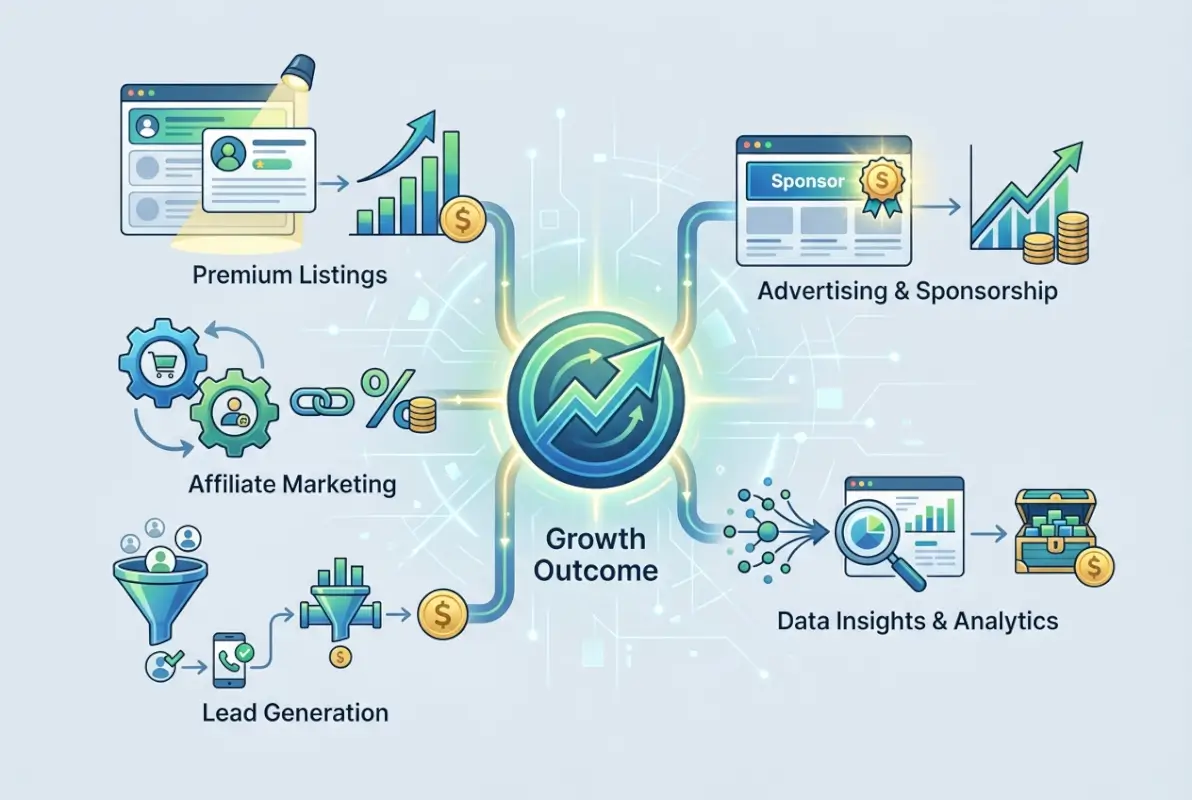
What makes subscriptions powerful isn’t just the recurring revenue (though that’s certainly valuable), it’s the relationship dynamic they create. Subscription customers expect ongoing value delivery, which forces you to continually improve your platform rather than resting on your laurels after a one-time sale. This creates a virtuous cycle where better service drives higher retention, which funds further improvements.
Designing Subscription Tiers That Convert
The psychology of subscription pricing differs from one-time purchases. People evaluate subscriptions based on ongoing perceived value rather than absolute cost. A business owner might balk at paying $500 upfront but happily commit to $49/month (which totals $588 annually) because the monthly cost feels manageable and can be evaluated month-to-month.
Your subscription structure should offer clear upgrade paths that businesses naturally want to climb as they grow. Consider this framework:
Progressive Subscription Strategy
Notice how each tier builds on the previous one rather than offering completely different features. This makes the upgrade decision easier because businesses aren’t abandoning their previous investment, they’re enhancing it. The business directory boosts local marketing potential increases dramatically when you structure subscriptions around progressive value delivery.
Retention Strategies That Matter
Acquiring subscribers is only half the battle—keeping them is where the real value accumulates. A subscriber who stays for 24 months is worth 10x more than one who churns after two months (when you factor in acquisition costs). Yet many directory owners obsess over new subscriptions while ignoring retention metrics.
Implement these retention tactics:
- Automated usage reports showing subscribers their profile views, clicks, and leads generated
- Quarterly business reviews for premium tier subscribers
- Early renewal incentives (10-15% discount for annual prepay)
- Proactive feature education through email sequences
- Personalized upgrade suggestions based on usage patterns
I’ve seen retention rates improve from 67% to 84% simply by implementing monthly value reports that showed businesses exactly what they were getting from their subscription. When businesses can see concrete metrics, subscription renewal becomes automatic rather than a monthly decision point.
Strategic Partnerships and Affiliate Revenue Streams
While premium listings and subscriptions require active selling, strategic partnerships and affiliate relationships can generate passive income once established. The key is finding alignment between your audience’s needs and partner offerings—when done right, partnerships feel like genuine recommendations rather than advertisements.

The mistake most directory owners make with partnerships is treating them as pure revenue plays without considering user value. If you’re running a restaurant directory and partner with unrelated software companies just because they offer affiliate commissions, you’re burning trust for pennies. But if you partner with reservation platforms, POS systems, or food photography services that restaurants genuinely need, you’re providing value while generating revenue.
Identifying High-Value Partnership Opportunities
The best partnerships solve specific problems your listed businesses face. For different directory types, this might look like:
- Service directories: Insurance providers, payment processing, scheduling software, invoicing tools
- Restaurant directories: Reservation systems, menu design services, food photography, delivery platforms
- Retail directories: E-commerce platforms, inventory management, point-of-sale systems, marketing tools
- Professional services: Practice management software, CRM systems, virtual meeting platforms, appointment booking
For directory owners seeking comprehensive solutions, TurnKey Directories offers WordPress-based platforms that include built-in partnership and affiliate management capabilities, making it easier to implement these revenue streams without extensive custom development.
Structuring Partnership Agreements
Partnership arrangements typically fall into three categories, each with different economics:
Affiliate commissions: You earn a percentage (typically 10-30%) of revenue generated from businesses you refer. This works well for software-as-a-service products with recurring revenue models. The lifetime value of referrals can be substantial—a single restaurant you refer to a reservation platform might generate $30-50 in monthly commissions for years.
Referral fees: You receive a flat fee for each qualified referral, regardless of transaction size. Common in service industries (insurance, financial services) where transaction values vary widely. Typical fees range from $50-500 depending on the service value.
Revenue sharing: You and your partner split revenue from co-created offerings. For example, you might co-develop a “directory optimization service” with a marketing agency, where you provide the platform knowledge and they deliver the service, splitting revenue 40/60.
According to Google AdSense policies for monetized content, transparency is critical—you must disclose affiliate relationships and partnerships clearly to users. This isn’t just about regulatory compliance; it builds trust when users understand your business model.
Implementation Without Compromising User Experience
The integration approach matters enormously. Compare these two scenarios:
Poor implementation: Random banner ads for partner services scattered throughout the site, with no contextual relevance to what users are viewing.
Effective implementation: A “Business Resources” section for each category with curated, relevant partner offerings. For restaurants, this might include sections on “Reservation Management,” “Marketing Tools,” and “Operations Software,” each featuring 2-3 vetted partner solutions with clear descriptions of how they help businesses.
The latter approach generates higher conversion rates (sometimes 5-10x higher) while actually enhancing user experience rather than degrading it. You’re functioning as a trusted advisor rather than just an ad platform.
Local Events, Webinars, and Sponsorship Opportunities
Physical and virtual events transform your directory from a passive platform into an active community hub, creating unique monetization angles while strengthening relationships with local businesses. This strategy works particularly well for niche directories serving specific industries or tight geographic areas where community identity is strong. The ListedIn business directory key benefits for your business include exactly this type of community building that drives long-term value.
Events generate revenue through multiple channels simultaneously—ticket sales, sponsorships, exhibitor fees, and post-event content monetization—while building goodwill that supports your other revenue streams. A business that attends your networking event and makes valuable connections is far more likely to maintain their premium subscription.
Virtual Events With Low Barriers to Entry
Virtual events have dramatically lowered the startup costs for directory owners to organize professional gatherings. You don’t need venue rentals, catering, or complex logistics—just a video platform and content worth attending. Consider these event formats:
- Industry-specific webinars: Expert presentations on topics relevant to your directory categories (45-60 minutes)
- Panel discussions: Multiple perspectives on current industry challenges (60-90 minutes)
- Virtual networking sessions: Structured networking with breakout rooms for targeted connections (60 minutes)
- Showcase events: Businesses present their offerings to an engaged audience (90-120 minutes)
- Training workshops: Tactical skill-building sessions that businesses can immediately apply (2-3 hours)
A wellness directory I consulted with implemented monthly “Wellness Wednesday” webinars featuring different practitioners each month. What started as a free community-building initiative evolved into a revenue stream when they noticed businesses were eager to present. They now charge $350-500 for featured presentation slots while keeping general attendance free, generating $1,400-2,000 monthly while building community loyalty.
| Revenue Source | Format | Typical Rate | Implementation Effort |
|---|---|---|---|
| Attendee Tickets | Individual or bundle passes | $15-49 per event | Low |
| Presenting Slots | Featured presentation time | $350-500 | Medium |
| Event Sponsorships | Logo placement, mentions, materials | $1,000-3,000 | Low |
| Recording Access | Post-event content library | $99-199 annual | Low |
Hybrid and In-Person Events for Deeper Engagement
Once you’ve established a successful virtual event cadence, hybrid or fully in-person events offer opportunities for premium pricing and deeper relationship building. Local business expos, industry conferences, or networking mixers create face-to-face connections that virtual events can’t replicate.
The economics differ significantly from virtual events—higher costs but also higher revenue potential. A well-executed local business expo might generate $15,000-30,000 in revenue through exhibitor fees ($200-500 per booth), sponsorships ($1,000-5,000 per sponsor level), and attendee tickets ($25-75 per person), but requires venue rental, insurance, and logistics coordination.
Content Repurposing for Extended Value
The revenue opportunities don’t end when the event closes. Event recordings, transcripts, and derivative content can be packaged for ongoing monetization. Create an “Event Archive” membership where businesses can access past presentations, panel discussions, and training content for $99-199 annually. This turns one-time event effort into recurring passive revenue while providing genuine value to businesses who couldn’t attend live or want to reference material later.
Frequently Asked Questions
How much can I realistically earn from a local business directory?
Revenue potential varies significantly based on niche, geographic area, and implementation quality. Successful local directories typically generate $5-15 monthly revenue per active business listing across all channels. A directory with 200 active listings might reasonably target $1,000-3,000 monthly revenue once monetization is established, scaling upward as you add listings and optimize conversion. Premium niches and exclusive territories can support significantly higher per-listing revenue.
What is the best monetization method for a new directory?
Start with tiered premium listings as your primary revenue stream because they’re straightforward to implement and easy for businesses to understand. Offer a robust free tier to build inventory and traffic, then introduce 2-3 paid tiers with clear value differentiation. Once you have 100+ active listings and meaningful traffic, layer in lead generation or strategic partnerships as your second revenue stream. Avoid trying to monetize everything at once.
How do I price my premium listings competitively?
Research what businesses in your niche pay for comparable visibility channels (Google Ads, local magazine ads, chamber memberships). Position your premium listings at 30-50% below these alternatives while emphasizing your qualified local audience. Test different price points with small cohorts, tracking both conversion rates and retention. Most directories find their sweet spot between $49-99/month for mid-tier offerings. Category-based pricing lets you charge premium rates in competitive niches.
Should I charge businesses or users for directory access?
Nearly all successful local directories monetize on the business side while keeping user access free. Charging users creates a barrier to traffic growth, which ultimately makes your platform less valuable to businesses. The exceptions are highly specialized B2B directories serving professional audiences willing to pay for exclusive vetted connections. For consumer-facing local directories, free user access with business-side monetization is the proven model.
How do I balance monetization with user experience?
Successful monetization enhances rather than degrades user experience by ensuring financial sustainability that funds platform improvements. The key is maintaining clear value exchange—premium placements should go to quality businesses, not just whoever pays. Avoid intrusive advertising formats that disrupt browsing. Implement sponsored content transparently with clear disclosure. When users trust that paid placements still represent quality options, everyone benefits from the business model.
What conversion rate should I expect from free to paid listings?
Industry benchmarks suggest 12-18% conversion from free to paid listings when value proposition and pricing are well-optimized. New directories often see 5-8% initially, improving as you refine messaging and demonstrate ROI. Premium tier conversion (from basic paid to higher tiers) typically runs 15-25%. Track these metrics monthly and test different approaches to pricing, feature sets, and sales messaging to optimize performance over time.
How long does it take to generate meaningful revenue from a directory?
Most directories require 6-12 months to reach $1,000+ monthly revenue, though this varies based on market size and execution quality. The first 90 days focus on building inventory and traffic without aggressive monetization. Months 4-6 introduce premium options to early adopters. By months 7-12, you refine pricing, add secondary revenue streams, and scale acquisition. Directories in underserved niches or exclusive territories can accelerate this timeline, while competitive markets may take longer.
What legal considerations apply to directory monetization?
Key legal areas include clearly disclosing affiliate relationships and sponsored content, complying with data protection regulations when collecting user information, establishing clear terms of service for both businesses and users, and maintaining accurate business information to avoid liability issues. For lead generation, implement transparent opt-in processes and honor user privacy preferences. Consult with legal counsel familiar with online platforms in your jurisdiction to ensure compliance.
Can I run a profitable directory part-time?
Many successful directory owners start part-time while maintaining other income sources. The platform aspects can be largely automated, but business outreach, content creation, and relationship building require consistent effort. Expect to invest 10-15 hours weekly minimum during the growth phase. Once systems are established and you have stable recurring revenue, maintenance can drop to 5-10 hours weekly. The key is focusing efforts on high-leverage activities rather than trying to do everything manually.
How do I compete with free platforms like Google Business Profile?
Compete on curation, context, and community rather than trying to replicate Google’s massive scale. Google provides basic information, but you can offer curated recommendations, neighborhood expertise, detailed industry-specific criteria, and community connections that algorithms can’t match. Position your directory as complementary to rather than competitive with GBP—businesses can maintain both. Your value proposition is quality and relevance for a specific niche or geography, not attempting to be everything to everyone.
Building Your Monetization Roadmap
The difference between directories that generate meaningful revenue and those that become abandoned side projects comes down to implementing a systematic monetization strategy rather than hoping revenue materializes organically. The tactics covered in this article—premium listings, lead generation, subscriptions, partnerships, and events—work synergistically when implemented thoughtfully over time.
Start with one primary revenue stream and execute it well before adding complexity. For most directories, tiered premium listings provide the most straightforward starting point because they’re simple to implement and easy for businesses to understand. Once you’ve achieved consistent conversions and refined your value proposition, layer in complementary streams like lead generation or strategic partnerships.
Your 90-Day Action Plan
Transform your directory from a listing platform into a revenue-generating business asset with this phased implementation approach.
- Audit current listings and traffic patterns
- Design 3-tier premium listing structure
- Create value proposition messaging and ROI calculators
- Set up payment processing and subscription management
- Soft launch premium listings to existing relationships
- Implement lead capture forms in 2-3 high-traffic categories
- Begin outreach to potential strategic partners
- Track conversion metrics and gather feedback
- Refine pricing based on initial conversion data
- Launch lead generation program with qualified businesses
- Finalize 1-2 strategic partnerships or affiliate relationships
- Plan first virtual event or webinar for month 4
Remember that monetization isn’t a one-time setup but an ongoing optimization process. The most successful directory owners treat revenue generation as a core product feature rather than an afterthought, continuously testing pricing, messaging, and value propositions to maximize both business revenue and customer satisfaction.
The local directory landscape continues to evolve, but the fundamentals remain constant: provide genuine value to businesses and users, maintain trust through transparency, and build sustainable revenue streams that fund continued improvement. By implementing the strategies outlined in this article, you’re positioning your directory not just as another listing site, but as an essential community resource that generates meaningful returns while serving your local business ecosystem.
Your directory has value—now it’s time to capture that value systematically while building something that serves your community for years to come.
Was this article helpful?