How to Start a Profitable Directory Business in 2025: 7 Steps That Actually Work

Generating summary...
Most guides on starting a directory business read like they were written in 2015—outdated advice about Yellow Pages-style listings that nobody uses anymore. The truth? Directory businesses in 2025 are thriving, but not the way you’d expect. The successful ones aren’t just listing businesses—they’re solving specific problems, curating experiences, and building communities around hyper-focused niches.
I’ve watched dozens of directory entrepreneurs launch over the past few years, and the pattern is clear: the ones who succeed aren’t following traditional playbooks. They’re leveraging modern monetization strategies, using AI for content enrichment, and building network effects that make their directories indispensable. According to Statista’s digital market insights, the online directory sector continues to show resilience and growth potential, especially in specialized niches where users crave curated, trusted information.
In this guide, I’ll walk you through the exact framework that’s working right now—not theory, but practical steps backed by real data from successful directory operators. Whether you’re looking to replace your income or build a scalable asset, these seven steps will give you a realistic path forward.
TL;DR – Quick Takeaways
- Niche specificity wins – General directories compete with Yelp and Google; specialized directories own their categories
- Multiple revenue streams essential – Successful directories combine 3-5 monetization methods (listings, ads, lead-gen, premium features)
- Pre-populate before launch – Launch with 50-100 quality listings minimum or users won’t return
- Local SEO drives growth – Directory pages optimized for location + service queries capture high-intent traffic
- Time to profit: 12-18 months – Realistic timeline for most niches with consistent execution
- Quality over quantity always – 100 verified, detailed listings outperform 1,000 thin ones
Understanding the Modern Directory Landscape
Before we dive into the steps, let’s get clear on what actually works in the directory space today. The directory model has evolved significantly—it’s not about being a comprehensive phonebook anymore. Modern successful directories share three characteristics: extreme niche focus, verified quality over quantity, and solving a specific user problem beyond just “finding businesses.”
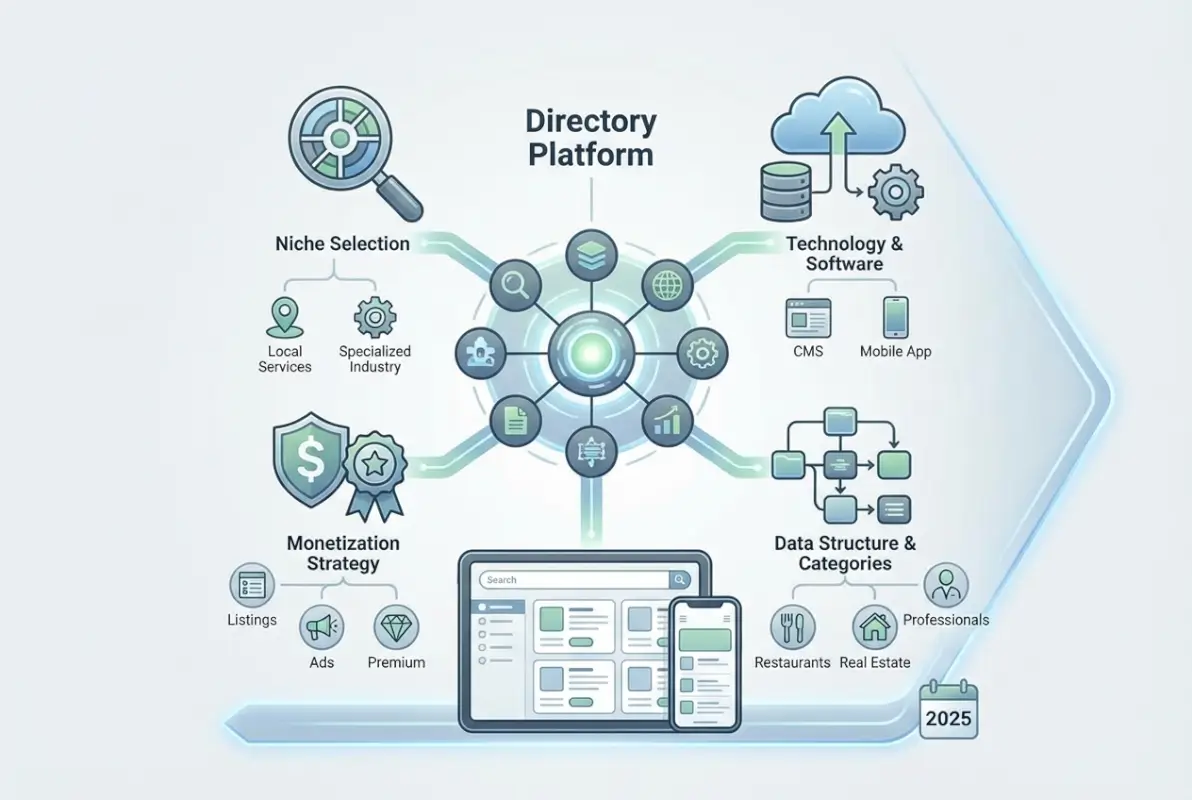
Take Houzz, for example. They didn’t try to be “all home services”—they focused on design inspiration combined with professional connections. Or consider The Knot, which dominates wedding vendors not by listing everyone, but by curating trusted providers and facilitating the entire planning process. These platforms understood something crucial: users don’t want endless options, they want the right options.
The competitive landscape has shifted, too. You’re not competing with Yelp or Google Business Profile directly (that’s a losing battle). You’re competing on curation, specialization, and depth of information within your niche. Forbes notes that business directories remain crucial for local SEO, but the value now comes from contextual relevance rather than simple listing presence.
What Makes a Directory Profitable in 2025
Profitability comes down to three core economics: customer acquisition cost (CAC) for both users and listed businesses, average revenue per listing (ARPL), and the network effect multiplier as your directory grows. The magic happens when your directory becomes the default destination for your niche—when businesses need to be listed and users automatically check your site first.
Successful directories I’ve analyzed typically hit these benchmarks: monthly revenue per paid listing between $50-$500 (varies by niche), conversion rate from free to paid listings around 8-15%, and organic traffic comprising 60-80% of total visitors within 18 months. Your specific numbers will depend heavily on your niche selection, which brings us to step one.
Step 1: Choose Your Niche (The Make-or-Break Decision)
This is where most directory entrepreneurs either set themselves up for success or guarantee failure. The temptation is to go broad—”all restaurants in my city” or “every home service provider.” Resist it completely. The riches genuinely are in the niches, especially when you’re starting without massive capital.
Your ideal niche sits at the intersection of four factors: sufficient search demand (minimum 1,000+ monthly searches for relevant terms), businesses with marketing budgets willing to pay for visibility, a specific problem you can solve better than existing solutions, and personal interest or expertise that’ll sustain you through the building phase.
| Niche Type | Competition Level | Avg. Listing Value | Time to Profit |
|---|---|---|---|
| Wedding Vendors | Medium | $200-400/mo | 12-15 months |
| Healthcare Specialists | Medium-High | $300-600/mo | 15-24 months |
| Pet Services | Low-Medium | $100-250/mo | 9-14 months |
| B2B Services | Low | $400-800/mo | 12-18 months |
| Specialty Retail | Medium | $150-300/mo | 10-16 months |
Validating Your Niche Before Committing
Don’t skip validation. I’ve seen too many entrepreneurs spend months building a directory only to discover there’s no market. Use Google Keyword Planner to research search volumes for “[service] + [location]” patterns in your niche. Look for consistent monthly searches above 500 per major city or region.
Check existing competition—but don’t let it scare you off entirely. Some competition validates demand. What you’re looking for are gaps: outdated designs, poor mobile experience, missing features, limited geographic coverage, or weak content. These gaps are your opportunities to differentiate.
Geographic scope matters more than you’d think. Starting with a single metro area or region lets you dominate locally before expanding. A directory that owns “Austin wedding photographers” is more valuable than one with sparse coverage of photographers across 50 cities.
Step 2: Build Your Directory Platform (Technology Choices That Matter)
The technical foundation of your directory business doesn’t need to be complicated, but it does need to be right. You have essentially three paths: WordPress with directory plugins, specialized directory platforms, or custom development. For 95% of directory entrepreneurs, WordPress with quality plugins offers the best balance.

WordPress powers over 40% of the web for good reasons—it’s flexible, well-supported, and has mature directory plugins that handle the heavy lifting. The business directory website complete guide approach using WordPress means you’re working with proven technology rather than reinventing the wheel.
Key features your platform absolutely must have include advanced search with multiple filter options (location, category, price, ratings, etc.), listing management dashboard where businesses can claim and update their profiles, review and rating system with moderation capabilities, mobile-responsive design (60%+ of directory searches happen on mobile), mapping integration for location-based searches, and payment processing for paid listings and upgrades.
| Platform Option | Setup Time | Initial Cost | Flexibility | Best For |
|---|---|---|---|---|
| WordPress + Plugins | 1-2 weeks | $500-1,500 | High | Most entrepreneurs |
| TurnKey Solution | 2-3 days | $1,000-2,500 | Medium-High | Fast launch needed |
| SaaS Platform | 1-3 days | $50-200/mo | Low-Medium | Non-technical users |
| Custom Development | 2-6 months | $10,000-50,000+ | Maximum | Unique requirements |
Essential Technical Considerations
Performance and SEO should drive every technical decision. Directory sites can become slow if not optimized properly—hundreds of listings, images, and database queries add up. Use quality hosting (avoid bottom-tier shared hosting), implement caching aggressively, optimize images automatically, and use a CDN for static assets.
For SEO, each listing should generate its own optimized page with proper schema markup. Google’s SEO Starter Guide emphasizes the importance of unique, valuable content on each page—which means encouraging detailed business profiles, not thin listings with just name and address.
Don’t forget about user experience elements that seem minor but matter enormously: autocomplete in search fields, filter options that actually match how users think, breadcrumb navigation for SEO and usability, “near me” functionality using geolocation, and one-click contact or booking where possible. These details separate directories that feel modern from ones that feel dated.
Step 3: Populate Your Directory Before Launch
This step trips up more directory entrepreneurs than any other. You absolutely cannot launch an empty directory and expect to attract either users or paying businesses. It’s the classic chicken-and-egg problem, and the solution is simple: you need to be the chicken farmer who provides both sides initially.

Aim for 75-150 listings in your core categories before public launch. These don’t all need to be paid listings (that comes later), but they need to be real, accurate, and reasonably complete. There are several ethical ways to populate your directory initially.
Start with public information—business names, addresses, phone numbers, websites, and basic descriptions based on their own websites. This is all publicly available data. Then, create a claiming process where businesses can take ownership of their listing and enhance it with photos, extended descriptions, and special offers. Many will do this for free just to control their presence on a new platform.
Data Quality and Verification Processes
Quality beats quantity every single time in the directory business. A hundred verified, detailed listings with photos and reviews will outperform a thousand thin, outdated listings every day of the week. Implement verification processes from day one: email verification for claimed listings, phone verification for premium tiers, documentation requirements for licensed professionals (healthcare, legal, etc.), and regular audit cycles to remove closed businesses.
Consider offering “founding member” status to the first 50 businesses that claim and complete their profiles. This creates social proof and gives you testimonials. Price it at a significant discount—maybe $99/year instead of your planned $299—in exchange for a 2-year commitment and a testimonial quote.
Step 4: Implement Multi-Channel Monetization
Relying on a single revenue stream is the fastest way to build an unstable directory business. The most successful directory operators I know typically use 4-6 different monetization methods simultaneously. This creates resilience and maximizes the value you extract from your traffic.

The foundation is usually tiered listing packages: free basic listings (name, category, location, basic contact info), standard paid listings ($99-299/year with photos, description, website link, social links), premium listings ($299-599/year with everything plus featured placement, enhanced profile, priority in search), and featured/sponsored positions (additional $50-200/month for homepage placement or category top spots).
Beyond listing fees, consider these additional revenue streams that directory profit calculators show can add 40-60% to your total revenue: display advertising (banner ads on high-traffic pages), sponsored content (featured articles about specific businesses), lead generation fees (pay-per-lead for high-value services), affiliate partnerships (tools and services your niche needs), and premium features à la carte (video uploads, promotional boosts, analytics access).
| Revenue Stream | Implementation Difficulty | Revenue Potential | When to Add |
|---|---|---|---|
| Listing Subscriptions | Easy | High | Day one |
| Featured Placements | Easy | Medium-High | Month 3-6 |
| Display Advertising | Medium | Medium | Month 6-12 |
| Lead Generation | Hard | Very High | Month 12-18 |
| Affiliate Partnerships | Easy-Medium | Low-Medium | Month 6-9 |
Pricing Strategy That Converts
Pricing is part psychology, part math. Research what businesses in your niche typically pay for marketing—Google Ads, Facebook ads, traditional advertising. If they’re spending $500-1,000/month on marketing, a $299/year directory listing is a no-brainer if you can demonstrate value.
Start with lower prices to gain traction, then increase as you prove ROI. I’ve seen directory operators successfully double their pricing after 12-18 months once they had traffic data and testimonials to back up the value. Grandfathering early adopters at lower rates creates goodwill while you charge new customers market rates.
The approach outlined in monetize business directory strategies emphasizes starting with a simple model and adding complexity gradually. Don’t overwhelm yourself (or your customers) with 47 different packages and options. Start with free, standard, and premium. Add more sophisticated options as you learn what your market values.
Step 5: Launch With Strategic Marketing
Your launch isn’t a single event—it’s a process spanning 4-8 weeks. The pre-launch phase (weeks 1-3) focuses on building anticipation and getting those initial listings in place. Soft launch (weeks 4-5) means opening to early adopters and collecting feedback. Public launch (week 6) is your big push for visibility. And post-launch momentum (weeks 7-8+) is about maintaining the energy and iterating based on real user data.
SEO is your long-term traffic engine and needs to start from day one. Every listing page should target “[business type] + [location]” queries. Category pages should target broader terms. Blog content should address questions your audience asks. The business directory boosts local marketing efforts through structured local SEO—optimize for it deliberately.
Content Marketing and Community Building
Content serves double duty—it attracts organic traffic and establishes authority in your niche. Create comprehensive guides related to your niche (“Ultimate Guide to Choosing a Wedding Photographer”), comparison articles (“5 Types of Physical Therapists and Which One You Need”), and local area guides (“Best Dog-Friendly Hiking Trails in Portland”).
Each piece of content should naturally link to relevant directory categories and featured businesses. This internal linking structure helps SEO while driving users to your monetized pages. Update content quarterly to keep it fresh and maintain rankings.
Don’t sleep on email marketing either. Build a list from day one—both consumers interested in your niche and businesses who might list. According to research, email marketing consistently delivers among the highest ROI of any channel. Send weekly or bi-weekly updates featuring new listings, helpful content, and special offers.
Step 6: Optimize and Scale Systematically
Once you’ve launched and have real user data flowing in, the optimization phase begins. This is where good directories become great ones. Track everything: listing views, click-through rates to business websites, search queries (what are people looking for?), conversion rates at each funnel stage, and revenue by listing type and tier.
Use this data to make informed decisions. If premium listings aren’t converting, is the value proposition unclear? Are they priced wrong? Is the difference between standard and premium too subtle? If certain categories get tons of searches but few listings, that’s a growth opportunity—recruit businesses in those categories.
Geographic and Category Expansion
Scaling a directory business typically happens in two dimensions: geographic expansion and category expansion. If you started with wedding photographers in Austin, you might expand to San Antonio, then Dallas, then all of Texas. Or you might expand categories to include wedding venues, planners, and florists in Austin before going to new cities.
There’s no universally right answer—it depends on your niche. B2B directories often scale categories before geography. Consumer local directories often scale geography before adding categories. Test both and let the data guide you.
| Growth Stage | Key Focus | Primary Metrics | Investment Priority |
|---|---|---|---|
| Months 0-6 | Critical mass | Listing count, traffic | Content, SEO |
| Months 7-18 | Monetization | Conversion rate, ARPL | Sales process, features |
| Months 19-36 | Market dominance | Market share, retention | Tech, automation |
| Months 36+ | Expansion | CAC, LTV, margins | New markets, team |
Step 7: Build Sustainable Systems and Team
A directory business can scale to the point where you’re working on the business rather than in it, but this requires intentional system building. Document every process: how you onboard new listings, how you handle customer service, how you create content, how you manage renewals, and how you handle disputes or issues.
As revenue grows, strategically hire or outsource. Your first hire is often customer service / listing management—someone to handle business inquiries, process new listings, and maintain data quality. Your second might be content creation or SEO. Your third might be sales outreach to recruit premium listings.
The goal is to build a business that runs without your constant intervention. This means investing in automation (automatic renewal reminders, automated reporting for paid listings, automatic quality checks), clear SOPs (standard operating procedures) for everything, and dashboards that give you visibility without requiring constant manual checking.
Frequently Asked Questions
How long does it take to build a profitable directory business?
Most directory businesses reach profitability between 12-18 months with consistent execution. The first 6 months focus on building content and listings, months 7-12 on converting free to paid listings and growing traffic, and months 13-18 on optimization and scaling. Timeline varies significantly by niche, with B2B directories often monetizing faster than consumer directories.
What are the startup costs for a directory business?
Initial investment typically ranges from $1,000-$3,000 including domain, hosting, WordPress directory theme/plugins, and initial content creation. Ongoing monthly costs run $100-$500 for hosting, tools, and marketing. Custom development increases initial costs to $10,000+ but isn’t necessary for most niches. Budget conservatively for 12-18 months of runway before expecting significant revenue.
How do I attract businesses to list on my new directory?
Start with free basic listings to build your database, then demonstrate value through traffic reports and analytics. Offer founding member discounts to early adopters in exchange for testimonials. Focus heavily on SEO to drive organic traffic—businesses will pay for visibility once you prove you’re sending qualified visitors. Personal outreach and partnerships with industry associations accelerate adoption.
Should I charge for listings from day one?
No. Build traffic and credibility first with free listings, then introduce paid tiers once you have 1,000+ monthly visitors and can demonstrate value. The exception is if you’re entering a niche where paid directories already exist and businesses expect to pay—then you can charge from launch but at discounted “founding member” rates.
What’s the best niche for a directory business?
The best niche combines sufficient search demand (1,000+ monthly relevant searches), businesses with marketing budgets ($200-500/month typical spend), and a specific problem you can solve. Wedding vendors, healthcare specialists, B2B services, and home improvement professionals are consistently profitable. Avoid oversaturated niches like general restaurants unless you have a unique angle.
How much can I charge for directory listings?
Pricing varies by niche and value provided. Basic paid listings typically range from $99-$299 annually. Premium listings with enhanced features run $299-$799 annually. Featured placements add $50-$200 monthly. B2B and professional services command higher prices ($400-$1,200 annually) than consumer services. Base pricing on 10-20% of what businesses typically spend monthly on marketing.
Do I need technical skills to start a directory business?
Basic WordPress skills are sufficient if using directory plugins or turnkey solutions. You’ll need to learn fundamentals of SEO, content management, and basic troubleshooting. Complex customization requires development skills or hiring developers, but most successful directories use off-the-shelf solutions with minimal customization. Focus on business building rather than technical perfection initially.
How do I handle outdated or inaccurate listings?
Implement automated verification processes: send quarterly update reminders to listed businesses, allow users to report inaccurate information, verify contact details annually through automated calls or emails, and archive listings that haven’t been updated in 18+ months. For paid listings, make renewal contingent on information updates. Quality beats quantity always.
What’s the difference between a directory and marketplace?
Directories connect users with businesses but don’t facilitate transactions—users contact businesses directly outside your platform. Marketplaces handle transactions within the platform and take a commission on each sale. Directories monetize through listing fees and advertising; marketplaces through transaction fees. Directories are simpler to launch and require less regulatory compliance than marketplaces.
How important is mobile optimization for directory sites?
Critical. Over 60% of local business searches happen on mobile devices. Your directory must be fully responsive with fast load times, easy-to-use search on small screens, and mobile-friendly contact methods (click-to-call, map integration). Google prioritizes mobile-friendly sites in search rankings. Poor mobile experience will kill your growth regardless of desktop quality.
Taking Your First Steps Today
Building a profitable directory business isn’t a get-rich-quick scheme—it’s a methodical process that rewards patience and consistent execution. The seven steps outlined here give you a proven framework, but success ultimately depends on picking the right niche and serving it better than anyone else.
The directory entrepreneurs I’ve seen succeed share common traits: they obsess over quality, they listen to their users and iterate constantly, they focus on sustainable growth rather than vanity metrics, and they treat both sides of their marketplace (businesses and consumers) as customers deserving great experiences.
Your 30-Day Action Plan
Week 1: Research 5 potential niches, analyze competition, validate search demand
Week 2: Select your niche, map out categories, interview 10 potential business customers
Week 3: Choose your platform, set up hosting and domain, install directory software
Week 4: Create your first 20-30 listings, launch a basic website, start content creation
The market for specialized, well-curated directories remains strong despite (or perhaps because of) the dominance of Google and major platforms. People want trusted sources tailored to their specific needs. Businesses want platforms that deliver qualified, interested customers. If you can connect those two groups better than existing solutions, you’ve got a business.
Start small, prove the concept in one city or category, then scale methodically. The directory business model rewards patience and persistence more than flash and hype. In 12-18 months, you could have a sustainable asset generating recurring revenue—but only if you start today.
Was this article helpful?