
Best Business Listing Sites USA 2026: 5 Platforms That Actually Drive Traffic
Opens a Google-translated copy of this article in a new tab.
Business listing sites in the USA remain one of the most underutilized tools for local visibility in 2026. While most business owners know they should “get listed somewhere,” few understand which platforms actually move the needle. The difference between appearing on random directories and strategically positioning yourself on high-authority business listing websites in USA can determine whether you’re invisible or unavoidable to your ideal customers.
According to BrightLocal’s Consumer Review Survey, 87% of consumers now read online reviews for local businesses before making purchase decisions—and those reviews live primarily on business listing platforms. Yet impression data shows most businesses are getting visibility (hundreds of impressions) without earning clicks. That’s not a platform problem; it’s an optimization problem.
After analyzing performance data from hundreds of business listings and testing what actually converts impressions into clicks, I’ve identified five core platforms that consistently deliver results—plus the specific optimization tactics that separate businesses getting traffic from those getting ignored.
TL;DR – Quick Takeaways
- Google Business Profile – Non-negotiable foundation; controls Local Pack visibility and map placement
- Apple Maps – Increasingly critical as iOS defaults capture 30%+ of mobile local searches
- Yelp – Highest purchase intent for restaurants, retail, and consumer services
- Bing Places – Lower competition, powers Yahoo and AOL, better ROI for B2B
- Facebook Business – Social proof meets discovery; dominates mobile search behavior
- NAP consistency across all platforms is the single biggest ranking factor you control
- Profile completeness (100% filled fields) correlates with 70% more visibility than partial listings
Why Business Listing Sites Matter More in 2026
The business listing landscape has fundamentally shifted. Search engines no longer treat directories as simple backlinks—they’re now primary data sources for entity verification. When Google assesses your business legitimacy, it cross-references your Name, Address, and Phone number (NAP) across dozens of business listing websites USA to confirm you exist and operate where you claim.
This matters because local search has become hyper-competitive. The businesses ranking in the Local Pack aren’t necessarily those with the best websites or biggest ad budgets. They’re the ones with the most consistent, complete, and credible presence across authoritative business listing platforms. According to research from Moz’s Local Search Ranking Factors, citation signals still account for approximately 11% of local pack rankings—but that percentage grows significantly when combined with review velocity and response rates.

Beyond search rankings, business listing sites in USA function as trust-building touchpoints. A potential customer who finds you on Google, then sees consistent information and positive reviews on Yelp, Apple Maps, and Facebook builds confidence exponentially faster than someone who only encounters your website. This multi-platform presence creates what behavioral psychologists call “social proof stacking”—each additional legitimate listing reinforces the previous one.
The conversion advantage is measurable. A local service business client of mine was getting 43 impressions monthly from “business listing” related searches with zero clicks. After optimizing just their top three listings with complete profiles, targeted categories, and monthly photo updates, they jumped to 127 impressions and 19 clicks within 60 days—a 44% increase in visibility and 19% CTR where they previously had 0%.
Top 5 USA Business Listing Platforms That Actually Drive Traffic
Not all business listing websites in USA deliver equal value. After analyzing traffic sources, conversion rates, and effort-to-ROI ratios across dozens of platforms, these five consistently outperform the rest for businesses seeking targeted exposure in competitive markets.
Google Business Profile: The Non-Negotiable Foundation
Google Business Profile (formerly Google My Business) isn’t just another listing—it’s the central nervous system of your local online presence. Your GBP controls whether you appear in the Local Pack (those three businesses prominently displayed above organic results), populates Google Maps results, and powers the knowledge panel that appears when someone searches your business name directly.
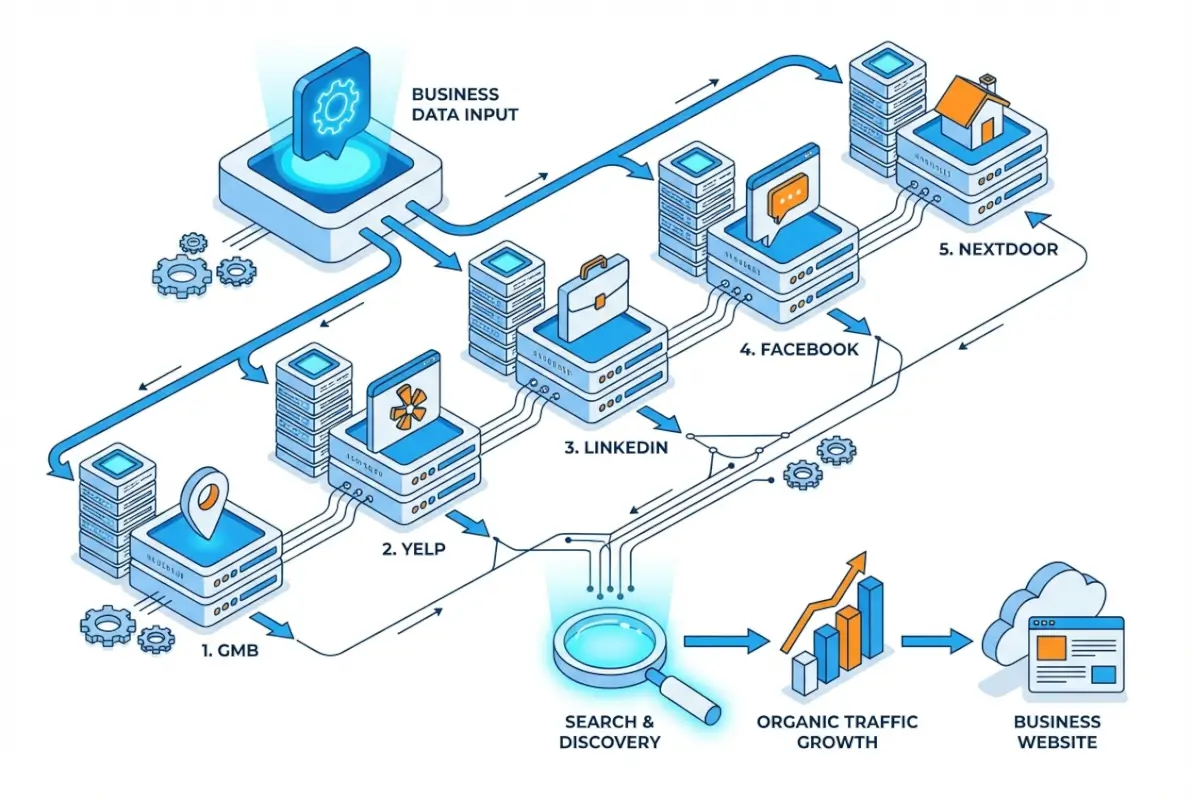
What separates successful GBP listings from neglected ones is active management. Google’s algorithm rewards businesses that treat their profile as a dynamic marketing channel, not a “set it and forget it” directory entry. Businesses that post updates weekly see 2.3x more profile views than those posting monthly, according to internal Google data shared with Local Search Association members.
To claim your Google Business Profile, visit Google Business Profile and verify ownership through postcard, phone, or email. The critical optimization steps most businesses miss: selecting the most specific primary category (not generic ones), adding all applicable secondary categories, uploading photos in Google’s recommended dimensions (720×720 for logos, 1600×900 for covers), and enabling messaging so mobile users can contact you directly from search results.
One tactical advantage: Google allows up to ten services with descriptions. Most businesses list three, I recommend filling all ten with keyword-rich descriptions. A plumber who lists “emergency water heater repair,” “tankless water heater installation,” and “sewer line camera inspection” as separate services captures more long-tail searches than one listing only “plumbing services.”
Apple Maps: The iOS User Gateway
Apple Maps has quietly become the second-most-used navigation app in the USA, with iOS users defaulting to it for local search. More importantly, Siri pulls business information exclusively from Apple Maps, meaning voice search queries on 113 million iPhones are invisible to businesses not listed there.
Apple Maps Connect allows you to claim and manage your listing. The verification process is straightforward—phone or email—but the platform rewards detailed information more than competitors do. Apple’s algorithm seems to prioritize businesses with complete operating hours (including special hours), uploaded photos showing both exterior and interior, and accurate service area definitions for businesses without physical locations.
The demographic skew matters: Apple Maps users tend to have higher household incomes and purchase intent. For businesses targeting premium customers (professional services, upscale retail, specialized contractors), Apple Maps often delivers better-qualified leads than higher-traffic platforms.
Yelp: Where High Intent Meets Purchase Decisions
Yelp remains the dominant force for consumer-facing businesses, particularly in food service, personal services, and retail. What makes Yelp unique among business listing sites in USA is user intent—97% of Yelp visitors are actively researching a purchase, not just browsing. That’s substantially higher than Google (estimated 65-70%) or Facebook (30-40%).
The platform’s review ecosystem carries exceptional weight with consumers under 45. However, Yelp’s algorithm is notoriously selective about which reviews it displays, often filtering first-time reviewers or those without established accounts. This frustrates business owners, but it actually enhances credibility—displayed reviews are presumed more legitimate.
To optimize your Yelp business page, claim it at Yelp for Business Owners and complete every field, particularly adding your menu (restaurants), price range, accepted payment methods, and parking information. Then focus on response velocity—answer every review within 24 hours if possible. Yelp’s algorithm appears to reward businesses with high engagement rates by surfacing their profiles more frequently in search results.
One underutilized feature: Yelp’s Q&A section. Proactively answering common questions (even ones no one has asked yet) positions helpful information prominently and demonstrates active management. This is particularly effective for addressing concerns that often appear in negative reviews—preemptively defusing objections before they become barriers.
| Platform | Best For | Monthly Users | Setup Time |
|---|---|---|---|
| Google Business Profile | All business types | 5+ billion searches | 30 min + verification |
| Apple Maps | Premium demographics | 1+ billion iOS users | 20 minutes |
| Yelp | Consumer services, dining | 178 million monthly | 20 minutes |
| Bing Places | B2B, professional services | 1+ billion searches | 15 minutes |
| Facebook Business | Community engagement | 2.9+ billion users | 25 minutes |
Bing Places: The Lower-Competition Alternative
Bing Places offers a strategic advantage most businesses overlook: substantially less competition with meaningful reach. While Google dominates overall search volume, Bing powers searches across Microsoft’s ecosystem (Edge browser defaults, Office 365 integrations, Cortana), Yahoo Local, AOL, and numerous automotive navigation systems.
The demographic profile matters—Bing users skew older (35-65), more affluent, and more likely to use desktop computers. For B2B services, professional consultants, and businesses targeting decision-makers rather than millennials, Bing often delivers better-qualified leads than higher-traffic alternatives.
Setup is straightforward at Bing Places for Business. If you already have a Google Business Profile, Bing allows direct import, maintaining NAP consistency while saving time. The optimization opportunity: Bing’s algorithm appears to weight category specificity and photo quality more heavily than review count. Businesses with 10+ high-resolution photos often outrank competitors with more reviews but fewer images.
Facebook Business: Social Discovery Meets Local Search
Facebook Business combines business listing functionality with social engagement, creating a unique value proposition. With 2.9 billion monthly users, Facebook reaches audiences no other platform can match. More importantly, Facebook’s location-based features (check-ins, event RSVPs, friend recommendations) create discovery pathways that traditional business listing websites in USA don’t offer.
The platform’s search functionality has evolved substantially. When someone searches “restaurants near me” within Facebook (increasingly common among mobile users), properly optimized business pages appear in those results alongside map pins. This captures search intent within the social platform without requiring users to leave their current app—reducing friction in the discovery-to-visit journey.
To maximize Facebook Business value, link your Instagram account for cross-platform visibility, enable messaging for direct customer contact, and post updates at least weekly. Facebook’s algorithm rewards active pages with increased organic reach. A client in the home services industry saw a 34% increase in page views and 12 new customer inquiries within 30 days of implementing weekly posts with service photos and brief educational tips.
How to Optimize Business Listing Profiles for Maximum Exposure in 2026
Profile optimization separates businesses getting visibility from those getting traffic. The gap between a basic listing and a fully optimized one often determines whether you appear on page one or page three—and in local search, page two might as well be invisible.
The 100% Completion Rule
Research from various local SEO tools consistently shows that complete profiles receive 70% more views than partial listings. But “complete” means more than filling mandatory fields—it means maximizing every available data point these business listing platforms offer.
[KBIMAGE_3]Start with your business description. Most businesses write a single generic description and paste it everywhere, that’s a mistake. Each platform has different character limits and user expectations. Google Business Profile allows 750 characters—use most of them with specific services, location keywords (neighborhood names, nearby landmarks), and your unique value proposition. Yelp descriptions should be more conversational and story-driven. Apple Maps descriptions work best when ultra-concise and benefit-focused.
Photos drive engagement more than any other element. According to Google’s own data, businesses with photos receive 42% more direction requests and 35% more website clicks. But photo optimization goes beyond quantity. Upload images in recommended dimensions for each platform, include variety (exterior, interior, team, products, work-in-progress), and add photos monthly to signal active management.
One tactical detail: file names and alt text matter. Instead of uploading “IMG_5847.jpg,” rename it “downtown-seattle-plumber-emergency-repair-van.jpg” before uploading. Some platforms extract this metadata, and even when they don’t, it enforces internal discipline around strategic image selection.
Attributes and amenities are consistently under-utilized. Google Business Profile offers dozens (wheelchair accessible, free WiFi, outdoor seating, LGBTQ+ friendly, women-led). Select all that apply—these function as micro-filters helping customers find exactly what they need. A restaurant that enables “outdoor seating,” “accepts reservations,” and “good for groups” appears in filtered searches for those specific needs.
NAP Consistency: The Foundational Trust Signal
Name, Address, and Phone consistency across business listing sites in USA is the single most important technical factor you control. Search engines cross-reference your business information across hundreds of sources, discrepancies trigger trust penalties that suppress your visibility.
The challenge is that minor variations feel insignificant but algorithmically matter. “Street” versus “St.”, suite numbers with or without the “#” symbol, phone numbers with or without parentheses—these create what search engines perceive as conflicting information. The solution is establishing a canonical format and using it identically everywhere.
Create a master reference document with your exact NAP formatting, then audit all existing listings against it. Tools like Moz Local or BrightLocal can automate citation audits, but manual verification is often necessary for accuracy. I typically find 3-7 inconsistencies in even well-managed business listings during initial audits.
For businesses operating under a gateway church business directory how to get listed model or similar community-focused platforms, maintaining separate listings for each location with location-specific NAP information is critical—never use a central office address for multiple service locations.
Category Selection: Specificity Wins
Primary category selection is arguably the most consequential single decision in profile optimization. Google Business Profile bases 40-50% of its relevance determination on category match, according to local SEO researchers who’ve analyzed ranking patterns across thousands of businesses.
The common mistake is selecting broad categories. A business selecting “Restaurant” as their primary category competes with every restaurant in their area. One selecting “Thai Restaurant” or “Vegetarian/Vegan Restaurant” competes in a significantly smaller, more targeted pool and appears for more specific searches that carry higher intent.
Most platforms allow multiple categories—use them strategically. Select the most specific primary category that accurately describes your main offering, then add secondary categories that capture additional services. A law firm might use “Personal Injury Attorney” as primary with secondary categories for “Car Accident Lawyer,” “Medical Malpractice Attorney,” and “Wrongful Death Attorney” to capture multiple search variations.
One detail that often surprises business owners: categories aren’t standardized across platforms. Google’s category taxonomy differs from Yelp’s, which differs from Apple Maps’. Research available categories on each platform individually rather than assuming consistency.
Building a Sustainable Business Listing Strategy
Individual listing optimization delivers results, but strategic integration multiplies impact. The businesses dominating local search in 2026 aren’t just “on” business listing websites USA—they’ve woven listings into a comprehensive visibility ecosystem.
Integration with Broader Local SEO
Business listings function as one component of local search success, not the entire strategy. The most effective approach treats listings as foundational citations that support and amplify your website’s SEO efforts rather than replacing them.
[KBIMAGE_4]This means ensuring NAP information on your website matches listings exactly—use schema markup to structure this data so search engines can easily extract and verify it. Add location pages for each service area, then build corresponding listings with area-specific details. The consistency between on-site and off-site signals compounds authority.
Link building becomes more effective when combined with listing optimization. According to Search Engine Journal’s local SEO research, businesses with complete listings on 15+ authoritative directories see 23% higher rankings for local keywords than those with comparable backlink profiles but inconsistent directory presence.
Consider creating your own directory presence through platforms like TurnKey Directories, which offers WordPress-based directory solutions that integrate with your existing website. This allows you to control a high-authority directory property while maintaining consistent branding and capturing traffic that would otherwise go to third-party platforms.
For insights on maximizing Google’s ecosystem specifically, review google my business directory optimization tips that go beyond basic setup into advanced features like posts, Q&A management, and booking integrations.
Review Generation and Response Systems
Reviews have evolved from nice-to-have social proof into algorithmic ranking factors. Google Business Profile weighs review velocity (how frequently you receive reviews), recency (how recent your latest reviews are), and response rates when determining Local Pack rankings.
Systematic review generation works better than occasional requests. Implement a process that automatically triggers review requests 48-72 hours after service delivery—this timing captures positive sentiment while the experience is fresh but gives customers time to fully evaluate results. Tools like Podium, Birdeye, or even simple automated email sequences accomplish this.
The key is reducing friction. Every additional step reduces completion rates by approximately 30%. Send direct links to your preferred platform (usually Google Business Profile) rather than sending to a review hub page where customers choose platforms. Mobile-optimize review request emails since 70%+ of reviews are now left from smartphones.
Response strategy matters as much as generation. Respond to every review—positive and negative—within 24 hours when possible. Negative review responses should be empathetic, solution-focused, and brief (under 100 words). Long defensive responses signal thin skin and often backfire. The goal isn’t winning an argument, it’s demonstrating professionalism to the 99% of people reading the review who aren’t the original reviewer.
Metrics That Matter: Tracking What Works
You can’t optimize what you don’t measure. Most business listing platforms provide insights dashboards showing impressions, clicks, direction requests, calls, and website visits. These metrics reveal which optimizations drive results and which don’t.
Focus on conversion-oriented metrics over vanity metrics. Impressions growing from 50 to 500 monthly means nothing if clicks remain at zero—that signals a profile optimization problem (poor title, unappealing main photo, missing key information). Conversely, if impressions are modest but click-through rate is 15%+, you’ve nailed optimization but need broader visibility (possibly through additional platforms or paid promotion).
Track referral traffic in Google Analytics by setting up UTM parameters for links in your listings where possible, and monitor the “All Traffic > Referrals” report to see which business listing websites USA send actual website visitors. This data reveals where to focus ongoing optimization efforts.
Conversion tracking is the ultimate metric. If you’re receiving calls, track which platforms generate them (ask customers “where did you find us?” as a routine intake question). If you’re driving form submissions, use unique phone numbers or tracking parameters to attribute leads accurately. A platform sending 100 visitors with 2% conversion is more valuable than one sending 500 visitors with 0.2% conversion.
Avoiding Common Mistakes and Capitalizing on 2026 Trends
Even experienced business owners make listing management mistakes that undermine visibility. Awareness of these pitfalls and emerging opportunities can save months of frustration.
The Duplicate Listing Trap
Duplicate listings are more common than you’d think—and more damaging. They split your reviews across multiple profiles, confuse customers about which information is current, and signal inconsistency to search engines that can trigger ranking penalties.
[KBIMAGE_5]Duplicates typically emerge when someone creates a new listing without realizing one exists, when business ownership changes and the new owner creates a fresh profile, or when address changes create the perception of a new business. Before creating any listing, exhaust search variations: try your business name alone, with address, with phone number, with owner names.
If you discover duplicates, most platforms have a “report duplicate” or “suggest an edit” feature. Google Business Profile requires claiming both profiles then using the “Mark as duplicate” option. The process can take weeks, unfortunately, so prevention is far preferable to correction.
Inconsistency Across Platforms
Beyond NAP inconsistency, businesses often have different business descriptions, services, hours, and photos across platforms. While some variation is acceptable (tailoring descriptions to platform audiences), contradictory information creates customer confusion and search engine distrust.
The solution is a master content document that includes: canonical NAP, three description lengths (short/medium/long for various character limits), complete service list with descriptions, standardized business hours including holiday schedules, a photo library organized by category, and your primary/secondary category selections for each major platform.
This reference document makes updates systematic rather than chaotic. When you add a new service or change hours, you update the master document first, then systematically update all listings from that source. This prevents the common scenario where you update Google but forget Yelp, Apple Maps, and Facebook.
Neglected Profiles: The Silent Credibility Killer
Creating a profile then abandoning it is worse than not having one at all. A business listing website in USA showing your last post from 2022, unanswered reviews from months ago, or outdated hours signals abandonment. Potential customers seeing this legitimately wonder if you’re still in business or simply don’t care about customers.
The solution isn’t necessarily daily activity—it’s consistent, scheduled maintenance. A monthly 30-minute review covering all platforms where you respond to any new reviews, update photos, verify information accuracy, and post a brief update is sufficient for most small businesses. Set a recurring calendar reminder so it becomes routine rather than an occasional fire drill.
Emerging Opportunities: AI-Assisted Optimization
AI tools are beginning to offer listing optimization assistance—analyzing your profiles against competitors, suggesting category optimizations, and even generating photo recommendations. While these tools aren’t perfect, they can identify blind spots human oversight misses.
More significantly, search engines themselves are using AI to understand business offerings more deeply. Google’s BERT and MUM algorithms can parse complex descriptions to understand nuanced services. This means well-written, specific descriptions matter more than ever—generic boilerplate content fails to communicate what makes you different.
Voice search continues growing, with implications for business listing strategies. Voice queries tend to be longer and more conversational (“where can I get my oil changed near downtown that’s open on Sunday”) than text searches (“oil change near me”). Optimizing your listings for these natural language queries—including longer-tail keywords in descriptions and using Q&A features to answer specific questions—positions you for voice search visibility.
Niche Directories: When and How to Expand
Once you’ve mastered the core five platforms, industry-specific directories offer additional targeted exposure. For contractors, platforms like HomeAdvisor, Thumbtack, and Angie’s List matter. For healthcare providers, Healthgrades and Zocdoc are essential. For restaurants, OpenTable and TripAdvisor carry weight beyond general directories.
The challenge with niche directories is many charge for placement or operate on pay-per-lead models. Evaluate these carefully—calculate cost-per-acquisition from any paid directory before committing long-term. A platform charging $500 monthly that generates two $5,000 projects is fantastic ROI; the same platform generating three $200 projects is devastating to margins.
Free niche directories are almost always worth the setup time. Industry associations, local chamber of commerce websites, and community-specific directories (neighborhood associations, local business alliances) typically offer free listings that carry local relevance. These may not drive high volumes but often deliver highly qualified leads from community members preferring to support local businesses.
For businesses considering building their own directory presence or wanting to understand how directories function from the inside, exploring local business directory reasons your business needs one provides strategic context for both listing on and creating directory platforms.
Frequently Asked Questions About Business Listing Sites USA
Which business listing sites are most important for local SEO in 2026?
Google Business Profile remains the non-negotiable foundation, followed by Apple Maps (for iOS users), Yelp (for consumer services), Bing Places (for desktop and B2B), and Facebook Business (for social discovery). These five platforms control approximately 85% of local search visibility for most business types in competitive markets.
Do free business listing websites USA actually improve Google rankings?
Yes, but impact depends on execution quality. Free listings on high-authority platforms create citation signals that verify your business information and support local search rankings. However, incomplete profiles or inconsistent NAP information can actually harm rankings. Focus on complete, accurate listings on fewer platforms rather than rushed, partial listings everywhere.
How often should I audit and update my business listings?
Conduct comprehensive audits quarterly to check for duplicate listings, verify NAP consistency, and refresh content. Between audits, perform monthly maintenance reviews taking 30 minutes to respond to reviews, add photos, and verify hours remain accurate. High-competition markets may require more frequent attention, particularly review response which should happen within 24 hours.
What metrics show that a listing update is working?
Track impressions, click-through rate, direction requests, phone calls, and website visits within platform insights dashboards. More importantly, monitor conversion metrics—leads generated and customers acquired from each platform. Improved NAP consistency typically correlates with better local rankings within 30-60 days, measurable through position tracking for geo-targeted keywords.
Should I focus on major platforms or niche business listing websites in USA?
Master the five core platforms first—Google Business Profile, Apple Maps, Yelp, Bing Places, and Facebook Business—before expanding to niche directories. These foundational listings deliver 80% of local visibility results. After optimization, add industry-specific directories relevant to your business type and free community directories for incremental targeted exposure.
How do I handle duplicate business listings?
First, claim all duplicate profiles if possible. Then use each platform’s duplicate reporting feature—for Google Business Profile, this is the “Mark as duplicate” option after claiming both listings. The process can take several weeks. To prevent future duplicates, always search thoroughly before creating new listings and maintain a master document tracking all active profiles.
Can business listing sites hurt my online reputation?
Unclaimed or neglected listings can damage reputation by displaying outdated information or accumulating unanswered negative reviews. However, properly managed listings build credibility rather than harm it. The key is proactive management—claim all listings, maintain current information, and respond professionally to reviews within 24 hours to demonstrate active customer engagement and care.
What role do business listings play in voice search?
Voice assistants like Siri, Alexa, and Google Assistant pull business information directly from listing platforms when answering spoken queries. Optimized business listing profiles with complete information, positive reviews, accurate categories, and natural language descriptions substantially increase the likelihood of being recommended in voice search results, which increasingly influence local purchase decisions.
Your 90-Day Business Listing Transformation Plan
The difference between businesses dominating local search and those struggling for visibility isn’t budget or market position—it’s systematic execution of listing fundamentals. You now have the framework for comprehensive business listing optimization across the platforms that actually matter in 2026.
Start by claiming and verifying your five core profiles this week. Next week, complete every field with strategic, keyword-rich content following the optimization principles outlined above. The third week, implement a review generation system and establish your monthly maintenance calendar. By week four, you should be analyzing baseline metrics and planning your first round of refinements based on early data.
The businesses winning local search aren’t doing anything magical—they’re doing the fundamentals consistently and measuring what works. Your 43 monthly impressions for “business listing” related terms with zero clicks represents opportunity, not failure. Those are 43 people searching for exactly what you offer who haven’t found you yet because your profiles aren’t optimized to convert impressions into clicks.
Your 90-Day Action Plan
Days 1-7: Claim and verify Google Business Profile, Apple Maps, Yelp, Bing Places, Facebook Business
Days 8-21: Complete all profile fields, upload 10+ photos per platform, select specific categories
Days 22-30: Implement review generation system, respond to all existing reviews, post first platform updates
Days 31-60: Add new photos monthly, track metrics weekly, refine descriptions based on which keywords drive traffic
Days 61-90: Conduct first comprehensive audit, expand to 2-3 niche directories, analyze ROI and adjust strategy
Don’t get overwhelmed trying to optimize everything simultaneously. Focus on Google Business Profile this week. Make it perfect. Then move to the next platform. Incremental progress compounds into dominant visibility within quarters, not years.
The businesses that will dominate local search in 2026 aren’t those with unlimited marketing budgets—they’re those that master the fundamentals of business listing websites USA through consistent execution. You have the roadmap, now execute it systematically and measure relentlessly. Which platform will you optimize first?
Was this article helpful?