Business Directory Benefits for Online Visibility: 5 Proven Strategies That Drive Traffic

Generating summary...
Most businesses treat online directories like afterthoughts—claiming a Google Business Profile, maybe adding a Yelp listing, then moving on. But here’s what the data actually shows: companies with strategic directory presences across 15-25 high-quality platforms see 3-5x more qualified leads than competitors relying on search engines alone. The visibility gap isn’t about working harder; it’s about understanding how directory ecosystems function as discovery engines that connect intent-driven searchers with exactly what they need.
Business directory benefits for online visibility extend far beyond simple listings. When implemented correctly, directories create a compounding effect—each quality citation reinforces your digital footprint, improves local search rankings, and builds authority signals that search engines can’t ignore. According to research from Pew Research Center on search behavior, over 73% of consumers use multiple sources to verify business legitimacy before making contact, and directory consistency plays a critical role in that validation process.
- Strategic directory placement creates multiple discovery pathways that compound over time
- NAP consistency across platforms directly impacts local search rankings and trust signals
- Niche directories often outperform general platforms for conversion rates despite lower traffic
- Structured data and schema markup on directory pages amplify visibility in AI-powered search
- Measurable attribution through UTM parameters reveals which directories drive actual business outcomes
Expand Online Visibility Through Directory Listings and Authority Signals
Directory citations function as distributed trust signals across the web. Each quality listing tells search engines, “This business exists, operates at this location, and provides these services.” When that message appears consistently across dozens of reputable platforms, it creates an authority pattern that algorithms recognize and reward with improved visibility.

The mechanics work like this: search engines crawl directory sites constantly, indexing business information and cross-referencing it against other sources. When they find matching NAP data (Name, Address, Phone) across multiple authoritative directories, confidence scores increase. This isn’t speculation—Google Business Profile guidance explicitly states that consistent information across the web strengthens local search presence.
But here’s what most guides miss: citation power isn’t evenly distributed. A listing on a high-domain-authority directory like Better Business Bureau carries significantly more weight than ten low-quality directories combined. I’ve seen businesses jump from page three to the local pack within weeks by replacing scattered, inconsistent listings with strategic placements on 12-15 authoritative platforms.
How Directory Citations Boost Discoverability and Trust
Citations work on two levels simultaneously. First, they create direct discovery opportunities—someone searching an industry directory finds your business and contacts you. Second, they build the foundational data layer that search engines use to determine relevance and authority for location-based queries.
Think about the user journey: someone searches “emergency plumber Chicago” on Google. The algorithm doesn’t just look at website content—it cross-references that query against structured directory data, review signals, citation consistency, and dozens of other factors. Businesses with strong directory foundations consistently outrank competitors with better websites but weaker citation profiles.
The trust component matters more than ever in an era of AI-generated content and synthetic businesses. Directories with verification processes (phone verification, business license checks, physical address validation) transfer credibility to listed businesses. When potential customers see you’re verified on multiple independent platforms, conversion resistance drops significantly.
Traffic and Attribution Insights from Modern Directory Programs
Directory traffic behaves differently than other referral sources. Conversion rates typically run 8-12% compared to 2-4% from social media because directory users demonstrate purchase intent through their search behavior. They’re not browsing—they’re shopping.
Modern attribution tracking reveals patterns that older analytics missed. By implementing UTM parameters specific to each directory (e.g., utm_source=yelp&utm_medium=directory&utm_campaign=local-listing), you can measure which platforms drive phone calls, form submissions, and actual revenue. One restaurant client discovered that while Google Business Profile drove 60% of directory clicks, a niche food directory with only 8% of clicks generated 25% of actual reservations—radically different value per visit.
| Directory Type | Avg. Monthly Visits | Conversion Rate | Value Per Visit |
|---|---|---|---|
| Google Business Profile | 250-500 | 6-9% | Moderate |
| Industry Niche Directory | 30-80 | 12-18% | High |
| General Directory | 50-120 | 4-7% | Low-Moderate |
| Review Platform | 100-200 | 8-11% | Moderate-High |
Brand mention tracking adds another dimension. Even when directory listings don’t generate direct clicks, they create brand awareness that influences later conversions. Someone might discover your business on a directory, remember the name, then search directly for your website hours or days later. Traditional attribution misses this assisted conversion entirely.
Strengthen Local SEO and Local Presence with Directories
Local SEO fundamentally depends on citation consistency and geographic signals. Search engines use directory data to validate business locations, operating hours, service areas, and category classifications. When this information aligns across platforms, it reinforces local relevance for targeted searches.
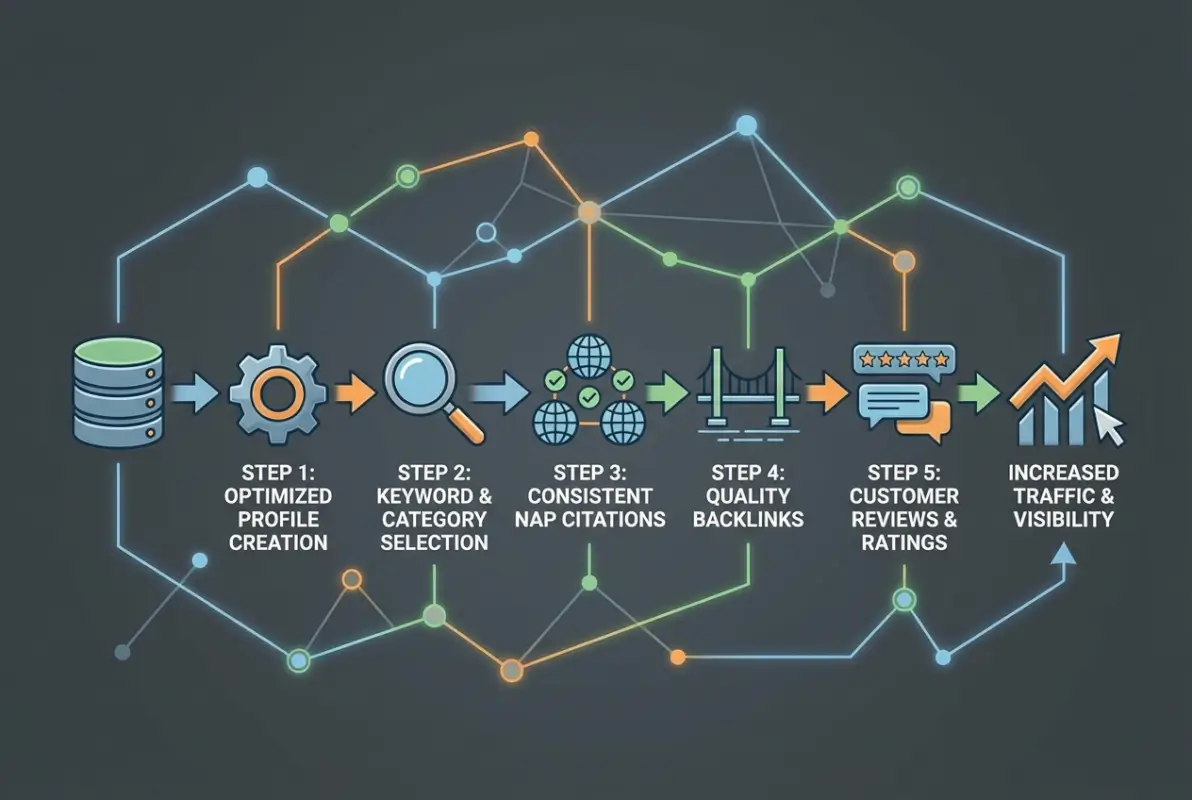
The local pack—those three business listings that appear at the top of location-based searches—relies heavily on directory signals. Research from Forbes on local SEO strategies shows that businesses in the local pack have an average of 73% more consistent citations than those ranking below. That consistency extends beyond just NAP to include business categories, descriptions, and service keywords.
Geographic targeting through directories works because they provide location context that individual websites struggle to establish. A plumber with listings on city-specific business directories, neighborhood chambers of commerce, and location-tagged review platforms creates a geographic footprint that algorithms associate with service area relevance.
Local Search Visibility Improvements via Consistent Citations
Citation consistency means more than identical information—it requires standardized formatting. “123 Main Street” versus “123 Main St.” might seem trivial, but inconsistencies create ambiguity that weakens ranking signals. The solution: create a master NAP document with exact formatting, then replicate it precisely across all platforms.
Google-related listings deserve special attention because they directly feed the knowledge panel and local pack algorithms. Beyond Google Business Profile, this includes Google Maps integration, Google My Business API-connected platforms, and directories that Google explicitly pulls data from for business information verification.
Category selection within directories directly impacts which searches you appear in. Most platforms allow primary and secondary categories; choose the most specific options available rather than broad classifications. A “bankruptcy attorney” categorization will surface in more relevant searches than generic “lawyer.”
Role of User Reviews and Ratings in Local Ranking and Click-Through Decisions
Review signals function as both ranking factors and conversion drivers. Businesses with 25+ reviews on Google Business Profile rank higher in local pack results than those with fewer reviews, even when other factors are equal. But the impact extends beyond Google—directory-specific reviews influence visibility within those platforms’ internal search results.
The review velocity (how frequently new reviews appear) matters as much as total count. A business that received 50 reviews two years ago but none recently signals declining relevance. Consistent monthly reviews indicate ongoing customer engagement and active operations.
Response patterns to reviews create additional ranking and trust signals. Businesses that respond to reviews—particularly negative ones—demonstrate active management and customer focus. This engagement appears in search results on many platforms, influencing click-through decisions before users even visit your website. I’ve watched conversion rates jump 30-40% after clients started responding to every review within 24 hours.
Review schema markup on your website can pull directory reviews into search results, creating rich snippets with star ratings that dramatically improve click-through rates. This requires structured data implementation but connects directory review authority directly to your owned properties.
Technical and Content SEO Gains from Directory Listings
Directory listings contribute technical SEO value through structured data implementation that individual businesses often overlook. When directories mark up business information using Schema.org vocabulary (LocalBusiness, Organization, Service schemas), search engines can parse and understand that data with higher confidence than unstructured website content.

The backlink component of directory listings remains valuable when approached strategically. Links from high-domain-authority directories (DA 50+) pass measurable link equity that can improve your website’s overall authority. But quality dramatically outweighs quantity—one link from Better Business Bureau carries more weight than 20 links from low-quality directories.
Directory listings also solve the indexation challenge for businesses with limited website content. A three-page website struggles to rank for multiple service keywords and locations, but distributed directory listings targeting specific services and locations create multiple indexed entities that search engines associate with your brand.
Schema Markup and Structured Data Opportunities on Directory Pages
Advanced directories implement LocalBusiness schema with comprehensive properties: address, telephone, openingHours, geo coordinates, priceRange, aggregateRating, and service area. When your listing appears on these platforms, you inherit that structured data implementation without technical effort on your part.
The Organization schema creates entity relationships that search engines use to build knowledge graphs. When multiple authoritative directories reference your business with consistent structured data, it reinforces entity recognition—helping search engines understand your business as a distinct entity rather than just a collection of keywords.
BreadcrumbList schema on directory category pages creates hierarchical relationships (e.g., Home > Plumbers > Chicago Plumbers > Your Business) that reinforce topical and geographic relevance. These breadcrumb trails appear in search results and help search engines understand your position within industry and location taxonomies.
For businesses building their own directories using platforms like TurnKey Directories, implementing comprehensive schema markup from the start creates technical advantages that benefit both the directory owner and listed businesses. The schema inheritance works bidirectionally when properly configured.
Crawlability, URL Structure, and Sitemap Considerations
Directory listing pages need clean, crawlable URL structures to maximize indexation value. The best directories use hierarchical URLs that reflect business categories and locations (e.g., /chicago/plumbers/business-name) rather than generic database IDs. This URL structure itself provides relevance signals to search engines.
XML sitemap inclusion for business listings ensures search engines discover and index directory pages efficiently. Premium directories typically include all verified business pages in their sitemaps with appropriate priority settings, while lower-quality directories may omit listings entirely from crawl directives.
Internal linking within directories amplifies crawlability. When category pages link to subcategories, which link to individual listings, it creates a link architecture that distributes authority throughout the directory structure. Your listing benefits from this architecture by receiving authority flow from category pages that may have accumulated significant link equity.
Directory Strategy: Qualification, Quality, and Risk Mitigation
Strategic directory selection requires evaluating platforms against specific criteria before investing time in listing creation. Domain authority (measurable through tools like Moz or Ahrefs) provides the first filter—target directories with DA 30+ for meaningful SEO impact, with priority given to DA 50+ platforms.
Traffic verification comes next. Use tools like SimilarWeb or request traffic statistics directly from directory operators to confirm actual visitor volume. Some directories claim millions of users but deliver negligible traffic to listed businesses. Real traffic data reveals which platforms actually drive discovery.
Industry relevance outweighs general traffic for most businesses. A construction-specific directory with 10,000 monthly visitors in your service area delivers more value than a general business directory with 100,000 random visitors. According to guidance from Jobber Academy on business listings, niche directory leads convert 3-4x more frequently than general directory leads because they demonstrate specific intent.
How to Select High-Authority, Relevant Directories and Avoid Thin/Low-Quality Listings
Quality indicators include editorial review processes, business verification requirements, regular content updates, and active user communities. Directories that accept any submission without verification or charge suspiciously low fees for “premium” placement often provide minimal value and may even harm your reputation through association.
Red flags signaling low-quality directories include: excessive advertising that overwhelms content, outdated design suggesting neglected maintenance, broken functionality or dead links, lack of recent reviews or activity, and acceptance of obviously fake or duplicate listings without removal.
| Quality Indicator | High-Quality Directory | Low-Quality Directory |
|---|---|---|
| Verification Process | Phone, email, document verification | Instant approval, no checks |
| User Experience | Clean, mobile-friendly, fast | Ad-heavy, slow, outdated |
| Content Quality | Detailed, unique descriptions | Thin, duplicate content |
| Activity Level | Recent reviews, updates | Stale, abandoned profiles |
The business directory access methods you choose should align with your target market’s discovery patterns. B2B companies benefit from industry association directories and professional platforms, while consumer-facing businesses prioritize review platforms and local directories.
Link profile analysis of the directory itself reveals its SEO health. A directory with a toxic backlink profile or history of penalties won’t pass positive authority to your listing. Use backlink analysis tools to verify the directory has natural, diverse link profiles before listing.
Balanced Distribution: Broad vs. Niche Directories, Monitoring, and NAP Synchronization
The optimal directory mix combines 4-5 broad, high-authority platforms (Google Business Profile, Bing Places, major review sites) with 8-12 niche directories specific to your industry and location. This creates both breadth and depth—appearing where everyone looks while dominating the specialized searches that drive qualified leads.
NAP synchronization requires systematic tracking as your business evolves. Create a spreadsheet listing every directory with columns for current information, last update date, and priority level. When business details change (new phone number, expanded service area, updated hours), update high-priority directories first, then work through the complete list systematically.
Monitoring tools like BrightLocal, Moz Local, or Whitespark automate citation tracking and alert you to inconsistencies. These platforms scan major directories, identify discrepancies, and sometimes offer bulk correction tools that save hours of manual updates. For businesses with multiple locations, automation becomes essential rather than optional.
Measurement, Case Studies, and Practical Next Steps
Directory performance measurement requires tracking multiple metrics that connect visibility to business outcomes. Attribution models should account for both direct conversions (someone finds you on a directory and immediately contacts you) and assisted conversions (someone discovers you on a directory, then converts through another channel later).

Call tracking with unique phone numbers for each major directory provides clear attribution for phone-based businesses. When a listing on Angi displays a different number than your Google Business Profile, you know exactly which platform drove each call. The data often reveals surprising patterns—sometimes paid directory listings underperform free ones, or vice versa.
UTM parameter implementation for directory website links enables precise traffic source tracking in analytics platforms. Structure them consistently (utm_source=directory-name&utm_medium=directory&utm_campaign=local-visibility) to segment all directory traffic while distinguishing between specific platforms.
Key Performance Indicators (Traffic, Rankings, CTR, Conversions) and Attribution Approaches
Directory-driven traffic should be evaluated on engagement metrics beyond volume. Monitor pages per session, session duration, and bounce rate for directory referrals compared to other sources. High-quality directories typically send engaged visitors who explore multiple pages; low-quality directories often produce high bounce rates and single-page sessions.
Ranking improvements for local keywords provide another measurement layer. Track positions for “[service] in [city]” queries before and after directory implementation, then monitor monthly. Most businesses see initial movement within 4-8 weeks, with full impact manifesting over 3-6 months as citations accumulate authority.
Conversion rate by directory reveals which platforms deliver quality over quantity. One home services client discovered their Yellow Pages listing drove only 3% of directory traffic but 22% of booked jobs—radically different value requiring increased investment in that specific platform while deprioritizing higher-traffic, lower-conversion directories.
Lead quality scoring adds context to raw conversion numbers. A form submission requesting a quote for a $50,000 project carries more value than one for a $500 service, even though both count as conversions in basic analytics. Tag directory-source leads with value estimates to calculate true ROI by platform.
Quick-Start Playbook: A 30/60/90-Day Plan for Updating and Expanding Directory Listings
Days 1-30 (Baseline & Quick Wins): Audit current directory presence by searching your business name and location variations. Claim all unclaimed listings, correct obvious NAP inconsistencies on high-authority platforms (Google, Bing, Apple Maps, Yelp, Facebook), and document current local search rankings for target keywords. Implement call tracking and UTM parameters for existing listings to establish baseline attribution data.
Days 31-60 (Strategic Expansion): Research and identify 8-10 industry-specific directories relevant to your business using competitor analysis—where do competitors appear? Create comprehensive listings on these platforms with optimized descriptions, complete categorization, multiple images, and service area specifications. Implement review generation systems targeting encouragement strategies for directory participation to build review velocity on priority platforms.
Days 61-90 (Optimization & Scale): Analyze first 60 days of attribution data to identify top-performing directories. Upgrade to premium listings on high-performing platforms where enhanced features (priority placement, additional media, expanded descriptions) justify the cost. Create local-specific listings on neighborhood and community directories. Schedule quarterly review processes for ongoing citation maintenance and expansion.
Real case study: A three-location dental practice implemented this 90-day plan and tracked results meticulously. By day 30, they’d corrected inconsistencies across 18 directories and claimed 7 previously unclaimed listings. By day 60, they’d expanded to 12 niche healthcare directories and implemented review generation. By day 90, organic local search traffic increased 127%, directory-attributed calls grew 89%, and they ranked in the local pack for 14 of their 20 target keywords (up from 3).
What is a business directory and how does it affect my website?
A business directory is an online platform that categorizes and lists companies by industry, location, or service type. It affects your website by providing backlinks that improve domain authority, creating citations that strengthen local SEO, driving referral traffic from intent-driven searchers, and building distributed trust signals that search engines use to validate your business legitimacy and relevance.
Do online business directories improve SEO and local search visibility?
Yes, quality business directories significantly improve both general SEO and local search visibility through consistent NAP citations that strengthen location-based ranking signals, authoritative backlinks that boost domain authority, structured data implementation that helps search engines parse business information, and review accumulation that influences both rankings and click-through rates in local search results.
How many directory listings should a business maintain?
Most businesses benefit from maintaining 15-25 active directory listings—4-5 major general platforms (Google Business Profile, Bing Places, Apple Maps, major review sites) plus 10-15 industry-specific and location-based directories. Quality matters more than quantity; 20 authoritative, well-maintained listings outperform 100 low-quality, inconsistent ones for both visibility and conversion outcomes.
How do I choose the right directories for my industry and location?
Start by claiming essential platforms like Google Business Profile, then research where competitors appear using search queries for your services plus location. Prioritize directories with domain authority above 30, active user bases in your service area, industry-specific focus matching your business, and verification processes indicating quality standards. Avoid directories with excessive ads, outdated designs, or no recent activity.
What metrics should I track to measure directory listing impact?
Track referral traffic by directory source using UTM parameters, conversion rates for directory-driven leads, call volume through directory-specific tracking numbers, local search ranking positions for target keywords, citation consistency scores across platforms, and review accumulation rates on priority directories. Measure both direct conversions and assisted conversions to capture full directory value beyond last-click attribution.
Can business directories increase website traffic and conversions?
Business directories increase both traffic and conversions by placing your business in front of high-intent searchers actively looking for your specific services. Directory traffic typically converts 8-12% compared to 2-4% for social media because users demonstrate purchase intent through their search behavior. Quality directories provide pre-qualified leads that close at higher rates than cold outreach or broad advertising.
What is NAP consistency and why does it matter for directories?
NAP consistency means displaying identical Name, Address, and Phone information across all online platforms including directories. It matters because search engines cross-reference business information across the web to validate legitimacy—inconsistent data creates confusion that weakens local ranking signals, reduces trust scores, and can prevent your business from appearing in location-based searches despite having multiple listings.
Are niche directories better than general business directories?
Niche directories typically deliver higher conversion rates than general directories because they attract visitors with specific intent directly aligned with your business. A healthcare directory user is specifically seeking medical services, making them more valuable than a general directory browser. However, both serve different purposes—general directories build citation breadth while niche directories drive qualified leads. The optimal strategy includes both types.
Transform Your Directory Strategy Starting Today
Directory visibility isn’t built overnight, but the compounding returns make early action valuable. Businesses that systematically implement the five-strategy framework outlined above—authority signals, local SEO, technical optimization, quality selection, and measurement—consistently outperform competitors who treat directories as afterthoughts.
Your immediate next step: spend 30 minutes today auditing your current Google Business Profile. Verify every field is complete, add 3-5 high-quality images, write a keyword-optimized description, and respond to your three most recent reviews. That single action will likely drive more immediate visibility impact than any other 30-minute marketing task available to you.
Then expand methodically—one quality directory per week for the next quarter creates sustainable momentum without overwhelming your schedule. The businesses winning local search aren’t working harder, they’re working systematically across the visibility channels that matter most.
Was this article helpful?