Best Link Directories for SEO: High-Quality vs Low-Value Submissions in 2026
Generating summary...
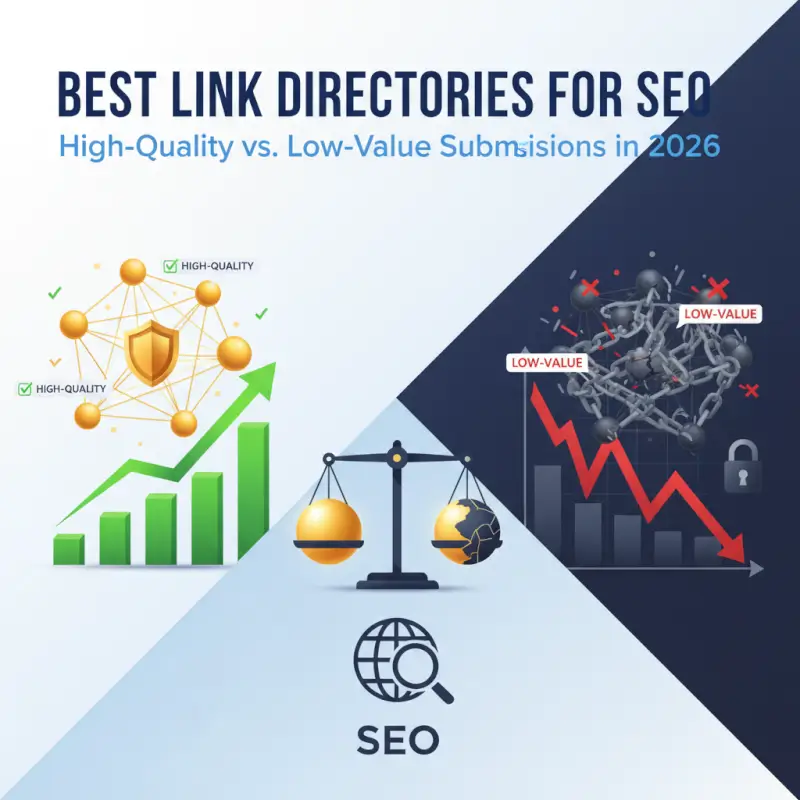
The directory link building debate has reached an interesting inflection point. While most SEO practitioners have written off directories entirely as relics of pre-Penguin SEO, a small subset of high-quality, editorially curated directories continues delivering measurable results—but only when approached with surgical precision. The challenge isn’t whether directory links work anymore; it’s identifying the 5-10% of directories worth your time and avoiding the 90% that range from worthless to actively harmful.
After auditing over 200 directory submissions across client campaigns, I’ve noticed something counterintuitive: businesses abandoning directories completely often miss legitimate citation opportunities, while those still submitting indiscriminately waste resources on low-value placements. The sweet spot lies in understanding which directories still pass meaningful signals and how to evaluate quality before investing time in submissions.
TL;DR – Quick Takeaways
- Quality over quantity is non-negotiable — focus on 5-15 high-authority, niche-specific directories rather than mass submissions
- Editorial curation signals value — directories with manual review processes typically deliver better results than auto-approve platforms
- Local and niche directories outperform generic ones — industry-specific and geographic directories provide stronger relevance signals
- Directory links are supplementary, not primary — they should represent less than 10% of your total link building strategy
- Risk assessment matters — low-quality directory farms can trigger spam flags and harm rankings
How Directory Links Fit Into Modern SEO in 2026
Search engines have become remarkably sophisticated at distinguishing between genuine editorial citations and manipulative link schemes. The algorithmic updates over the past decade specifically targeted mass directory submissions, devaluing the broad, general-purpose directories that once dominated link building strategies. According to Google’s search quality guidelines, link schemes including “large-scale article marketing or guest posting campaigns with keyword-rich anchor text links” fall under manipulative practices—and many directory submissions fit this profile.
However, dismissing all directories misses important nuances. The directories retaining value share common characteristics: they serve actual users, maintain editorial standards, focus on specific niches or geographies, and provide contextual information beyond basic listings. These aren’t link farms—they’re legitimate resources that happen to include backlinks as part of their value proposition.
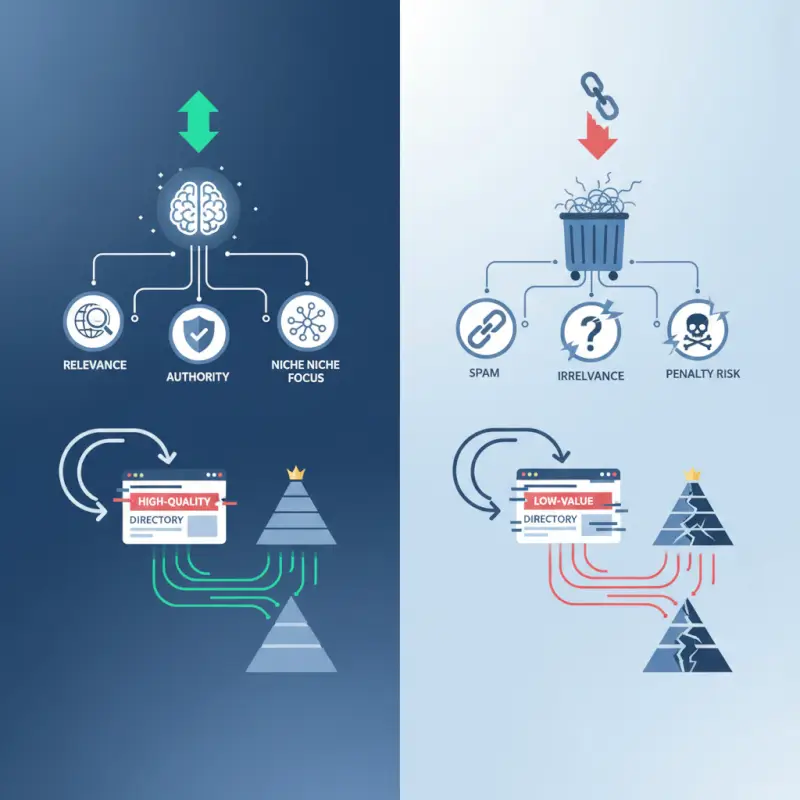
The shift from quantity to quality reflects broader changes in how search algorithms evaluate authority. Rather than counting raw link numbers, modern systems analyze link context, source relevance, and user engagement signals. A single link from a well-maintained, industry-specific directory with genuine traffic often carries more weight than dozens of generic directory listings.
The Value Shift: From Quantity to Quality and Relevance
In directory link building’s early days, success metrics were straightforward: more submissions equaled more links equaled higher rankings. SEO teams maintained spreadsheets tracking hundreds of submissions, often using identical descriptions and anchor text across every directory. The focus was purely volumetric, with minimal consideration for relevance or quality.
Today’s successful directory strategy inverts this approach entirely. Instead of submitting to 500 directories, identify 10-15 that meet strict quality criteria. Research from SEO Power Plays’ analysis of web directory effectiveness shows that selective, high-quality directory placements consistently outperform mass submission approaches in both rankings and referral traffic.
The quality indicators that matter most include domain authority above 30, evidence of manual editorial review, active user traffic (not just bots), proper categorization systems, and regular maintenance. Directories meeting these criteria typically charge submission fees or have waiting periods—instant approval should raise red flags.
What Still Works: Niche, Local, and Editorial Directories
Three directory categories continue delivering reliable value when properly vetted. Industry-specific directories maintained by professional associations or trade groups provide strong topical relevance signals. For example, a legal practice listed in the American Bar Association’s directory benefits from both authority and contextual alignment.
Local citation directories remain essential for location-based businesses. Google Business Profile, Yelp, and industry-specific local directories directly influence local search visibility and provide verified business information that search engines trust. According to U.S. Census Bureau business pattern data, consistent NAP (Name, Address, Phone) citations across directories correlate strongly with local search performance.
Editorially curated directories—those requiring human review and maintaining strict acceptance criteria—typically retain more value than automated systems. These directories function more like vetted resource lists than simple link repositories, providing genuine utility to users searching within specific categories.
Threats and Red Flags to Watch When Submitting to Directories
Not all directories pose equal risk, but certain warning signs reliably indicate low-quality platforms that could harm rather than help your SEO efforts. Understanding these red flags helps avoid wasting time on worthless submissions or, worse, attracting algorithmic penalties from association with spam networks.
The most obvious warning sign is instant auto-approval. Legitimate directories with editorial standards require review periods ranging from days to weeks. If your submission appears live immediately without any verification or review process, the directory likely accepts anything—including spam sites, abandoned domains, and content farms.
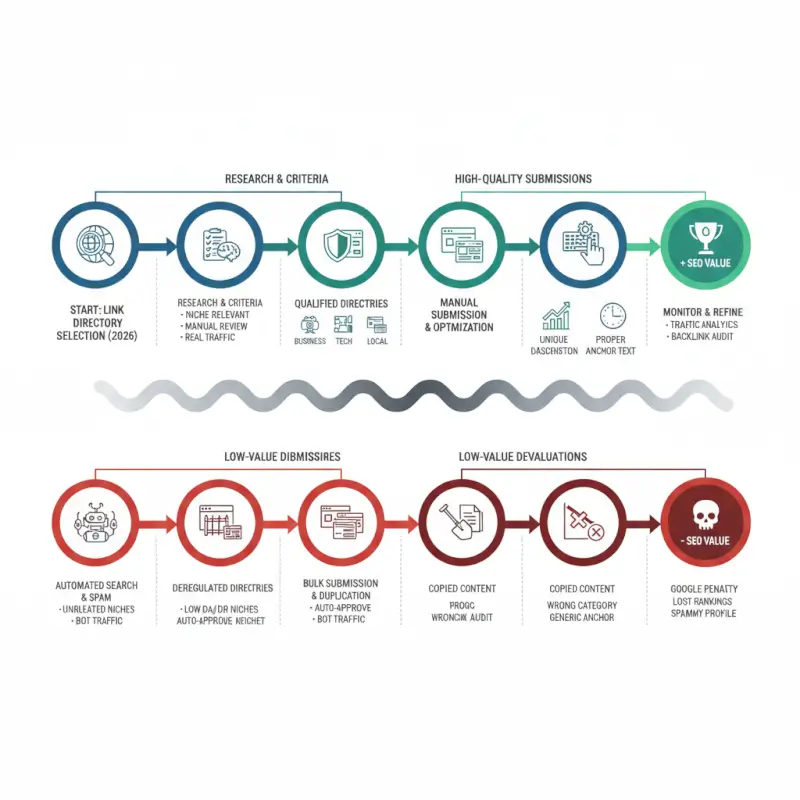
Another critical indicator is the presence of obviously spammy listings. Browse the directory’s existing entries before submitting. If you see nonsensical business names, broken links, duplicate listings, or sites promoting illegal content, the directory lacks quality control and association with it could signal poor judgment to search engines.
Spammy/Auto-Approve Directories and Link Farms
Link farms operate by creating networks of interconnected sites designed solely to manipulate search rankings. They typically disguise themselves as directories but serve no genuine user need. According to analysis from Backlynk’s directory backlinks research, directories showing excessive outbound links (500+ per page), minimal descriptive content, and no evidence of organic traffic typically function as link farms rather than legitimate resources.
Auto-approve directories remove the editorial barrier that helps maintain quality. While convenience might seem appealing, instant approval means the directory accepts everyone—including your competitors, spam sites, and potentially penalized domains. This creates guilt by association, where your link appears alongside questionable content.
I once audited a client whose previous agency had submitted them to 300+ directories over six months. When we analyzed the backlink profile, roughly 80% came from auto-approve directories with domain authorities under 10, many showing spam scores above 50%. We spent three months disavowing toxic links before seeing ranking recovery—a perfect example of how shortcuts create cleanup work.
Distinguishing Beneficial Directories from Low-Quality Aggregators
Quality directories share distinct characteristics that separate them from low-value aggregators. Beneficial directories typically feature detailed category structures with thoughtful organization, comprehensive listing information beyond basic NAP data, evidence of active user engagement (comments, reviews, ratings), and regular content updates showing ongoing maintenance.
Low-quality aggregators, conversely, show minimal categorization (often just alphabetical listings), sparse listing details, no user interaction features, outdated or broken links, excessive advertising, and poor site design suggesting neglect. The visual presentation often signals underlying quality—professional directories invest in user experience because they serve actual users.
Check the directory’s own backlink profile as well. If a directory has primarily low-quality inbound links or shows evidence of link exchange schemes, it won’t pass meaningful authority to your site regardless of its domain age or superficial metrics.
Evaluation Framework: Authority, Relevance, Traffic, and Trust
Systematic evaluation prevents wasted effort on low-return directory submissions. Rather than relying on gut instinct or outdated lists, apply a consistent framework assessing multiple quality dimensions before committing time to any submission.
The evaluation process should examine four core factors: authority metrics (domain authority, page authority, backlink profile quality), topical relevance (niche alignment, category structure, listing context), traffic signals (organic visitor data, engagement metrics, user behavior), and trust indicators (editorial process, listing quality, site maintenance). Each factor provides independent signal quality, but they work synergistically—high authority matters less if relevance is poor.

Create a simple scoring rubric assigning points for each factor. For instance, domain authority 40+ (2 points), niche-specific focus (2 points), evidence of organic traffic (2 points), manual review process (2 points), established domain age 3+ years (1 point), active maintenance within 6 months (1 point). Directories scoring 7+ out of 10 merit submission; those below 5 should be skipped.
Domain Authority/DR Thresholds and Editorial Curation
Domain authority and domain rating metrics provide useful baseline filters, though they shouldn’t be the sole evaluation criteria. Research from SEO Genix’s analysis of off-page SEO trends suggests directories with domain authority below 25 rarely pass sufficient link equity to justify submission time, while those above 40 show measurably stronger correlation with ranking improvements.
However, domain authority alone misses critical context. A DA 35 niche directory with strong editorial standards often delivers better results than a DA 50 general directory accepting unlimited submissions. The editorial review process serves as a quality gate, ensuring listed sites meet minimum standards and maintaining the directory’s overall reputation.
Look for concrete evidence of editorial curation: submission guidelines with specific requirements, stated review timelines, rejection rates or quality standards mentioned publicly, and editor contact information. Directories highlighting their selective acceptance process typically maintain higher quality than those promising guaranteed inclusion.
Topical/Industry Relevance and User Intent
Relevance signals matter increasingly in modern search algorithms. A link from a directory specifically focused on your industry or service category provides stronger topical alignment than a general business directory listing every category imaginable. This contextual relevance helps search engines understand your site’s focus and authority within specific domains.
Evaluate how precisely the directory’s categories align with your business. Narrow, specific categories (e.g., “Commercial Real Estate Appraisers in Texas”) indicate better categorization than broad buckets (e.g., “Business Services”). The more granular and relevant the category, the stronger the topical signal.
Consider user intent as well—would someone actually search this directory when looking for businesses like yours? The ways to access business park directory information illustrates how specialized directories serve specific user needs rather than functioning as generic link repositories. If you can’t imagine a real user scenario where someone finds value in the directory, it’s probably not worth your time.
Practical Quick Wins: When and Where to Use Directory Links for Real Value
Understanding where directory links deliver actual ROI helps allocate limited resources effectively. Rather than treating all directories equally, strategic prioritization focuses effort on placements most likely to drive measurable results through either direct link value, referral traffic, or local search signals.
The highest-value opportunities typically fall into distinct categories with different benefits. Local citations build geographic relevance and appear in local pack results. Industry directories establish topical authority and may drive qualified referral traffic. Resource directories curated by authoritative sites provide editorial-quality links. Each category requires different evaluation criteria and delivers different outcomes.
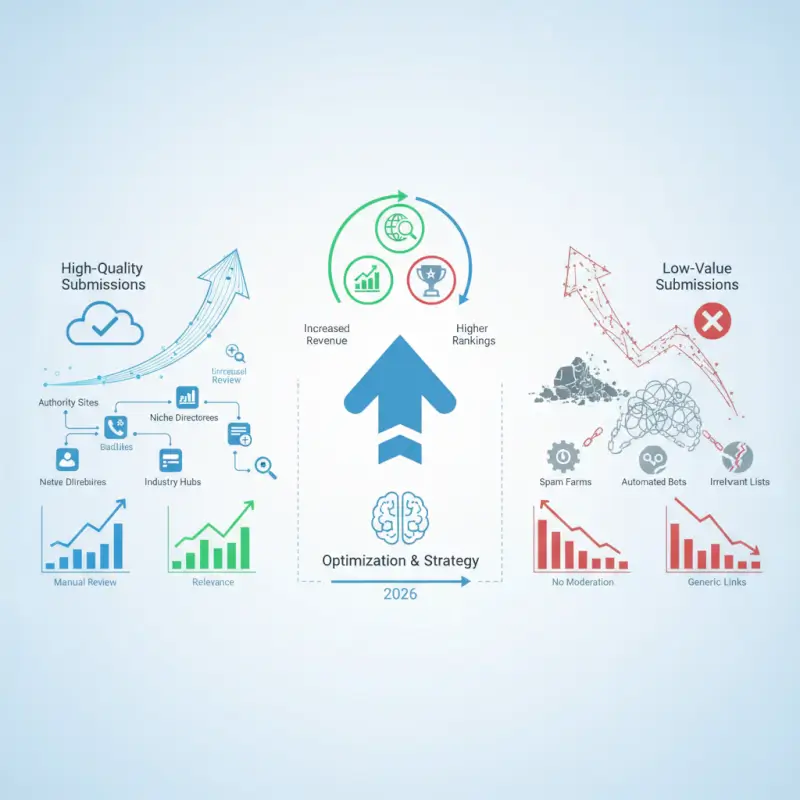
Focus initial efforts on “quick win” directories offering the best effort-to-value ratio. These typically include your local chamber of commerce, Google Business Profile and major data aggregators (Acxiom, Localeze), 2-3 top industry association directories, and 1-2 highly relevant local or niche directories with strong domain authority. This core set often delivers 80% of potential directory value with 20% of submission effort.
Local Citations vs. Global Directories
Local citations and global directories serve fundamentally different purposes and should be evaluated using distinct criteria. Local citations—listings in location-specific directories, chambers of commerce, local news sites, and geographic business directories—primarily support local search visibility and provide verification signals for map pack rankings.
For location-based businesses, local citations remain essential. Consistent NAP data across major citation sources directly influences local search performance. The how to search businesses in fslocal directory tips demonstrates how local directories function as discovery tools for consumers actively searching geographic areas.
Global or general business directories, conversely, aim for broader reach but often provide weaker relevance signals. Unless the directory has exceptional authority (DA 60+) or serves a specific niche, general directories typically underperform compared to targeted local or industry options. The exception is established directories with genuine traffic, like those maintained by major media properties or long-standing industry resources.
Niche/Vertical Directories and Resource Pages
Vertical directories focusing on specific industries or service categories often punch above their weight in terms of link value. A well-maintained healthcare directory with DA 45 may deliver better results for medical practices than a general business directory with DA 60, thanks to superior topical relevance and qualified referral traffic.
Resource pages maintained by authoritative sites represent premium directory-style placements. Universities, government agencies, professional associations, and industry publications often maintain curated lists of recommended resources, vendors, or service providers. These “directories” typically have strict inclusion criteria and provide both link equity and referral traffic from highly qualified audiences.
When evaluating niche directories, assess whether they serve a genuine community need. Directories created by industry insiders, maintained by professional organizations, or sponsored by recognized authorities tend to retain value. Those created purely for SEO purposes, filled with advertising, or showing minimal unique content typically don’t justify submission time.
Best Practices for Free vs. Paid Directory Submissions in 2026
The free versus paid directory decision isn’t straightforward—some free directories deliver excellent value while some paid directories aren’t worth the investment. The key is understanding what you’re paying for and whether the additional value justifies the cost compared to free alternatives.
Paid directories typically offer faster review times, more prominent placement, additional profile features (images, videos, extended descriptions), and sometimes better link attributes (dofollow vs. nofollow). However, payment alone doesn’t guarantee quality. Evaluate paid directories using the same criteria as free options, then determine whether the premium features justify the cost for your specific goals.

For most businesses, a mixed approach works best: claim free listings in high-authority local and niche directories first, then selectively invest in paid placements where the incremental benefits (prominent placement, enhanced profiles, guaranteed inclusion) align with business objectives. The key steps run successful directory website business guidelines show how quality directories balance free and paid models to maintain editorial standards.
Selection Criteria for Free Directories (Quality, Relevance, Traffic, Moderate DA/DR)
Free directories worth your time share specific characteristics distinguishing them from low-value options. High-quality free directories typically operate as community resources supported by advertising, professional associations funded by memberships, government or educational institution directories serving public information needs, or established platforms with freemium models offering basic free listings.
Apply these selection filters for free directories: minimum domain authority of 25-30, evidence of organic traffic (use SimilarWeb or comparable tools), active maintenance with recent updates visible, proper categorization system rather than simple alphabetical lists, and reasonable listing density (not thousands of listings in every category suggesting auto-approval).
Be particularly selective with free general business directories. The economics of free, general-purpose directories often force them toward low-quality models accepting anyone to build listing volume. Exceptions exist—established directories with other revenue sources or those operated by credible organizations—but most free general directories don’t justify submission time.
How to Submit with Maximum Context and Minimal Risk
Submission best practices minimize risk while maximizing potential value from approved listings. Start by thoroughly completing all profile fields—incomplete listings signal low investment and may receive less favorable treatment in directory search results. Include unique descriptions rather than copying your website’s about page; search engines recognize duplicate content and may devalue identical descriptions across multiple directories.
Vary your anchor text if the directory allows custom linking. Rather than using identical keyword-rich anchors across every directory (which can trigger over-optimization flags), mix branded anchors, naked URLs, and natural variations. Natural linking patterns show diversity rather than manipulation.
Document all submissions in a tracking spreadsheet noting submission date, directory URL, listing URL once approved, login credentials, and renewal dates if applicable. This prevents duplicate submissions and enables systematic audit of your directory portfolio. Set calendar reminders to review listings quarterly, updating information and removing outdated placements that may have declined in quality.
When to Prioritize Editorial/Curated Directories Over Automated Lists
Editorial directories—those requiring human review and maintaining acceptance standards—consistently outperform automated alternatives in both link value and longevity. The editorial review process serves as quality control, ensuring the directory maintains standards that preserve its authority over time.
Prioritize editorial directories when seeking placements with lasting value, building authority in competitive niches, or targeting industries where credibility matters significantly (legal, medical, financial services). The review requirements mean fewer total listings exist, which increases the relative value of inclusion and reduces association with spam.
Automated lists work best for basic local citations where consistent NAP data matters more than editorial approval. Data aggregators like Acxiom or Localeze use automated systems but serve important functions in local search ecosystems. However, for link building value beyond basic citations, editorial directories justify the additional submission effort and possible fees.
Understanding how to organize active directory for business environment principles can inform your approach to managing directory submissions systematically, treating them as structured data assets rather than random link opportunities.
Are free link directories still useful for SEO in 2026?
Free link directories can still provide value if they’re high-quality, niche-specific, and editorially curated. However, most free general directories offer minimal SEO benefit and some may harm rankings if they’re low-quality link farms. Focus on selective, authoritative directories relevant to your industry or location rather than mass submissions.
What kinds of directories should I target for SEO in 2026?
Target niche industry directories with editorial standards, local citation sources for geographic businesses, and high-authority curated resource lists. Avoid generic auto-approve directories with low domain authority. The best directories serve actual users first and provide SEO benefits as a secondary outcome, not link farms created solely for backlinks.
How do I evaluate a directory before submitting my website?
Check the directory’s domain authority (aim for 30+), verify it has organic traffic using tools like SimilarWeb, confirm manual editorial review rather than auto-approval, assess topical relevance to your industry, and examine existing listings for quality. Directories with broken links, spam listings, or excessive advertising should be avoided regardless of other metrics.
Can directory links hurt my SEO rankings?
Yes, low-quality directory links can harm rankings if search engines interpret mass submissions as manipulative link schemes. Directories functioning as link farms, those with excessive spam listings, or auto-approve platforms with minimal quality control can trigger algorithmic penalties. Always audit directory quality before submitting and monitor your backlink profile for toxic associations.
Should I focus on free directories or paid editorial placements?
Use a mixed approach: claim high-quality free listings in relevant local and niche directories first, then selectively invest in paid editorial placements that offer meaningful incremental value like prominent positioning or enhanced profiles. For maximum impact, prioritize content marketing and digital PR over extensive directory submissions, using directories as supplementary citation sources only.
What metrics should I track after submitting to directories?
Monitor referral traffic from directory listings, track changes in local pack rankings for location-based directories, measure indexed status of your directory pages, watch for ranking fluctuations on target keywords, and assess overall backlink profile health. Set up Google Analytics goals to measure conversions from directory referrals specifically.
How many directory submissions should I do per month?
Limit yourself to 3-5 high-quality directory submissions monthly, focusing exclusively on relevant, well-maintained directories with editorial standards. This conservative approach ensures you’re pursuing only valuable opportunities while avoiding patterns that might trigger spam filters. Quality and relevance always matter more than submission volume in modern SEO.
Do local business directories still help with local SEO?
Yes, local business directories remain important for local SEO when they provide consistent NAP citations and appear on trusted platforms. Google Business Profile, major data aggregators, chamber of commerce listings, and industry-specific local directories directly influence local pack rankings and map visibility. Maintain accurate, consistent information across all local citations.
Strategic Directory Implementation for Sustainable Results
The path forward with directory links requires abandoning outdated mass-submission thinking in favor of strategic selectivity. Rather than viewing directories as a primary link building tactic, treat them as one component of a diversified authority-building strategy that prioritizes quality editorial placements, content-driven link acquisition, and genuine relationship building.
Your directory strategy should operate within clear boundaries: allocate no more than 5-10% of total link building time to directory submissions, maintain a target list of 10-15 high-value directories rather than pursuing hundreds, audit existing directory links quarterly and disavow toxic associations proactively, and track specific KPIs (referral traffic, local pack visibility, topical authority signals) rather than just counting links.
For businesses managing their own directory platforms, solutions like TurnKey Directories (https://turnkeydirectories.com/) provide WordPress-based systems that help create the kind of high-quality, user-focused directories that still deliver value—platforms built around genuine user needs rather than SEO manipulation. This reflects the broader industry shift toward directories that serve communities first and provide SEO benefits as a natural consequence of quality and relevance.
The directories surviving and thriving in competitive search environments share common DNA: they solve real user problems, maintain editorial standards that preserve quality, focus on specific niches or geographies rather than trying to list everyone, and invest in user experience because they serve actual traffic rather than just collecting links. When you find directories meeting these criteria, they’re worth your submission time. Everything else is noise.
Start by auditing your current directory presence. Identify which listings drive actual referral traffic or conversions, which appear in high-quality directories worth maintaining, and which represent toxic associations requiring disavowal. Then build a focused target list of 5-10 missing opportunities—local citations you haven’t claimed, industry directories relevant to your niche, or editorial resource pages where inclusion makes strategic sense. Approach this as quality curation, not quantity accumulation, and you’ll extract whatever value remains in directory links without the baggage of outdated tactics.
Was this article helpful?