Business Directory Email Marketing: 7 Proven Strategies to Boost Engagement in 2026

Email marketing for business directories isn’t just alive—it’s thriving in ways most directory owners haven’t tapped into yet. While social media algorithms keep changing and paid ads get more expensive, email remains the one channel where you own the relationship. The difference between directories that struggle and those that flourish often comes down to one thing: how well they leverage email to nurture both sides of their marketplace.
I’ve watched directory owners make the same mistakes repeatedly (I made them myself early on). They build these beautiful platforms, get businesses listed, attract searchers… and then let those relationships go cold. Meanwhile, the savvy operators are using email to create sticky ecosystems where businesses renew year after year and users keep coming back. The gap isn’t about budget or technical skill—it’s about understanding how email fits into the unique dynamics of a two-sided marketplace.
TL;DR – Quick Takeaways
- Modern metrics matter more than opens – Focus on click-through rates (CTR) and click-to-open rates (CTOR) as primary engagement signals, since open rates are increasingly unreliable due to privacy protections
- Segment ruthlessly by listing status – Claimed vs. unclaimed listings, premium vs. free tiers, and engagement levels require completely different messaging strategies
- Deliverability is your foundation – Without proper authentication (SPF, DKIM, DMARC) and list hygiene, even brilliant content never reaches inboxes
- Mobile-first design is non-negotiable – With 60%+ of emails opened on mobile devices, responsive templates and touch-friendly CTAs determine success or failure
- Automation creates consistency – Welcome sequences, renewal reminders, and re-engagement campaigns run on autopilot while maintaining personalized touch
- Local relevance drives action – Geographic and category-specific content dramatically outperforms generic directory updates
- Privacy compliance builds trust – GDPR and CCPA aren’t just legal requirements—they’re opportunities to demonstrate respect for your users
Understanding Modern Email Benchmarks for Directory Marketing
Before diving into tactics, let’s establish realistic expectations based on current data. The email landscape has shifted significantly, and what worked three years ago might be completely off-base today. According to HubSpot’s 2025 email benchmarks by industry, average open rates vary wildly by sector, but here’s what matters more: those numbers are increasingly unreliable.
Apple’s Mail Privacy Protection (MPP) and similar features from other providers now artificially inflate open rates by pre-loading email content. This means an “open” might just be Apple’s server checking for malicious content, not a human actually reading your email. For business directories, this creates a measurement challenge—you can’t trust opens the way you used to.
Instead, smart directory operators focus on click-through rate (CTR) and click-to-open rate (CTOR). CTR measures clicks divided by total emails delivered, while CTOR measures clicks divided by opens. CTOR is particularly valuable because it isolates content effectiveness from subject line performance. For directory-related emails, a CTR of 2-3% is solid baseline performance, while CTOR above 15% indicates genuinely engaging content.
Setting Your Baseline
Don’t just compare yourself to industry averages—establish your own baseline from historical data. Pull metrics from your last 6-12 campaigns and calculate median performance (not average, which can be skewed by outliers). This becomes your true starting point. One directory I worked with was discouraged by “low” 18% open rates until we realized their 4.1% CTR was crushing industry benchmarks—their subject lines needed work, but their content was exceptional.
Seven Updated Strategies for Directory Email Success
1. Strengthen Your Directory-Specific Value Proposition
Generic “newsletter” emails get ignored. Every email you send should answer one question for the recipient: “What’s in this for me?” For businesses listed in your directory, that might be visibility metrics, tips to improve their profile, or notifications about searcher activity. For directory users, it’s discovering new businesses, exclusive offers, or category-specific recommendations.
I remember helping a local restaurant directory reframe their weekly email. Instead of “This Week’s New Listings,” they switched to “5 Restaurants That Opened This Week Near You (Plus Their Opening Specials).” Same content, completely different value framing. Their CTR jumped from 1.8% to 3.4% within two sends.
Test different value propositions systematically. For listing owners, compare performance of emails focused on visibility (“Your listing got 47 views last week”) versus action items (“3 quick updates to improve your profile”). Track which generates more clicks and, more importantly, which drives desired actions like profile updates or tier upgrades.
2. Segment by Intent, Status, and Behavior
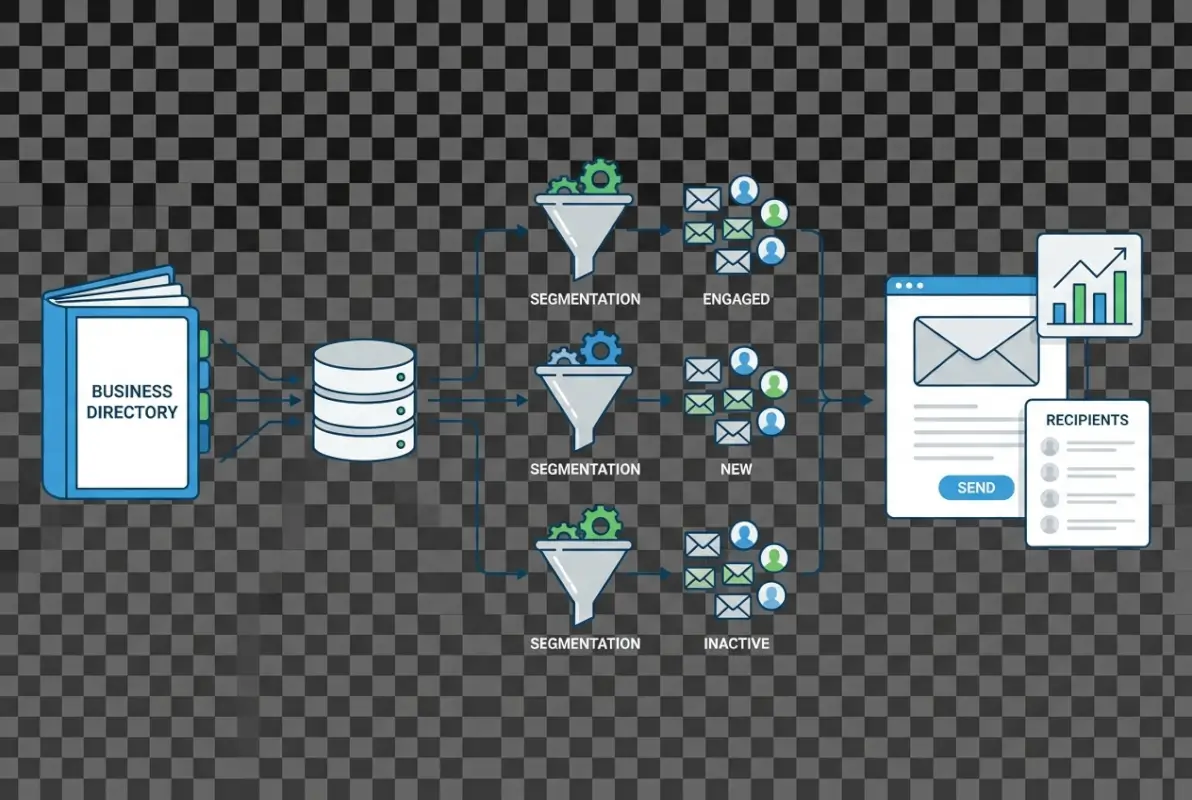
The most powerful lever in directory email marketing is segmentation. You’re managing a two-sided marketplace with fundamentally different audiences, and treating them as one homogeneous list is like using a sledgehammer when you need a scalpel. According to MailerLite’s 2025 benchmark data, segmented campaigns generate 46% higher open rates and 73% higher click rates compared to batch-and-blast approaches.
Start with these foundational segments for business listings:
- Claimed vs. unclaimed profiles – Unclaimed listings need education about benefits; claimed listings need optimization tips
- Free vs. premium tiers – Free users get upgrade incentives; premium users get retention-focused value delivery
- Profile completeness – Incomplete profiles (under 60%) get specific next-step guidance
- Engagement level – Active updaters get advanced features; dormant listings get re-engagement sequences
- Geographic location – City or region-specific opportunities and local trends
- Business category – Industry-specific content (restaurants vs. contractors vs. healthcare)
For directory users (searchers), segment based on:
- Search behavior – Categories they repeatedly browse
- Visit frequency – Weekly users vs. monthly vs. dormant
- Location patterns – Single city focus vs. multi-location searches
- Interaction history – Businesses contacted, reviews left, favorites saved
| Segment | Primary Goal | Email Frequency | Key Metric |
|---|---|---|---|
| Unclaimed Listings | Claim conversion | 2-3x/month | Claim rate |
| Free Tier Active | Upgrade to premium | 1x/week | Upgrade rate |
| Premium 30d Pre-Renewal | Retention | 3-4 emails total | Renewal rate |
| Dormant (90d+) | Re-engagement | 1x special sequence | Reactivation rate |
| Active Searchers | Continued engagement | 1x/week | Directory visits |
3. Optimize Deliverability Before Creative
The most brilliant email in the world is worthless if it lands in spam. Deliverability is the unglamorous foundation that too many directory owners neglect until it’s too late. Your sender reputation—built on authentication, engagement patterns, and complaint rates—determines whether your emails reach the inbox, promotions tab, or spam folder.

Start with technical authentication. Implement SPF (Sender Policy Framework), DKIM (DomainKeys Identified Mail), and DMARC (Domain-based Message Authentication) records for your sending domain. These aren’t optional anymore—major email providers like Gmail and Yahoo now require them. If you’re using a platform like Mailchimp or similar, they’ll guide you through setup, but verify everything is properly configured using tools from your DNS provider.
List hygiene is equally critical. Remove hard bounces immediately—keeping them tanks your sender reputation. Implement a sunset policy for unengaged subscribers (those who haven’t opened your last 15-20 emails over 6+ months). I know it feels counterintuitive to delete subscribers, but a clean list of 5,000 engaged contacts outperforms a bloated list of 20,000 where 15,000 never open anything.
4. Create Hyper-Relevant Content for Each Segment
Once you’ve segmented your audience, the next step is crafting content that feels personally relevant to each group. Generic directory updates (“We added 50 new businesses this month!”) get ignored. Specific, actionable content (“3 new plumbers joined your neighborhood—here’s how to stand out”) drives engagement.
For unclaimed business listings, your email sequence should focus on education and urgency. Explain what claiming does, show social proof (testimonials from businesses that claimed and saw results), and create mild urgency (“Your competitors are claiming their listings—here’s what you’re missing”). A healthcare directory I advised created a simple before-and-after visual showing an unclaimed vs. claimed profile. Their claim rate jumped 34% in the following month.
For premium listing owners approaching renewal, shift to value reinforcement. Send performance summaries: “Your listing was viewed 347 times last month—here’s how that compares to non-premium listings in your category.” Include specific ROI examples when possible. The goal is making cancellation psychologically difficult because you’ve proven ongoing value.
5. Implement Intent-Driven Automation
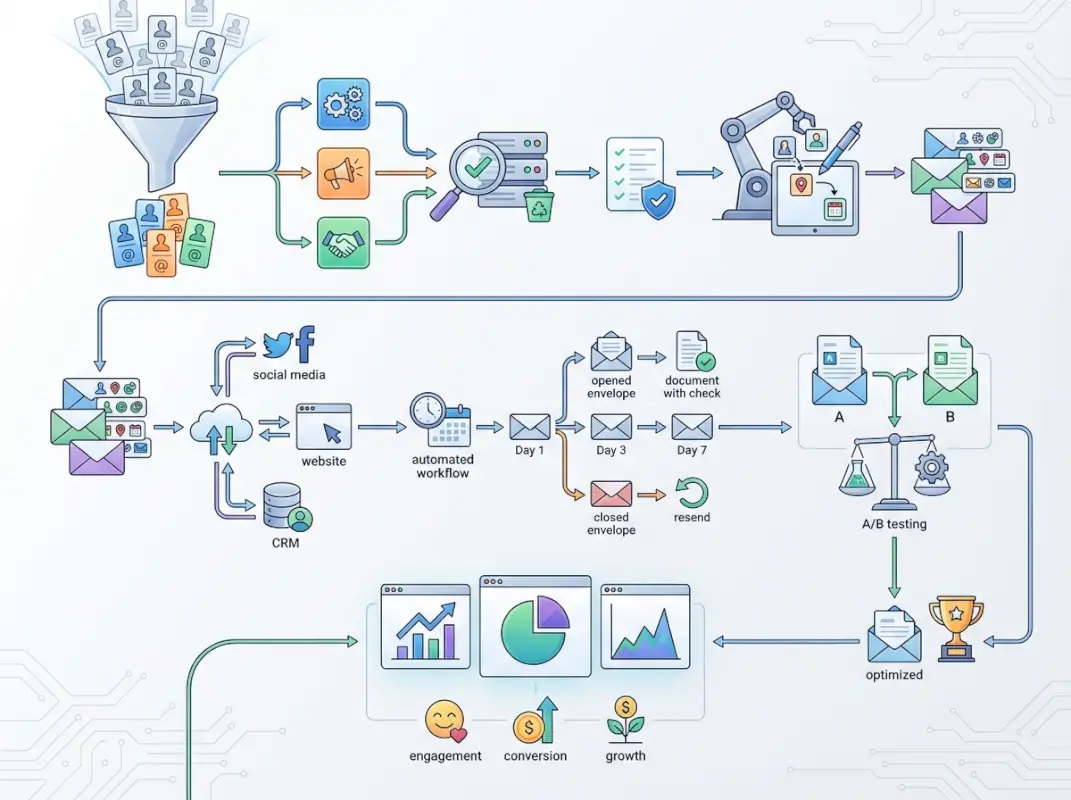
Automation is where email marketing scales without losing personalization. The key is triggering emails based on specific actions or milestones rather than just calendar dates. Your directory platform (like business directory website solutions from TurnKey Directories) should integrate with your email platform to enable behavioral triggers.
Essential automation workflows for directories include:
- Welcome sequence for new listings – 5-7 emails over 14 days covering profile optimization, category selection, photo guidelines, and early upgrade incentives
- Profile completion nudges – Triggered when completion drops below 60%, with specific next steps
- View milestone celebrations – Automated “Congrats! Your listing just hit 100 views” messages that reinforce value
- Renewal sequences – Starting 30 days before expiration with graduated urgency and incentives
- Review response reminders – When a business receives a new review, prompt timely response
- Re-engagement campaigns – For dormant listings that haven’t logged in for 60+ days
- Upgrade opportunity notifications – When free listings hit high-traffic thresholds (proving demand)

6. Design for Mobile and Accessibility First
More than 60% of emails are now opened on mobile devices, and that percentage is higher for local business directories where users search on-the-go. If your emails don’t render perfectly on a smartphone, you’re losing the majority of your audience before they read a single word.
Use responsive email templates that adapt to screen size. Keep your design single-column—multi-column layouts break on mobile. Make CTA buttons large enough for thumbs (minimum 44×44 pixels according to W3C mobile accessibility standards). Use font sizes of at least 14-16px for body text so readers don’t have to pinch-zoom.
Accessibility goes beyond mobile. Include alt text for every image (so screen readers can describe them to visually impaired users). Ensure sufficient color contrast between text and background. Structure content with proper heading hierarchy so assistive technology can navigate effectively. These aren’t just nice-to-haves—they’re legal requirements in many jurisdictions and ethical imperatives everywhere.
7. Measure What Actually Matters
Stop obsessing over open rates. With privacy protections making them unreliable, focus instead on metrics that directly correlate with directory success: CTR, CTOR, conversion rates (claims, upgrades, renewals), and revenue per email. For business directory boosts local marketing efforts, track secondary actions like profile updates, photo uploads, and review responses triggered by emails.
Set up proper attribution tracking. Use UTM parameters on every link so you can see which emails drive which actions in your analytics platform. Create unique promo codes for email-exclusive offers to measure conversion precisely. Track the full funnel—not just immediate clicks but whether those clicks lead to desired outcomes weeks later.

A/B test systematically, not randomly. Test one variable at a time: subject line approaches (question vs. statement, with/without personalization, with/without numbers), send times (Tuesday 10am vs. Thursday 2pm), CTA wording (“Upgrade Now” vs. “Enhance My Listing”), and email length (concise vs. detailed). For lists under 5,000, run tests across multiple sends to gather statistically significant data.
Advanced Tactics for Directory Email Excellence
Personalization Beyond the First Name
Everyone personalizes with {{FirstName}} now—it’s table stakes. Real personalization uses directory-specific data to make each email feel custom-crafted. Reference the recipient’s business category, location, listing tier, recent activity, and performance metrics. Instead of “Hi Sarah,” try “Hi Sarah—your dental practice in Austin just had its best month for views.”
Dynamic content blocks take this further. Show different content sections based on segment attributes. Premium members might see advanced feature tutorials while free users see upgrade incentives in the same email slot. Category-specific tips can rotate automatically—restaurants get booking optimization advice while contractors get lead response time best practices.
Localized Content Strategy
For multi-city or regional directories, location-specific content dramatically outperforms generic updates. A “5 New Businesses This Week” email is fine; “5 New Businesses in Downtown Seattle This Week” is significantly more compelling to Seattle users. Segment by user location and business service areas, then craft geography-specific content.
I worked with a statewide contractor directory that shifted from monthly state-wide digests to weekly city-specific spotlights. Same effort (they rotated through cities), but CTR increased from 2.1% to 4.7% because recipients saw their specific area featured. Local relevance cuts through inbox noise like nothing else.
Listing Owner Incentives and Promotions
Strategic incentives delivered via email can drive specific behaviors while maintaining profitability. Time-limited upgrade discounts (“30% off premium listings—48 hours only”) create urgency. Feature placement auctions (“Bid for top placement in your category this week”) generate engagement. Referral bonuses (“Refer another business, get a free month”) leverage existing relationships for growth.
The key is making offers feel exclusive and time-bound. Avoid perpetual discounts that train users to wait for deals. Instead, use occasional limited promotions tied to specific goals (end-of-quarter push for premium upgrades, seasonal campaigns for categories with cyclical demand).
| Incentive Type | Best For | Typical Response Rate | Duration |
|---|---|---|---|
| Upgrade Discount | Free tier converting to premium | 8-12% | 48-72 hours |
| Featured Placement | Premium retention | 15-20% | 1 week |
| Referral Bonus | Active, satisfied users | 5-8% | Ongoing |
| Early Renewal Discount | 60d pre-renewal premium | 12-18% | 2 weeks |
| Win-Back Offer | Lapsed premium users | 6-10% | 1 week |
Compliance and Privacy as Competitive Advantage
GDPR and CCPA compliance aren’t just legal checkboxes—they’re trust-building opportunities. Be transparent about data usage. Make unsubscribing genuinely easy (one click, no login required). Honor preference centers where users choose email frequency and topics. Respect opt-outs immediately.
Include clear privacy information in welcome emails and maintain accessible privacy policies. For directories operating globally or in multiple jurisdictions, comply with the strictest applicable regulations everywhere. The short-term cost is worth the long-term trust and reduced legal risk.
Your 30-Day Directory Email Refresh Plan
Implementing everything at once is overwhelming and counterproductive. Here’s a phased approach to modernize your directory email marketing over one month:
Week 1: Foundation Audit
Days 1-2: Pull last 90 days of email performance data. Calculate median CTR, CTOR, bounce rate, and unsubscribe rate for each major segment. Identify your baseline and spot obvious problems (segments with abnormally high bounces or low engagement).
Days 3-4: Verify technical setup. Confirm SPF, DKIM, and DMARC are properly configured using your email platform’s authentication checker. Test email rendering across devices (desktop, iOS, Android) using tools like Litmus or Email on Acid if budget allows, or manual testing if not.
Days 5-7: Clean your list. Remove hard bounces immediately. Tag unengaged subscribers (no opens in last 6 months) for a re-engagement campaign or sunset. Segment your list into the primary categories outlined earlier (claimed/unclaimed, tier, engagement level, category, location).
Week 2: Content and Template Updates
Days 8-10: Audit existing email templates for mobile responsiveness. Update or replace templates that don’t render well on smartphones. Ensure minimum 14px font sizes, single-column layouts, and 44x44px touch targets for buttons.
Days 11-12: Create segment-specific email templates. At minimum, build distinct templates for: (1) unclaimed listing outreach, (2) free tier engagement, (3) premium retention, (4) user/searcher updates. Each should have appropriate tone, value proposition, and CTAs.
Days 13-14: Write 3-5 subject line variants for each segment following different formulas (question-based, stat-driven, urgency-focused, benefit-focused). You’ll test these in week 3.
Week 3: Automation and Testing
Days 15-17: Set up your first two automation workflows. Start with highest-impact sequences: (1) new listing welcome series (5 emails over 14 days), and (2) renewal reminder sequence (starting 30 days pre-expiration). Map out email content, timing, and success metrics for each.
Days 18-19: Launch your first A/B test on subject lines. Choose your highest-volume segment and test two distinctly different subject line approaches. Ensure you have sufficient volume (at least 1,000 recipients per variant) for meaningful results.
Days 20-21: Begin a re-engagement campaign for unengaged subscribers identified in week 1. Send a simple “Do you still want to hear from us?” email with easy reconfirm or unsubscribe options. This improves deliverability by removing dead weight.
Week 4: Measurement and Optimization
Days 22-24: Set up proper tracking for key conversion actions. Implement UTM parameters on all email links to track directory visits, profile updates, claims, and upgrades back to specific emails. Create dashboard views in your analytics platform for easy monitoring.
Days 25-27: Analyze A/B test results from week 3. Implement winning variants and plan your next test. Review automation workflow performance—are people progressing through sequences or dropping off at specific emails?
Days 28-30: Document your new baseline metrics and set 90-day improvement goals. Schedule monthly review sessions to assess progress and plan next optimizations. Identify the next automation workflow to build (likely profile completion nudges or high-traffic upgrade prompts).
Tools and Resources for Directory Email Marketing
Email Marketing Platforms
Choose platforms that offer robust segmentation, automation, and API integration capabilities. Popular options include Mailchimp (user-friendly, good for beginners), ActiveCampaign (powerful automation), Klaviyo (excellent for e-commerce and transactional triggers), and SendGrid (developer-friendly with strong deliverability). For how to start profitable business directory steps, ensure your email platform can integrate with your directory software to trigger behavioral emails.
Testing and Optimization Tools
Litmus and Email on Acid provide comprehensive email testing across devices and clients. For subject line optimization, tools like CoSchedule’s Email Subject Line Tester or Send Check It analyze effectiveness. Google Analytics (with proper UTM tracking) remains essential for conversion attribution.
Deliverability Monitoring
Tools like Postmaster Tools (from Google) and similar offerings from other major providers let you monitor sender reputation. MXToolbox helps verify DNS records including SPF, DKIM, and DMARC configuration. Mail-Tester provides free testing to check spam score before sending.
Frequently Asked Questions
What is a good email open rate for business directories in 2026?
Open rates vary significantly by industry and are increasingly unreliable due to privacy protections like Apple’s Mail Privacy Protection. For business directories, open rates typically range from 18-28%, but focus instead on click-through rate (2-3% is solid baseline) and click-to-open rate (above 15% indicates engaging content) as more meaningful engagement metrics that directly correlate with directory success.
How can I improve deliverability for my directory email list?
Implement proper authentication (SPF, DKIM, DMARC records), maintain rigorous list hygiene by removing hard bounces immediately and sunsetting unengaged subscribers, use double opt-in for new subscribers, send from your own domain (never free providers like Gmail), maintain consistent sending schedules, and monitor sender reputation through tools like Google Postmaster. Good content that recipients want to read is ultimately your best deliverability insurance.
Should I segment my directory email list by business category?
Absolutely. Category-specific segmentation allows you to deliver highly relevant content that resonates with specific industries. Restaurants need different optimization advice than contractors or healthcare providers. Segmented campaigns consistently show 46% higher open rates and 73% higher click rates compared to generic batch emails. Start with broad category segments, then refine further based on performance data and available resources.
What email automation workflows are essential for business directories?
Priority workflows include: new listing welcome series (5-7 emails over 14 days covering optimization), profile completion nudges (triggered when completion drops below 60%), renewal reminders (starting 30 days pre-expiration), view milestone celebrations (proving value when listings hit traffic thresholds), review response prompts (when businesses receive reviews), and re-engagement campaigns for dormant listings. These automate relationship nurturing while maintaining personalized touch at scale.
How often should I email businesses listed in my directory?
Frequency depends on segment and value delivery. Active free-tier users can handle weekly emails if content is genuinely useful. Premium members benefit from weekly performance updates and optimization tips. Unclaimed listings should receive 2-3 monthly claim prompts. Dormant users need re-engagement sequences rather than regular cadence. The key is providing consistent value—recipients tolerate frequency when emails help them succeed. Monitor unsubscribe rates; spikes above 0.5% per campaign indicate frequency or relevance problems.
What metrics should I track for directory email marketing success?
Prioritize click-through rate (CTR), click-to-open rate (CTOR), and conversion metrics specific to your directory goals (listing claims, profile updates, tier upgrades, renewals). Track revenue per email sent for financial performance. Monitor list growth rate, bounce rate (should stay under 2%), and unsubscribe rate (target under 0.5% per campaign). For listing owners, track profile completion rates and listing optimization actions triggered by emails. Focus on trends over time rather than individual campaign fluctuations.
How do I create effective subject lines for directory emails?
Effective directory subject lines are specific, value-focused, and often include personalization or location elements. Test different formulas: questions (“How many people viewed your listing last week?”), stats (“Your listing got 47 views—here’s how to double that”), urgency (“Last chance: Featured placement expires tonight”), and benefits (“3 quick updates to rank higher in search”). Keep mobile display in mind—front-load important words within first 30-40 characters. Test systematically and let data guide decisions rather than assumptions.
Should I use plain text or HTML emails for my business directory?
Use HTML for most directory emails to leverage visual elements, branding, and clear CTAs. However, plain text outperforms HTML for highly personal outreach (individual business owner communications) and some re-engagement campaigns where authenticity matters more than polish. Many platforms support multipart emails that send both versions and let recipient email clients choose. For newsletters and promotional content, well-designed mobile-responsive HTML is standard. For individual relationship building, plain text often feels more genuine.
How can I re-engage dormant businesses in my directory?
Create a targeted re-engagement sequence specifically for listings inactive 60+ days. Start with a simple value reminder (“Your listing still gets 15+ views monthly—here’s how to capture those leads”), followed by specific missing opportunities (“Businesses with complete profiles get 3x more contact requests”), then a direct question (“Should we keep your listing active?”). Offer incentives like free featured placement or profile audit. If no response after 3-4 emails over 30 days, consider sunsetting from active campaigns while keeping the listing live.
What are common mistakes in business directory email marketing?
Common mistakes include: treating all subscribers identically without segmentation, focusing on features rather than benefits, neglecting mobile optimization (60%+ of opens), over-relying on open rates instead of CTR/CTOR, sending inconsistent or unpredictable cadences, ignoring deliverability fundamentals (authentication, list hygiene), using purchased lists (destroys sender reputation), failing to test systematically, not tracking conversions properly, generic subject lines that don’t communicate value, and overwhelming recipients with too many CTAs in a single email. Focus on one primary action per email for best results.
Taking Action on Your Directory Email Strategy
The gap between directories that thrive and those that stagnate often comes down to systematic relationship nurturing. Email marketing isn’t about interrupting businesses with sales pitches—it’s about providing ongoing value that makes your directory indispensable to their growth. When listing owners see tangible results in their inbox (performance metrics, optimization tips, success stories), renewal becomes automatic. When directory users receive genuinely helpful recommendations, they return repeatedly.
Start with the 30-day refresh plan outlined above. Don’t try to implement everything simultaneously—that leads to half-finished implementations that underperform. Pick the highest-impact changes for your specific situation. If your deliverability is questionable, start there. If you’re not segmenting at all, that’s your priority. If you have solid fundamentals but no automation, build your first workflow this week.
The directories winning in this space aren’t necessarily the ones with the biggest budgets or fanciest technology. They’re the ones who understand that email is fundamentally about relationships, and relationships require consistent value delivery tailored to individual needs. Implement these strategies systematically, measure relentlessly, and optimize based on data rather than assumptions. Your directory’s growth depends on it.