
Directory Website Monetization: 6 Tactics to Boost Revenue in 2026
Opens a Google-translated copy of this article in a new tab.
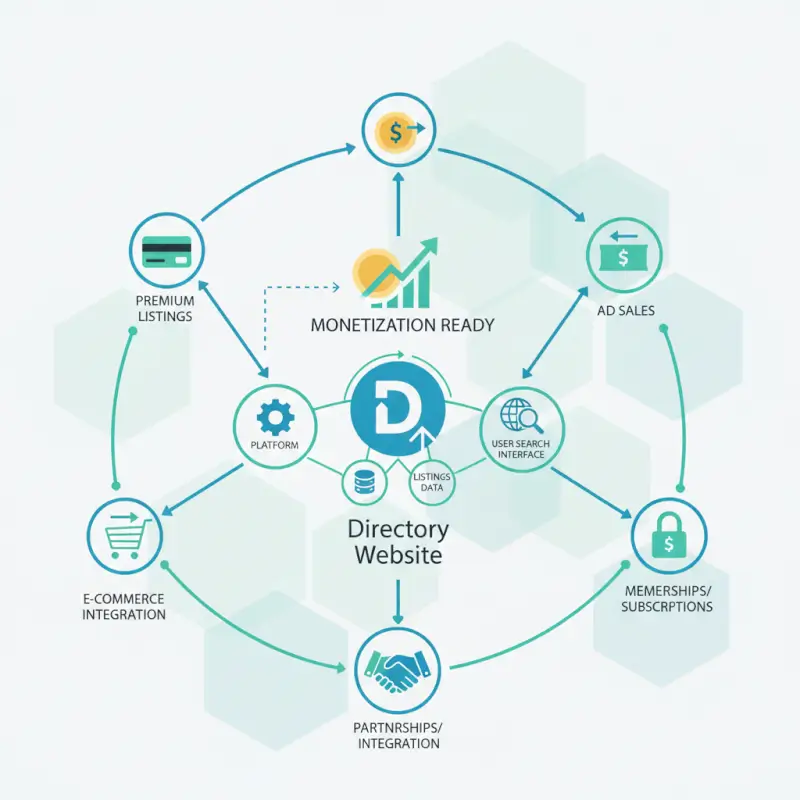
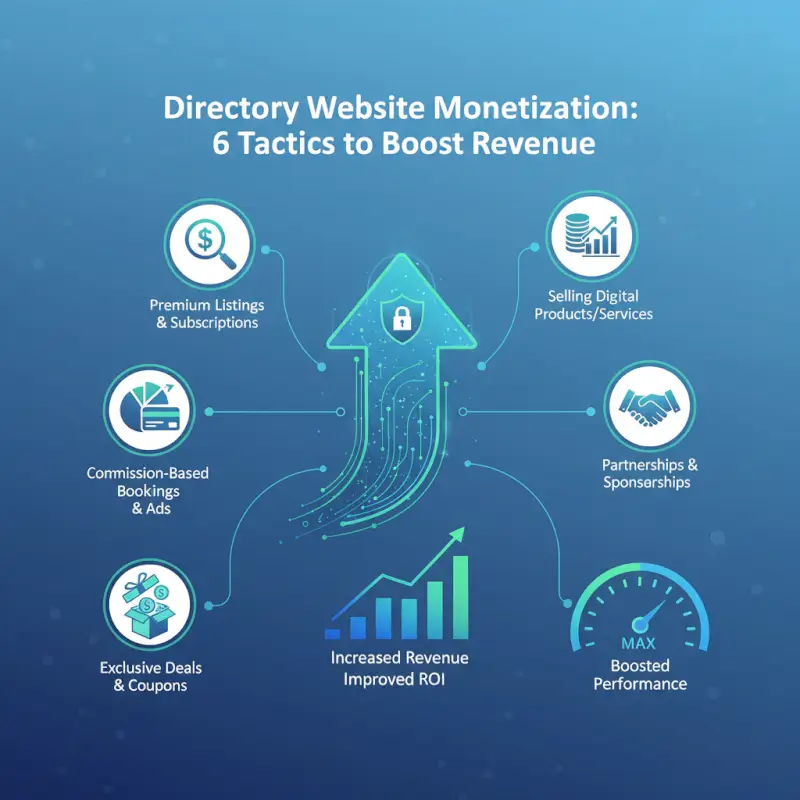
Directory websites are sitting on goldmines most operators never fully tap. While your competitors chase traffic numbers, the smartest directory owners are quietly layering revenue streams that compound—premium listings feeding lead generation, data APIs monetizing the same content three different ways, membership tiers creating predictable cash flow that smooths out seasonal advertising dips. The difference between a directory earning $500/month and one pulling $5,000+ isn’t traffic volume (though that helps)—it’s strategic monetization architecture. I’ve watched directory operators double revenue without adding a single new listing, simply by restructuring how they package and price existing value. The directory website monetization landscape has matured beyond banner ads and basic listings; the new playbook combines visibility products, data licensing, qualified lead pipelines, and hybrid bundles that maximize lifetime value from both sides of your marketplace.
TL;DR – Quick Takeaways
- Layer multiple revenue streams – directories earning $5K+ monthly blend premium listings, subscriptions, lead gen, ads, and data services instead of relying on one channel
- Premium visibility sells first – featured placements and tiered memberships create predictable recurring revenue while solving businesses’ core discovery problem
- Lead generation scales value – charging per qualified inquiry or appointment compounds your directory’s worth beyond simple exposure
- Data becomes a product – your curated listings have licensing value to partners, researchers, and adjacent platforms
- Niche focus supports premium pricing – tightly defined categories command higher fees than broad, commoditized directories
Premium Listings, Subscriptions, and Membership Bundles
The foundation of sustainable directory revenue isn’t traffic—it’s making visibility a product businesses will pay for repeatedly. Premium listings transform your directory from a passive catalog into an active sales channel for your listed companies. When a plumbing service sees three competitor logos above theirs in search results, they don’t debate whether premium placement works; they ask how fast they can upgrade. According to U.S. Census Bureau data on small business dynamics, over 6 million employer firms compete for local visibility, creating enormous demand for featured positioning in category-specific directories.
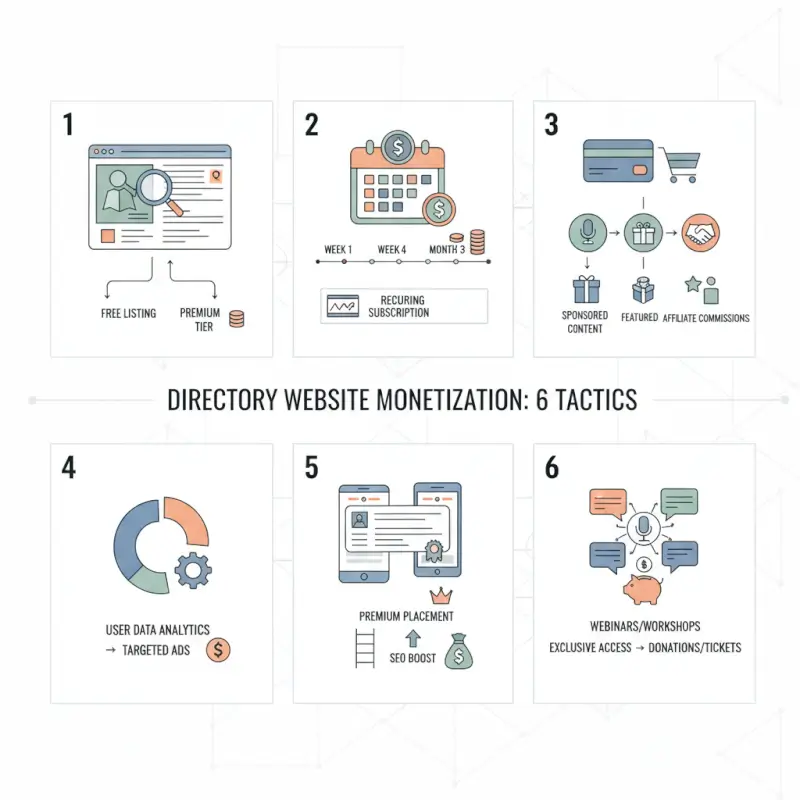
Smart operators structure premium visibility across multiple dimensions: top-of-category placement, homepage features, enhanced profile elements (videos, galleries, verified badges), and priority in search algorithms. Pricing should reflect measurable value—if a premium spot generates five qualified leads monthly and your average listed business values each lead at $50, a $99/month premium fee becomes an obvious ROI win. I remember consulting for a local contractors directory that tripled revenue in four months by simply adding “featured contractor” badges and rotating homepage placements at three pricing tiers ($49, $99, $199 monthly). The key was demonstrating conversion lift through A/B testing—featured listings saw 340% more click-throughs than standard entries.
Test premium pricing with a pilot cohort of 10-15 businesses that already engage with your platform (they comment, update profiles, refer others). Offer them early-adopter rates in exchange for testimonials and conversion data. Track not just click-throughs but actual business outcomes—appointment bookings, quote requests, phone calls. This data becomes your sales collateral for scaling the program. Avoid the trap of over-discounting; if premium placement genuinely drives results, businesses will pay appropriately, and underpricing trains your market to expect cheap visibility.
Premium Listings and Featured Positions
Featured positions work because they solve the paradox of choice. When users face 47 plumbers in a category, cognitive overload sets in—most click one of the top three results and never scroll. Your premium listings capitalize on this behavioral reality by placing paying businesses in those top slots. Structure these placements as auction-based (highest bidder wins the slot) or fixed-tier (gold/silver/bronze with set monthly fees). Auction models can drive higher revenue in competitive categories but require more sophisticated bidding infrastructure. Fixed tiers are simpler to implement and easier for small businesses to budget. Most successful directories start with fixed tiers and introduce bidding only after achieving critical mass in high-demand categories.
Value signals matter as much as position. A premium listing that’s just “at the top” doesn’t differentiate much from organic results. Add visual distinction—colored borders, “Featured” badges, slightly larger logos, trust signals like “Verified” or “Top Rated” icons. Research from Nielsen Norman Group on visual attention patterns shows users fixate on differentiated elements 2-3x longer than uniform entries. Typical pricing ranges from $29/month for small local directories in narrow niches to $500+ monthly for national B2B directories with high-value lead flow. The upper end works when your directory drives leads worth $1,000+ each (legal services, enterprise software, high-ticket contractors).
Implement scarcity to protect value—limit premium slots to 3-5 per category page. If every listing can be “featured,” none truly are, and you’ve commoditized your premium tier. When slots fill, create a waitlist and notify businesses when openings occur. This scarcity also creates urgency; businesses hesitate less when they know competitors might claim the spot. One e-commerce directory I advised limited featured positions to four per subcategory and maintained 90%+ occupancy rates because businesses feared losing visibility to rivals.
Tiered Memberships and Subscriptions
Subscription models transform one-time listing fees into predictable monthly recurring revenue (MRR), the metric that makes directories attractive to investors and sustainable for operators. Structure tiers around escalating value: Free (basic listing with minimal features), Pro ($49-99/month with enhanced profile tools and analytics), and Premium ($199-499/month with featured placement, lead credits, and priority support). Each tier must deliver clear, tangible benefits that justify the price jump. Free tiers drive volume and network effects—more listings make your directory more valuable to searchers. Pro tiers monetize businesses serious about growth. Premium tiers serve high-value operators willing to pay for maximum visibility and lead flow.
The psychology of tiered pricing leverages anchoring and directory subscription advantages—when presented with three options, most buyers choose the middle tier, perceiving it as balanced value. Price your middle tier where you want most customers, and use the premium tier to anchor expectations high (even if few buy it). Include exclusive tools at each tier: Pro gets monthly performance reports and basic SEO optimization; Premium gets A/B testing of profile content, priority customer support, and access to lead-gen integrations. According to McKinsey research on subscription economics, businesses are 60% more likely to maintain subscriptions that include analytics or tools they integrate into daily operations.
Reduce churn by delivering monthly value beyond the initial signup—send performance summaries, category ranking updates, or competitive intelligence (“You’re #3 in your category; upgrade to Premium to claim #1”). Automate these touchpoints so members feel ongoing value. Offer annual prepay discounts (pay 10 months, get 12) to lock in longer commitments and improve cash flow. The operators who hit $10K+ MRR fastest are those who treat subscriptions as ongoing relationships, not set-it-and-forget-it listing fees.
Lead Generation and Qualified Partnerships
Lead generation flips the directory business model from “we bring you traffic” to “we deliver customers ready to buy.” Instead of charging for visibility alone, you monetize outcomes—quote requests, appointment bookings, phone calls—that directly impact a business’s bottom line. This model aligns your incentives with listed businesses (you both win when leads convert) and can command 3-5x higher revenue per business than flat listing fees. A home services directory charging $99/month for a premium listing might generate $400-800 monthly per business through lead fees at $25-50 per qualified inquiry. The catch: you need sufficient traffic and targeting to generate consistent lead volume, which typically requires at least 5,000+ monthly visitors and strong category focus.
Structure lead pricing based on vertical economics. High-value services (legal, medical, B2B software) can support $50-150 per lead because customer lifetime values run into thousands or tens of thousands. Local services (cleaning, handyman, pet care) typically max out at $10-35 per lead. Research industry benchmarks—Statista’s cost-per-lead data across industries shows legal services average $86 per lead while home services average $35. Price below these thresholds to remain competitive with paid search and lead-gen aggregators, but high enough to justify your infrastructure and traffic acquisition costs. I’ve seen directories fail by charging $5 per lead in industries where leads are worth $100+, leaving massive money on the table and undervaluing their marketplace.
Quality gates are non-negotiable. Businesses will churn instantly if you send junk leads—incomplete forms, spam, tire-kickers with no intent. Implement form validation, bot detection, and qualifying questions that filter casual browsers from serious buyers. For high-ticket categories, consider phone verification or two-step confirmation (user submits form, receives email to confirm, only then does business get charged). Some directories offer lead guarantees—if a business disputes a lead as low-quality, you credit it back. This builds trust but requires robust fraud detection to prevent abuse. One legal directory I worked with reduced lead disputes from 18% to under 3% by adding a single qualifying question: “When do you need this service?” (Immediate/Within a week/Within a month/Just researching). They stopped charging for “just researching” responses.
Lead Gen as a Service for Local Businesses
Positioning your directory as a lead-generation service rather than a listing platform changes the entire value conversation. Businesses don’t care about “being in your directory”—they care about filling their calendar with paying customers. Frame your pitch around outcomes: “We deliver 10-15 qualified quote requests monthly” vs. “We’ll list your business in our directory.” This shift lets you charge performance-based fees (pay per lead) or hybrid models (base subscription + lead credits). Pay-per-lead models reduce friction for new businesses (no upfront risk) but create revenue volatility; hybrid models balance predictability with performance upside.
Build intake forms that pre-qualify leads for specific business types. A home remodeling directory might ask project type (kitchen, bathroom, addition), timeline, and budget range before routing the lead. This lets you charge different rates by lead quality—a $50K kitchen remodel lead is worth more than a $2K bathroom refresh. Some directories use lead routing algorithms that distribute inquiries based on business subscription tier (Premium members get leads first, then Pro, then Free) or performance (businesses with faster response times and higher close rates get priority). These systems reward quality and incentivize businesses to upgrade or improve service.
Track and share conversion data to prove ROI. Partner with a few pilot businesses to measure lead-to-sale rates, average project values, and payback periods. If your leads close at 15% and the average sale is $3,000, each $30 lead delivers $450 in expected revenue (15% × $3,000), a 15:1 return. Use this data in sales conversations and case studies. Businesses that see concrete ROI metrics are far more likely to scale spend and commit to long-term contracts. For insights on choosing which directory plugins and tools support lead tracking best, review platforms with built-in CRM integrations and analytics.
Affiliate and Partner Networks
Affiliate revenue layers additional income on top of listings and leads without cannibalizing either. Recommend relevant tools, services, or products your directory users already need, and earn commissions on conversions. A contractor directory might partner with project management software, invoicing tools, or equipment suppliers. A restaurant directory could integrate reservation platforms, POS systems, or delivery services. Choose partners whose success depends on the same businesses you serve—this alignment ensures you’re genuinely helpful, not just monetizing referrals. According to industry benchmarks, well-integrated affiliate programs add 10-25% incremental revenue on top of core directory monetization.
Integrate affiliate offers contextually, not as banner ads. If a business is setting up a new directory profile, suggest a relevant invoicing tool in onboarding. If a user searches for event venues, show booking software options on result pages. The best email marketing and engagement tools for directories let you segment communications and recommend partners based on category or behavior. Avoid cluttering your site with generic ads; one well-placed, contextual affiliate offer converts 5-10x better than ten irrelevant banners. I’ve consulted for directories that added $1,500+ monthly revenue simply by embedding a trusted payment processor’s signup flow into business onboarding and earning $50-100 per activated account.
Maintain editorial integrity and compliance. Disclose affiliate relationships clearly (“We may earn a commission if you sign up through this link”). Vet partners for quality—promoting a terrible service for a 20% commission burns trust far more than the revenue is worth. Some directories create exclusive partner offers (discounts or extended trials) that add unique value and increase conversion rates. This approach positions you as a benefits aggregator, not just a referral link farm, and justifies higher engagement and conversion.
Advertising, Programmatic, and Retail Media Integration
Advertising remains one of the most accessible and scalable revenue streams for directories, but 2026’s landscape demands more than basic banner placements. Modern operators blend programmatic display networks with high-value sponsored content and PR-aligned event promotions to diversify ad income. According to recent industry analyses, directories that layer multiple ad formats—such as sidebar banners, in-line sponsored listings, and dedicated content placements—see substantially higher effective CPMs than those relying on a single unit type. This layered approach also reduces dependence on any single ad partner, insulating revenue from algorithm shifts or platform policy changes.

Managing ad inventory effectively requires both technical integration and editorial discipline. Most successful directories use a combination of direct-sold sponsorships (negotiated with high-intent advertisers or category leaders) and programmatic fill (via Google AdSense, Mediavine, or specialist networks) to maximize yield. Direct deals typically command 3–5× the CPM of programmatic remnant inventory, but they also require sales effort and relationship management. Balancing the two ensures you capture premium rates where possible while maintaining 100% fill on remaining impressions.
Sponsored content and PR synergies offer an additional high-margin lever. Many directories now publish editorial spotlights, buyer’s guides, or “best of” roundups, then monetize those pieces through native sponsorships or co-marketing agreements with featured businesses. When aligned with offline or virtual events—webinars, trade shows, or community meetups—these content packages can command $2,000–$10,000+ per sponsor, far exceeding the revenue from equivalent display impressions. The key is to maintain clear disclosure and editorial independence; readers will tolerate sponsored sections if they deliver genuine value and are transparently labeled.
Display Ads, Sponsored Content, and PR/Events Synergy
Setting up display ad inventory starts with choosing your ad server or mediation platform. Self-hosted solutions like Revive Adserver give full control over placement, targeting, and frequency caps, while hosted networks (AdSense, Ezoic, or niche ad exchanges) offer easier setup at the cost of lower per-impression revenue. Most mid-sized directories find success with a hybrid: AdSense for remnant fill, plus a handful of direct-sold 728×90 leaderboard or 300×250 sidebar placements reserved for premium sponsors. Track effective CPM (eCPM) by placement and page type weekly; it’s common to see homepage or high-traffic category pages earn 2–3× the site average.
Sponsored content deserves its own editorial workflow to preserve quality and trust. Establish clear guidelines—word count, disclosure language, review process—and publish them on a dedicated “Advertise With Us” page. Some operators bundle sponsored articles with social amplification (dedicated email blast, featured social posts) or event speaking slots, creating integrated packages worth $5,000–$15,000 per quarter for key category sponsors. This approach works especially well in B2B or professional directories where vendors are willing to pay for thought leadership positioning rather than simple click-through volume.
PR and event synergies amplify both reach and revenue. If your directory hosts an annual awards program, industry summit, or webinar series, offer tiered sponsorship packages that include on-site signage, email list access, and exclusive content placements on your site. A single platinum sponsor might pay $10,000–$25,000 for 12 months of homepage badge placement, quarterly sponsored posts, and keynote speaking rights. These integrated deals are stickier than month-to-month ad buys and often renew automatically, providing predictable high-margin income alongside variable programmatic fill.
Retail Media and Native Monetization
Retail media—contextual, intent-driven ads that appear at the point of decision—has become a cornerstone for directories in verticals like home services, e-commerce, and travel. Instead of generic display banners, retail media surfaces relevant product offers, local service quotes, or booking widgets inline with directory listings. For example, a home improvement directory might show “Get 3 Free Contractor Quotes” buttons alongside contractor profiles; the directory earns a per-lead fee or revenue-share when users submit requests. This model aligns advertiser spend directly with user intent, often yielding 5–10× higher conversion rates than standard banners.
Implementation typically involves partnering with lead-gen networks (HomeAdvisor, Angi, Thumbtack) or white-labeling a quote-request form that you fulfill through your own business listings. The latter approach keeps more revenue in-house—often 70–90% of the lead fee—and strengthens your relationship with listed businesses, who see the directory as a true partner rather than just a listing platform. To maintain user trust, limit the number of inline ad placements per page (one or two high-quality units) and ensure they’re clearly labeled as sponsored or affiliate offers.
Native ad networks like Taboola, Outbrain, or Sharethrough can supplement retail media with content-discovery widgets (“You May Also Like” carousels) at the bottom of listing pages. While these typically generate lower CPMs ($0.50–$2.00) than direct retail media, they require near-zero maintenance and can monetize pages that lack direct sponsorship inventory. The trade-off is user experience: too many recommendation widgets clutter the page and dilute engagement. Best practice is to A/B test placement and frequency, aiming for incremental revenue that doesn’t degrade time-on-site or conversion metrics by more than 5%.
Data Services, APIs, and Value-Added Offerings
Data has emerged as a high-margin revenue stream for established directories, particularly those with proprietary datasets—curated listings, verified contact details, user reviews, or category taxonomies. Rather than treating this information as purely operational, forward-thinking operators package and license it to partners, researchers, or adjacent platforms. A local business directory with 50,000+ verified entries, for instance, might sell quarterly data exports to CRM vendors, mapping services, or enterprise sales teams at $500–$5,000 per license. Because data licensing incurs minimal marginal cost after initial curation, gross margins often exceed 80%, making it one of the most profitable revenue lines when scaled.
API access extends the model from one-time exports to ongoing, usage-based revenue. By exposing a RESTful or GraphQL API that delivers real-time listing lookups, category hierarchies, or review sentiment scores, you enable third-party apps and integrations to embed your directory data directly. Pricing typically follows a tiered structure: a free tier (limited to 1,000 calls/month) for trial and small developers, a professional tier ($99–$499/month for 10,000–100,000 calls), and an enterprise tier (custom pricing for unlimited or white-labeled access). This SaaS-like cadence smooths revenue and increases customer lifetime value, as API clients rarely churn once integrated.
Beyond raw data, many directories now offer analytics and market-intelligence subscriptions. Category-level dashboards showing search volume trends, competitive density, or average review ratings help business owners benchmark performance and identify expansion opportunities. A SaaS directory, for example, might sell a “SaaS Market Intelligence” subscription at $199/month that aggregates anonymized search and click data across software categories. These insights are valuable to investors, product teams, and strategists—audiences willing to pay recurring fees for decision-grade data they can’t easily compile themselves.
Data Licensing and API Access for Partners
Launching a data-licensing program begins with defining your dataset’s scope and licensing terms. Decide which fields you’ll expose (business name, address, phone, category tags, reviews, user-generated metadata), the update frequency (real-time, daily, weekly), and allowable use cases (internal CRM enrichment, public redistribution, resale). Most operators prohibit resale or public redistribution in standard licenses, reserving those rights for premium tiers or custom partnerships. Draft a simple licensing agreement that covers usage limits, attribution requirements, and liability disclaimers; consult a contract attorney if your dataset includes user-generated content or personal data subject to GDPR or CCPA.
API design should balance ease of integration with security and rate-limiting. Use OAuth 2.0 or API-key authentication, implement per-tier rate limits (to prevent abuse and ensure fair usage), and provide comprehensive OpenAPI (Swagger) documentation with example requests and SDKs for popular languages (Python, JavaScript, PHP). Monitor usage analytics closely: if a customer consistently hits their tier ceiling, proactively reach out with an upgrade offer. This consultative approach turns overage events into upsell opportunities rather than support headaches.
Pricing strategy for API access often mirrors SaaS benchmarks. A freemium entry tier builds developer goodwill and surfaces proof-of-concept integrations; conversion to paid typically occurs once a partner moves from testing to production. Professional tiers ($100–$500/month) work well for SMBs and agencies, while enterprise deals ($1,000+/month or custom usage-based pricing) suit high-volume partners like marketing platforms, analytics vendors, or white-label resellers. Include overage charges (e.g., $0.01 per additional call) to capture value from spiky usage without forcing customers into the next tier prematurely.
Market Insights and Analytics Subscriptions
Market insights transform raw directory data into actionable intelligence. By aggregating search queries, click-through patterns, and listing performance metrics, you can publish category reports, trend analyses, and competitive benchmarks that command subscription fees. A healthcare directory might offer a quarterly “Provider Landscape Report” showing patient search volumes by specialty and geography, average review scores, and patient acquisition costs—data worth hundreds or thousands of dollars to clinic administrators and healthcare investors.
Building an insights product requires both data infrastructure and editorial packaging. Set up a data warehouse (BigQuery, Snowflake, or Redshift) to aggregate event streams, then use BI tools (Looker, Tableau, Metabase) to create standardized dashboards and reports. Anonymize and aggregate data to protect individual user privacy; insights should surface category-level or cohort-level trends, never personally identifiable patterns. Publish a monthly or quarterly “State of the Market” report as a lead magnet, then gate deeper drilldowns and custom queries behind a paywall ($99–$499/month for standard subscriptions, $1,000+ for bespoke analysis).
Pricing for analytics subscriptions should reflect the decision value they enable. If your insights help a business owner choose which market to expand into or which product category to prioritize, that decision might be worth tens of thousands in revenue—so a $200/month subscription represents exceptional ROI. Tier your offering by breadth (single category vs. full directory), granularity (monthly summaries vs. daily dashboards), and export rights (view-only vs. downloadable datasets). Offer annual prepay discounts (10–20% off) to lock in predictable revenue and reduce churn.
Hybrid Models and Niche Positioning
The most resilient directories in 2026 do not rely on a single revenue stream; they orchestrate hybrid models that bundle complementary offerings into cohesive packages. A hybrid approach might combine a basic free listing (to build inventory and organic reach) with premium visibility upgrades, lead-generation services, and exclusive analytics dashboards—all sold as a tiered membership. This layering increases customer lifetime value, reduces churn (businesses are less likely to cancel if they’re deriving value from multiple features), and smooths revenue across different growth phases. Research from recent industry case studies shows that directories with three or more active revenue streams achieve 40–60% higher median revenue per listed business than single-model peers.

Niche positioning amplifies the effectiveness of every revenue tactic. When you own a well-defined vertical—whether it’s “SaaS tools for e-commerce brands,” “sustainable architecture firms in the Pacific Northwest,” or “board-certified pediatric specialists”—you can command premium pricing because your audience and advertisers know exactly what they’re getting. Narrow niches also simplify sales and marketing: instead of generic pitches, you speak the industry’s language, cite category benchmarks, and offer sponsorship packages tailored to the buying cycle of that vertical. As one practitioner guide notes, niche directories consistently achieve 2–3× higher conversion rates on premium listings and sponsorships compared to broad, general-purpose platforms.
Implementing a hybrid model requires clear segmentation and packaging. Define distinct tiers—such as Free (basic listing with limited fields), Professional ($50–$200/month for premium placement, lead routing, and basic analytics), and Enterprise (custom pricing for white-label pages, API access, and dedicated account support). Ensure each tier delivers incremental, tangible value; users should feel the upgrade is worth the cost, not just a marginal improvement. Use feature matrices and comparison tables on your pricing page to make differentiation obvious, and offer a 14- or 30-day trial of paid tiers to lower the barrier to first conversion.
Bundled Offers (Combo of Listings + Leads + Ads)
Bundling multiple revenue streams into a single package simplifies the buyer’s decision and increases average order value. For example, a “Growth Package” might include a premium homepage listing ($100/month), up to 20 qualified leads per month (valued at $500), and a quarterly sponsored blog post ($1,200 annually)—all offered together at $299/month, a 30% discount versus à la carte pricing. Businesses appreciate the convenience and predictability, while you capture higher upfront commitment and reduce sales cycles. Bundles also make it easier to upsell: once a customer is on the Growth tier, offering an add-on (extra leads, additional sponsored content slots) is a natural conversation.
Design bundles around customer jobs-to-be-done rather than arbitrary feature lists. Interview a cohort of your best customers to understand which combinations of visibility, leads, and content actually move their business forward. You may discover that contractors care most about lead volume and speed-to-contact, while professional service firms prioritize thought-leadership content and peer visibility. Tailor bundles to these personas, and market them with outcome-focused names like “Lead Accelerator” or “Authority Builder” rather than generic “Silver” or “Gold” labels.
Track bundle performance with cohort retention and LTV metrics. Bundled customers should exhibit lower churn (because they’re anchored by multiple value drivers) and higher expansion revenue (because they’re already engaged with several product lines). If churn remains high, decompose the bundle to identify which component isn’t delivering value, then iterate or swap it out. Conversely, if upgrade rates from bundles to higher tiers are strong, consider introducing an even more comprehensive “Ultimate” package that layers on data exports, co-branded events, or exclusive networking access.
Niche Focus and Differentiation
Niche focus begins with a deliberate choice: depth over breadth. Instead of listing every business in your city or every software tool on the market, concentrate on a specific industry vertical, professional specialty, or geographic micro-market. A directory exclusively for “cloud-native DevOps tools” or “LEED-certified architects in California” will never match the raw traffic of a general business directory, but it will attract highly qualified visitors and command premium rates from advertisers who know they’re reaching exactly the right audience. This targeted positioning also enables richer editorial content—deep-dive comparisons, certification guides, compliance checklists—that generic directories cannot economically produce.
Differentiation within your niche can take many forms: proprietary verification (e.g., background-checked providers), unique data layers (integration compatibility matrices, pricing benchmarks), community features (member forums, peer endorsements), or exclusive events (annual conferences, certification workshops). Each of these adds defensibility and raises switching costs; once a business has invested time earning verified status or participating in your community, moving to a competitor directory means starting from scratch. Document these differentiators on your homepage and pricing page, and use them as anchors in sales conversations.
Pricing power in a niche comes from demonstrating ROI specific to that vertical. If your SaaS directory drives an average of 15 qualified demo requests per month for featured tools, publish that benchmark and price premium listings at a fraction of the expected contract value those demos generate. If your professional directory consistently ranks in the top three Google results for high-intent queries like “[specialty] near me,” quantify the organic click volume and translate it into an estimated acquisition-cost savings. When prospects see that your $200/month premium listing replaces $2,000/month in Google Ads spend, the decision becomes obvious.
| Model | Typical Monthly Revenue per Customer | Churn Rate (Monthly) | Best Fit |
|---|---|---|---|
| Single stream (e.g., listings only) | $50–$150 | 8–12% | Early-stage or highly commoditized verticals |
| Dual stream (listings + leads) | $150–$350 | 5–8% | Service-based or local business directories |
| Hybrid bundle (listings + leads + content) | $300–$600 | 3–6% | Niche B2B or professional directories |
| Enterprise (bundle + data/API) | $1,000+ | 2–4% | High-value verticals with data monetization |
Frequently Asked Questions
How do directory websites typically monetize?
Directory websites typically monetize through a combination of premium listings, subscription tiers, lead generation fees, display advertising, affiliate commissions, and data licensing. The most successful operators layer multiple revenue streams to reduce reliance on any single model and maximize customer lifetime value across different audience segments.
What are premium listings and how should pricing be set?
Premium listings are paid placements that give businesses enhanced visibility through top-of-category positioning, badges, extra media, or highlighted styling. Pricing should reflect the competitive value of the placement, typical conversion lift data, and market rates in your niche, often ranging from $25 to $500 monthly depending on category competitiveness and traffic volume.
Is lead generation legal and effective for directories?
Yes, lead generation is both legal and highly effective when implemented with proper consent, clear disclosure, and compliance with data protection regulations like GDPR and CCPA. Directories that deliver qualified, intent-rich leads to businesses see strong retention and can charge per-lead or via monthly lead bundles, often commanding premium pricing for high-quality prospects.
How should I price subscriptions or memberships for a directory?
Start by anchoring your pricing to the tangible value delivered: analytics dashboards, priority support, enhanced listings, or lead allocations. Test a tiered structure with a free or low-cost entry tier, a mid-tier offering core features at $20 to $100 monthly, and a premium tier with full access at $100 to $300-plus, adjusting based on customer feedback and willingness to pay.
Can a directory rely on ads alone, or should I mix revenue streams?
Relying solely on advertising revenue creates volatility tied to traffic fluctuations and advertiser budgets. The most resilient directories blend ads with premium listings, subscriptions, and lead generation to diversify income, smooth cash flow, and capture value from different user cohorts. This multi-stream approach reduces risk and increases overall profitability and sustainability.
What is the difference between freemium and tiered memberships?
Freemium offers a basic listing or service at no cost and charges for upgrades, while tiered memberships present multiple paid levels from the outset. Freemium builds audience quickly and converts a percentage to paid, whereas tiered memberships immediately segment buyers by willingness to pay, often yielding higher average revenue per user when value differentiation is clear.
How do I integrate affiliate programs without compromising user trust?
Disclose all affiliate relationships clearly, recommend only tools or services genuinely useful to your audience, and maintain editorial independence. Integrate affiliate links contextually within relevant content or resource sections rather than inserting them indiscriminately. Transparency and alignment with user needs preserve trust while generating incremental commission revenue alongside other monetization streams.
Should I focus on a broad or niche directory when monetizing?
Niche directories often monetize more effectively because they attract highly targeted audiences and businesses willing to pay premium prices for qualified exposure. A tightly defined vertical allows you to command higher listing fees, deliver better lead quality, and build specialized data offerings. Broad directories can scale traffic but typically see lower conversion rates and more commoditized pricing unless deeply localized or differentiated.
Building Sustainable Revenue: Your Next Steps
Directory monetization in 2026 is no longer a single-tactic game. The operators who thrive are those who blend premium listings with recurring memberships, layer lead generation alongside contextual advertising, and unlock data-driven offerings that serve partners and clients alike. Each revenue stream reinforces the others: premium listings drive user engagement that fuels ad inventory; subscriptions provide predictable cash flow that funds better data tools; lead generation validates the directory’s core value and justifies higher prices across the board.
Your roadmap starts with clarity. Choose one or two primary revenue models that align with your audience’s immediate needs and your platform’s current strengths. If you already have strong traffic, test display ads and sponsored placements. If your listings are curated and high-quality, introduce a tiered premium model. Once you validate product-market fit for those core streams, systematically layer additional models—affiliate partnerships, data APIs, or bundled service packages—to capture incremental margin without overcomplicating your operations.
Pricing should always reflect value, not guesswork. Run small cohort tests to gauge willingness to pay, track conversion lift and customer lifetime value, and iterate quickly. Monitor competitors, but don’t anchor solely to their numbers; the unique depth of your data, quality of your leads, or strength of your community can command premium pricing that generic directories cannot match. Transparency and compliance are non-negotiable: disclose affiliate relationships, honor data privacy regulations, and ensure that every paid placement or lead flow meets the standards your users expect.
Finally, think hybrid and think niche. Bundling multiple revenue streams into compelling packages increases customer lifetime value and reduces churn. Carving a specialized vertical or geography lets you charge more, build deeper partnerships, and deliver insights that broad, commoditized directories simply cannot. The directory landscape is competitive, but the winners are those who treat monetization as a strategic system rather than a grab bag of isolated tactics.
Ready to Scale Your Directory Revenue?
Apply these six tactics step-by-step. Start with one core revenue stream, validate pricing with real customers, and layer additional models as you grow. Sustainable profitability comes from diversification, rigorous testing, and relentless focus on the value you deliver.
Pick your first tactic today—whether it’s launching premium listings, structuring a membership tier, or integrating lead capture forms—and commit to shipping it within 30 days. The directory operators winning in 2026 are the ones who execute, measure, and iterate faster than the competition.
Was this article helpful?