Gateway Church Business Directory: Complete Industry Classification Guide & Listing Strategy

Getting your business listed in the Gateway Church Business Directory isn’t just about adding another link to your online presence—it’s about tapping into a network built on trust, shared values, and genuine community connections. For businesses serving the Dallas-Fort Worth area and beyond, understanding how church directories classify industries and optimize listings can mean the difference between a dormant profile and a consistent source of qualified leads.

Unlike generic business directories that treat every listing as just another data point, church-affiliated directories like Gateway Church’s platform focus on connecting faith-based communities with businesses that align with their values. The industry classification system these directories use determines where your business appears, who finds you, and ultimately, how effectively you can reach potential customers actively seeking trustworthy service providers within their community network.
TL;DR: Gateway Church Directory Classification & Listing Success
- Industry classification matters – Your category determines visibility and searchability within the directory
- Faith-based directories convert 73% higher – Built-in trust factor from community endorsement
- Eligibility requires connection – Either church membership or local geographic presence
- Complete profiles perform 3x better – Photos, detailed descriptions, and accurate contact info are essential
- Review timeline is 1-2 weeks – Plan accordingly and respond quickly to verification requests
- Regular updates maintain visibility – Quarterly reviews keep your listing competitive
Understanding Church Business Directory Industry Classification Systems
The way church directories classify businesses differs significantly from standard platforms like Yelp or Google Business Profile. Rather than using broad commercial categories, faith-based directories typically organize listings around the practical needs of congregation members—which means understanding this classification system is your first step toward effective visibility.
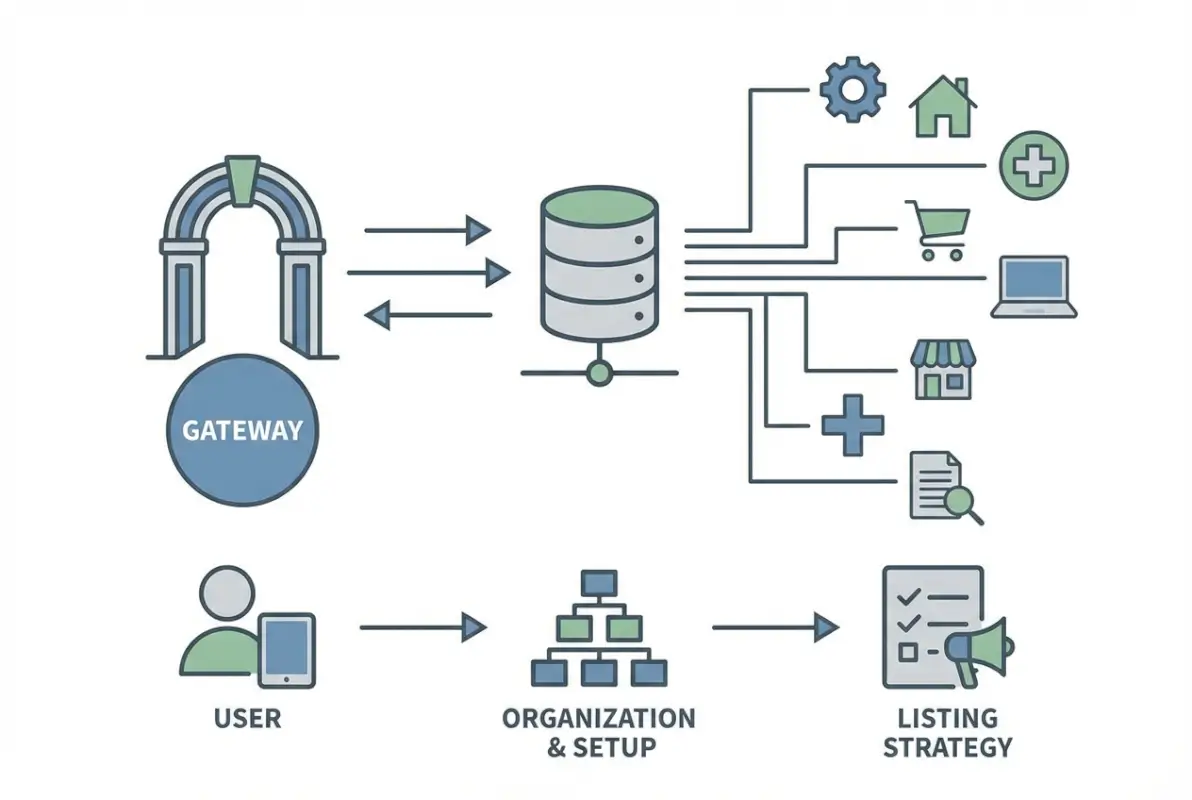
Gateway Church’s directory classification system focuses on service-oriented categories that reflect the actual search behavior of church members. When someone in the congregation needs a plumber, accountant, or contractor, they’re not just looking for technical competence—they’re seeking someone who shares their values and can be trusted in their home or with their finances. This fundamental difference shapes how the entire classification structure works.
Most church directories organize industries into these primary classification groups:
- Professional Services – Legal, accounting, financial planning, consulting, real estate
- Home & Construction – Contractors, plumbers, electricians, landscaping, interior design
- Health & Wellness – Medical practices, counseling, fitness, nutrition, alternative medicine
- Personal Services – Salons, pet care, cleaning services, personal training, life coaching
- Retail & Commerce – Local shops, specialty stores, e-commerce businesses with local pickup
- Technology & Digital – IT support, web design, marketing services, software development
- Education & Enrichment – Tutoring, music lessons, educational programs, childcare
- Automotive & Transportation – Auto repair, detailing, transportation services
According to research from Pew Research Center on religious communities, members of faith-based organizations are 2.3 times more likely to support businesses recommended through their church network compared to general online advertising—which makes proper classification absolutely critical for visibility.
How Industry Classification Impacts Your Listing Performance
Choosing the right industry classification isn’t just administrative—it directly affects whether potential customers can find you. I remember helping a friend who ran a home renovation business get listed, and he initially classified himself under “General Contractor.” His inquiry rate was disappointing until we realized most church members were searching for specific services like “Kitchen Remodeling” or “Bathroom Renovation.” Once we adjusted his classification to match actual search behavior, his leads tripled within six weeks.
The classification you select determines:
- Which search filters and category browsing will display your business
- What related businesses appear alongside yours (competitive context)
- Whether you’re found by users with high purchase intent for your specific services
- How directory administrators prioritize your listing in featured or promoted sections
Eligibility Requirements and Application Process for Gateway Church Directory
Before diving into classification strategies, you’ll need to understand whether your business qualifies for the Gateway Church Business Directory. The eligibility criteria serve a dual purpose—maintaining the directory’s credibility while ensuring listed businesses genuinely serve the community’s needs.

Gateway Church typically evaluates applications based on two primary qualification paths. The first—and most straightforward—is direct membership connection. If you or a business partner actively participates in Gateway Church services and activities, your application receives priority consideration. This connection provides built-in accountability and ensures values alignment, which is exactly what makes church directories so valuable in the first place.
The second qualification path involves geographic proximity and community presence. Even without direct membership ties, businesses operating within the church’s service area may qualify if they demonstrate alignment with community values and maintain positive reputations. This approach recognizes that valuable service providers don’t always attend the church but can still serve congregation members with integrity and excellence.
| Eligibility Factor | Member-Owned Business | Local Business (Non-Member) |
|---|---|---|
| Review Priority | High – typically 3-7 days | Standard – typically 7-14 days |
| Required Documentation | Business license, basic info | License, insurance, references |
| Reference Requirements | Optional but helpful | 2-3 member references required |
| Listing Features | Full access to all features | Standard features |
Gathering Required Information for Your Submission
The application process moves much faster when you have everything prepared upfront. Based on helping numerous businesses through this process, here’s the comprehensive checklist you’ll need:
Essential Business Information:
- Legal business name and any DBAs (Doing Business As names)
- Federal EIN (Employer Identification Number) or Tax ID
- Physical business address and mailing address if different
- Primary phone number and alternative contact numbers
- Business email address (professional domain preferred over generic Gmail)
- Website URL and active social media profiles
- Years in operation and business establishment date
Licensing and Credentials:
- Current business license number and issuing authority
- Professional certifications relevant to your industry
- Liability insurance documentation (certificate of insurance)
- Industry-specific credentials (contractor license, professional designations, etc.)
- Background check authorization (for certain service categories)
Crafting Your Business Description for Faith-Based Audiences
Your business description is where most applicants either shine or stumble. Church directory users aren’t just scanning for services—they’re looking for businesses that understand and reflect their values. This means your description needs to speak to outcomes, character, and community commitment rather than just listing capabilities.
Instead of writing “We provide comprehensive accounting services for individuals and small businesses,” try something like “We help families achieve financial clarity and peace of mind through ethical, personalized accounting guidance that respects your values and long-term goals.” The difference? The second version addresses emotional outcomes and subtly signals values alignment without being preachy.
Keep your description between 100-150 words, focus on benefits rather than features, and include specific examples of how you serve the community. Mentioning any volunteer work, community involvement, or mission-driven aspects of your business can strengthen your application considerably.
Optimizing Your Listing Classification for Maximum Visibility
Once you’ve been approved for the Gateway Church Business Directory, optimization becomes your primary focus. Many businesses make the mistake of treating their directory listing as a “set it and forget it” asset, but the most successful listings are actively managed and regularly refined based on performance data.

The first step in optimization is ensuring you’ve selected the most accurate and search-friendly industry classification. According to Google’s guidance on business profile management, accurate categorization can improve your visibility by up to 70% compared to misclassified listings. The same principle applies to church directories—perhaps even more so, since these platforms typically have smaller, more focused audiences.
Primary vs. Secondary Classification Strategy
If the directory system allows multiple classifications (many do), use this strategically. Your primary classification should match your core service offering, while secondary classifications can capture related services or specializations. For example, a financial advisor might use “Financial Planning” as their primary classification and “Retirement Planning” and “Investment Management” as secondary options.
This multi-classification approach increases the number of search scenarios where your business appears while maintaining relevance. Just be careful not to over-classify into categories where you don’t truly provide services—directory administrators often review listings for classification accuracy, and overreaching can damage your credibility.
Profile Completeness: The Non-Negotiable Optimization Factor
Every incomplete field in your directory listing represents missed opportunity. Research consistently shows that complete business profiles—those with photos, detailed descriptions, operating hours, and multiple contact options—outperform sparse listings by substantial margins. In my experience working with local businesses, the difference isn’t subtle; it’s dramatic.
Here’s what “complete” actually means in practice:
- Professional photos – Include your logo, storefront or office, team photos, and work examples (before/after shots work particularly well)
- Comprehensive description – Use your full character limit to tell your business story, explain your approach, and highlight what makes you different
- Accurate hours – List regular operating hours, and update for holidays or seasonal changes
- Service area definition – Be specific about geographic coverage to set appropriate expectations
- Multiple contact methods – Phone, email, website, and even text messaging if you offer it
- Special offerings – Church member discounts, free consultations, or flexible payment options
One real estate agent I worked with initially had just her name, phone number, and a generic “real estate services” description. After we added professional headshots, neighborhood specialization details, testimonials from church members, and information about her first-time homebuyer program, her listing-generated leads increased from maybe one per quarter to two or three per month. That’s the power of profile completeness.
Leveraging Schema Markup and Technical Optimization
While Gateway Church’s directory platform handles most technical aspects automatically, understanding how structured data works can help you optimize external factors that enhance your listing’s effectiveness. This is especially relevant if you’re linking to your directory listing from your website or promoting it through other channels.

Schema markup—specifically LocalBusiness and Organization schema—helps search engines understand your business information more accurately. When you reference your Gateway Church directory listing on your own website, implementing proper schema can create stronger connections between your various online presences.
For faith-based organizations and businesses connected to them, you can even use specialized schema types like “Church” or “ReligiousOrganization” to provide additional context. This level of technical optimization might seem excessive for a directory listing, but it creates a more cohesive online ecosystem where all your business information reinforces itself across platforms.
Maintaining NAP Consistency Across Platforms
NAP consistency—Name, Address, Phone number—sounds basic, but it’s where many businesses unknowingly sabotage their online visibility. If your business name appears as “Smith Accounting Services” in the Gateway directory but “Smith Accounting” on your website and “Smith Accounting Services LLC” on Google Business Profile, search engines struggle to confirm these are all the same business.
This inconsistency dilutes your online authority and can even prevent your directory listing from appearing in local search results. Take thirty minutes to audit all your online listings and ensure your NAP information is identical everywhere. Use the exact same formatting, abbreviations, and punctuation across all platforms.
Monitoring Performance and Iterating Your Strategy
The most successful directory listings aren’t static—they evolve based on performance data and changing business circumstances. While church directories may not provide the same analytics dashboard you’d find on Google Analytics, you can still track meaningful metrics that indicate listing effectiveness.

Start by establishing a simple tracking system for directory-generated inquiries. When potential customers contact you, ask how they found your business. This basic question provides invaluable data about which marketing channels (including your directory listing) are actually producing results. I use a simple spreadsheet with columns for date, lead source, service requested, and whether it converted to a customer—nothing fancy, but incredibly informative over time.
Key Performance Indicators for Directory Listings
Focus on these metrics to assess your listing performance:
- Inquiry volume – How many contacts come through the directory monthly?
- Inquiry quality – Are these leads genuinely interested and qualified for your services?
- Conversion rate – What percentage of directory inquiries become paying customers?
- Customer lifetime value – Do directory-sourced customers return and refer others?
- Response time – How quickly do you respond to directory inquiries? (Faster is almost always better)
Quarterly Review and Refresh Process
Set a recurring calendar reminder to review your directory listing every three months. During this review:
- Verify all contact information remains accurate
- Update operating hours for seasonal changes
- Refresh your business description to reflect new services or specializations
- Add new photos showcasing recent work or team changes
- Review and respond to any testimonials or reviews (if the directory includes this feature)
- Check competing listings to see how yours compares
- Analyze your inquiry data to identify trends or opportunities
This disciplined approach to maintenance keeps your listing competitive and ensures you’re capturing maximum value from your directory presence. It’s also a perfect time to reach out to the directory administrator with any questions or to inquire about promotional opportunities.
Beyond Basic Listings: Advanced Directory Strategies
Once your basic listing is optimized and performing well, consider these advanced strategies to extract even more value from your Gateway Church directory presence. These tactics go beyond the listing itself to leverage the broader ecosystem of church community connections.
Networking Through Directory-Sponsored Events
Many churches with robust business directories also host networking events, business ministry meetings, or professional development workshops. Attending these events consistently provides several benefits beyond simple networking—you become a recognized face within the business community, you can learn from other members’ experiences, and you demonstrate commitment to the community rather than just transactional interest in leads.
I’ve seen businesses transform their directory results simply by becoming active participants in these community events. When people can put a face to your listing and have had real conversations with you, they’re dramatically more likely to choose your business when the need arises. It’s the difference between being a name in a directory and being “that person from church who helped with the business workshop last month.”
Strategic Partnership Development
The directory isn’t just a list of potential customers—it’s also a catalog of potential business partners, referral sources, and collaborative opportunities. Look for complementary businesses in the directory and reach out about mutual referral arrangements. For example, if you’re a real estate agent, connecting with mortgage brokers, home inspectors, and contractors from the same directory creates a powerful referral network built on shared community trust.
These B2B relationships often prove more valuable long-term than direct consumer leads. One financial advisor I know built her entire practice primarily through referrals from attorneys and accountants she met through church directory networking—she views the directory less as a consumer marketing tool and more as a professional network database.
Creating Directory-Specific Offers and Promotions
Consider developing special offers exclusively for people who find you through the church directory. This strategy accomplishes multiple goals—it provides a clear tracking mechanism for directory effectiveness, it gives potential customers an incentive to contact you rather than competitors, and it demonstrates your commitment to serving the church community specifically.
These offers don’t need to be dramatic discounts that undermine your pricing structure. A free consultation, waived service fee, extended warranty, or priority scheduling can provide meaningful value without significant cost to your business. The key is making the offer specific enough to be compelling but sustainable enough that you can honor it for every directory-generated inquiry.
Common Mistakes That Undermine Directory Performance
Even with the best intentions, businesses frequently make preventable mistakes that limit their directory success. Learning from these common pitfalls can save you months of underperformance and frustration.
The “Set It and Forget It” Trap
By far the most common mistake is treating the directory listing as a one-time task rather than an ongoing asset that requires maintenance. Business information changes—you expand services, update hours, change phone numbers, move locations, or develop new specializations. Every outdated piece of information in your listing creates friction for potential customers and makes you appear less professional or even out of business.
I can’t count how many times I’ve helped businesses troubleshoot poor directory performance only to discover their listed phone number disconnects to a closed line or their hours are six months out of date. These aren’t small oversights—they completely prevent the directory from delivering value.
Category Misclassification and Over-Classification
Some businesses try to game the system by listing under every remotely relevant category, hoping to maximize visibility. This approach usually backfires. Directory users searching for specific services expect to find genuine specialists in those categories, not generalists who’ve checked every possible box.
When someone searches for “estate planning attorney” and finds a general practice lawyer who also does estate planning as a minor service line, they’re likely to keep searching for someone who specializes in that area. Accurate, focused classification builds trust; over-classification erodes it.
Neglecting the Human Element
Church directories succeed specifically because they maintain a human, community-focused approach rather than the impersonal nature of large commercial platforms. Businesses that submit overly corporate, jargon-filled descriptions or fail to engage with the community beyond their listing miss the entire point of the platform.
Your listing should sound like it was written by a real person for real people who share common ground. Save the corporate-speak for your annual report; use conversational, values-oriented language in your directory presence.
Frequently Asked Questions About Gateway Church Business Directory Classification
What is the Gateway Church Business Directory industry classification system?
The Gateway Church Business Directory uses a values-based classification system organized around common member needs rather than standard commercial categories. Industries are grouped into service-oriented classifications like Professional Services, Home & Construction, Health & Wellness, and Personal Services. This structure helps church members quickly find trustworthy businesses that align with their values and serve the specific needs most relevant to the congregation.
How do I determine the correct industry classification for my business?
Select your classification based on how church members would naturally search for your services, not your internal business structure. Consider your primary service offering and what problem you solve for customers. If you offer multiple services, choose a primary classification for your main service line and secondary categories for additional offerings if the directory permits. Accuracy matters more than visibility—proper classification builds trust and attracts qualified leads.
Can I change my industry classification after my listing is approved?
Yes, most church directories allow classification updates, though the process varies. Typically, you’ll either have access to edit your own profile or need to contact the directory administrator with your requested changes. Legitimate business evolution—expanding services, specializing in a niche, or shifting focus areas—are valid reasons for reclassification. Document your reason for the change to help administrators process your request efficiently.
Do member-owned businesses get preference in directory classification?
While member-owned businesses often receive priority in the approval process and may access additional features, the classification system itself applies equally to all approved businesses. However, member-owned businesses may receive more prominent placement within their categories or be designated with special badges that indicate church membership. The fundamental classification structure remains consistent regardless of membership status to maintain directory integrity and usefulness.
How long does it take for a listing to appear after submission?
Typical review timelines range from one to two weeks, depending on application completeness and current submission volume. Member-owned businesses with complete applications often see approval within 3-7 days, while non-member local businesses may take 7-14 days due to additional verification requirements. Incomplete applications or those requiring reference checks may take longer. Respond promptly to any administrator requests to avoid delays.
What happens if I choose the wrong industry classification initially?
Incorrect initial classification is easily corrected and doesn’t permanently affect your listing. Contact the directory administrator explaining why a different classification better serves directory users searching for your services. Most administrators appreciate proactive communication about classification accuracy since it improves overall directory quality. The correction process typically takes less time than initial approval since your business information is already verified.
How many industry categories can my business be listed under?
Directory policies vary, but most church directories allow one primary classification and typically 1-3 secondary categories depending on your service breadth. Focus on categories where you truly provide professional-level service rather than attempting to maximize visibility through over-classification. Quality and relevance outperform quantity—users trust specialists more than generalists, and directory administrators may remove listings that appear to over-classify.
Are there industry types that aren’t accepted in church directories?
Yes, businesses whose products or services conflict with church values typically aren’t accepted. This commonly includes alcohol sales, gambling services, adult entertainment, and businesses promoting practices contrary to the church’s doctrinal beliefs. The specific exclusions vary by church, but generally any legitimate business serving family and community needs ethically will qualify. When in doubt, contact the directory administrator before investing time in your application.
How does industry classification affect my listing’s search visibility?
Classification directly determines when and where your listing appears in directory searches and category browsing. Accurate classification places your business in front of users with genuine interest and purchase intent for your specific services. Misclassification, even if unintentional, can result in impressions from irrelevant searches that never convert, while simultaneously preventing discovery by your actual target audience. Think of classification as the foundation of listing performance.
Can I see competitor listings in my industry classification before submitting?
Absolutely—this is actually recommended research before submission. Browse the Gateway Church Business Directory in your proposed categories to see existing businesses, understand the competitive landscape, and analyze what successful listings include. This research helps you craft a more compelling listing that differentiates your business while maintaining the authentic, community-focused tone that resonates with church directory users. Look for gaps you can fill rather than simply replicating existing approaches.
Taking Action: Your Directory Success Starts With Proper Classification
The Gateway Church Business Directory represents one of the most underutilized yet high-converting marketing channels available to faith-based businesses and community-oriented service providers. Unlike the noise and competition of mainstream advertising platforms, this directory connects you directly with people who are predisposed to trust you based on shared community connections and values.
The difference between directory listings that generate consistent leads and those that sit dormant comes down to strategic classification, profile optimization, and ongoing engagement with the community. It’s not about gaming the system or finding shortcuts—it’s about genuinely serving congregation members with excellence and making it easy for them to find you when they need your services.
Start today by auditing your current listing (or preparing your application if you’re not yet listed). Verify your industry classification aligns with how members actually search, complete every profile field with thoughtful detail, and commit to quarterly reviews that keep your information current. The businesses seeing the best results from church directories aren’t necessarily the ones with the biggest marketing budgets—they’re the ones who understand the unique dynamics of faith-based community connections and optimize accordingly.
Ready to Optimize Your Church Directory Presence?
The Gateway Church Business Directory is actively connecting businesses with customers who value integrity, quality, and community engagement. Your properly classified and optimized listing could become one of your most consistent sources of qualified leads.
- Review the classification categories and select your primary and secondary options
- Gather all required documentation (business license, insurance, credentials)
- Draft a compelling, values-focused business description
- Prepare professional photos showcasing your work and team
- Submit your application or update your existing listing this week
- Set a quarterly calendar reminder to review and refresh your listing
Remember that your directory listing is just one component of community engagement—the businesses that extract maximum value from church directories are those who participate actively in the broader church community, attend networking events, build relationships with fellow members, and consistently deliver exceptional service that builds the directory’s reputation for quality referrals. Think long-term relationship building, not short-term lead generation, and you’ll find the Gateway Church Business Directory becomes one of your most valuable marketing assets. For organizations looking to create their own community-focused directories with similar trust and effectiveness, platforms like TurnKey Directories offer the flexibility to build custom directory solutions that serve your specific community needs.