Well-Known Directory Websites: Top 10 Platforms for Business Listings

When you’re competing for local customers, your digital presence extends far beyond your website. Every major search engine, mapping service, and specialty platform maintains its own directory of businesses—and if your information is missing, inconsistent, or buried under competitors, you’re handing those customers to someone else. Most businesses approach directory listings as a checkbox exercise, claiming a Google Business Profile and calling it done. That’s a mistake. The real opportunity lies in treating well-known directory websites as a network of interconnected trust signals that collectively tell search engines and consumers you’re legitimate, active, and worth discovering.
Here’s what’s rarely discussed: directories don’t just help people find you—they help search engines understand you. When your business appears with identical name, address, and phone (NAP) data across dozens of platforms, you’re essentially vouching for your own identity from multiple angles. Google’s local ranking algorithm weighs these citations heavily because they’re hard to fake at scale. A scammer can spin up a quick website, but maintaining consistent, verified listings across Yelp, Apple Maps, Bing Places, and twenty niche directories? That requires sustained legitimacy.
TL;DR – Quick Takeaways
- Google Business Profile is foundational – but adding Apple Maps, Bing Places, and Yelp creates a multi-platform visibility layer that search algorithms reward
- NAP consistency matters more than volume – ten perfectly matched listings outperform fifty inconsistent ones for local rankings
- Industry-specific directories build qualified traffic – healthcare, legal, and home service directories deliver higher-intent leads than generic platforms
- Free platforms drive 80%+ of directory value – paid upgrades make sense only after you’ve maxed out free listings’ potential
- Automation prevents drift – manual updates across multiple platforms invite errors; centralized tools maintain accuracy at scale
The Landscape of Top Directory Platforms
The directory ecosystem has consolidated around a few dominant players, with Google Business Profile holding an overwhelming lead. Research shows that GBP drives the majority of local discovery events, making it the mandatory starting point for any business with a physical location or service area. But treating GBP as your only directory presence is like building a house on a single support column—functional until something shifts.

Apple Maps has quietly become the second-most important platform for mobile discovery, especially among iPhone users (who tend to skew toward higher household incomes). Bing Places captures a smaller but commercially valuable audience, particularly in enterprise and older demographics. Yelp remains the go-to for restaurant, retail, and service businesses where reviews drive decisions. Together, these four platforms form what practitioners call the “core four”—the baseline presence every business needs before exploring niche options.
Beyond the core platforms, directories split into two categories: broad aggregators like Google Business Profile that serve all industries, and vertical-specific platforms like Healthgrades (healthcare) or Avvo (legal services) that cater to particular sectors. The broad platforms deliver volume; the niche platforms deliver intent. A podiatrist might get a hundred views on Google Maps but only five on Healthgrades—yet those five are far more likely to book an appointment because they’re actively comparing providers within the specialty.
If you’re building your own directory website, using WordPress directory plugins like those offered by TurnKey Directories can help you create a professional, searchable listing platform without custom development. Similarly, understanding what a company directory is and why you need one helps you position your business within larger directory ecosystems.
Platform-Specific Strengths and Use Cases
Google Business Profile dominates because it sits at the intersection of search and maps, the two most common local discovery methods. When someone searches “dentist near me,” GBP listings populate the Local Pack—the three-business cluster that appears above organic results. Claiming and optimizing your GBP means you’re competing for that visible real estate. The platform also aggregates reviews, photos, Q&A, and posts, making it a mini-website within Google’s ecosystem.
Apple Maps serves a different use case: directional intent. Users rarely browse Apple Maps the way they browse Google; they open it when they’ve already decided where to go and need navigation. That means your Apple Maps listing needs pinpoint location accuracy and clear business hours more than it needs rich media. According to Statista’s mobile OS data, iPhone users represent about half the U.S. smartphone market, so ignoring Apple Maps cuts you off from a substantial audience.
Bing Places captures the desktop search audience that hasn’t migrated to Google. While Bing’s overall search share hovers around 3-6% in most markets, it skews older and more affluent—demographics worth targeting if your product or service aligns. Bing also powers Yahoo’s search results, effectively doubling your reach with a single listing. The platform’s interface mirrors GBP’s structure, so if you’ve optimized one, you can replicate the effort quickly.
For industry-specific directories, the value comes from pre-qualified traffic. A construction company listed on Houzz reaches homeowners actively planning renovations. A lawyer on Avvo connects with people comparing attorneys within a specific practice area. These platforms charge for premium placements, but even free listings deliver ROI because the audience has commercial intent baked in. When evaluating niche directories, check if they rank for “[your service] + [your city]” searches—that’s the clearest signal they’re driving traffic. You can explore company listing websites that help businesses boost their online presence across multiple platforms.
Managing all these profiles efficiently often requires centralized tools. If you’re considering directory software, reviewing company directory software solutions can help you compare platforms that automate updates across multiple listings. Additionally, maintaining a company email directory alongside your public listings ensures internal and external contact accuracy aligns.
Local SEO Impact and Data-Driven Strategy
Directory listings contribute to local search rankings primarily through entity clarity, citation consistency, and trust signals aggregated across platforms. When your business name, address, and phone number (NAP) appear consistently across Google Business Profile, Apple Maps, Bing Places, and other authoritative directories, search engines gain higher confidence in your entity data. This clarity directly impacts your visibility in local map packs, “near me” queries, and location-specific organic results.

Research from industry practitioners indicates that businesses maintaining accurate listings across 15–20 high-quality directories typically see measurable lifts in local search impressions and click-through rates compared to those relying on Google Business Profile alone. The incremental benefit comes from both direct discovery on secondary platforms and the reinforcement of entity signals that flow back to primary search engines. Regular updates—especially posting hours, services, and reviews—also send engagement signals that correlate with improved rankings in competitive local markets.
Actionable benchmarks to monitor include NAP consistency scores (aim for 95%+ match across core platforms), number of verified listings (baseline: GBP, Apple Maps, Bing Places, Yelp, plus 2–4 industry directories), and review velocity (new reviews per month on major platforms). Monthly audits of top 10–15 directories help catch unauthorized edits, duplicate listings, or formatting drift that can dilute trust signals. If your business operates in multiple locations, tracking these metrics per location ensures consistent performance and quickly surfaces outliers that need correction.
Data-driven strategy means prioritizing platforms where your target customers actually discover businesses. For consumer services, Google Maps and Yelp drive the majority of mobile discovery; for B2B, industry-specific directories and LinkedIn can generate higher-quality leads. Use analytics to track referral traffic, lead conversions, and engagement by source, then reallocate effort toward directories delivering measurable ROI rather than chasing exhaustive coverage.
Management and Best Practices for Consistent NAP Data
NAP consistency is the foundation of effective directory management: every listing should use identical formatting for business name, street address, and primary phone number. Even minor variations—such as “Street” versus “St.” or including suite numbers inconsistently—can fragment your citation profile and weaken entity confidence in search algorithms. Establish a canonical NAP format (including punctuation, abbreviation style, and suite/unit placement) and enforce it rigorously across all platforms.

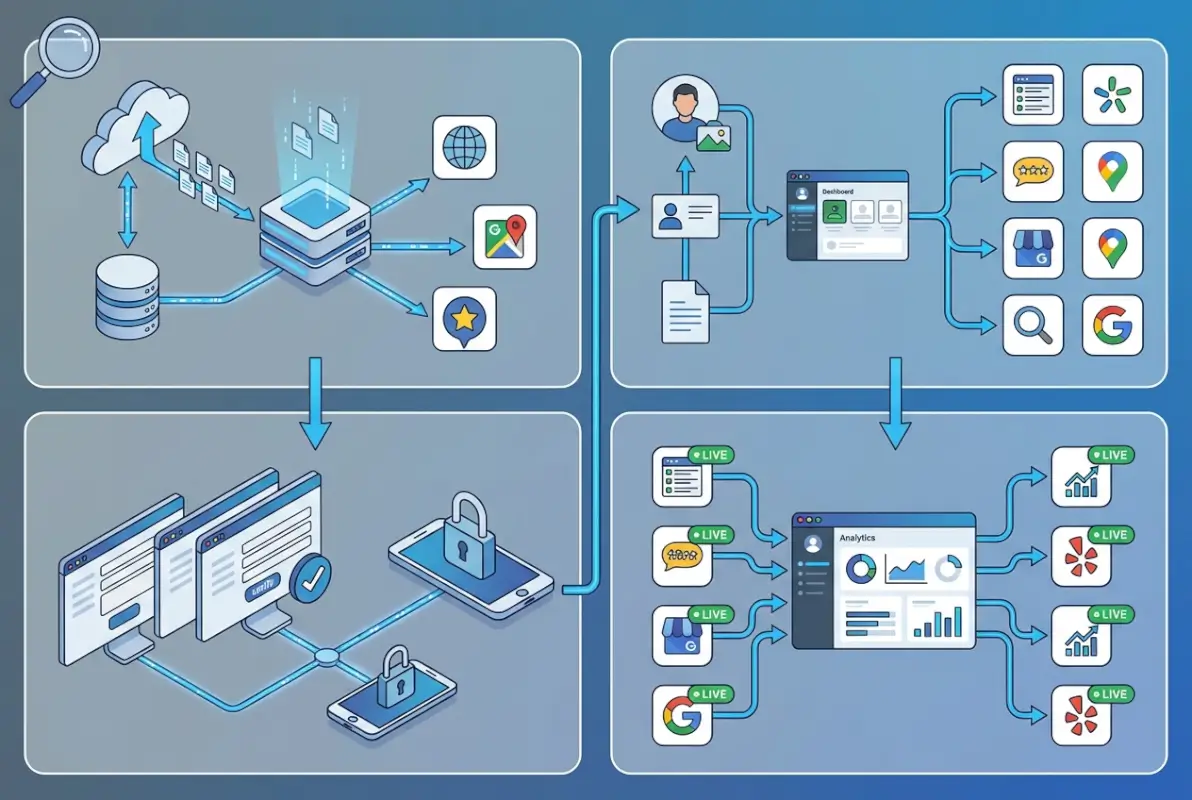
Operational workflows for multi-location or multi-brand businesses typically fall into three tiers: manual claim-and-update for core platforms (GBP, Apple Maps, Bing Places), semi-automated bulk submission tools for secondary directories, and continuous monitoring via listing-management software that alerts teams to unauthorized changes. Manual verification on major platforms ensures control and responsiveness, while automation scales coverage to 20+ directories without proportional time investment. Regular monitoring prevents third-party aggregators or user edits from introducing inconsistencies that dilute your citations.
Handling duplicates requires systematic detection and suppression: use each platform’s native tools to claim or report duplicates (Google Business Profile’s “mark as duplicate” flow, Yelp’s duplicate-listing support), and monitor data aggregators like Localeze or Factual that feed downstream directories. If duplicates persist, document ownership proof (business license, utility bills, official correspondence) to escalate resolution with platform support teams. Duplicate suppression is especially critical in competitive markets where competitors or lead-generation services may create spurious listings to capture calls or traffic.
Verification and ongoing maintenance should be calendared, not ad hoc: schedule quarterly full audits of your top 15–20 directories, with monthly spot-checks on GBP and any platform showing unusual traffic or review activity. Assign ownership of each major platform to a team member, document login credentials and verification methods securely, and establish escalation paths for issues like suspension, unauthorized edits, or negative review spikes. This structure ensures accountability and rapid response when directory issues threaten visibility or reputation.
| Task | Frequency | Owner/Tool |
|---|---|---|
| Verify NAP consistency on core platforms (GBP, Apple Maps, Bing, Yelp) | Monthly | Assigned team member or listing-management software |
| Full audit of top 15–20 directories | Quarterly | Marketing/operations lead with audit checklist |
| Monitor for duplicate listings and unauthorized edits | Continuous (alerts enabled) | Automated monitoring tool or weekly manual scan |
| Update hours, services, and special attributes | As needed (holidays, service changes) | Assigned team member with calendar reminders |
| Respond to reviews and manage Q&A on major platforms | Weekly (or real-time for high-volume) | Customer service or reputation manager |
Emerging Trends and Niche Directories
The directory ecosystem in 2024–2026 is shifting toward credibility signals, with platforms increasingly prioritizing verified business identities, authentic review patterns, and integration with social profiles. Google Business Profile now surfaces verification badges and review authenticity indicators more prominently, while Apple Maps and Yelp reward businesses that maintain complete, up-to-date profiles with better visibility in recommendation algorithms. This trend means that simply listing your business is no longer sufficient—active management, regular updates, and genuine engagement drive ranking and recommendation advantages.

User intent signals are also reshaping how directories surface results: platforms analyze search context, device type, time of day, and historical behavior to personalize recommendations. Mobile users searching “near me” during evening hours may see different directory rankings than desktop users researching options days in advance. Businesses should optimize for these signals by ensuring hours are accurate, response times are fast for inquiries, and service attributes (e.g., “wheelchair accessible,” “free Wi-Fi,” “open late”) are complete and current across platforms.
Niche and industry-specific directories continue to deliver outsized value for certain verticals, particularly in healthcare, legal, home services, and hospitality. Platforms like Healthgrades, Avvo, Houzz, and TripAdvisor command high trust in their respective domains and often convert at higher rates than general directories because users arrive with strong commercial intent. Prioritize 2–4 niche directories aligned to your industry, invest in complete profiles with rich media (photos, videos, case studies), and actively solicit reviews from satisfied clients to build authority within your category.
Balancing free versus paid directory placements depends on ROI and competitive pressure: free listings on core platforms (GBP, Apple Maps, Bing Places, Yelp) are non-negotiable, while paid enhancements (featured placements, promoted listings, premium badges) should be tested and measured against lead quality and cost per acquisition. In highly competitive local markets, paid placements on Yelp or industry directories can provide near-term visibility while organic strategies mature. Start with free baseline coverage, then selectively layer paid enhancements on platforms demonstrating measurable returns in your analytics.
| Trend | Impact on Listings Strategy | Actionable Response |
|---|---|---|
| Verification & credibility signals | Platforms prioritize verified businesses with authentic review patterns | Complete verification on all core platforms; solicit genuine, diverse reviews |
| User intent & personalization | Search context (mobile, time, location) influences ranking and recommendations | Keep hours, service attributes, and response times current; optimize for mobile discovery |
| Niche directory authority | Industry-specific platforms deliver higher conversion rates and trust in verticals | Prioritize 2–4 niche directories; invest in rich profiles with media and case studies |
| Social profile integration | Directories link to and validate social presence (LinkedIn, Instagram, Facebook) | Ensure social handles are consistent and linked from all major directory profiles |
| Paid vs. free placements | Competitive markets may require paid enhancements for near-term visibility | Test paid placements on high-ROI platforms; measure cost per lead and conversion |
Frequently Asked Questions
What are the top directory platforms every business should consider in 2026?
Core platforms typically include Google Business Profile, Apple Maps, Bing Places, Yelp, and select social or industry-specific directories. The exact mix depends on your target audience and industry vertical, but these platforms form a strong baseline for local visibility and consumer discovery.
How many directory listings should a business maintain?
Best practice is a diversified presence across core platforms like Google Business Profile, Apple Maps, Bing Places, and Yelp, plus two to four niche or industry-specific directories. Many practitioners aim for a scalable baseline and expand over time based on performance metrics and audience engagement.
Do free directory listings really help with SEO or rankings?
Yes, especially when listings maintain accurate and consistent NAP data and are reinforced with credible reviews and citations. The impact is strongest when listings support trust signals and entity clarity, helping search engines validate your business information and improve local search performance.
What is the best way to fix inconsistent NAP data?
Audit all major platforms for NAP consistency, standardize naming and address formatting, claim ownership where possible, and implement ongoing monitoring with automated alerts for changes. Regular audits help catch discrepancies early and maintain the data integrity that supports local search rankings.
Should a business use Google Maps and Google Business Profile as the primary listing?
Google Business Profile is foundational for local search and maps visibility. A strong GBP presence supports discovery, review collection, and local intent matching. It should serve as a baseline in most local strategies, with other platforms complementing this core presence for broader reach.
Can niche directories improve lead quality compared to general platforms?
Yes, industry-specific directories often deliver higher-quality leads because users arrive with clearer intent and service expectations. For healthcare, legal, home services, or hospitality businesses, niche directories provide targeted visibility and trust signals that align with what specialized consumers actively seek.
How often should businesses update their directory listings?
Review and update core listings at least quarterly, with immediate updates for any changes to name, address, phone, hours, or services. Regular updates signal active management to both platforms and users, improving trust and ensuring accurate information reaches potential customers.
What role do reviews play in directory listing effectiveness?
Reviews serve as critical trust signals that influence both search rankings and consumer decisions. Platforms prioritize listings with recent, authentic reviews, and users rely on review content to evaluate quality and credibility. Actively managing and responding to reviews amplifies their positive impact.
Conclusion
Building a strong directory presence across the top platforms is no longer optional for businesses serious about local visibility and customer acquisition. The data is clear: accurate, consistent listings on Google Business Profile, Apple Maps, Bing Places, Yelp, and carefully selected niche directories drive measurable improvements in search rankings, user trust, and conversion rates.
Start with the fundamentals. Claim and verify your Google Business Profile, then systematically expand to Apple Maps, Bing Places, and Yelp. From there, identify two to four industry-specific directories where your target audience actively searches. Prioritize platforms that align with your business model and customer journey, rather than chasing every possible listing opportunity.
Data hygiene is non-negotiable. Inconsistent NAP data fragments your entity signals and confuses both search engines and potential customers. Implement regular audits, standardize your business information across all platforms, and set up monitoring to catch changes before they impact performance. Treat your directory presence as living infrastructure that requires ongoing maintenance, not a one-time setup task.
Reviews and active engagement separate effective listings from placeholder profiles. Respond promptly to customer feedback, encourage satisfied customers to share their experiences, and use review content to identify service improvements. Platforms reward active management with better visibility, and consumers reward responsiveness with their business.
Take Action on Your Directory Strategy Today
Audit your current listings, identify gaps in coverage or consistency, and prioritize the platforms that will deliver the highest ROI for your business. Start with Google Business Profile as your foundation, then build out strategically. Your next customer is searching right now—make sure they find accurate, compelling information about your business wherever they look.
The businesses that win in local search are those that treat directory management as a core marketing discipline, not an afterthought. Invest the time to get it right, and the returns will compound over time.