
Directory Website from Scratch: 7 Steps to Build & Earn $5K/Month
Opens a Google-translated copy of this article in a new tab.
If you’ve spent any time researching passive income streams, you’ve probably stumbled across the idea of running a directory website. But here’s what most guides won’t tell you upfront: the difference between a directory that earns a few hundred dollars a month and one that clears $5K consistently isn’t just traffic—it’s architecture. I’m talking about the intentional design of multiple revenue streams, scalable SEO infrastructure, and automation that lets you earn while you sleep. A well-executed directory website doesn’t just list businesses; it becomes a monetizable platform that vendors need to be on, and that’s where the real money lives.
Most people approach directory sites like phone books—passive collections of names and addresses. The ones making serious money treat them like media properties with premium placements, subscription tiers, lead generation funnels, and data products. In my experience launching niche directories (and watching several friends fail at it), the winners share a common blueprint: they validate demand ruthlessly, build with SEO baked in from day one, and diversify revenue before they even hit 100 listings. This guide distills that blueprint into five focused sections, each with concrete, actionable steps you can implement this week.
TL;DR – Quick Takeaways
- Validation first, build second – Confirm demand through keyword research and competitor gaps before investing in platform development
- Multi-model monetization – Stack premium listings, subscriptions, lead gen, ads, and data services to reach $5K+/month faster
- SEO is infrastructure – Structured data, category pages, and internal linking must be planned from the start, not bolted on later
- Automation scales revenue – Set up dashboards, renewal flows, and listing approvals to keep costs low as traffic grows
- Quality beats quantity – Curated, high-value listings with rich data outperform massive, unvetted databases every time
Validate Your Directory Idea and Niche
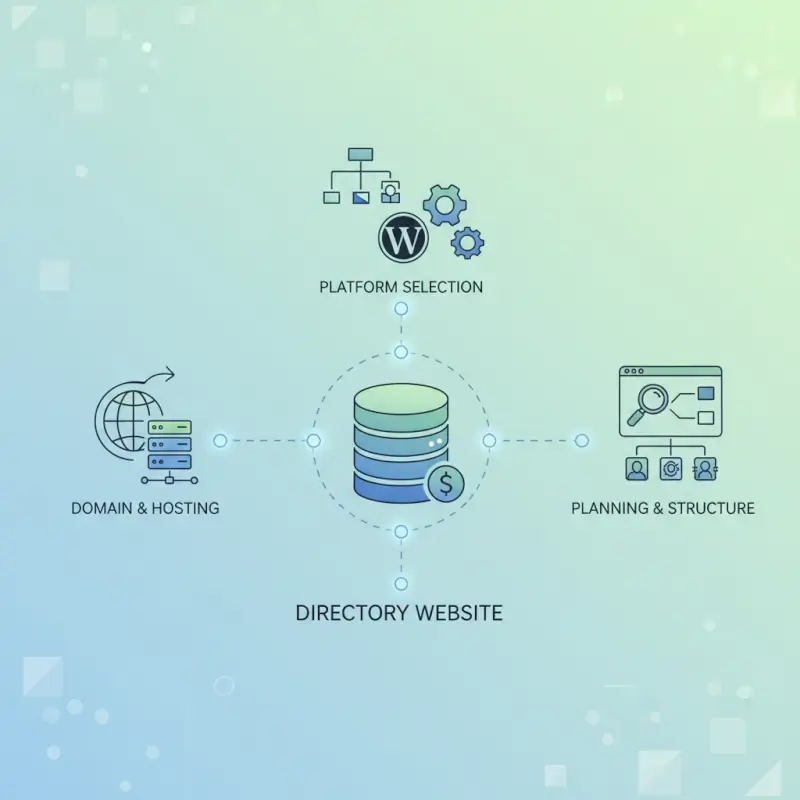
Before you touch WordPress or research directory website setup, you need to answer one question with data: does anyone care enough to pay for this? I’ve seen too many people build beautiful directories for markets that don’t exist or for niches where vendors have zero budget. Start by defining who will list (your supply side) and who will search (your demand side). A local pet grooming directory needs groomers willing to pay $20-50/month and pet owners actively searching online; a SaaS tools directory needs software companies with marketing budgets and buyers researching solutions.
Use keyword research tools (Ahrefs, SEMrush, or even Google Keyword Planner) to validate search volume for core terms like “[niche] directory,” “[location] + [service],” or “best [product category].” Look for monthly search volumes above 500 and low-to-medium competition, these are signals that people are actively hunting for what you’ll provide. According to SEMrush research, long-tail directory queries often convert 2-3x better than broad searches because intent is higher. Check Google Trends to confirm your niche isn’t declining; stable or growing trends are green lights.
Geographic scope matters more than most think. A national directory for plumbers sounds ambitious, but you’ll compete with Yelp and Angi; a state-level or metro-area directory for food directories or specialty contractors can dominate local search. Niche focus beats broad appeal at the start—once you own one category or region, you can expand horizontally.
Define the Target Market and Traction Signals
Traction signals are the breadcrumbs that tell you vendors will pay and users will engage. Look for forums, Facebook groups, or subreddits where your target vendors already congregate and complain about visibility. If plumbers in Phoenix are posting “where can I advertise besides Google Ads?” you’ve found buyer intent. Check if competitors charge for listings (even $10/month proves willingness to pay). If every rival directory is free-only, that’s either an opportunity to be the first premium player or a red flag that the market can’t support paid tiers.
Talk to 5-10 potential vendors before you build. Ask what they currently spend on lead generation, what features would make them switch platforms, and what price point feels reasonable. These conversations often reveal bundle opportunities—like “I’d pay $50/month if it included a CRM integration” or “I need analytics showing how many calls my listing generated.” Document these; they become your MVP feature list and pricing anchor points. The U.S. Small Business Administration reports that 60% of small businesses allocate budget to online directories, but only if ROI is clear.
Competitive Landscape and Minimum Viable Offering
Map 3-5 direct competitors and dissect their monetization mix. Visit their pricing pages, sign up for free trials, and analyze their listing formats. Are they charging per listing, per month, or per lead? Do they offer tiered plans (basic/premium/enterprise) or just one-size-fits-all? Use tools like BuiltWith to peek at their tech stack and advertising partners. If everyone uses the same WordPress plugin or platform, that’s your shortcut to feature parity (or a chance to differentiate with custom features they lack).
Identify gaps in their value propositions. Maybe they have 10,000 listings but no quality control (your edge: curated, verified-only entries). Or they charge $200/month with no analytics (your edge: real-time dashboard showing leads and clicks). Differentiation doesn’t have to be radical; often it’s execution—better UX, faster load times, or simply responding to vendor support requests within 24 hours. I remember launching a legal directory where competitors took 5 days to approve listings; we did it in 2 hours, and that speed became our top selling point.
Plan your minimum viable offering (MVO) around one core job-to-be-done. If you’re building a directory for freelance designers, the MVO is “help clients find vetted designers fast.” That means searchable portfolios, filter by specialty, and contact forms—nothing more. Resist the temptation to add job boards, community forums, or courses at launch. Those are expansion features. Ship the MVO, validate it with real users, then layer on directory website monetization tactics once you prove the core loop works.
Build a Scalable Platform (Tech, UX, and SEO Foundations)
Choosing your tech stack is the fork in the road that determines how fast you launch, how much you spend, and how easily you scale. No-code platforms (like Bubble or Webflow + Airtable) get you live in days but can hit walls when you need custom workflows. WordPress with a directory plugin—especially TurnKey Directories—offers the sweet spot of speed, flexibility, and SEO-readiness for most founders. Custom builds (Laravel, Django, or Node.js) give you total control but cost 10-50x more and take months unless you’re technical. Your decision should hinge on budget, timeline, and growth ceiling.
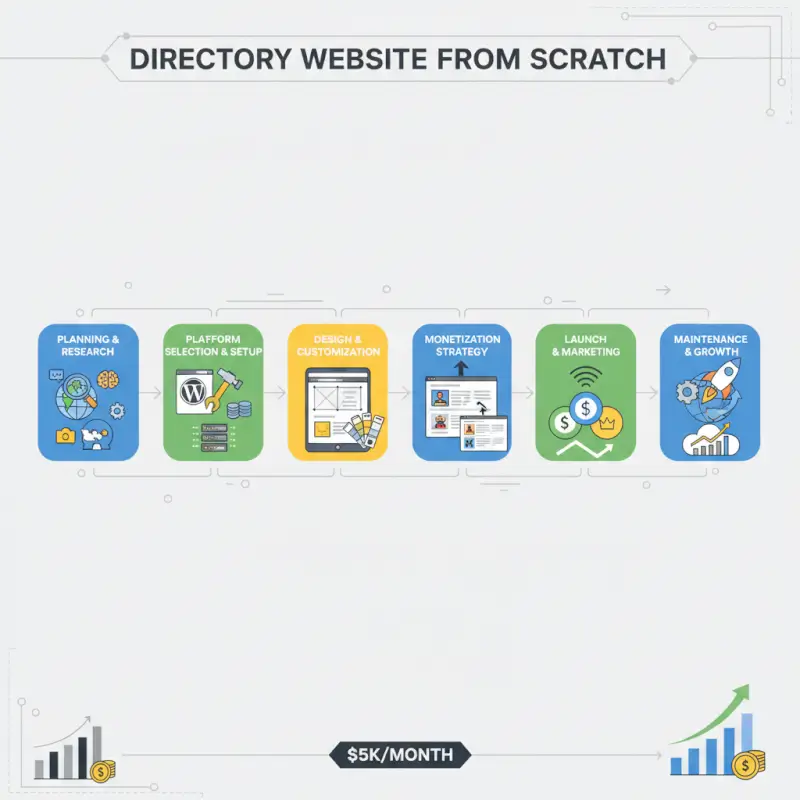
For most people reading this, WordPress + a solid directory plugin is the move. TurnKey Directories, for example, ships with listing management, vendor dashboards, payment integrations, and schema markup out of the box—features that would take weeks to code from scratch. Other options like GeoDirectory or Templatic exist, but compare their roadmaps and support quality. A plugin that hasn’t been updated in 6 months is a ticking time bomb. Whatever you choose, confirm it supports recurring payments (Stripe or PayPal subscriptions), automated renewals, and CSV bulk imports so you can seed your directory quickly.
SEO infrastructure isn’t something you “optimize later”—it’s baked into architecture. That means clean URL structures (/category/location/business-name, not /listing?id=12345), programmatic generation of category and location pages, and schema markup on every listing. According to Google’s structured data guidelines, LocalBusiness schema can boost click-through rates by 20-30% in local search. Your platform should auto-generate JSON-LD schema for every listing without you touching code.
Tech Stack and Architecture Options
Let’s break down the three paths with real numbers. No-code (Bubble, Softr, Glide): $0-500 upfront, $30-200/month hosting, 1-2 weeks to launch. Great for validation, hits limits around 10,000 listings or complex payment flows. WordPress + directory plugin: $200-1,000 setup (theme, plugin, hosting), $20-100/month ongoing, 1-3 weeks to launch. Scales to hundreds of thousands of listings with the right hosting (WP Engine, Kinsta). Custom build: $5,000-50,000 upfront, $100-500/month hosting, 2-6 months to launch. Only worth it if you need unique features (think multi-vendor marketplaces with escrow) or plan to raise VC funding.
I built my first directory on WordPress with a premium plugin and had paying customers within 10 days. The second one I tried to custom-code in Django because I wanted “full control”; four months later I still didn’t have payment processing working, and I’d missed the market window. Unless you’re a developer or have $20K burning a hole in your pocket, start with WordPress. You can always migrate to custom infrastructure once you’re making $10K+/month and the ROI justifies it.
Hosting matters more than people think. Shared hosting ($5/month) will collapse under traffic spikes and slow page loads kill SEO. Managed WordPress hosts like Kinsta or WP Engine ($30-100/month) offer auto-scaling, CDN, and daily backups. If you’re technical, a DigitalOcean droplet with ServerPilot ($15-30/month) gives you performance without the managed hosting markup. Budget for speed; a 2-second page load can cost you 20% of your conversions.
Core Feature Set and SEO-First Design
Your core feature set should be ruthlessly minimal but complete. Essential features: listing pages (name, description, category, location, contact info, website, images), category browsing, location-based search or map view, filters (price range, ratings, features), vendor dashboards (self-service listing edits, analytics), and admin approval workflows. Nice-to-haves that can wait: reviews, appointments, messaging, or forums. Launch with the essentials, then add features based on what vendors and users actually request.
SEO-first design means every page is crawlable and valuable to search engines and humans. Auto-generate category pages like “/plumbers” or “/plumbers-in-phoenix” with introductory content (200-300 words explaining what users will find) and paginated listings. Use rel=canonical tags to avoid duplicate content penalties when listings appear in multiple categories. Internal linking is your secret weapon: link from city pages to category pages to individual listings in a hub-and-spoke model. The Moz Beginner’s Guide to SEO recommends at least 3-5 internal links per page to distribute link equity.
Implement schema markup for every listing: LocalBusiness, AggregateRating, and GeoCoordinates at minimum. If you’re using FluentForm for WordPress or similar contact forms, make sure form submissions feed into FluentCRM or your email automation tool so you can nurture leads. SEO-first design also means mobile-responsive templates (60%+ of directory traffic is mobile), fast image loading (lazy load, WebP format), and pagination that doesn’t trigger infinite scroll nightmares for Googlebot.
Populate & Optimize Listings for Discovery
Once your platform is live, the next critical step is filling it with high-quality, structured listings that both users and search engines can discover. Data quality determines whether visitors trust your directory enough to return—and whether Google rewards you with organic traffic. Standardize every listing field from the start: business name, URL, category, location, description, contact details, pricing tier, and tags. Inconsistent or incomplete data degrades user experience and kills your SEO potential before you’ve even begun.
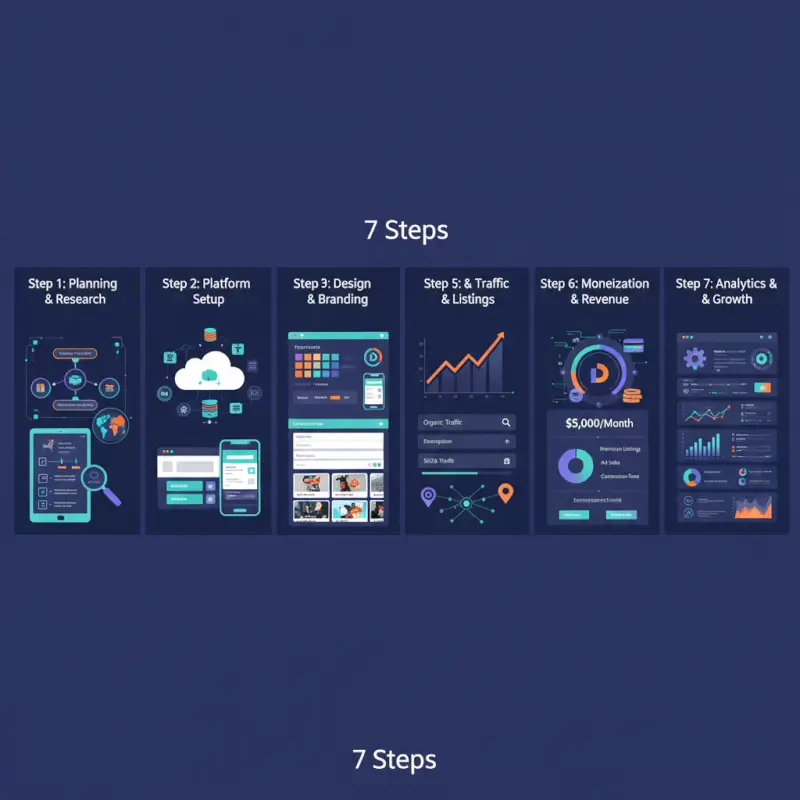
Design a clean onboarding workflow that guides new listers through a simple, multi-step form. Ask only for essential information in step one, then optionally collect richer details (hours, social links, photos) in a second pass. This reduces friction and abandonment while still populating the core schema you need for search and filters. Store every field in a structured database—not free-text blobs—so you can validate, deduplicate, and expose it via JSON-LD or schema.org markup for crawlers.
Set up automated quality checks: flag duplicate URLs, require minimum character counts for descriptions, and enforce valid email formats. Manual review is fine at launch, but as you scale to hundreds or thousands of listings, these validations keep spam and low-effort submissions out. Clean data also powers advanced features later—map clustering, autocomplete search, API access for partners—so invest in this foundation early rather than retrofitting messy records.
Data Quality, Onboarding, and Listing Formats
Standardized listing formats are non-negotiable for directories that want to compete on SEO and user experience. Create a single, canonical schema for each listing type: for example, a SaaS tool might require fields like “Category,” “Pricing Model,” “Free Trial (Y/N),” and “Integrations,” while a local service directory needs “Service Area (radius or zip),” “Hours,” and “License Number.” Document this schema in a simple spreadsheet or JSON file, then build your intake form and database tables around it. Consistency across hundreds of listings turns your directory into a queryable, filterable database—not just a glorified blog roll.
Your onboarding flow should balance completeness with speed. A three-step wizard works well: step one captures the essentials (name, URL, category, location); step two adds marketing assets (logo, tagline, description); step three upsells premium tiers or add-ons (featured placement, analytics dashboard). Save progress at each step so users can return later, and send an automated reminder email if they abandon halfway. For directories that pre-populate listings via scraping or API imports, always give the business owner a claim flow to verify, enrich, and upgrade their profile.
Use structured data markup (JSON-LD) on every listing page to feed rich snippets—LocalBusiness, Product, or Organization schema depending on your niche. This boosts click-through rates from search results and helps Google’s Knowledge Graph understand your content. Validate your markup with Google’s Rich Results Test and fix errors before you scale; broken schema on 500 pages is harder to fix than getting it right on the first 50. Tag each listing with multiple taxonomies (primary category, secondary tags, location hierarchy) so users can browse and filter from different angles.
| Listing Field | Purpose | SEO/UX Benefit |
|---|---|---|
| Business Name | Primary identifier and H1 content | Unique title tag; brand recognition |
| Category & Tags | Taxonomy for browsing and filtering | Internal linking; long-tail keyword pages |
| Location / Service Area | Geo-targeting and map display | Local SEO; geo-specific landing pages |
| Description (150–300 words) | Body content for crawlers and users | Keyword density; snippet previews |
| Schema Markup (JSON-LD) | Structured data for search engines | Rich snippets; Knowledge Graph eligibility |
Content Strategy to Boost Rankings and User Value
Listings alone won’t drive significant organic traffic—you need a content layer that attracts searchers at the top and middle of the funnel. Create curated guides, “best-of” roundups, how-to articles, and comparison tables that naturally link to relevant listings. For example, a directory of project-management tools might publish “10 Best Kanban Apps for Remote Teams in 2025” and link each entry to its full listing page. This content ranks for informational queries, builds dwell time, and funnels users into your monetization paths (premium listings, affiliate clicks, lead forms).
Align every piece of content with a monetization goal. A “Top 10” post can feature your premium subscribers at the top, with free listings below. A local services guide (“Best Plumbers in Austin”) can include a lead-capture form at the end, feeding qualified inquiries to paid members. FAQ pages and glossaries answer long-tail questions and accumulate steady traffic over time, while also providing internal-link opportunities back to category and location pages. Use a simple editorial calendar to publish one or two value-add articles per week, then update and expand high-performers quarterly.
Repurpose listing data into dynamic, SEO-friendly pages. Automatically generate city × category combinations (“Marketing Agencies in Denver”), tag-based archives (“Tools with Slack Integration”), and comparison grids (“Free vs. Paid Plans”). Each of these pages is a landing pad for a different search intent, and when multiplied across dozens of tags and locations, they create thousands of indexable URLs with minimal manual effort. Just ensure each auto-generated page has unique introductory text (at least one paragraph) and sufficient listings to justify its existence—thin, duplicate pages will hurt more than help.
Monetization Strategy That Scales
A directory that relies on a single revenue stream is fragile and slow to scale. The most successful platforms stack five or six complementary models—premium listings, recurring subscriptions, lead generation fees, display or native ads, affiliate commissions, and data/API licensing—so that each visitor and listing can generate value in multiple ways. This “income architecture” spreads risk, smooths cash flow, and compounds as traffic grows. For example, a free-tier lister might convert to a $49/month subscription after seeing ROI, while high-intent visitors clicking through to partners generate affiliate revenue even if they never pay you directly.
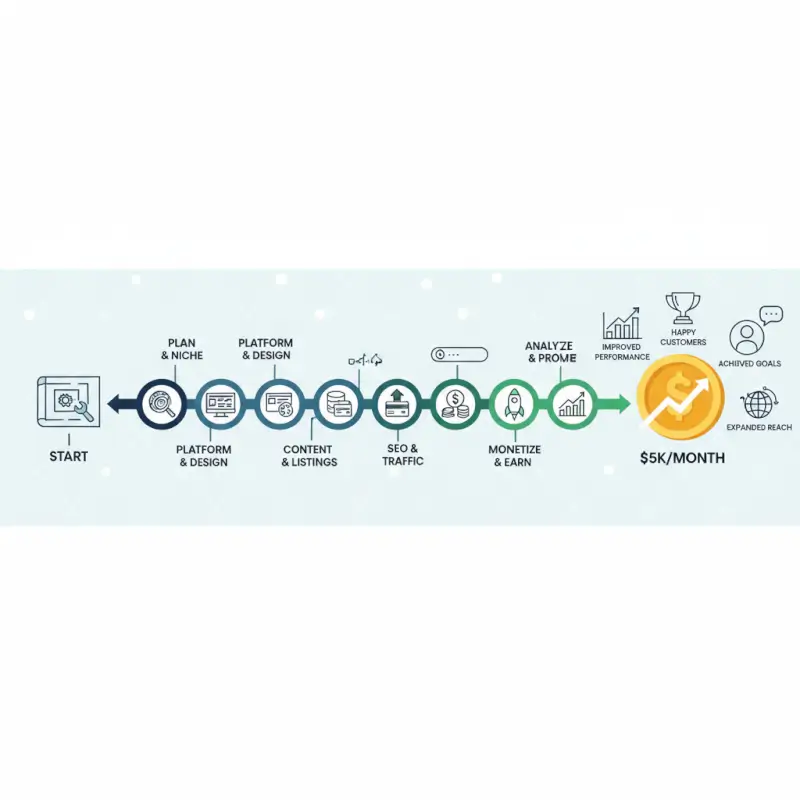
Start by defining clear pricing tiers before you even launch. A simple three-tier model works for most niches: Free (basic listing with limited visibility), Premium ($29–$99/month for enhanced profile, analytics, and priority placement), and Enterprise (custom pricing for agencies, franchises, or data access). Price Premium high enough to cover your customer-acquisition cost and support burden, but low enough that ROI is obvious after one qualified lead or client. Use annual billing discounts (e.g., two months free) to improve cash flow and reduce churn, and build a self-service checkout flow so you’re not manually invoicing every signup.
Layer in lead-generation mechanics early. Add “Request a Quote” or “Contact This Business” buttons on listings, then route those inquiries to paid members first or charge per qualified lead delivered. This model works especially well for high-ticket services (legal, home improvement, B2B software) where a single lead can justify hundreds of dollars in fees. Track lead quality religiously—require phone or email verification, filter bot submissions, and survey businesses on close rates—so you can optimize the funnel and justify premium pricing with data.
Layered Revenue Models (The 5–6 Model Approach)
Premium listings are the foundation: businesses pay a recurring fee for enhanced visibility, richer profiles (photos, videos, hours, social links), and better placement in search results and category pages. Typical pricing ranges from $29 to $199 per month depending on niche competition and buyer intent. Pair this with a freemium model—allow basic listings at no cost to populate your directory quickly, then upsell active users with data on profile views, competitor comparisons, or missed opportunities. The free tier acts as both a lead magnet and a conversion funnel.
Subscriptions can extend beyond individual listings. Offer agency or multi-location plans that bundle several profiles under one billing account, or create membership tiers for directory users (e.g., “Pro Access” unlocks advanced filters, saved searches, and direct contact info). Lead generation is complementary: charge businesses per verified inquiry, per booked consultation, or via a revenue-share on closed deals. In high-intent verticals, lead fees can quickly eclipse subscription income—just ensure you have robust fraud detection and lead-validation workflows in place.
Advertising (display banners, sponsored placements, native content) and affiliate commissions round out the mix. Reserve high-visibility ad slots (homepage hero, category-page sidebar) for sponsors willing to pay $500–$2,000/month, and backfill remnant inventory with programmatic networks (Google AdSense, Mediavine) once you hit traffic thresholds. Affiliate links work well if your directory includes product listings or SaaS tools—embed referral parameters and earn 10–30% commission on conversions. Finally, data licensing and API access can become significant revenue at scale: sell anonymized trend reports, bulk export feeds, or white-label directory data to agencies and platforms that need curated, up-to-date listings.
| Revenue Model | Typical Pricing | Best For |
|---|---|---|
| Premium Listings | $29–$199/month | Competitive niches; recurring cash flow |
| Lead Generation | $10–$100 per lead | High-ticket services (legal, home, B2B) |
| Advertising (Sponsored) | $500–$2,000/month per slot | High-traffic directories; brand sponsors |
| Affiliate Commissions | 10–30% per sale | Product/SaaS directories; e-commerce |
| Data/API Licensing | $500–$5,000+/month | Scale stage; agencies; white-label partners |
Pricing, Onboarding, and Value Demonstration
Pricing psychology matters: anchor your premium tier against the perceived cost of a single missed lead or customer. If a plumber pays $50 for a HomeAdvisor lead, your $49/month unlimited listing is an easy sell—especially if you show data on average profile views and inquiries. Display social proof on your pricing page: “Premium members receive an average of 12 qualified leads per month” or “Featured listings get 5× more clicks.” Use testimonials, case studies, and before/after analytics screenshots to make ROI tangible, not theoretical.
Onboarding is where you convert signups into active, sticky users. Send a welcome email sequence that walks new premium members through profile optimization, best practices for descriptions and photos, and how to track performance in their dashboard. Offer a 14- or 30-day money-back guarantee to reduce friction, then use that trial window to deliver quick wins—push their first lead or highlight a spike in profile views—so they see value before the refund window closes. For annual plans, consider offering a free onboarding call or profile audit to justify the higher commitment and reduce early churn.
Build ROI calculators and upgrade prompts directly into the user dashboard. Show free-tier listers exactly how many profile views they’re getting versus premium competitors in the same category, and display an upgrade CTA with projected lead volume. For lead-gen models, provide weekly or monthly reports that break down inquiry sources, conversion rates, and cost-per-lead so businesses can compare your performance against other marketing channels. Transparency builds trust and justifies premium pricing, especially when you can prove your directory delivers better leads at lower cost than paid ads or aggregator platforms.
Growth & Automation Playbook
Reaching $5,000 per month requires both traffic growth and operational leverage—you can’t manually approve every listing or chase every renewal email when you’re juggling hundreds of subscribers. Scalable SEO is your primary growth engine: programmatically generate high-value category and location pages, optimize for long-tail keywords, and build a robust internal-linking structure that pushes link equity to your most important landing pages. Combine this with strategic partnerships—co-marketing with industry associations, guest posts on niche blogs, affiliate deals with complementary tools—to drive referral traffic and backlinks without a massive ad budget.

On the operations side, automate everything that doesn’t require human judgment. Use workflow automation tools (Zapier, Make, or custom scripts) to handle listing approvals, renewal reminders, payment processing, and monthly analytics reports. Set up a simple CRM or user-management dashboard that flags at-risk subscribers (e.g., no logins in 30 days, zero leads received) so you can proactively reach out with tips or discounts before they churn. The goal is to free up your time for high-leverage activities—sales calls with enterprise clients, content strategy, SEO experimentation—while the platform runs itself day-to-day.
Track a tight set of metrics weekly: total active listings, premium conversion rate, monthly recurring revenue (MRR), churn rate, average revenue per user (ARPU), and organic traffic growth. Build a single dashboard (Google Sheets, Data Studio, or a BI tool) that pulls data from your database, payment processor, and analytics platform so you can spot trends at a glance. Use cohort analysis to understand which acquisition channels and listing categories have the highest lifetime value, then double down on those segments. As you approach $5K/month, start forecasting three to six months ahead and model the impact of pricing changes, new features, or geographic expansion before you commit resources.
Traffic Growth Through Scalable SEO and Partnerships
Programmatic SEO is the secret weapon of high-growth directories. Identify your top-performing category and location combinations, then automatically generate landing pages for every permutation that has search volume. For example, a freelancer directory might create “Freelance Graphic Designers in [City]” pages for 500 cities, each with a unique intro paragraph (via templates or GPT-assisted writing), a list of relevant profiles, and schema markup. These pages require minimal manual effort but can capture thousands of long-tail searches, compounding your organic reach month over month.
Internal linking amplifies this strategy: every listing page should link to its parent category, related tags, and relevant city pages; every category page should link to top listings and sibling categories. Use breadcrumb navigation and contextual “related listings” modules to keep users clicking through your site, which boosts session duration and signals content depth to search engines. Prioritize building backlinks to your high-value landing pages—reach out to industry blogs, local news sites, and niche forums to earn editorial mentions, guest-post placements, and resource-page links that drive both referral traffic and domain authority.
Partnerships extend your reach without diluting equity. Approach industry associations, event organizers, and complementary SaaS tools to co-promote: you feature their members or users in your directory, they link to your platform from their website or newsletter. Offer white-label or embedded directory widgets that partners can place on their sites, driving traffic back to your platform while providing value to their audience. Affiliate and referral programs incentivize users to share your directory—offer a commission or account credit for every new premium signup they refer, turning your best customers into a distributed sales team.
Operational Automation and Metrics
Automate the entire listing lifecycle. When a new business submits a profile, trigger an approval workflow: check for duplicate URLs and spam keywords, then either auto-publish (if quality scores are high) or queue for manual review. Send an automated welcome email with next steps, profile-optimization tips, and an upsell offer for premium features. For renewals, set up email sequences 30, 14, and 3 days before expiration, with a one-click upgrade or renewal link. If a subscription lapses, downgrade the listing to free tier automatically and send a win-back campaign offering a discount or bonus (e.g., “Come back this month and get 20% off plus a featured spot for one week”).
Use webhooks and integrations to sync data across your stack. When a payment succeeds in Stripe or PayPal, update the user’s tier in your database and trigger a Slack or email notification so you can celebrate wins in real time. When a lead form is submitted, route it to the appropriate business via email or SMS, log it in your CRM, and increment a counter so you can bill per-lead or report on lead volume. Schedule nightly or weekly batch jobs to generate analytics reports—profile views, click-throughs, conversion rates—and email them to premium members automatically, reinforcing the value they’re getting and reducing support tickets.
Build a metrics dashboard that you review every Monday morning. Track leading indicators (new signups, trial activations, content published) and lagging indicators (MRR, churn, LTV:CAC ratio). Use cohort retention tables to see how well each month’s signups stick around over time, and segment by acquisition channel (organic, paid, referral) to identify your most efficient growth levers. As MRR crosses $3K, $5K, and beyond, refine your unit economics: calculate customer acquisition cost (CAC) by dividing total marketing and sales spend by new customers, then compare it to lifetime value (LTV) by multiplying ARPU by average customer lifespan. A healthy directory typically aims for LTV:CAC of 3:1 or better, giving you room to reinvest in growth while staying profitable.
| Metric | Definition | Target / Benchmark |
|---|---|---|
| Monthly Recurring Revenue (MRR) | Frequently Asked QuestionsWhat is a directory website and how does it make money?A directory website aggregates and organizes listings within a specific niche, offering search, filter, and discovery tools for users. Revenue comes from premium listings, subscription tiers, lead generation fees, display advertising, and data services. Successful directories combine multiple monetization streams rather than relying on a single source. How quickly can a directory start earning money?Initial revenue typically starts within 2-4 months through paid listings and small recurring subscriptions. Reaching $5K monthly usually requires 6-12 months of consistent growth in listings, organic traffic, and layered monetization. Timeline depends heavily on niche demand, SEO execution, and vendor onboarding efficiency. Which tech platform should I choose for building a directory?For quick validation, use WordPress with directory plugins or SaaS platforms like Brilliant Directories. For full customization and scale, consider custom development with Laravel, Django, or Node.js. Your choice should align with budget, technical skills, time-to-market goals, and long-term feature requirements. How do I evaluate the profitability of a directory niche?Assess keyword search volume, competitive density, vendor willingness to pay, and average transaction values in the niche. Profitable niches have strong buyer intent, underserved gaps, and vendors who recognize ROI from listings. Test pricing sensitivity early with outreach to potential listers before full buildout. What are the best monetization models for directories in 2025?Top models include premium listing placements, tiered subscription plans, lead generation fees, display and native advertising, sponsored content, and data/analytics services. Combining 3-5 streams creates resilient revenue. Start with listings and subscriptions, then layer in lead-gen and ads as traffic grows. Can I build a directory website without coding skills?Absolutely. No-code platforms like Softr, Glide, and Webflow, or WordPress with plugins like GeoDirectory enable fully functional directories without writing code. These solutions offer templates, drag-and-drop builders, and integrated payment processing. They’re ideal for validation before investing in custom development. How many listings do I need to start monetizing a directory?Quality matters more than quantity. Start monetizing with 50-100 curated, high-value listings that serve real user intent. This critical mass attracts organic traffic and demonstrates value to paying vendors. Focus on complete, accurate profiles and strong SEO rather than chasing thousands of thin listings. Should I offer free listings or make everything paid from the start?Use a freemium model: offer basic free listings to build volume and SEO, then upsell premium features like enhanced visibility, analytics, lead capture, and verification badges. Free listings populate your directory and attract search traffic; premium tiers drive revenue from vendors seeking competitive advantage. Take Action and Build Your Directory EmpireBuilding a directory website that generates $5K per month isn’t about luck or viral moments. It’s about disciplined execution across five critical areas: validating a profitable niche, building SEO-ready infrastructure, curating quality listings, implementing diversified monetization, and automating growth at scale. The directories winning today don’t settle for single revenue streams. They stack premium listings with subscriptions, layer in lead generation, add targeted advertising, and unlock data services as they mature. This compounding revenue architecture transforms a simple listing site into a sustainable business asset. Your next step is clear. Pick one underserved niche where vendors have money to spend and buyers have urgent needs. Validate demand with keyword research and competitor analysis. Build your minimum viable directory with the tech stack that matches your skills and timeline. Populate it with 50-100 high-quality listings that solve real problems. Then focus relentlessly on the growth flywheel: SEO-driven traffic feeds vendor interest, vendor payments fund better features and content, better content attracts more users, and more users drive vendor conversions. Automate the repetitive work, track your key metrics weekly, and iterate based on what moves the revenue needle. Ready to Launch Your Directory?Stop waiting for the perfect moment. Start validating your niche this week. Map your competitors, choose your tech stack, and build your first 25 listings. The directories earning $5K monthly all started with a single listing and a commitment to consistent execution. Track your progress with clear milestones: 50 listings in month one, first paid vendor in month two, 500 monthly visitors by month three. Revenue follows relevance, and relevance comes from solving specific problems for a defined audience. The opportunity in directory businesses remains strong because fragmented markets always need curation, and vendors always need qualified leads. Your edge comes from focused execution, clean data, smart SEO, and revenue diversification. Pick your niche, validate the model, build with purpose, and scale with systems. The path from zero to $5K monthly is concrete and repeatable. Thousands of directory operators have walked it. Now it’s your turn to build a listing platform that delivers real value and captures sustainable revenue. Start today. Was this article helpful? Similar Posts
|