Local Business Listings SEO: 5 Essential Services to Boost Visibility in 2026

Generating summary...
If you’ve ever wondered why some local businesses dominate search results while others remain invisible, the answer lies in how they manage their online listings. With nearly 46% of all Google searches carrying local intent, your business listings are the digital storefronts that connect you to customers actively searching for what you offer. According to BrightLocal’s 2025 consumer research, 87% of consumers now read online reviews before visiting a local business—making accurate, optimized listings more critical than ever.
The challenge isn’t just being found; it’s being found consistently across every platform where potential customers search. A dental practice I worked with couldn’t understand their poor rankings despite excellent reviews. The culprit? Forty percent of their online listings still showed an old address from a move two years prior. Once we corrected these inconsistencies, their local rankings jumped 15 positions in three months.
- Google Business Profile remains the non-negotiable foundation for local visibility in 2026
- NAP consistency (Name, Address, Phone) across all platforms is critical for search engine trust
- Multi-platform presence on Bing, Yelp, Apple Maps, and Facebook captures diverse user bases
- Review management directly impacts both rankings and consumer trust signals
- Data accuracy prevents lost customers and damaged reputation from outdated information
- Strategic optimization can increase local visibility by up to 70% within 3-6 months
Optimize and Protect the Core: Google Business Profile and Local Listings Accuracy
Your Google Business Profile (GBP) isn’t just another listing—it’s your primary discovery surface for local searches. With Google processing over 8.5 billion searches daily, this free platform directly controls how you appear in Google Search and Maps. According to BrightLocal’s Local SEO Roadmap 2026, businesses with complete GBP profiles receive 520% more customer actions than those with incomplete information.

Claiming your GBP listing starts at business.google.com with a simple verification process, typically involving a postcard with a verification code. But verification is only step one. Complete optimization requires filling every available field with accurate, keyword-rich information that matches your website exactly.
Essential GBP Optimization Elements
Start with your business name, address, and phone number—exactly as they appear on your website. This NAP consistency is foundational. Your business category selection dramatically affects visibility; choose the most specific primary category available, then add relevant secondary categories. For example, “Italian Restaurant” performs better than the generic “Restaurant.”
Your business description should naturally incorporate local keywords while focusing on customer value. Avoid keyword stuffing, which Google penalizes. Instead, explain what makes your business unique and why customers choose you. Include your services or products with detailed descriptions, opening hours (including special holiday hours), and booking or appointment links when applicable.
High-quality photos increase views by up to 42%. Upload at least 10 images representing different aspects of your business: exterior shots, interior views, products, team members, and behind-the-scenes content. Update photos seasonally to reflect current offerings and demonstrate active management.
Maintaining Data Accuracy Across Citations and Directories
Data accuracy across the web remains one of the strongest local ranking signals. When search engines encounter consistent NAP information across multiple authoritative sources, they gain confidence in your legitimacy. Inconsistencies, however, can tank your rankings faster than almost any other factor.
Run quarterly data audits to verify core NAP information and primary categories across your GBP and top directories. Create a spreadsheet tracking every claimed listing with URLs, login credentials, and last update dates. This simple governance structure prevents the chaos that undermines most local SEO efforts.
Prioritize high-authority citation sources first: data aggregators like Neustar Localeze, Factual, Foursquare, and Acxiom distribute your information to hundreds of downstream directories. Correcting information at the aggregator level creates a cascading effect across the local search ecosystem.
| Data Element | Consistency Requirement | Common Mistakes |
|---|---|---|
| Business Name | Exactly as registered, no keywords | Adding city names or service keywords |
| Address | Exact format including suite numbers | “Street” vs “St”, missing suite info |
| Phone Number | Same format across all listings | Mixing local and toll-free numbers |
| Hours | Updated for holidays and changes | Outdated seasonal or holiday hours |
| Website URL | Single canonical version | HTTP vs HTTPS, www vs non-www |
Build a Robust Local Listings Ecosystem: Citations, Directories, and Authority
Beyond your GBP, a strategic citation footprint across high-authority directories amplifies your local signals. Quality matters more than quantity—ten accurate listings on authoritative sites outperform fifty on low-quality directories. According to U.S. Census Bureau data, local businesses generate the majority of their revenue from customers within a 10-mile radius, making hyper-local citation strategies essential.
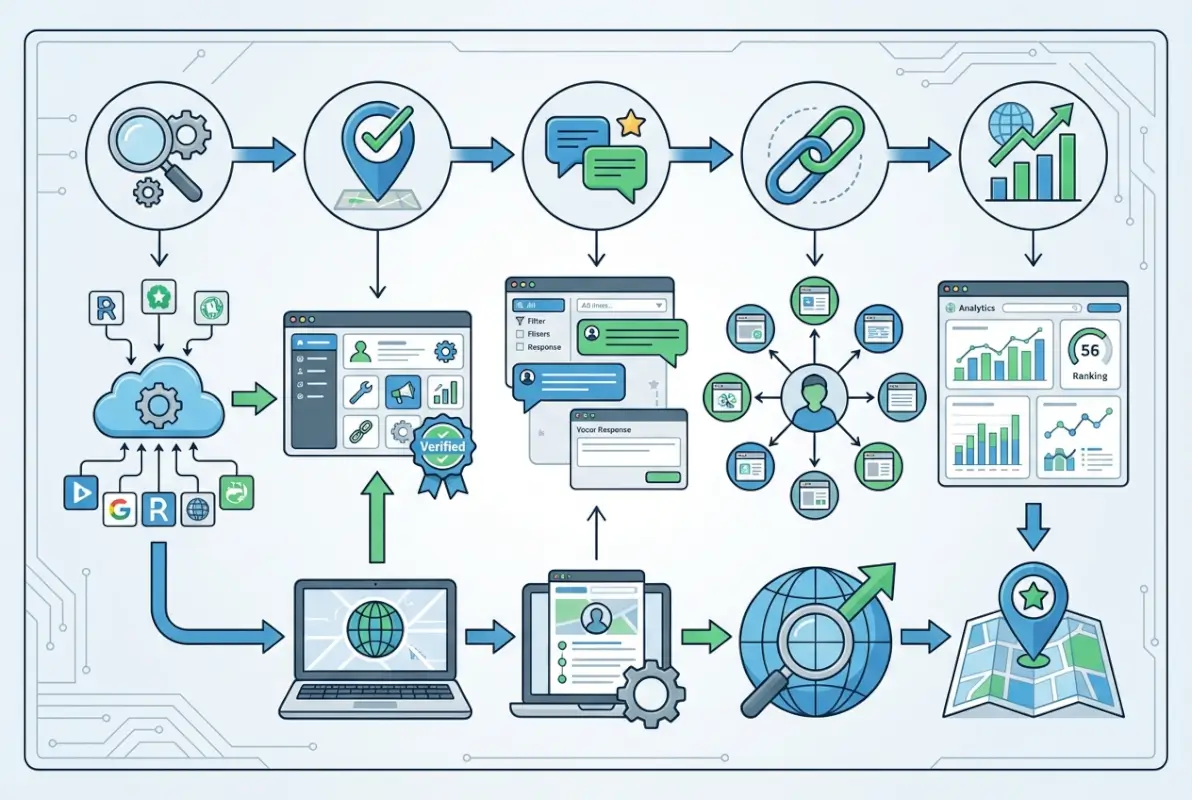
The five essential platforms every local business must claim are Google Business Profile, Bing Places, Yelp, Apple Maps, and Facebook Business. But the citation ecosystem extends beyond these core platforms to industry-specific directories, local chamber of commerce listings, and geographic-focused directories.
Establishing a Disciplined Citation Strategy
Identify the top 10-15 directories with high domain authority relevant to your sector and geography. For restaurants, this includes OpenTable, TripAdvisor, and Zomato. Professional service businesses should prioritize Avvo, Healthgrades, or industry-specific associations. Retail businesses benefit from Yellow Pages, Superpages, and shopping-focused platforms.
Ensure consistent NAP information, business categories, descriptions, and photos across all platforms. Create templates for your business description in multiple lengths (50 words, 150 words, 300 words) so you can quickly populate different directories while maintaining message consistency.
Implement a cadence for updates: whenever your GBP data changes, update all claimed listings within 48 hours. This synchronized approach prevents the inconsistencies that confuse search engines and customers alike.
Governance and Monitoring for Multi-Location Businesses
Businesses with multiple locations face exponential complexity. A single incorrect listing multiplied across ten locations creates ten separate problems. Centralized governance becomes non-negotiable.
Create a comprehensive listings playbook documenting ownership, verification processes, update cadences, and escalation procedures for each location. Assign specific team members as location owners responsible for their listings’ accuracy. Use dashboard tools to monitor listing health metrics: completeness scores, NAP consistency, photo counts, and review activity.
For franchises or multi-location brands, consider enterprise listing management platforms that enable bulk updates while maintaining location-specific customization. These platforms typically cost $100-500 per location annually but prevent the manual labor nightmare of managing dozens or hundreds of individual listings.
Content Signals and Engagement: Local Pages, Photos, Reviews, and Posts
Search engines increasingly evaluate engagement signals—how users interact with your listings—as ranking factors. High click-through rates, direction requests, phone calls, and website visits all signal relevance and quality. Your content strategy must extend beyond static listing information to include dynamic elements that drive engagement.
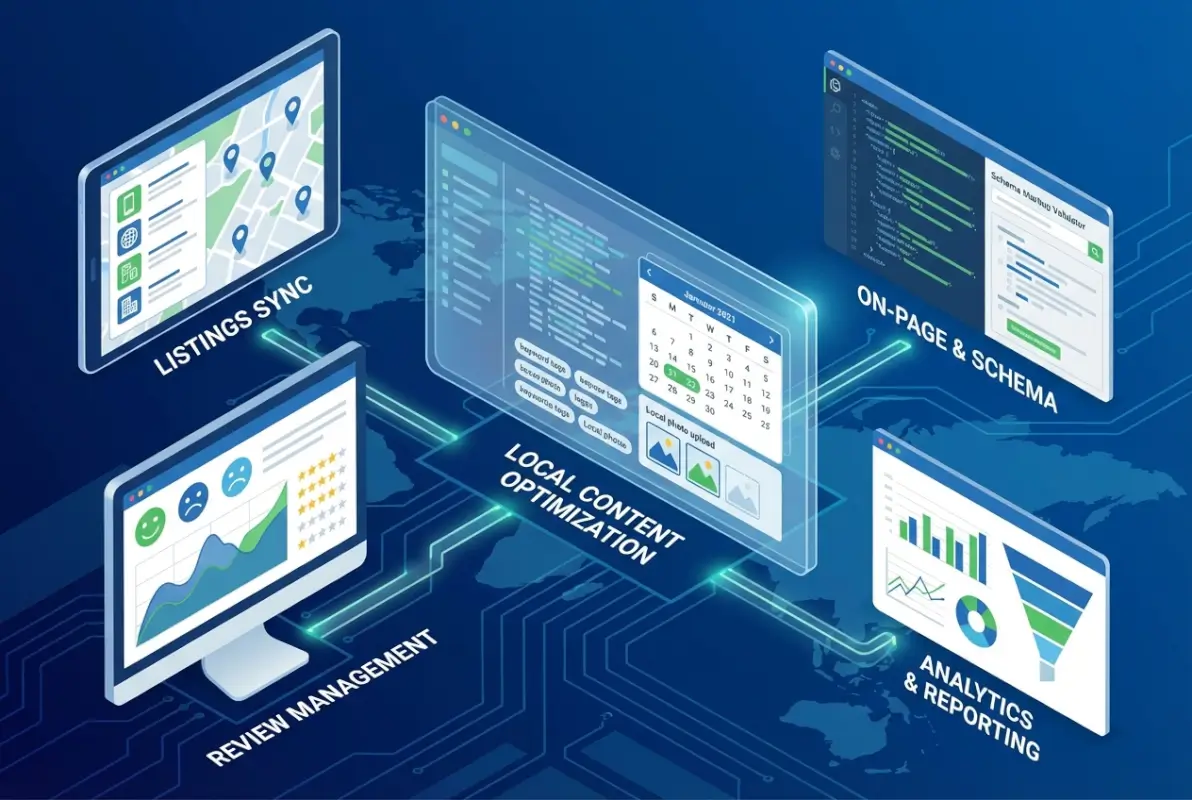
Local landing pages that echo your listing data create powerful relevance signals. When your GBP listing, citations, and website all present consistent location-specific information, search engines reward this alignment with higher visibility.
Creating Local Landing Pages Aligned with Listing Signals
Build dedicated service-location pages for each geographic area you serve. For example, “Plumbing Services in [City Name]” or “[Service] in [Neighborhood]” pages that include consistent NAP data, customer testimonials, location-specific content, and embedded maps.
Implement schema markup (LocalBusiness or Service schema) that mirrors your GBP information. This structured data helps search engines understand the relationship between your website and your listings, strengthening your overall local presence.
Include genuine location-specific content, not just find-and-replace city names. Reference local landmarks, discuss area-specific challenges you solve, and incorporate authentic local knowledge. Search engines can detect template-based, low-value location pages and may penalize them.
Photos, Videos, and Reviews as Trust Signals
Visual assets dramatically impact engagement. Businesses with professional photos receive 42% more direction requests and 35% more website clicks than those without. But quality matters more than quantity—three excellent photos outperform ten mediocre ones.
Upload diverse image types: exterior shots showing your building and signage, interior photos highlighting atmosphere and amenities, product or service photos demonstrating what you offer, team photos building personal connection, and action shots showing your business in operation. Update photos quarterly to reflect seasonal changes, new products, or renovations.
Video content, while more resource-intensive, generates even higher engagement. A simple 30-second tour of your business, a quick introduction from the owner, or a demonstration of your service can significantly boost click-through rates. Google increasingly features video content in local results, giving early adopters an advantage.
Reviews remain one of the strongest trust signals for both consumers and search engines. According to Pew Research Center findings, 82% of consumers read online reviews for local businesses before visiting, with review recency and response rates heavily influencing decisions.
Implement a systematic review collection program. After positive customer interactions, send follow-up emails with direct review links. Make the process effortless—include links to your GBP review form, Yelp page, and Facebook reviews. Ethical review solicitation is perfectly acceptable; offering incentives for positive reviews is not.
Respond to all reviews within 24-48 hours. Thank positive reviewers specifically, referencing details from their review to demonstrate genuine engagement. Address negative reviews professionally, acknowledge concerns, apologize if appropriate, offer solutions, and invite offline discussion for complex issues. Never argue or become defensive—your response speaks to future customers, not just the reviewer.
Data Integrity, Measurement, and AI-Driven Optimization
You can’t optimize what you don’t measure. Local SEO success hinges on actionable data and repeatable processes. Without clear KPIs and regular audits, you’re essentially flying blind, unable to identify what’s working or where problems emerge.
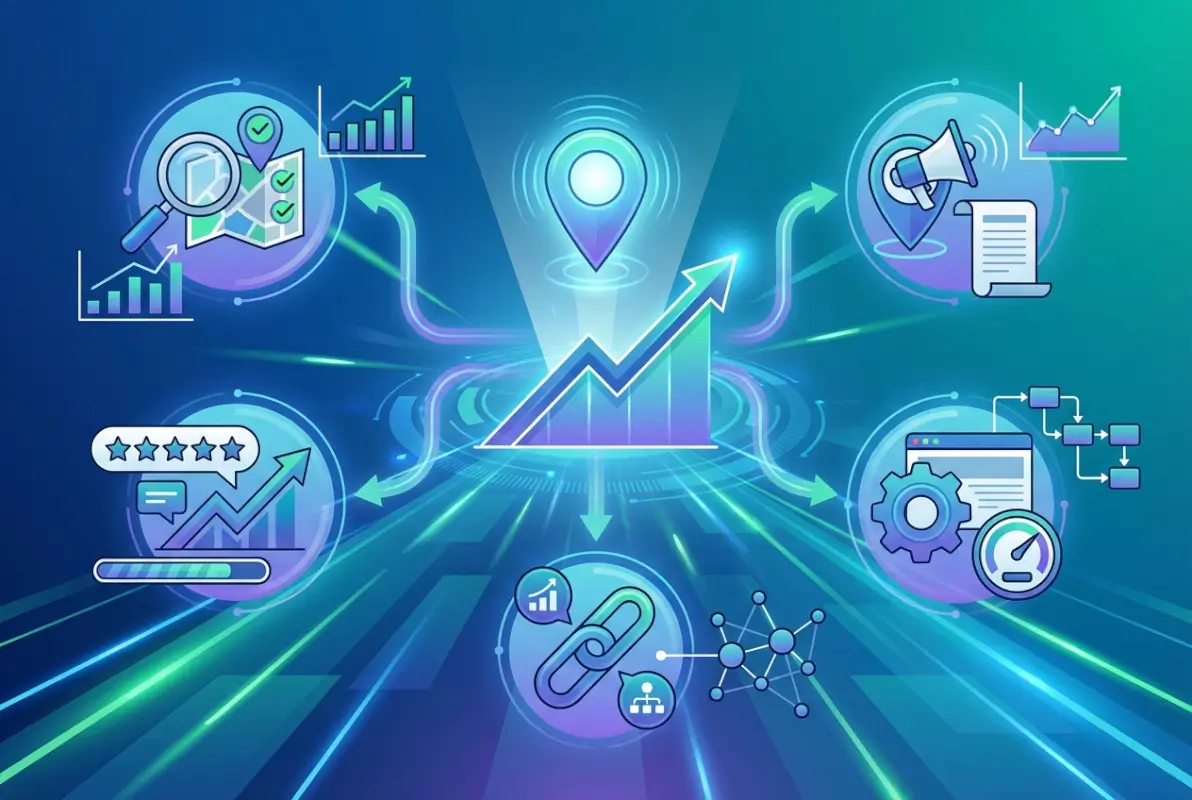
Establish core metrics that matter: GBP views, customer actions (website visits, calls, direction requests), listing completeness scores across platforms, citation consistency percentages, review velocity and sentiment, local pack ranking positions, and organic traffic from local queries. Track these monthly to identify trends and opportunities.
Building Audit Frameworks and KPI Dashboards
Create a standardized audit template that covers all essential listing elements: NAP accuracy, category selections, business hours, description quality, photo quantity and recency, review response rates, and link functionality. Run this audit quarterly for single-location businesses, monthly for multi-location operations.
Use centralized dashboards to track performance across platforms. Google’s built-in GBP insights provide valuable data on search queries, customer actions, and photo views. Third-party tools like BrightLocal, Moz Local, or Yext offer comprehensive multi-platform visibility and automated monitoring.
Document every change you make and track its impact on rankings and traffic. This historical record helps you understand which optimizations deliver results and which waste resources. Over time, you’ll develop a playbook of high-impact actions specific to your business and market.
AI-Assisted Optimization and Future-Ready Strategies
AI tools are increasingly integrated into local SEO workflows, particularly for content creation, review management, and data quality monitoring. Use AI to identify gaps in your listings compared to competitors, generate location-specific content ideas that avoid generic templates, draft optimized page copy incorporating local intent keywords, and analyze review sentiment to inform service improvements.
AI-powered review insights can identify common themes in customer feedback, highlighting strengths to emphasize and weaknesses to address. These patterns often reveal opportunities that manual review reading misses, especially for businesses with high review volumes.
However, AI requires human governance. Always review AI-generated content for accuracy, local relevance, and brand voice alignment. Use AI as a productivity tool, not a replacement for strategic thinking and local knowledge.
Growth, Risk Management, and Long-Term Local Brand Health
Sustainable local SEO success requires balancing growth initiatives with risk management. While optimizing listings drives short-term visibility gains, protecting your reputation and maintaining data integrity ensures long-term brand health.

Your online reputation extends beyond ratings to encompass how you handle problems publicly. Consumers expect businesses to acknowledge mistakes and offer solutions. Your response strategy directly impacts both consumer trust and search engine evaluation of your business quality.
Implementing a Comprehensive Reputation Management Strategy
Review quality and recency significantly influence local rankings. Fresh reviews signal active customer engagement; review velocity (the rate at which you receive new reviews) indicates business momentum. Businesses averaging 3-5 new reviews monthly typically outrank those with stagnant review profiles, even if the older businesses have more total reviews.
Create a structured review collection program with clear timelines and responsibilities. After service completion or purchase, send follow-up communication within 24-48 hours while the experience is fresh. Include direct links to your preferred review platforms. Segment your outreach based on customer satisfaction—highly satisfied customers receive immediate review requests; neutral customers receive a feedback survey first to address concerns privately before they consider public reviews.
Monitor review sentiment and use negative feedback to drive operational improvements. The best reputation management strategy is delivering excellent service that naturally generates positive reviews. When issues arise, address them systematically to prevent recurring negative feedback.
Train staff on the importance of reviews and empower them to request reviews during positive customer interactions. A simple “We’d love your feedback on Google—here’s a card with the link” converts happy customers into public advocates.
Integrating Paid Local Advertising with Organic Listing Efforts
GBP features now include advertising options that complement organic listing signals. Local Services Ads, Google Guaranteed badges, and promoted pins can enhance visibility while you build organic rankings. However, ensure alignment between organic and paid strategies to avoid mixed signals.
When running local ads, maintain identical NAP information, business descriptions, and service offerings across paid and organic listings. Inconsistencies confuse potential customers and may trigger quality score penalties that increase advertising costs.
Track the incremental impact of GBP-related changes on local visibility separately from paid campaigns. Attribution gets messy when multiple channels drive the same actions, but understanding which efforts deliver results helps optimize budget allocation.
Consider the lifetime value implications of different channels. Customers acquired through organic local search typically cost less and often show higher lifetime value than paid channel customers, though paid channels can accelerate initial growth while organic efforts gain traction.
Frequently Asked Questions
What is local listing optimization and why does it matter for my business?
Local listing optimization aligns your business data across Google Business Profile and high-value directories to improve visibility in local search and maps. This consistency signals legitimacy to search engines while ensuring customers find accurate information regardless of where they search, driving more qualified traffic, calls, and visits to your business.
How often should I audit my business listings for accuracy?
Quarterly audits work for most single-location businesses, while monthly checks suit multi-location operations or competitive markets. Set calendar reminders to review your top 10-15 listings, checking NAP consistency, business hours, photos, and review responses. Automated monitoring tools can flag unauthorized changes between audits, preventing ranking drops from incorrect information.
Do Google Business Profile listings still affect rankings in 2026?
Yes, GBP remains the central discovery surface for local queries. Profile completeness, accuracy, and engagement signals like reviews, posts, and photos continue to heavily influence visibility in both Google Search and Maps. While AI and other factors increasingly shape search results, GBP optimization delivers measurable improvements in local pack rankings and customer actions.
Which directories matter most for local SEO in 2026?
Google Business Profile is primary, followed by Bing Places, Yelp, Apple Maps, and Facebook Business. Supplement these with high-authority data aggregators like Neustar Localeze and Factual, plus industry-specific directories relevant to your sector. Focus on data accuracy and consistent NAP across all platforms rather than maximizing listing quantity.
How can I measure the impact of my listing optimization efforts?
Track GBP views, customer actions (website visits, calls, direction requests), local pack ranking positions, citation consistency scores, and review velocity. Use GBP insights and third-party tools like BrightLocal or Moz Local to monitor these metrics monthly. Document all changes and correlate them with traffic and ranking movements to identify high-impact optimizations.
Should I respond to negative reviews on my business listings?
Absolutely. Businesses that respond to negative reviews receive 33% more follow-up business than those that ignore complaints. Respond within 24 hours, acknowledge the concern, apologize if appropriate, offer a solution, and invite offline discussion. Your professional response demonstrates customer service quality to prospective customers while signaling active engagement to search algorithms.
Can I manage business listings myself or do I need a service?
Single-location businesses with available time can effectively self-manage by focusing on the five essential platforms first. Multi-location businesses, franchises, or those wanting comprehensive coverage across 50+ directories benefit significantly from listing management services or platforms like TurnKey Directories, which provide consistent maintenance and better results while saving substantial time.
How long does it take to see results from local SEO listing optimization?
Initial improvements typically appear within 1-3 months, with significant gains occurring between 3-6 months. Timeline depends on your starting position, competition level, NAP consistency, review quantity and quality, and business age. New businesses generally require longer to establish local authority than established ones with existing online presence and review history.
Take Control of Your Local Visibility Today
The businesses dominating local search in 2026 are those that started optimizing yesterday. Don’t let another day pass without claiming and optimizing your core listings. Start with a comprehensive audit of your Google Business Profile, verify NAP consistency across your top 10 citations, and implement a review response system within the next week.
Remember that local SEO isn’t a one-time project but an ongoing process of optimization, engagement, and adaptation. Set quarterly review reminders, track your core metrics monthly, and document what works for your specific market. The data you collect becomes your competitive advantage.
For businesses exploring directory solutions or looking to understand ways to access business park directories and similar platforms, consider how comprehensive directory software like white label business directory solutions can support your overall local presence strategy. Your consistent attention to these digital touchpoints will translate into measurable business growth, higher customer trust, and sustainable competitive advantage in your local market.
Was this article helpful?