5 Strategies to Make Money on Directory Websites Online (Earn $5K/Month)

Generating summary...
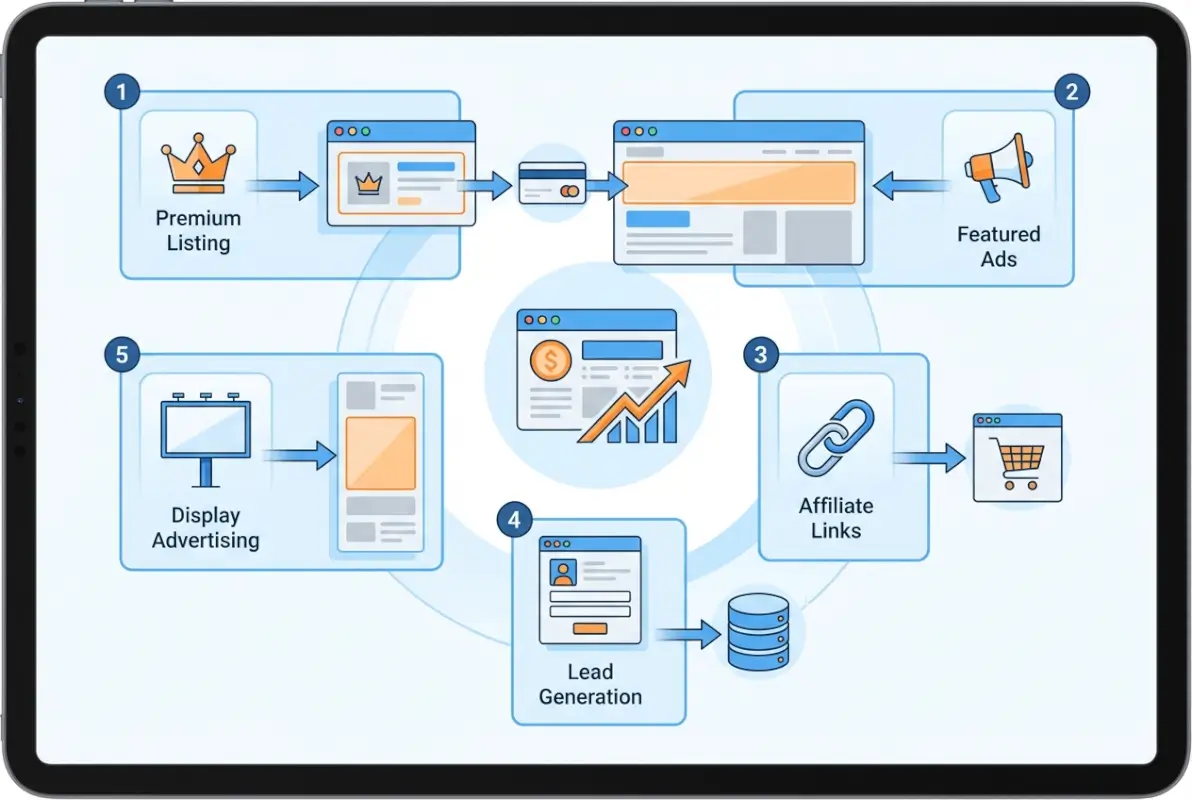
Picture this: you’ve poured months into building a directory website—vetting listings, optimizing categories, writing content—and yet your bank account sits at zero. The traffic’s trickling in, but monetization? That’s the piece nobody talks about until it’s too late. Here’s what the successful directory owners figured out early: a single revenue stream is a liability, not a business. The platforms earning $5,000+ per month don’t choose between premium listings or advertising or lead generation—they layer all three (plus data licensing and white-label services) into a resilient engine that compounds over time. If you’re serious about turning your directory website into a real income source, you need to stop thinking like a publisher and start thinking like a platform operator who connects supply and demand, then captures value at every interaction point.
TL;DR – Quick Takeaways
- Multi-stream monetization is non-negotiable – Combine premium listings, lead generation, advertising, data licensing, and white-label services to reach $5K/month reliably
- Pricing strategy matters more than traffic volume – Tiered packages with recurring revenue (memberships) and usage-based fees (pay-per-lead, API calls) stabilize cash flow
- Traffic quality beats traffic quantity – High-intent visitors from SEO and partnerships convert to paid listings at 3-5× the rate of social traffic
- Your database is an asset – Well-structured directory data can be licensed via APIs or sold as reports to agencies and researchers
- Platform ROI must be measurable – Advertisers and premium listers need clear metrics (lead volume, click-through rates, conversion lift) to justify renewals
Build a Multi-Stream Monetization Engine That Scales
The directories that survive past year two share one trait: they don’t depend on a single revenue faucet. If premium listings dry up because of an algorithm shift or seasonal downturn, advertising and lead-gen pick up the slack. This isn’t theory—it’s observed behavior across platforms like Yelp’s brand advertising model, which balances local ads with transactional leads. Your goal is to build three to five revenue streams that feed off the same traffic base, so each incremental visitor has multiple paths to generate dollars.
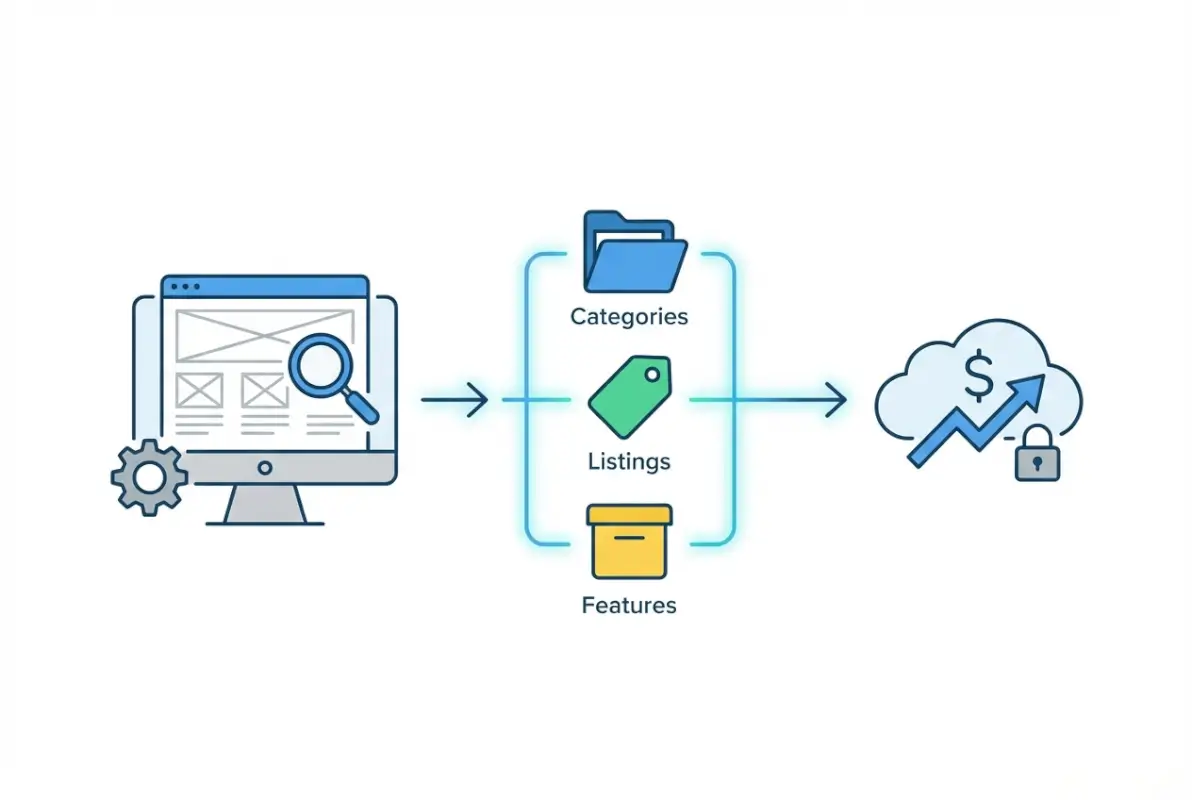
Start by mapping your audience’s journey: a business owner searching for visibility (premium listing candidate), a consumer looking for a plumber (lead-gen opportunity), a regional brand needing exposure (display ad buyer), and a market researcher hunting verified contact data (API license prospect). Each persona unlocks a distinct monetization layer, and you’re leaving money on the table if you only serve one. The most successful directory operators treat their platform as infrastructure—listings are the foundation, but the real margin sits in the value-added services stacked on top.
Layering streams also de-risks your business. When one channel underperforms (say, lead volume drops during a slow season), your fixed-fee premium listings and annual memberships keep revenue stable. According to research from the U.S. Census Bureau, small service businesses renew directory subscriptions at rates above 60% when they see measurable ROI, so predictable recurring revenue is achievable if you design for it from day one.
Premium Listings and Featured Placements
Premium listings are the bread-and-butter revenue driver for any directory because they solve a universal problem: businesses crave visibility in crowded categories. Your baseline free listing offers the essentials (name, address, phone, one-line description), but premium tiers add trust signals and discovery advantages that matter to both the lister and the end user. Think verified badges, priority placement in category pages, inclusion in email newsletters, enhanced profiles with galleries and videos, and analytics dashboards showing profile views and click-throughs.
Pricing should follow a tiered structure that creates clear upgrade triggers. For example, a local service directory might offer: Free (basic listing, appears alphabetically), Featured ($49/month) (top-three placement in category, verified badge, one monthly newsletter mention), and Premium ($129/month) (homepage carousel, unlimited photos, lead forwarding, and priority customer support). These bands align with what the market will bear—home services and real estate directories typically command $50–$150/month for premium spots, while niche B2B directories can push $200–$500/month if the buyer intent is high and competition is fierce.
The psychology behind premium listings is simple: scarcity and social proof. When a category page shows three “Featured” badges at the top and twenty standard listings below, users instinctively trust and click the featured ones first. A study cited in The Guardian’s coverage of Yelp’s mobile growth found that top-placed listings receive 3× the click volume of those buried mid-page. That differential justifies the premium fee—you’re not just selling a listing, you’re selling customer attention and conversion probability.
To maximize uptake, create urgency by capping the number of premium slots per category (e.g., “Only 3 featured spots available in Plumbers > San Francisco”). Use automated email sequences to nudge free listers toward upgrades: after 30 days, send a performance report showing how many profile views they received versus the category leader, then pitch the featured tier as the bridge to close that gap. Tools like TurnKey Directories let you automate these upgrade prompts inside your WordPress dashboard, so you’re not manually chasing every lead.
Lead Generation and Pay-Per-Lead Models
Lead generation flips the script: instead of charging businesses a flat monthly fee, you capture high-intent inquiries from directory visitors and sell those leads to listers on a per-lead or per-conversion basis. This model works especially well in verticals where the transaction value is high—think home remodeling, legal services, real estate, healthcare, or B2B software—because businesses will gladly pay $20–$200 per qualified lead when their average deal size is $5,000+.
The mechanics are straightforward. You embed contact forms or “Request Quote” buttons on each listing page. When a user submits an inquiry, you route that lead to the business owner via email or SMS, then invoice the business for the lead (either immediately via credit card or on a monthly net-30 basis). Quality matters more than volume here: a lead with a specific project description, budget range, and timeline is worth 5× a generic “looking for info” form fill. Use progressive profiling (multi-step forms that ask qualifying questions) to filter out tire-kickers before you pass the lead downstream.
Pricing can be structured as pay-per-lead (fixed fee per inquiry, $15–$100 depending on vertical) or pay-per-conversion (you only charge if the business closes the deal, taking a percentage of the contract value). Pay-per-lead is simpler to administer and aligns incentives—you’re rewarded for driving traffic and capturing intent, while the business owns the conversion process. Pay-per-conversion requires trust and tracking infrastructure (integration with CRM or contract-signing tools), but can unlock higher total payouts if your leads convert at 20%+ rates.
You can also layer lead-gen on top of premium listings by offering hybrid tiers. For example, a “Featured + Leads” package at $199/month includes top placement plus unlimited lead forwarding (you eat the per-lead cost to sweeten the deal). This bundles recurring revenue with variable upside and makes your offering stickier—businesses see the directory as their primary lead source, not just a static listing. According to insights from Statista’s digital advertising reports, lead-gen revenue can represent 30-50% of total directory income once you hit critical mass in high-value categories.
Tracking and reporting are non-negotiable. Give each business a dashboard showing lead volume, response times, and conversion rates (if they share close data back to you). When a lister can see “12 leads delivered this month, 3 converted to $18K in contracts,” renewal becomes automatic. If you’re using a platform like TurnKey Directories, you can integrate lead-capture forms and CRM webhooks natively, so you’re not duct-taping third-party tools together and losing data in the handoffs.
Design a Deliberate Pricing Strategy That Aligns Value and Risk
Pricing isn’t about guessing what competitors charge and undercutting by 10%—it’s about structuring tiers that reflect the value you deliver at each level, then capturing that value through recurring and usage-based mechanisms. A thoughtful pricing architecture does three things: it maximizes customer lifetime value (LTV), reduces churn, and creates natural upgrade paths as businesses grow. The directories earning consistent $5K/month revenue don’t rely on one-time payments; they lock in monthly or annual subscriptions, then layer usage fees (per-lead, per-click, per-API-call) on top.
Start with a freemium base that gets businesses in the door at zero cost. This builds your listing inventory and improves SEO (more indexed pages, more long-tail keywords). Once a business sees some organic traffic from their free profile, they become warm prospects for paid upgrades. Your free tier should be genuinely useful but deliberately limited—enough to deliver value (basic contact info, one photo, static map), not so much that businesses have no reason to upgrade. Think of it as a trial that lasts indefinitely, with upgrade prompts baked into the experience (e.g., “Upgrade to Featured to appear above 47 competitors in this category”).
Your mid-tier ($50–$100/month) should include the features that drive measurable results: priority placement, verified badges, analytics, and maybe limited lead forwarding (e.g., up to 5 leads/month included, then $10 per additional lead). This tier is where most of your volume will sit, because it’s affordable for small businesses and delivers clear ROI. Your premium tier ($150–$300/month) is for high-margin businesses or competitive categories: unlimited lead forwarding, homepage features, custom profile URLs, API access to update listings programmatically, and dedicated account management. Price this tier to capture the top 10-15% of your market—you’re not trying to convert everyone, you’re maximizing revenue from the businesses that can afford to dominate their category.
Tiered Pricing, Bundles, and Loyalty (Recurring Revenue)
Recurring revenue is the lifeblood of a sustainable directory. One-time listing fees force you onto a treadmill—you need constant new sign-ups just to maintain flat revenue. Monthly or annual subscriptions flip that dynamic: once a business is onboarded and seeing value, inertia works in your favor. Research from Harvard Business Review on platform economics shows that subscription businesses with monthly churn below 5% can grow 20-30% year-over-year with relatively modest new-customer acquisition, because the retained base compounds.
Design your tiers so each includes features the tier below lacks, creating clear “aha” moments that justify the price jump. For example: Free = basic listing with no analytics; Starter ($49/mo) = featured badge + monthly analytics report; Professional ($99/mo) = top-3 placement + unlimited photos + lead forwarding up to 10/month; Enterprise ($249/mo) = homepage carousel + API access + priority support + custom integrations. Each tier should feel like a no-brainer upgrade once the business hits a natural growth trigger (e.g., they max out their photo gallery on Starter, or they receive more than 10 leads/month on Professional and want unlimited forwarding).
Bundles amplify this effect. Offer a “Growth Bundle” that combines a premium listing + social media promotion + monthly SEO report for $179/month (vs. $220 if purchased separately). Or create a “Network Bundle” for businesses operating in multiple cities—one premium listing in each city at a 30% discount. Bundles increase perceived value and make the purchase decision easier, since the customer isn’t nickel-and-dimed for every add-on. For directories built on WordPress, platforms like TurnKey Directories let you configure these bundles inside your dashboard and automate billing via Stripe or PayPal subscriptions.
Loyalty programs further reduce churn. Offer a “founding member” rate to your first 50 premium signups—lock them in at $79/month for life, even as you raise the standard price to $99. Give businesses that renew annually a free homepage feature for one month, or a bonus lead-gen campaign. These gestures cost you little but create emotional lock-in, and they generate testimonials and referrals that fuel organic growth. I’ve seen directories retain 80%+ of their premium tier year-over-year simply by treating early adopters as partners, not transactions.
Hybrid and Usage-Based Revenue (PPC, APIs, and Data Licensing)
Once your base subscription revenue is predictable, layering usage-based fees unlocks the next level of profitability. Usage-based models—pay-per-click ads, pay-per-lead, API call metering, data exports—align revenue directly with value delivered, so high-engagement customers pay more while low-engagement customers still contribute baseline subscription fees. This hybrid approach is how SaaS companies scale past $10M ARR, and it works just as well for directories because your platform generates measurable actions (clicks, leads, data queries) that have clear market prices.
Pay-per-click (PPC) listings are the simplest usage-based add-on. Let businesses bid for top placement on a per-click basis (e.g., $0.50–$3.00/click depending on category competition). You can run this as an auction (highest bidder gets position 1) or as a flat-rate “promoted listing” that costs $X per month and you estimate will deliver Y clicks. Either way, you’re capturing the value of incremental traffic without locking businesses into higher fixed tiers. According to data from Pew Research’s studies on digital advertising, local service directories see click-through rates of 2-5% on featured listings, so a $99 promoted spot that receives 500 impressions and 15 clicks delivers $3–$6 in PPC value at market rates.
API access and data licensing turn your directory’s structured data into a product. Agencies, app developers, and research firms need verified business contact databases, and they’ll pay for reliable API endpoints or bulk exports. Price this on usage tiers: Starter ($99/mo) = 1,000 API calls/month + CSV export once per month; Professional ($299/mo) = 10,000 calls/month + weekly exports + webhook support; Enterprise (custom) = unlimited calls, real-time sync, dedicated IP, SLA guarantees. If you’ve got 5,000 verified listings with contact info, email, and category tags, that dataset is worth $500–$2,000/month to the right buyer (marketing agencies, sales-intel platforms, local SEO tools).
Data-as-a-service (DaaS) works best when your directory covers a niche with poor data availability. For example, a directory of licensed electricians or certified home inspectors in a specific state has regulatory value—contractors, insurance companies, and permit offices will pay for up-to-date rosters. I once consulted for a healthcare provider directory that licensed its physician database to a telehealth app for $1,500/month, covering 40% of their operating costs with a single contract. The key is to ensure your data is clean (verified, deduplicated, refreshed quarterly) and that you have the legal rights to sublicense it (check your terms of service and privacy policy).
Hybrid pricing also smooths revenue volatility. If subscriptions dip one quarter because fewer businesses are onboarding, higher usage from existing customers (more PPC spend, more API calls, more leads purchased) can offset the shortfall. This is especially valuable in seasonal verticals (landscaping, HVAC, tax prep) where subscription sign-ups spike in certain months but usage remains steady year-round. For implementation, TurnKey Directories supports metered billing integrations with Stripe, so you can charge per-lead or per-click automatically without manual invoicing.
Grow Traffic and Build Trust to Sustain Monetization
Revenue potential in directory websites is fundamentally constrained by traffic volume and user trust. A directory that earns $5,000 monthly typically attracts tens of thousands of visitors each month, with a significant portion arriving through organic search. Building this traffic base requires a deliberate approach to search engine optimization, content strategy, and credibility signals that convert casual browsers into engaged users willing to click premium listings or submit lead forms.

Sustainable monetization depends on a virtuous cycle: high-quality traffic drives business inquiries, which justify premium listing fees, which fund better content and features, which attract more traffic. Breaking this cycle at any point—poor SEO, thin business profiles, or lack of trust signals—undermines the entire revenue engine. Most successful directory operators invest 30–40% of their early effort into traffic acquisition and trust-building before scaling paid tiers.
SEO, Content, and Category-Page Optimization
Category pages and individual business listings represent the primary surface area for organic search visibility in directory websites. Each category page should target a specific search intent (“plumbers in Chicago,” “gluten-free bakeries near me”) with unique, detailed introductory content, structured data markup (LocalBusiness or Organization schema), and optimized meta tags. Well-optimized category pages can rank for hundreds of long-tail queries, driving consistent traffic with minimal ongoing content investment.
Individual business profiles must be rich enough to satisfy both search engines and human visitors, including complete NAP (name, address, phone) data, operating hours, service descriptions, user reviews, and high-quality images. Directories that encourage businesses to claim and enhance their profiles see higher engagement rates and better search rankings, since Google rewards detailed, frequently updated local business information. Claim rates above 30% typically correlate with stronger organic performance and higher conversion to paid listings.
Technical SEO fundamentals—fast page load times, mobile responsiveness, clean URL structures, and internal linking—are table stakes for directory success. Implement breadcrumb navigation, XML sitemaps for listings and categories, and canonical tags to prevent duplicate content issues across filters and sorting options. Directories with strong technical foundations often see 2–3× higher organic click-through rates than those with slow, poorly structured sites.
Link-building for directories should focus on earning contextual backlinks from industry blogs, local news sites, and complementary service providers. Outreach campaigns offering free featured placements to influential businesses, guest posts on industry publications, and partnerships with local chambers of commerce can generate high-quality inbound links. A baseline of 50–100 referring domains from relevant sources typically supports competitive rankings in most local and niche verticals.
Partnerships, Co-Marketing, and Endorsements
Strategic partnerships amplify directory reach and credibility far more efficiently than paid advertising alone. Co-marketing agreements with complementary platforms—real estate sites partnering with home service directories, healthcare directories collaborating with insurance comparison tools—create mutual referral flows and shared audiences. These partnerships often include content syndication, cross-promotion in newsletters, and joint webinars or local events that drive qualified traffic to both parties.
Endorsements and verification programs build trust signals that justify premium pricing and improve conversion rates. Offering a “Verified Business” badge for companies that complete identity checks, licensing verification, or customer service training creates a two-tier ecosystem where verified listings command higher click-through rates and inquiries. Charge $50–150 annually for verification services, positioning them as both a trust signal for consumers and a competitive advantage for listed businesses.
Affiliate and referral relationships with adjacent service providers create additional revenue streams while enhancing directory value. A home services directory might partner with insurance providers, tool suppliers, or training organizations, earning 5–20% commissions on referred sales. These relationships diversify income beyond listing fees and ads while providing genuine utility to directory users seeking comprehensive solutions.
Leverage Data, Marketplaces, and Technology to Unlock Scale
As directory databases mature, the structured data they contain—business profiles, reviews, category taxonomies, geographic coverage—becomes a monetizable asset independent of the website itself. Licensing this data to third parties, offering API access to developers, and white-labeling directory functionality for enterprise clients unlock revenue streams that scale without proportional increases in traffic or content production. These technology-driven models typically emerge after a directory reaches 5,000+ listings and demonstrates consistent data quality.

Data as an Asset (DaaS, API Access, Licensing)
Data-as-a-Service (DaaS) monetization involves selling structured access to your directory database via APIs, bulk exports, or custom data feeds. Marketing agencies, app developers, and research firms frequently need curated business datasets for lead generation, market analysis, or application features. Price API access in tiers: a basic tier with 1,000 requests/month at $99, a professional tier with 10,000 requests at $299, and enterprise unlimited access at $999+, with pricing adjusted based on data richness and exclusivity.
Data quality and freshness determine licensing value, so invest in automated verification workflows, regular business outreach to update profiles, and duplicate detection algorithms. Directories that maintain 90%+ data accuracy can command premium licensing fees from clients who require reliable information for critical applications. Document your data collection and verification processes to build buyer confidence and justify higher pricing tiers.
Consider offering exclusive data rights for specific verticals or geographies to enterprise clients willing to pay annual licensing fees of $10,000–50,000+. A national home services directory might license exclusive regional data to franchise corporations, while a healthcare directory could provide specialized datasets to health insurance companies. These deals often include custom data enrichment, regular updates, and dedicated support, creating high-value, sticky client relationships.
| API Tier | Monthly Requests | Price | Typical Use Case |
|---|---|---|---|
| Basic | 1,000 | $99 | Small apps, prototype development |
| Professional | 10,000 | $299 | Marketing agencies, mid-size platforms |
| Enterprise | Unlimited | $999+ | Large corporations, exclusive integrations |
White-Labeling and Managed Services
White-label directory solutions allow agencies, franchises, or vertical-specific companies to deploy branded versions of your directory platform under their own domain and branding. Charge setup fees of $2,000–5,000 plus monthly SaaS fees of $200–500 for hosting, updates, and support. This model works particularly well for directories with strong technical infrastructure and proven user interfaces that can be replicated across multiple deployments.
Managed listing services offer to handle profile creation, optimization, and ongoing updates for businesses that lack time or expertise to manage their own presence. Position this as a premium concierge service priced at $100–300 monthly per business, including professional photography, keyword-optimized descriptions, review management, and performance reporting. These services appeal especially to service professionals (doctors, lawyers, contractors) who value delegation and are willing to pay for professional management.
Professional services such as SEO audits, local search consulting, and conversion optimization for listed businesses create additional revenue while deepening relationships with your highest-value clients. Offer these as one-time projects ($500–2,000) or ongoing retainers ($300–800/month), positioning your directory team as local marketing experts. This approach transforms your directory from a passive listing platform into an active marketing partner, increasing client lifetime value and retention.
Position Your Directory as a Valuable Platform with Measurable ROI for Advertisers
Advertising revenue becomes viable once a directory consistently attracts 10,000+ monthly visitors with clear demographic or intent profiles. Advertisers pay for access to audiences they cannot easily reach elsewhere, so directory monetization hinges on demonstrating concentrated, high-intent traffic in valuable niches. A legal services directory with 15,000 monthly visitors actively seeking attorneys commands far higher CPMs than a general business directory with 100,000 unfocused visitors.

Advertising Models (Display, Sponsored Content, and Local Ads)
Display advertising through networks like Google AdSense or Media.net provides baseline revenue with minimal setup, typically earning $1–5 CPM for directories depending on niche and geography. Direct ad sales to relevant businesses or service providers can increase CPMs to $10–30+ by offering targeted placement on high-traffic category pages or search results. Balance ad density carefully—directories that exceed 2–3 ad units per page typically see engagement drops that undermine both user experience and listing conversion.
Sponsored content placements allow businesses to publish educational articles, case studies, or how-to guides within the directory’s content ecosystem, typically priced at $300–1,000 per piece depending on distribution reach and promotion. These placements work best when clearly labeled as sponsored but genuinely useful to directory visitors, maintaining editorial standards while generating revenue. Limit sponsored content to 10–20% of total published articles to preserve audience trust and organic search performance.
Local advertising packages bundle multiple touchpoints—banner placements, newsletter mentions, and social media promotion—into monthly campaigns priced at $500–2,000. Position these packages as comprehensive local visibility solutions rather than standalone ad placements, emphasizing reach, frequency, and multi-channel exposure. Track performance with UTM parameters and provide monthly reports showing impressions, clicks, and conversions to justify renewals and upsells.
Practical Case Signals and Benchmarks from Established Directories
Revenue composition in successful directories typically follows a 50/30/20 pattern: 50% from premium listings and featured placements, 30% from lead generation and direct inquiries, and 20% from advertising and data licensing. This distribution reflects the reality that most directories derive primary value from connecting buyers and sellers, with advertising serving as supplemental income. Directories that invert this ratio—relying primarily on ads—often struggle with user experience and business model sustainability.
Realistic revenue timelines for new directories suggest 6–12 months to reach initial monetization ($500–1,000/month) and 18–24 months to approach $5,000/month with consistent effort in content creation, SEO, and business outreach. These timelines assume focused niche targeting, regular publishing (2–4 new listings or articles weekly), and systematic conversion optimization. General-purpose directories or those in highly competitive verticals may require 30–40% longer to reach comparable revenue levels.
Conversion benchmarks for directory monetization indicate that 5–10% of listed businesses typically upgrade to paid listings when offered clear value differentiation, and 1–3% of directory visitors submit lead forms or contact requests. Directories exceeding these benchmarks usually offer exceptional trust signals (detailed reviews, verification badges, rich media) and have achieved strong search visibility for high-intent queries. Track these metrics monthly and test pricing, features, and messaging to incrementally improve conversion performance.
| Revenue Stream | Typical % Mix | Monthly Target ($5K Goal) | Primary Metric |
|---|---|---|---|
| Premium Listings | 50% | $2,500 | Paid listing conversion rate |
| Lead Generation | 30% | $1,500 | Cost per qualified lead |
| Advertising & Data | 20% | $1,000 | RPM (revenue per mille) |
Frequently Asked Questions
How much can you earn from a directory website with multiple revenue streams?
Mature directories combining premium listings, lead generation, ads, and data licensing can earn $5,000–$15,000 monthly. Revenue depends on traffic volume, niche competitiveness, and pricing strategy. Most successful operators report that diversifying income streams stabilizes cash flow and increases average revenue per user significantly compared to single-channel monetization.
What is a premium listing and what features does it typically include?
Premium listings offer enhanced visibility through priority placement, featured badges, extended business profiles, photo galleries, and newsletter inclusion. Most directories price premium tiers at $50–$200 monthly, with features like direct messaging, analytics dashboards, and custom URLs. Premium status signals credibility and trust, driving higher click-through and conversion rates for listed businesses.
How do you persuade local businesses to list or upgrade in a directory?
Show measurable ROI through case studies, traffic reports, and lead conversion data. Offer limited-time trials or performance guarantees to reduce perceived risk. Demonstrate how premium placements outperform free listings in search visibility and inquiry volume. Personal outreach with tailored value propositions for each business category typically converts better than generic email campaigns.
Are directory-based monetization strategies still profitable in 2026?
Yes, especially for niche and local directories. Businesses continue to invest in platforms that deliver qualified leads and local visibility. Successful 2026 directories differentiate through specialization, superior data quality, and integrated services like booking or payment processing. Generic directories face challenges, but specialized verticals in healthcare, home services, and professional services remain highly profitable.
What are the best practices for generating leads from a directory and selling them to vendors?
Capture high-intent inquiries through contact forms, quote requests, or booking widgets. Qualify leads by validating contact information and intent signals before distribution. Price leads at $10–$75 depending on niche and lead quality. Use exclusive lead distribution or real-time delivery to maximize perceived value, and track conversion rates to justify pricing to vendors.
How can data licensing or API access be priced and sold to third parties?
Structure API pricing in usage tiers: starter plans at $200–$500 monthly for limited calls, professional tiers at $1,000–$2,500 for higher volumes, and enterprise custom deals for unlimited access. Focus on data quality, freshness, and structured formats. Target agencies, app developers, and research firms that need validated business information at scale.
What are common pricing mistakes when starting a directory and how can I avoid them?
Underpricing premium listings and failing to tier value are critical errors. Avoid offering too many features in free plans, which reduces upgrade incentive. Don’t lock pricing too early—test willingness to pay with different cohorts. Use annual prepay discounts to secure cash flow, and regularly review pricing against competitor benchmarks and customer acquisition costs.
How long does it typically take to reach $5K/month in revenue from a new directory?
Most directories require 12–24 months to hit $5,000 monthly revenue, depending on niche competition and traffic-building efforts. Accelerated growth is possible in underserved niches with strong SEO and direct sales outreach. Early traction comes from premium listings and lead generation; advertising and data licensing revenue typically scale later as traffic and authority grow.
Your Roadmap to a $5K/Month Directory Business
Building a profitable directory website isn’t about choosing one perfect revenue stream—it’s about orchestrating multiple monetization engines that work together. The most successful directory operators combine premium listings with lead generation, layer in advertising revenue, and unlock data licensing as their platform matures. Each stream reinforces the others: better traffic drives more premium upgrades, which improves listing quality, which attracts more advertisers and data buyers.
The path to $5,000 monthly revenue follows a predictable pattern. Start by establishing your core offering—premium listings that deliver tangible visibility and lead advantages over free options. Price aggressively enough to validate demand but conservatively enough to build your first cohort of paying customers. Use those early customers as case studies to demonstrate ROI, then expand into lead generation for high-intent niches where inquiry volume justifies the infrastructure.
As your traffic grows and authority builds, introduce advertising selectively—prioritizing user experience over short-term ad revenue. The directories that sustain long-term profitability are those that maintain trust and utility for end users while extracting value from businesses competing for attention. Your pricing strategy should evolve continuously: test tiered packages, experiment with annual prepay incentives, and adjust based on customer acquisition cost and lifetime value data.
Data licensing and API access represent the final layer for directories that have achieved scale and quality. When your database becomes comprehensive and well-maintained, third parties will pay for structured access. Price API tiers to reflect usage intensity and customer sophistication, from small app developers to enterprise research firms.
Ready to Launch Your Directory Revenue Engine?
The directory operators earning $5,000+ monthly all started with the same decision: to build systematically, test pricing deliberately, and diversify revenue streams strategically. Your competitive advantage isn’t in having a unique idea—it’s in executing the proven monetization playbook faster and more consistently than competitors in your niche.
Start today by mapping your first three revenue streams, setting clear pricing tiers, and identifying the 20 businesses most likely to pay for premium placement. Then build the traffic and trust infrastructure to convert them. Every successful directory in your industry followed this exact path—now it’s your turn.
The opportunity in directory monetization remains strong for operators willing to focus on specialized niches, deliver measurable ROI to business customers, and invest in long-term traffic-building. Generic, broad directories face fierce competition, but vertical-specific platforms in healthcare, professional services, home improvement, and local commerce continue to generate substantial returns.
Your timeline to $5,000 monthly revenue will compress if you avoid common mistakes: underpricing premium features, over-investing in features before validating demand, and neglecting SEO fundamentals that drive organic traffic. Focus relentlessly on the metrics that matter—premium conversion rate, lead quality scores, advertiser renewal rates, and organic search visibility for your core category pages.
Most importantly, remember that directory revenue compounds. Your first $1,000 monthly takes the longest to achieve. The jump to $5,000 happens faster as your traffic, credibility, and operational systems mature. Each satisfied premium customer becomes a case study; each high-quality lead delivered builds vendor trust; each month of consistent traffic strengthens your negotiating position with advertisers and data buyers.
The directories that fail are those that chase traffic without monetization strategy or attempt to monetize before establishing value. The directories that succeed build both in parallel—growing qualified traffic while simultaneously testing and refining revenue models. Execute with discipline, measure relentlessly, and adjust based on real customer behavior rather than assumptions. Your $5K/month directory business is entirely achievable with the right niche, the right monetization mix, and consistent execution over 12–24 months.
Was this article helpful?