6 Proven Ways to Earn Money from an Online Business Directory

Generating summary...
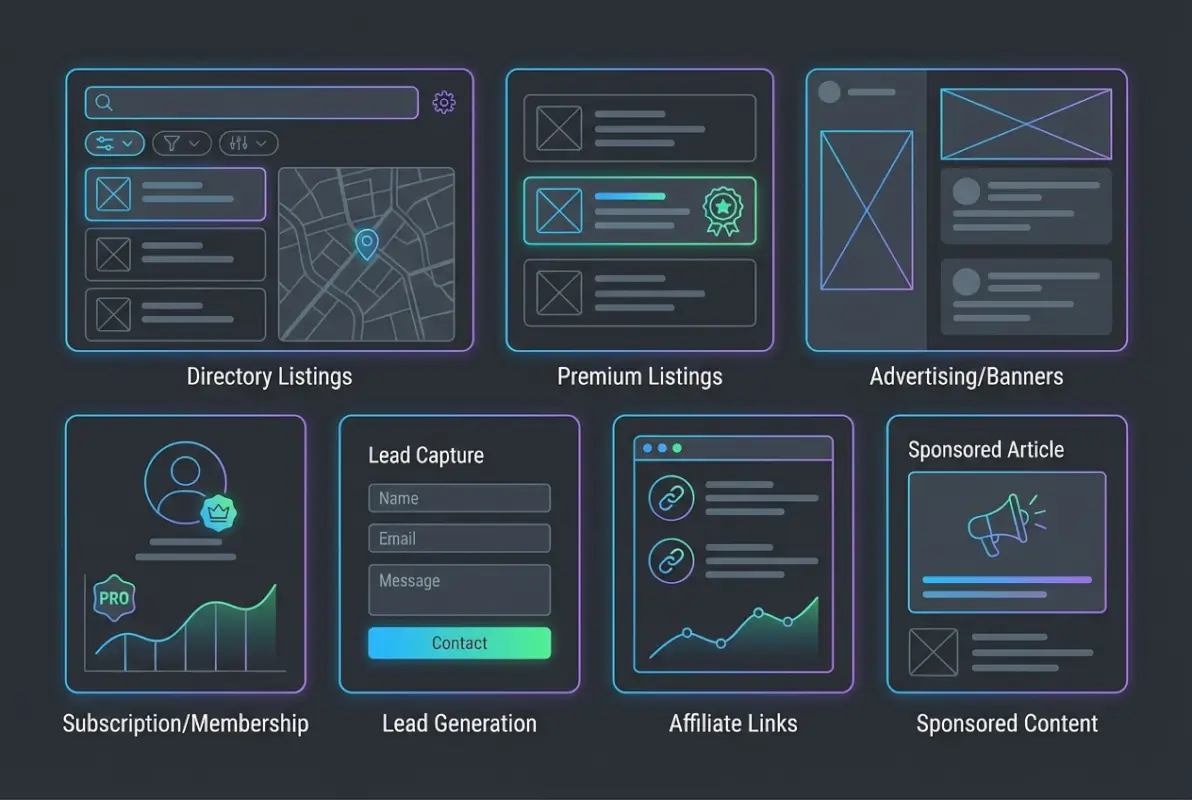
Running a successful online business directory can feel like juggling multiple revenue streams at once—and that’s exactly the point. Unlike traditional websites that rely on a single monetization model, directories sit at the intersection of local commerce, niche expertise, and digital marketing, giving you multiple levers to pull when it comes to revenue. The real opportunity lies not just in collecting listings, but in positioning your directory as the trusted middleman between businesses hunting for customers and customers hunting for the right service. In my experience building and consulting on directory platforms, the most profitable operators treat their sites like modern media companies: they blend advertising, premium placements, lead generation, affiliate partnerships, and value-added services into a cohesive revenue engine. Here’s what most guides won’t tell you: the key to earning money from an online business directory isn’t picking one monetization method—it’s orchestrating several in a way that compounds value for both sides of your marketplace.
TL;DR – Quick Takeaways
- Premium listings average $49.50/month – Tiered packages with enhanced visibility and features drive recurring revenue
- Multiple revenue streams compound – Combine ads, lead generation, affiliate commissions, and services for resilient income
- Niche focus beats broad directories – Specialized directories command higher trust, better conversions, and premium pricing
- Data quality is non-negotiable – NAP consistency and verification modules protect your reputation and boost lead performance
- AI and API integrations unlock scale – Automation, verification tools, and platform partnerships are shaping directory monetization through the next few years
How Premium Listings and Advertising Form Your Revenue Foundation
Premium listings and display advertising are the bread and butter of directory monetization because they align perfectly with business intent: companies want visibility, and you control the real estate. The core principle is simple—businesses pay more for features that translate into customer attention, whether that’s top placement in search results, enhanced profile layouts, or homepage visibility. Recent data shows premium listing costs averaging around $49.50 per month across various directory niches, with higher rates in competitive verticals like legal services or home improvement. The pricing sweet spot depends on your niche’s average customer lifetime value; a plumber landing one $5,000 bathroom remodel can justify $100/month for a featured slot, while a dog walker might balk at anything over $30.

When structuring your strategies to make money with directory websites, think in tiers rather than single price points. A typical ladder includes a free basic listing (name, address, phone, website), a “classic” tier adding photos and extended descriptions for $20–40/month, a “premium” tier with priority placement and analytics for $50–80/month, and category sponsorships that grant exclusive top billing for $150–300/month. The psychology here matters—anchor your pricing with the sponsorship tier so the premium package feels like a smart middle option. I’ve seen directories increase conversion by 40% just by renaming their tiers and adding one expensive anchor option that few actually buy.
Bundling is where pricing gets strategic. Offer quarterly billing at a 10% discount and annual plans at 20% off to reduce churn and lock in predictable revenue (businesses hate subscription fatigue as much as consumers). Include tangible extras at each level: the premium tier might add video uploads, appointment booking widgets, or click-through analytics dashboards. These features cost you little to provide but solve real pain points—business owners obsess over data and anything that streamlines customer acquisition. One directory operator I know added a simple “message this business” button to premium listings and saw upgrade conversions jump 25% because it created a direct lead channel businesses could track.
How to Position Ad Placements and Category Sponsorships for Maximum Value
Banner ads and sponsorships work best when they mirror user intent at different stages of the browsing journey. Homepage banners capture broad awareness (think brand ads from national chains or SaaS tools targeting all listed businesses), category page banners align with specific buyer intent (a roofing contractor ad on your “Home Services > Roofing” page), and listing detail page ads can promote complementary services (financing options on individual contractor profiles). The key mistake is treating all ad inventory equally—category-specific placements command 2–3× the CPM of generic homepage slots because the targeting is tighter and conversion potential higher.
Category sponsorships deserve their own pricing model because they deliver exclusivity and trust signals that banner ads can’t match. A single sponsor paying $200–500/month to “own” the top of a category page (logo, tagline, featured placement) creates a halo effect that feels more like an endorsement than an ad. From the sponsor’s perspective, it’s lower cost than PPC for the same search terms and builds brand association with your directory’s authority. For you, it’s high-margin recurring revenue with minimal delivery friction. If you run a specialized directory—say, for finding qualified dieticians and nutrition experts—a supplement brand or meal prep service would gladly sponsor that category because the audience alignment is perfect.
Ad networks (Google AdSense, Mediavine) can fill unsold inventory, but they typically yield $2–10 per thousand impressions depending on niche and traffic quality. Direct-sold sponsorships, by contrast, can generate $50–200 CPM equivalent when you calculate the monthly fee against actual impressions. The math favors direct sales in any niche with commercial intent, which is why you should reserve your best placements for direct deals and use programmatic ads only as backfill. One smart play: offer existing premium listers a discounted add-on sponsorship bundle—they’re already paying you, trust your platform, and are likelier to convert than cold outreach prospects.
How Lead Generation and Affiliate Partnerships Multiply Your Revenue Per Visitor
Lead generation flips the traditional listing model on its head: instead of charging businesses a flat monthly fee, you charge per qualified inquiry or quote request. This performance-based approach aligns incentives perfectly—businesses only pay when they get a potential customer, and you’re motivated to drive higher-quality traffic and better matching. Common structures include pay-per-lead (flat fee per form submission, typically $5–50 depending on service value) or cost-per-acquisition agreements where you earn a percentage of the closed deal (rare in directories, more common in high-ticket B2B niches). The biggest operational challenge is defining “qualified”—you need clear criteria (location match, service need stated, valid contact info) and a dispute resolution process when businesses claim leads are junk.

To create a successful directory website with lead-gen monetization, start by embedding inquiry forms on business profile pages and category landing pages. Route each lead to the appropriate business (or multiple businesses if you sell shared leads at a discount), track open rates and response times, and use that data to reward responsive businesses with better placement or lead priority. Quality control is everything here—one bad batch of bot-filled submissions will torch your relationships with paying businesses. Invest in CAPTCHA, email verification, and basic fraud filters. I’ve watched directories lose half their lead-gen revenue in a quarter because they skimped on validation and businesses stopped trusting the pipeline.
The beauty of lead-gen models is they scale with traffic, not just with business sign-ups. A directory with 10,000 monthly visitors and a 2% inquiry conversion rate generates 200 leads per month; at $20 per lead, that’s $4,000 in revenue even if only 20 businesses are participating. Compare that to a flat-fee model where those same 20 businesses might pay $40/month each ($800 total). The multiplier effect is real, but it requires higher traffic volumes and strong SEO to sustain. If your directory ranks well for high-intent local queries (like finding the best dentist near you), lead-gen becomes your highest-margin revenue stream because the incremental cost of each additional lead is near zero.
How Affiliate Partnerships Turn Listed Businesses into Recurring Commissions
Affiliate monetization works when you position your directory as a gateway not just to customers, but to the tools and services businesses need to succeed. Think payment processors (Stripe, Square), booking and scheduling software (Calendly, Acuity), CRM platforms (HubSpot, Zoho), website builders, or niche SaaS relevant to your directory’s focus. Every business you list is a potential referral—if you run a directory for creative professionals, partner with design tools like Adobe or design resources platforms and earn commissions when your listers sign up through your affiliate links. The key is relevance: only promote tools your audience actually needs, or you’ll erode trust faster than you earn commissions.
Implementation can be passive or active. Passive: add a “Resources” or “Tools for Businesses” page with affiliate links and brief reviews, then drive traffic via email newsletters to your listed businesses. Active: build affiliate offers into your onboarding flow (e.g., “Get 20% off your first year of scheduling software when you upgrade to a premium listing”) or offer bundled packages where businesses get a directory listing plus discounted access to a partner tool. The latter increases your average revenue per user and gives you a talking point that differentiates your directory from free competitors. According to research from Statista, affiliate marketing spending continues to grow year-over-year as businesses seek lower-risk customer acquisition channels, and directories sit in a prime position to capture that spend.
Attribution and tracking are critical—use unique referral links for each partner and monitor conversion rates religiously. Most SaaS affiliate programs pay 20–30% recurring commissions for the lifetime of the customer, which means a single referral can generate $50–500 in total commissions depending on the product’s price point. If you refer 10 businesses per month to a $99/month CRM at 25% commission, that’s $250/month in recurring revenue that compounds as your directory grows. Stack this with listing fees, ad revenue, and lead-gen, and you start to see why diversified monetization is so powerful. One affiliate partnership I set up for a niche directory now generates more monthly revenue than their entire premium listing tier, and it required maybe 10 hours of initial integration work.
Niche Focus and Differentiation to Improve Monetization
Directories that serve focused verticals or geographic markets consistently outperform broad general listings in both engagement and monetization. A tight niche—plumbers in the Pacific Northwest, B2B software vendors for healthcare, or pet services in metro regions—builds immediate trust because visitors know the directory curates listings relevant to their exact need. This specialization also attracts businesses willing to pay premium fees, since competition for visibility is limited and the audience is pre-qualified by category interest.
Category discipline means resisting the temptation to list every possible business type and instead focusing on a coherent theme or service area. For example, a directory targeting licensed contractors will enforce verification of trade licenses, bonding, and insurance—filters that general directories skip. That rigor justifies higher listing prices and opens doors to category-specific sponsorships from tool suppliers, material vendors, and industry associations who value targeted reach over mass distribution.
Niche positioning also simplifies marketing and SEO: you compete for “best HVAC directories” or “top wedding vendor directories” rather than fighting aggregators like Yelp or Google Maps on broad keywords. Businesses in these verticals often report better lead quality from niche directories than from mass platforms, because the traffic is intentful and less diluted by casual browsing. When you own a clearly defined segment, advertisers and sponsors view your inventory as premium—and price it accordingly.
Verified Listings, Trust Signals, and Data Quality as Value Drivers
Data accuracy is non-negotiable for directory credibility. Inconsistent Name, Address, and Phone (NAP) information erodes trust and harms SEO performance, since search engines penalize directories that propagate outdated or conflicting business data. Implementing automated verification modules—cross-checking business registrations, phone validation, and address geocoding—ensures listings remain current and reduces complaints from both users and listed businesses.
Trust signals such as verified badges, owner-claimed profiles, and review authenticity filters differentiate your directory from scraper sites and low-quality aggregators. When businesses see that listings require validation or owner confirmation, they perceive higher value in a premium placement and are more likely to invest in enhanced profiles. Similarly, users gravitate toward directories that visibly curate listings, which increases dwell time and conversion rates for advertisers and lead-generation partners.
Data quality directly impacts monetization levers: accurate listings support higher click-to-call and form-fill rates, which improve lead-generation revenue and justify premium pricing for top placements. Regular audits—quarterly or semi-annual checks for closed businesses, moved locations, and changed contact details—protect your reputation and sustain the virtuous cycle of engaged users and paying businesses. Directories that neglect hygiene see churn spike as businesses fail to receive quality leads and advertisers observe declining performance metrics.
Lead Generation Through Buyer-Side Tools and Services
Beyond static listings, modern directories monetize by offering businesses value-added services that justify recurring subscription fees. Appointment booking widgets, integrated messaging systems, and analytics dashboards transform a directory profile into a working business tool. When a contractor or consultant sees real-time lead notifications and can respond directly through your platform, the directory becomes indispensable—and switching costs rise, reducing churn on monthly or annual plans.

These services also create natural upsell paths: a basic listing might include NAP and description, a classic tier adds photos and hours, and a premium package bundles appointment booking, chat widgets, and detailed traffic analytics. Each layer delivers measurable ROI for the business—more bookings, faster response times, and insights into customer behavior—which makes the incremental cost easier to justify than a simple “featured placement” with no tangible tooling.
Integration partnerships amplify this model. By embedding third-party booking systems, CRM connectors, or payment gateways, you can earn affiliate commissions while expanding the utility of each listing. Businesses appreciate one-stop enablement—they upgrade their directory profile and simultaneously gain scheduling or invoicing capabilities—and you capture both subscription revenue and ongoing referral fees as they use the integrated tools.
Lead Matching and Marketplace Features
Intelligent lead routing elevates a directory from passive catalog to active marketplace. When a user submits a service request or quote form, algorithms can match the inquiry to the most relevant businesses based on location, specialty, availability, and past performance. This targeted distribution ensures higher conversion rates than broadcasting every lead to all listings, which dilutes quality and frustrates businesses with irrelevant inquiries.
Performance-based pricing—charging businesses per qualified lead rather than flat fees—aligns incentives and scales revenue with traffic growth. Businesses pay only when they receive actionable opportunities, making the investment low-risk and easy to approve. On your side, lead quality controls—duplicate detection, spam filtering, and minimum information requirements—protect the integrity of the marketplace and maintain trust with paying customers.
Advanced filters and search features further improve lead quality. Allowing users to specify budget ranges, preferred timelines, certifications, or customer ratings narrows the match set and increases the likelihood of conversion. When businesses see that leads are pre-qualified and contextually relevant, they’re willing to pay premium rates for access to the pipeline, and your average revenue per user climbs without requiring more traffic or listings.
| Service Layer | Typical Pricing Model | Primary Benefit |
|---|---|---|
| Appointment booking widget | $10–20/month add-on | Reduces no-shows, increases conversion |
| Lead routing & matching | $5–15 per qualified lead | Pay-per-performance, low-risk for business |
| Analytics dashboard | Bundled in premium tier | Insights into profile views, click-to-call |
| Integrated messaging | Bundled or $5–10/month | Faster response time, higher close rate |
Growth Tactics, Data, and Operational Metrics for 2024–2026
Sustainable directory revenue depends on tracking the right metrics at each tier of your funnel. Average revenue per listing (ARPL) reveals whether upsells and premium placements are working; segment this by category to identify high-value verticals worth expanding. Lead-to-sale conversion rates—measured as the percentage of directory-sourced leads that close into paid jobs or contracts—demonstrate the quality of your traffic and the effectiveness of your matching algorithms.

Churn on monthly subscription plans is a critical early-warning signal. If businesses cancel after one or two months, it usually means they’re not seeing enough leads or the leads are low-quality. Track churn by listing tier and geography to diagnose whether pricing is misaligned, competition is too intense in certain categories, or your verification and data quality efforts need tightening. Industry observations for 2025 suggest that well-maintained directories see monthly churn below 5 percent on annual contracts and 10–15 percent on month-to-month plans.
Category-wise performance metrics help you allocate marketing spend and prioritize product development. If legal services listings generate twice the ARPL of general retail, invest in SEO and outreach targeting law firms and redirect resources away from low-margin categories. Similarly, if certain regions show higher engagement and conversion, expand sales efforts and consider localized landing pages or city-specific sponsorship packages to capture more of that demand.
Technology and Partnerships That Unlock Scale
AI-assisted listing verification is rapidly becoming table stakes. Automated modules that check business licenses, cross-reference public registries, and flag duplicate or suspicious entries reduce manual moderation costs and improve trust signals at scale. As directories grow past a few hundred listings, human review alone cannot maintain data quality; AI tools handle the bulk work and escalate edge cases to staff, preserving accuracy without ballooning overhead.
API-based licensing opens new revenue streams by allowing third-party platforms—mapping apps, voice assistants, industry portals—to pull verified listing data via paid feeds. Licensing your curated, high-quality directory as a data source generates recurring revenue independent of traffic to your own site. This model works especially well for niche directories with unique datasets that aggregators or vertical SaaS platforms cannot easily replicate.
Strategic partnerships with complementary software providers—CRM vendors, payment processors, scheduling platforms—create win-win arrangements. You earn affiliate commissions or revenue-share when listed businesses adopt these tools, and the integrations increase the stickiness of your directory by embedding it into daily workflows. Look for partners whose user base overlaps with your listed businesses and negotiate tiered commission structures that scale with adoption and transaction volume.
| Metric | Target Benchmark (2025–2026) | Action if Below Target |
|---|---|---|
| Average revenue per listing (ARPL) | $40–60/month (premium tiers) | Introduce upsell features, tiered pricing |
| Monthly churn (annual plans) | < 5% | Improve lead quality, add value-added services |
| Lead-to-sale conversion rate | 15–25% (varies by vertical) | Refine matching algorithms, filter spam |
| Category revenue concentration | Top 3 categories = 60–70% revenue | Double down on high-value niches, prune low performers |
Frequently Asked Questions
How do online directories make money?
Online directories generate revenue through premium listing fees, display advertising, category sponsorships, lead generation (pay-per-lead), affiliate commissions, and value-added services like booking tools and analytics dashboards. Successful directories typically combine multiple streams, with premium listings and targeted ads forming the core baseline revenue.
What is the best way to price directory listings?
Use tiered pricing with clear value differentiation: free basic listings, mid-tier enhanced visibility, and premium packages with photos, videos, and analytics. Offer annual discounts to reduce churn, and price category sponsorships separately. Limit premium slots per category to create scarcity and justify higher pricing based on proven conversion lift.
Are lead generation and affiliate programs effective for directories?
Yes, when implemented with quality controls and proper tracking. Lead generation monetizes user intent directly, with pay-per-lead models performing well in professional services and trades. Affiliate programs work best when recommending tools businesses already need—payment processors, CRM software, or booking platforms—with transparent attribution ensuring sustainable partnerships and recurring commissions.
Should I niche my directory or keep it broad?
Niche directories generally outperform broad ones in monetization because they attract higher-intent traffic, build stronger trust, and command better pricing. A focused vertical (plumbers, dentists, or B2B SaaS tools) lets you dominate search terms, tailor features to specific needs, and justify premium fees. Broad directories require significantly larger scale to compete effectively.
What are current industry benchmarks for directory monetization in 2025?
Premium listing fees average around $49.50 per month in 2025, with category sponsorships and annual bundles pushing average revenue per user higher. Directories are increasingly adopting AI-driven verification, lead-based pricing models, and API licensing. Data quality, mobile optimization, and trust signals have become critical differentiators as competition intensifies across verticals.
How important is data quality for directory revenue?
Data quality is foundational to monetization. Inconsistent business names, addresses, and phone numbers (NAP) erode trust, reduce conversion rates, and hurt SEO rankings. Verified listings, regular audits, and automated validation tools increase user confidence, improve lead quality, and justify higher pricing for premium placements, directly impacting revenue per listing and customer retention.
Can I monetize a directory with low traffic?
Yes, if you focus on high-value niches and lead quality over volume. Even modest traffic in a specialized vertical (legal services, medical specialists, or industrial suppliers) can support premium listings and lead-gen revenue when buyers have strong intent. Prioritize conversion optimization, trust signals, and targeted outreach to businesses that benefit most from qualified leads.
What technologies help scale directory monetization?
AI-powered listing verification, automated NAP validation, and API integrations for CRM, booking, and payment systems unlock new revenue streams and reduce manual overhead. Machine learning can improve lead matching and personalization, while white-label API licensing allows other platforms to embed your directory data, creating scalable B2B revenue channels beyond direct listings and ads.
Turning Your Directory Into a Sustainable Revenue Engine
An online business directory is far more than a passive listing platform—it’s a scalable monetization engine when you layer premium listings, targeted advertising, lead generation, affiliate partnerships, and value-added services into a cohesive strategy. The key differentiators are niche focus, rigorous data quality, and trust signals that convert casual browsers into paying customers and loyal business partners.
Success in directory monetization hinges on balancing value for both sides of your marketplace. Businesses need visibility, qualified leads, and tools that justify recurring fees. Users demand accuracy, relevance, and frictionless discovery. When you deliver on both fronts—through verified listings, intelligent matching, transparent pricing, and continuous optimization—you create a flywheel where traffic, trust, and revenue reinforce each other.
The industry trends for 2025 and beyond favor directories that embrace AI-driven verification, modular pricing, and API-enabled partnerships. Whether you’re launching a new vertical or scaling an established directory, the fundamentals remain constant: choose a niche you can dominate, invest in data hygiene from day one, and design pricing tiers that reflect real value. Premium listing costs are rising because buyers recognize the ROI of verified, prominently placed business profiles in high-intent categories.
Technology is lowering the barrier to entry while raising the bar for quality. Automated NAP validation, smart lead routing, and integrated booking or payment tools are no longer optional—they’re expected. Directories that treat data quality as a competitive moat and user experience as a retention lever will capture disproportionate value as the market matures and consolidates around trusted platforms.
Ready to Build Your Monetization Strategy?
Start by auditing your current listings for data quality, then map your pricing tiers to real business outcomes. Test one new revenue stream this quarter—whether it’s category sponsorships, a pay-per-lead pilot, or an affiliate integration—and measure the impact. Sustainable directory revenue comes from compounding improvements in trust, conversion, and value delivery.
Focus on the fundamentals, iterate based on data, and build partnerships that scale. Your directory can become the go-to resource in your niche when you consistently deliver quality and align pricing with proven results.
Was this article helpful?