
Business Listing Database: 5 Best Providers for Data Accuracy & Local SEO in 2026
Opens a Google-translated copy of this article in a new tab.
Managing accurate business information across the internet isn’t optional anymore—it directly impacts whether customers find you, trust you, and choose you over competitors. A robust business listing database keeps your Name, Address, and Phone (NAP) data consistent across hundreds of platforms, from Google Maps to industry-specific directories. I’ve watched businesses lose thousands in revenue because outdated addresses lingered on popular apps, sending customers to closed locations while competitors captured that foot traffic.
The business listing database landscape has matured significantly. Today’s leading providers offer more than simple data syndication—they deliver real-time updates via API connections, AI-powered duplicate detection, and analytics that link listing performance to actual customer behavior. If you’re evaluating business list providers or wondering which business database services deliver the fastest updates and broadest coverage, this guide cuts through the marketing noise with practical comparisons and decision frameworks you can apply immediately.
TL;DR – Quick Takeaways
- Top providers for 2026: Yext (enterprise scale), Data Axle (data licensing breadth), BrightLocal (SMB budget-friendly), Moz Local (SEO integration), Google Business Profile (essential baseline)
- Real-time updates matter: Providers with direct API connections (Yext, Data Axle enterprise tier) push changes instantly; aggregator-based solutions take 24–48 hours
- Accuracy wins over volume: 95%+ NAP accuracy across 80–100 directories beats 200+ directories with inconsistent data quality
- Decision criteria: Match provider capabilities to your scale (single location vs. multi-location), integration needs (CRM/SEO tools), and update urgency
- Cost vs. value: Budget solutions ($15–50/location/month) work for stable businesses; enterprises need premium tiers ($150+/location/month) for compliance, API access, and audit trails
The 2026 Landscape of Business Listings and Data Quality
Search engines and AI assistants now treat business listings as structured entity data, not just directory entries. Google’s Knowledge Graph, Apple Maps, and voice assistants like Alexa pull business information from interconnected data sources—when your NAP details conflict across platforms, algorithms flag your entity as unreliable, suppressing visibility in local search results and map packs. According to the U.S. Census Bureau’s County Business Patterns program, accurate business data underpins economic analysis and market research, highlighting how foundational clean data has become across public and private sectors.
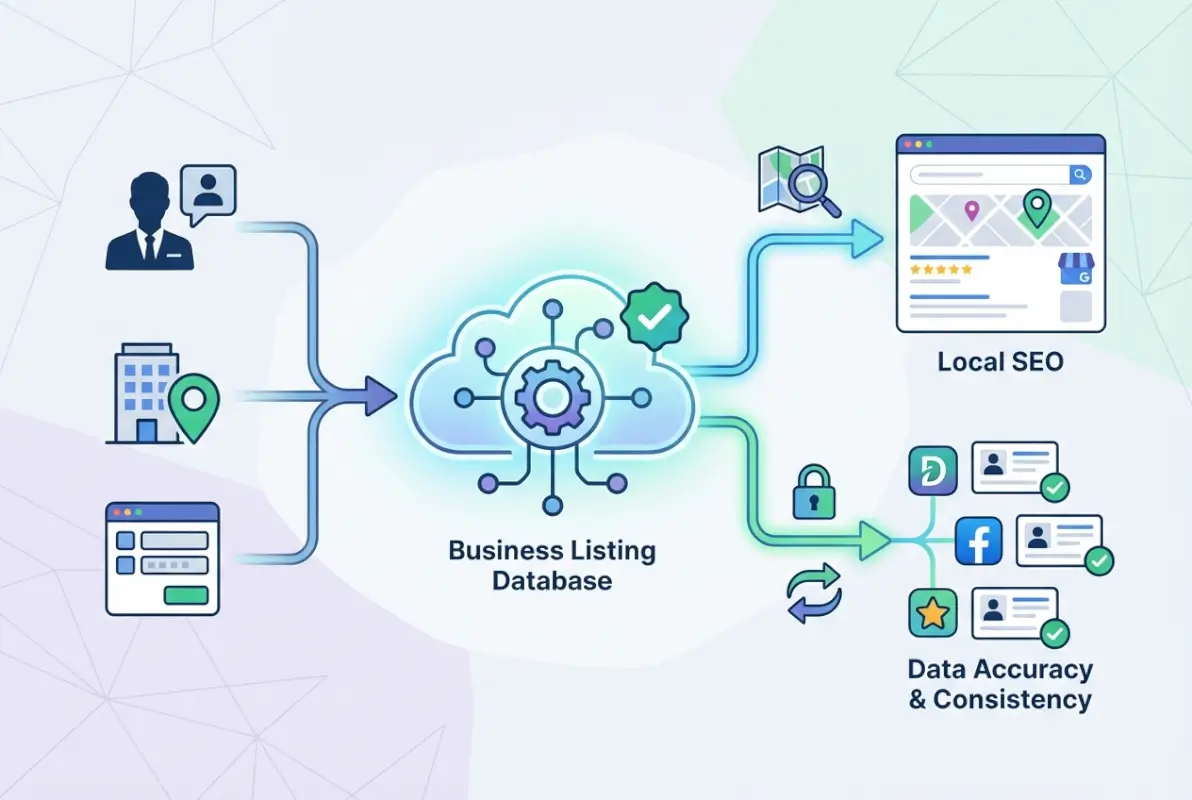
The practical impact? A healthcare provider I consulted discovered 14 variations of their business name and address across directories following a merger. Website traffic from local searches jumped 27% within three weeks of deploying a business listings database solution that corrected those inconsistencies. The shift from manual updates to automated syndication saved their team approximately 12 hours weekly while eliminating human error in data entry.
Why Listing Accuracy Is More Critical Than Ever
Local SEO ranking factors have evolved beyond simple keyword matching. Google’s local algorithm weighs NAP consistency heavily—businesses with identical information across 50+ authoritative directories rank significantly higher in local pack results than competitors with scattered, conflicting data. Research from Moz’s local SEO learning center demonstrates that citation consistency correlates with higher rankings across all major search engines.
AI readiness adds another layer. Large language models and voice assistants increasingly answer location-based queries by synthesizing data from multiple sources. If your operating hours differ between Google Business Profile and Yelp, AI systems may surface incorrect information or skip your business entirely, defaulting to competitors with cleaner data profiles. Data freshness matters too—platforms prioritize recently verified information, making real-time update capabilities a competitive advantage rather than a luxury feature.
What Top Providers Are Practically Delivering Today
Leading business database providers now offer three core capabilities that separate them from basic directory submission services. First, coverage breadth determines how many platforms receive your data—premium providers distribute to 100+ directories, aggregators, GPS systems, and voice search platforms through a mix of direct API connections and partnerships with data aggregators like Neustar Localeze and Factual.
Second, real-time synchronization via API ensures updates propagate instantly to critical platforms like Google Business Profile, Apple Maps, and Facebook. Aggregator-based distribution (used by budget providers) typically takes 24–72 hours as data flows through intermediary systems. Third, data verification processes combine automated checks (address validation against postal databases) with human review for edge cases—Data Axle, for example, employs verification teams that call businesses to confirm details, achieving 95%+ accuracy rates that automated-only systems can’t match.
Five Leading Providers in 2026 and What They Do Best
The business listing database market consolidates around providers with either extensive data licensing agreements or deep platform integrations. Rather than ranking them linearly, understanding each provider’s core strengths helps match capabilities to your specific requirements—enterprise-scale distribution, SMB affordability, SEO workflow integration, or data licensing partnerships.
| Provider | Core Strength | Best For | Starting Cost | Update Speed |
|---|---|---|---|---|
| Yext | 200+ direct API connections | Enterprise multi-location | Custom pricing | Real-time |
| Data Axle | Human verification, data licensing | Data accuracy focus | Custom pricing | 24–48 hours |
| BrightLocal | Affordable citation building | SMBs, agencies | $35/month | 24–72 hours |
| Moz Local | SEO tool integration | SEO-focused businesses | $129/year/location | 24–48 hours |
| Google Business Profile | Search/Maps dominance | All businesses (baseline) | Free | Instant |
Yext and Data Axle: Enterprise-Grade Data Distribution
Yext operates the most extensive direct integration network, connecting to over 200 platforms through APIs rather than aggregators. This architecture enables instant updates across Google, Apple Maps, Facebook, Bing, and hundreds of niche directories simultaneously. Their Knowledge Graph technology structures all business information—products, services, FAQs, promotions—in a centralized database that feeds dynamic content to connected platforms. For enterprises managing 50+ locations, Yext’s bulk update tools, advanced schema markup capabilities, and white-label options for franchise systems justify premium pricing (typically $150–300+ per location monthly). According to Yext’s product overview, their platform specializes in maintaining accuracy across complex, frequently changing business networks.
Data Axle (formerly Infogroup) distinguishes itself through data quality rather than speed. Their verification team manually calls businesses to confirm addresses, phone numbers, and operating hours—a human-in-the-loop process that achieves 95%+ accuracy but introduces 24–48 hour delays. Data Axle licenses business data to hundreds of directories, GPS providers, and marketing platforms, making them a foundational data source for the broader ecosystem. Their business database services extend beyond listings management to custom data sets for B2B marketing, market analysis, and compliance applications. As detailed in Data Axle’s business data documentation, they maintain one of North America’s most comprehensive databases with 30+ million business records.
BrightLocal, Moz Local, and Google: Accessible Entry Points
BrightLocal targets small businesses and agencies with transparent, no-contract pricing starting at $35 monthly. Their Citation Builder combines automated distribution to 60+ platforms with manual submission for challenging local directories that don’t accept automated feeds. The platform includes local rank tracking, reputation monitoring, and audit tools alongside listing management—making it a comprehensive local SEO toolkit rather than just a business listing database. White-label options let agencies rebrand reports and dashboards for clients. BrightLocal’s approach sacrifices some automation and speed (updates take 24–72 hours) but delivers excellent value for businesses with stable information that changes infrequently, as outlined in BrightLocal’s citation builder documentation.
Moz Local integrates listing management into Moz’s broader SEO platform, making it ideal for businesses already using Moz Pro for keyword research, link analysis, or technical SEO audits. At $129 per location annually, Moz distributes to major aggregators (Neustar Localeze, Factual) and directly to Google, Facebook, and Apple Maps. Their analytics dashboard correlates listing performance with search rankings and organic traffic—showing which directories drive actual website visits rather than just reporting submission status. For businesses prioritizing local database business listing optimization as part of comprehensive SEO strategy, Moz’s unified reporting across listings, rankings, and backlinks streamlines workflow significantly.
Google Business Profile remains the non-negotiable foundation. Free and directly managed, your Google profile feeds Maps, local search results, and Knowledge Panels across Google properties. No third-party business listing service providers can substitute for direct Google management—they supplement it. Claim and verify your profile first, then use paid providers to extend consistency to the 100+ other platforms that influence local search rankings and customer discovery beyond Google’s ecosystem.
Practical Criteria for Selecting a Listings Provider
Choosing the right business list provider requires matching platform capabilities to your operational reality—number of locations, information volatility, existing tech stack, and budget constraints. I’ve seen businesses overpay for enterprise features they never activate while others outgrow basic platforms within months, forcing expensive migrations.

Data Quality, Update Frequency, and Publisher Reach
Assess providers on three technical dimensions. First, accuracy verification methods—does the provider validate addresses against postal databases? Do they cross-reference phone numbers with telecommunications records? Human verification (Data Axle’s strength) catches edge cases like suite numbers or seasonal hour variations that automated systems miss, but adds latency. Second, update propagation speed determines how quickly changes reach customer-facing platforms. Direct API connections (Yext, Google Business Profile) push updates instantly; aggregator-based distribution (BrightLocal, Moz Local) introduces 24–72 hour delays as data flows through intermediary systems.
Third, distribution breadth matters more for some industries than others. A local plumber primarily needs Google Maps, Yelp, and Angi—60 directories suffice. A multi-location healthcare provider benefits from presence on health-specific directories (Healthgrades, Vitals), insurance provider locators, and GPS systems that ambulances use—justifying 100+ directory coverage. Don’t pay for 200-platform distribution if your customers only use 10 platforms; likewise, don’t skimp on niche industry directories that drive qualified traffic.
Integration, Workflow Fit, and Cost Considerations
Evaluate how providers connect to your existing marketing infrastructure. CRM integration (Salesforce, HubSpot) enables listing data to flow into customer records automatically—when a prospect searches your location, your CRM can log that interaction. API access lets developers pull listing performance data into custom dashboards or trigger automated responses to specific events (new review posted, duplicate listing detected). SEO platform integration (Moz, SEMrush) correlates listing accuracy with keyword rankings and organic traffic, proving ROI beyond anecdotal evidence.
Workflow compatibility often matters more than feature lists. If your team already uses white label business directory software solutions like TurnKey Directories for WordPress-based directory sites, choosing a listings provider with WordPress plugins or API documentation accelerates implementation. Audit trail capabilities—detailed logs of who changed what information when—become critical for regulated industries (healthcare, finance) where compliance officers must verify data integrity.
Cost structures vary significantly. Per-location pricing ($15–300 monthly per location) scales linearly but can become expensive for 100+ location enterprises—negotiate volume discounts or consider annual contracts (typically 15–20% savings). Some providers charge separately for one-time services (duplicate cleanup, initial distribution) versus ongoing management, watch for those line items in proposals. Factor in hidden costs like setup fees, required annual minimums, and charges for advanced features (API access, custom reporting, priority support) that may be essential for your use case.
Strategy for 2026: How to Use Listings Providers for B2B and Enterprise Needs
Enterprise deployments introduce complexity that SMB-focused platforms can’t handle—franchisee independence, multi-brand portfolios, international markets, and compliance requirements reshape provider selection criteria. A franchise with 500 locations needs granular permission systems (corporate controls brand name, franchisees manage local hours) and bulk update tools that SMB platforms simply don’t offer.
[KBIMAGE_4]Enterprise-Grade Versus SMB-Friendly Deployments
Use this go/no-go checklist to determine whether you need enterprise-tier providers (Yext, Data Axle enterprise, Uberall) or can succeed with mid-market solutions (Moz Local, BrightLocal, SEMrush Listing Management). Enterprise features become necessary when you manage 20+ locations across multiple markets, operate in regulated industries requiring audit trails and compliance reporting, need API access to integrate with proprietary systems, run multi-brand portfolios requiring separate listing management per brand, or have franchisees/agents requiring delegated access with permission controls.
SMB-focused platforms work well when you manage fewer than 20 locations in a single country, experience infrequent information changes (quarterly or less), use standard tools (WordPress, basic CRM) without custom integration needs, prioritize cost over update speed, and can tolerate 24–72 hour update delays. There’s middle ground too—BrightLocal’s agency plans offer white-label reporting and bulk management suitable for marketing agencies handling 50+ small business clients, while SEMrush Listing Management (powered by Yext technology) provides enterprise-grade distribution at mid-market pricing for businesses already invested in SEMrush’s ecosystem.
International expansion changes the equation. Multi-language support, country-specific directory coverage, and regional compliance (GDPR in Europe, LGPD in Brazil) require providers with global infrastructure. Yext and Uberall specialize in international deployments; most budget providers focus primarily on North American directories and struggle with accurate data formatting for non-English markets.
Best Practices for Ongoing Maintenance, Audits, and Performance Metrics
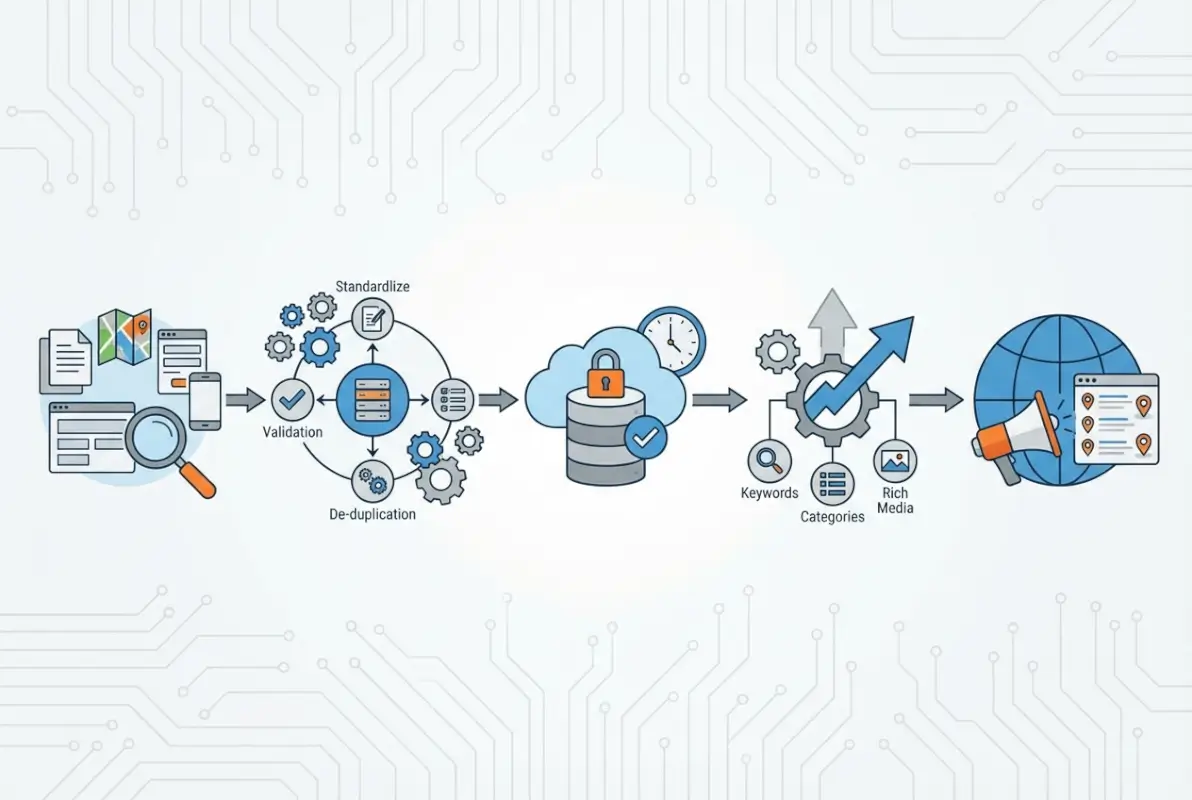
Implementing a business listings database is step one; maintaining accuracy requires systematic processes. Establish quarterly audit cycles where you verify NAP accuracy across top 20 directories manually—automated systems miss edge cases like recently changed street names or phone carrier migrations. Document a change management protocol specifying who can authorize listing updates, how changes flow from decision to publication, and verification steps before distribution to prevent errors from cascading across hundreds of platforms.
Track these KPIs to measure impact: NAP consistency rate (percentage of directories showing identical information, target 95%+), listing completeness score (percentage of available fields populated—photos, hours, services, target 80%+), duplicate suppression rate (number of duplicate listings detected and removed monthly), local pack appearances (frequency your business appears in Google’s top-3 map results for target keywords), and listing-driven conversions (calls, direction requests, website visits attributed to directory listings via UTM parameters or call tracking).
Connect listing performance to business outcomes. Use Google Analytics’ Source/Medium reports to identify which directories drive actual website traffic (not just link placements). Implement call tracking numbers unique to each major directory to measure phone inquiries generated per platform. For multi-location businesses, benchmark performance across locations to identify outliers—if Location A generates 50 direction requests weekly while Location B gets 5, investigate NAP accuracy, photo quality, and review volume differences between the two profiles.
Trend-Forward Considerations and Alternatives
The business listing database space continues evolving rapidly as AI, privacy regulations, and platform consolidation reshape how business information flows across the internet. Understanding emerging trends helps future-proof your provider selection and avoid platforms built on outdated architectures.
[KBIMAGE_5]The Role of AI in Listings Management
Machine learning now powers several critical listing management functions. Automated duplicate detection uses fuzzy matching algorithms to identify listings that represent the same business despite variations in name formatting, address abbreviations, or phone number formats—catching duplicates human reviewers might miss. Semantic category matching suggests optimal business categories across directories with different taxonomies (Google’s categories differ from Yelp’s, which differ from Bing’s) by analyzing your services and competitors’ categorization.
Natural language processing enables AI-powered review response generation. Some platforms (Reputation.com, Yext) analyze review sentiment and suggest contextually appropriate responses, saving hours weekly for businesses managing dozens of monthly reviews. Predictive analytics identify patterns—”businesses that add video to their Google profile see 30% more direction requests within 14 days”—prompting proactive optimizations rather than reactive fixes.
Voice search optimization represents AI’s next frontier for listings. As consumers increasingly use Siri, Alexa, and Google Assistant to find “plumbers near me” or “pizza open now,” providers are structuring data to match conversational queries. This means optimizing for question-based keywords, ensuring hours are current (voice assistants heavily weight this), and using schema markup that voice platforms can parse accurately. The shift from typed searches to voice queries rewards complete, accurate listings over competitors with bare-minimum information.
Data Licensing and Compliance
Privacy regulations increasingly govern how business database providers collect, store, and distribute business information. GDPR in Europe and CCPA in California grant individuals (including business owners) rights to access, correct, or delete their data from commercial databases. Providers must now offer self-service portals where business owners can claim their listing, dispute inaccuracies, and opt out of certain data uses—capabilities that some legacy platforms still lack.
Data licensing transparency matters more than it once did. When you publish information through a provider, where does that data actually go? Premium providers maintain documented relationships with every directory, specifying data usage rights and update frequencies. Budget providers often rely on opaque aggregator networks where your data may be resold or repurposed in ways you didn’t authorize. For regulated industries (healthcare under HIPAA, financial services under GLBA), understanding data lineage—the complete path from your database to end-user platforms—becomes a compliance requirement, not merely a best practice.
Consent management is emerging as a competitive differentiator. Some providers now offer location-level privacy controls letting businesses opt out of specific directories while maintaining presence on others—useful for medical practices that want Google visibility but prefer to avoid certain review sites, or multi-location retailers where franchise agreements grant corporate control over some platforms but delegate others to local operators.
What is a business listings database and why does it matter for local SEO?
A business listings database centralizes your NAP data and distributes it across directories, maps, and search platforms. It matters for local SEO because search engines interpret consistent information across multiple authoritative sources as a trust signal, boosting your local pack rankings and map visibility while eliminating confusion caused by conflicting addresses or phone numbers.
How should I choose between Yext and Data Axle for enterprise needs?
Choose Yext if you need real-time updates across 200+ platforms via direct API connections and can justify premium pricing for instant synchronization. Choose Data Axle if data accuracy through human verification matters more than speed, or if you need custom data licensing for B2B marketing beyond standard directory listings. Yext excels at breadth and speed; Data Axle prioritizes accuracy and data versatility.
How often should business listings be updated across directories?
Update listings immediately when critical information changes—address, phone number, or operating hours. For non-urgent updates like photos or service descriptions, quarterly reviews suffice. Use a provider with real-time API capabilities if your business experiences frequent changes (seasonal hours, rotating promotions); aggregator-based platforms work fine for stable information that changes annually or less.
Do I need multiple listing providers or can I rely on a single platform?
One comprehensive provider typically suffices for most businesses. Start with Google Business Profile (free, essential), then add one paid provider (Yext, Data Axle, BrightLocal, or Moz Local) for broader coverage. Using multiple paid providers creates redundancy without proportional benefit—focus budget on one quality platform with 80+ directory reach rather than spreading across several limited-scope services.
What metrics should I track to measure listing management impact?
Track NAP consistency rate across top 20 directories (target 95%+), local pack appearances for target keywords, direction requests and calls from listings, listing-driven website traffic via UTM parameters, and review velocity (new reviews per month). Measure quarter-over-quarter changes to isolate listing improvements from seasonal traffic fluctuations and prove ROI beyond vanity metrics like total directory count.
How do I handle duplicates and conflicting data across directories?
Use your provider’s duplicate detection tool to identify conflicting listings, then systematically claim and merge duplicates on major platforms (Google, Yelp, Facebook) directly through those sites’ business portals. For directories you can’t access directly, request suppression through your listings provider. Run duplicate audits quarterly—new duplicates appear as data aggregators update their databases and third parties create unauthorized listings.
Is Google Business Profile enough or should I publish to third-party directories?
Google Business Profile is essential but insufficient. While Google dominates local search, consumers also use Apple Maps, Yelp, Facebook, and industry-specific directories. Publishing to 60–100 additional directories builds citation diversity that strengthens your overall local SEO authority, reaches non-Google users, and provides redundancy if your Google profile encounters issues or penalties. Think of Google as your foundation and other directories as reinforcement.
Your Next Step: Choose and Deploy
You now have a framework for selecting a business listing database provider aligned to your scale, industry, and integration needs. The difference between businesses that succeed with listing management and those that waste budget comes down to matching platform capabilities to actual requirements—not buying the most features, but buying the right features.
Start by claiming your Google Business Profile if you haven’t already (it’s free and takes 10 minutes). Next, audit your current NAP consistency using BrightLocal’s free citation checker or Moz Local’s listing scan to establish a baseline. Request demos from two providers that fit your budget and location count—compare their duplicate detection results, update speed commitments, and analytics dashboards with your specific business data loaded.
Implement one provider on a 90-day trial window focused on measurable outcomes: hours saved versus manual updates, traffic increase from local searches, and duplicate listings suppressed. Track those three metrics weekly, review monthly, and make a final commitment decision at 90 days based on actual performance rather than feature lists. Your customers are searching right now—accurate listings ensure they find you instead of competitors.
Was this article helpful?